Want to practice this with a native Korean teacher?
100-min free trial — no card required.
Saying "hi" in Korean is more layered than English. Native speakers choose between at least five greetings depending on age, formality, time of day, and how close they are to you. Pick the wrong one and you'll either sound rude (using 안녕 with your boss) or stiff (using 안녕하십니까 with a college friend).
This guide covers all the main greetings — formal, polite, casual, texting — with IPA pronunciation so you can practice without a teacher present, plus when to bow and what to say next.
Quick Pronunciation Reference
| Greeting (Hangeul) | Romanization | IPA | Use With |
|---|---|---|---|
| 안녕하세요 | annyeonghaseyo | [an.njʌŋ.ɦa.se.jo] | Almost everyone (default) |
| 안녕 | annyeong | [an.njʌŋ] | Close friends, younger family, kids |
| 안녕하십니까 | annyeonghasimnikka | [an.njʌŋ.ɦa.ɕim.ni.k͈a] | Bosses, military, formal address |
| 좋은 아침 | joeun achim | [tʃo.ɯn a.tʃʰim] | Morning greeting (less common in Korea than in English) |
| 오랜만이에요 | oraenmanieyo | [o.ɾɛn.ma.ni.e.jo] | "Long time no see" — anyone you haven't seen in a while |
| 만나서 반갑습니다 | mannaseo bangapseumnida | [man.na.sʌ paŋ.gap.s͈ɯm.ni.da] | "Nice to meet you" — first introductions |
| ㅎㅇ | (letter abbreviation) | "hi-eung" | Texting slang for "hi" |
Three pronunciation tricks that fix 80% of beginner mistakes:
- 녕 is not "young." It's [njʌŋ] — like saying "nyu-ng" quickly. Your tongue should touch the roof of your mouth at the start.
- 하 is a clear [ha], with the [h] actually pronounced — don't drop it.
- 요 at the end is short and not stressed. English speakers tend to drag it ("yoooo"). It's a quick [jo].
Your Go-To Greeting: 안녕하세요 (Annyeonghaseyo)
안녕하세요 is the safest first word in any Korean conversation:
- It works with strangers, coworkers, customers, in-laws, taxi drivers, baristas, and store staff.
- It works any time of day — Korean doesn't separate "good morning" / "good afternoon" / "good evening" the way English does.
- It works for "hi" and "bye" in most casual contexts.
Literally what it means: 안녕 (an-nyeong) is a Sino-Korean word from 安寧, meaning "peace and well-being." 하세요 is the polite imperative ending of 하다 (to do). So the literal translation is "do peace" or "be at peace" — closer to "I hope you're well" than "hi."
Casual Chats: Greeting Friends with 안녕 (Annyeong)
안녕 is banmal (casual speech). Drop the -하세요 ending and you have a casual "hi" for friends and family.
When to Use 안녕 (Annyeong)
- Close friends your age or younger
- Younger siblings, cousins, kids
- Pets (yes, Koreans say 안녕 to their dogs)
When to Avoid 안녕 (Annyeong)
- With anyone older than you
- At work with coworkers (unless very close peers)
- With customers, clients, or service staff
- With in-laws (even ones you like)
The Most Formal Greeting: 안녕하십니까 (Annyeonghasimnikka)
The formal -ㅂ니다 ending replaces -요. This is the stiffest, most respectful greeting in Korean.
When You'll Hear This Greeting
- Military settings (every cadet greets superiors this way)
- Customer service announcements (department stores, banks)
- Job interviews
- Television news anchors
- Formal business meetings with new clients
You'll hear it more than you'll say it. Most foreigners can default to 안녕하세요 even in fairly formal settings without offense.
Beyond a Simple Hello: More Ways to Greet
Good Morning: 좋은 아침 (Joeun Achim)
Literal "good morning." Less common in Korea than in English — Koreans usually just say 안녕하세요 in the morning. But you'll hear 좋은 아침 in offices among colleagues.
Long Time No See: 오랜만이에요 (Oraenmanieyo)
For anyone you haven't seen in weeks or longer. Often paired with 안녕하세요: "안녕하세요, 오랜만이에요!"
Nice to Meet You: 만나서 반갑습니다 (Mannaseo Bangapseumnida)
First introductions, formal contexts. The casual version is 반가워 (bangawo). When meeting a Korean for the first time, follow with a small bow.
Texting Hi in Korean: ㅎㅇ and KakaoTalk Culture
If you message a Korean friend on KakaoTalk or text them, you'll almost never see them write 안녕 in full. Korean texting culture has its own shorthand for greetings.
The most common chat greetings
| Slang | Full Form | Meaning | Vibe |
|---|---|---|---|
| ㅎㅇ | 하이 (hi) | "hi" (cropped) | Very casual, like English "hey" or "yo" |
| 안녕 | (no change) | "hi" | Casual, friendly |
| 하잉 | (slang version of 하이) | "hi" | Playful, slightly cute |
| 헬로 | (Korean spelling of "hello") | "hello" | Casual, often ironic |
| 방가 | 반갑다 (nice to meet you) | "nice meeting ya" | Short, ultra-casual |
When to use them:
- Texting close friends or family → ㅎㅇ, 안녕, 하잉
- New acquaintance on KakaoTalk → 안녕하세요 (still in full — texting doesn't unlock banmal automatically)
- Group chat with mixed seniority → 안녕하세요, even if it feels stiff
Regional Variations You'll Hear in Korea
Standard Korean (서울말) uses the greetings above. But if you travel within Korea, regional accents and dialect-specific greetings can confuse you.
Jeju (제주도)
Jeju's traditional dialect (제주어) is the most distinct in Korea. Older speakers may use:
- 혼저옵서예 (honjeo-opseoye) — "welcome" / "please come in" (tourist signage)
- Casual Jeju "hi" is still 안녕 in younger speech; standard 안녕하세요 works everywhere.
Busan / Gyeongsang (부산 / 경상도)
Busan accent has different intonation but uses standard greeting words. Notable features:
- Sharper, more clipped pronunciation: 안녕하세요 sounds more like 안녕하세요↗ (rising tone)
- Older speakers may say 수고하이소 (sugohaiso) as a "hi/bye" hybrid in casual encounters
Don't worry about dialects as a learner. Standard 안녕하세요 is understood in every region of Korea.
Mastering the Art of the Korean Bow
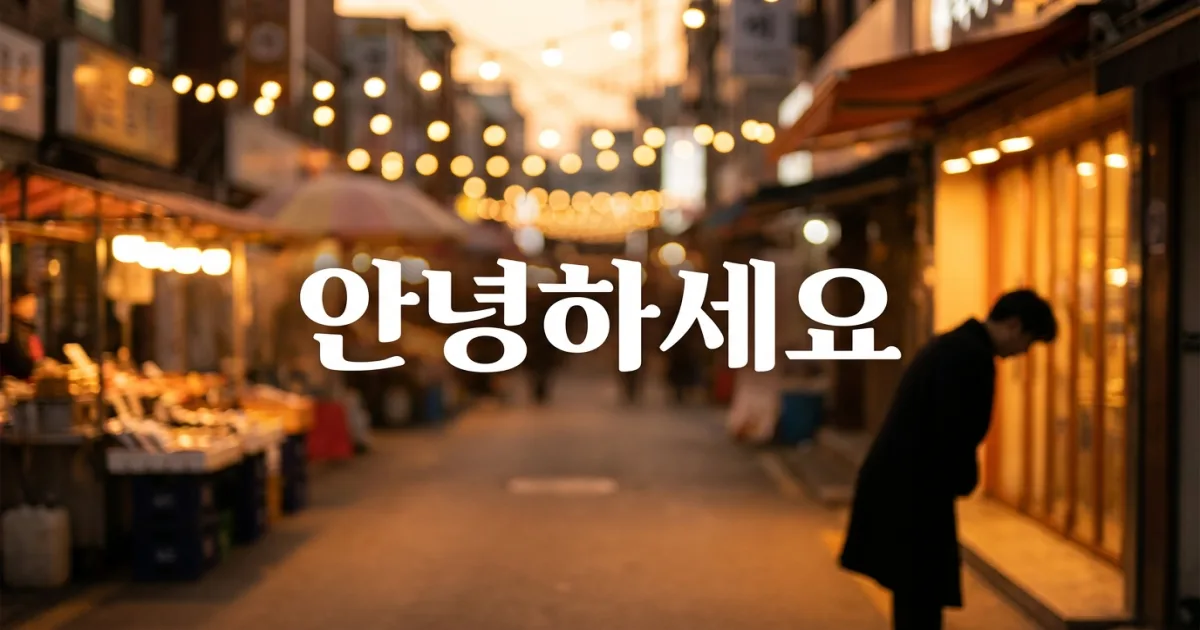
The bow (인사, insa) is the physical companion to a Korean greeting.
The Three Bow Levels You'll Actually Use
| Bow Type | Angle | Hold Time | Use With |
|---|---|---|---|
| Quick nod (목례) | 5–15° | 1 second | Peers, casual acquaintances, passing colleagues |
| Standard bow (보통례) | 30° | 2 seconds | Strangers, customers, most polite greetings |
| Deep bow (정중례) | 45–60° | 3+ seconds | Elders, executives, formal apologies, very respected figures |
Common mistakes:
- Don't shake hands. Korean greeting culture doesn't include handshakes by default.
- Don't combine a bow with too much eye contact. Lower your gaze slightly during the bow.
- Don't bow if both your hands are full. A nod is fine.
What to Say After Hello
Korean conversations rarely stop at "hi." Have a follow-up ready.
Easy Follow-Up Questions
- 어떻게 지내세요? (eotteoke jinaeseyo?) — How are you?
- 잘 지내요? (jal jinaeyo?) — Are you well?
- 요즘 바빠요? (yojeum bappayo?) — Are you busy these days?
- 밥 먹었어요? (bap meogeosseoyo?) — Have you eaten? (literally "did you eat rice" — common greeting, not a real question)
Putting It All Together
The four greetings you actually need to remember:
- 안녕하세요 — your default for 95% of situations. Memorize the IPA, drill it daily.
- 안녕 — only with close friends and younger family. Never use it with anyone older or in a customer/service context.
- 안녕하십니까 — formal business or military. You may hear it more than you say it.
- ㅎㅇ — texting only, only with close friends.
Pronunciation drill: record yourself saying 안녕하세요 three times. Compare against a native recording — you can ask any KTalk Live teacher in a free trial class to record it for you. The most common slip is dropping the [h] in 하 or rushing 요.
Next: once your greeting is solid, try Korean verb conjugation to handle "How are you?" and follow-up questions, or how to say no in Korean for the inevitable polite refusals.
Ready to stop reading and start speaking?
Practice what you just learned with a native Korean teacher — free for 100 minutes. No card, no commitment.