Want to practice this with a native Korean teacher?
100-min free trial — no card required.
You're at a Korean BBQ restaurant in Seoul. The ajumma comes over, takes the tongs out of your hand, cooks your meat herself, and brings two extra side dishes you didn't order. Later at the market, a grandma waves your money away because — she says — you're a foreigner, you're far from home. On the taxi ride back, the driver pulls up to your building, waits, watches you walk to the entrance, and only drives off after you're safely inside.
Three different people. Three different acts. One Korean word for all of it: 정 (jeong).
There is no English word for 정. Not "affection," not "loyalty," not "warmth," not "love." Every translation gets some of it and misses the rest. That's why nearly every essay about Korean culture calls 정 the most important word in the language — and the hardest one to explain.
What 정 Actually Is
정 is the feeling that grows between people who have shared something — meals, time, daily life, small kindnesses — over and over. It's not a single emotion. It's the bond that builds up quietly when you keep showing up for each other.
It's why your neighbor brings you kimchi without being asked. It's why a Korean mom sends extra food home with your friend. It's why old shopkeepers slip you extra fruit "for the road." It's why people who used to fight — siblings, old friends, ex-roommates — still take care of each other years later. They have 정 between them. They can't really turn it off.
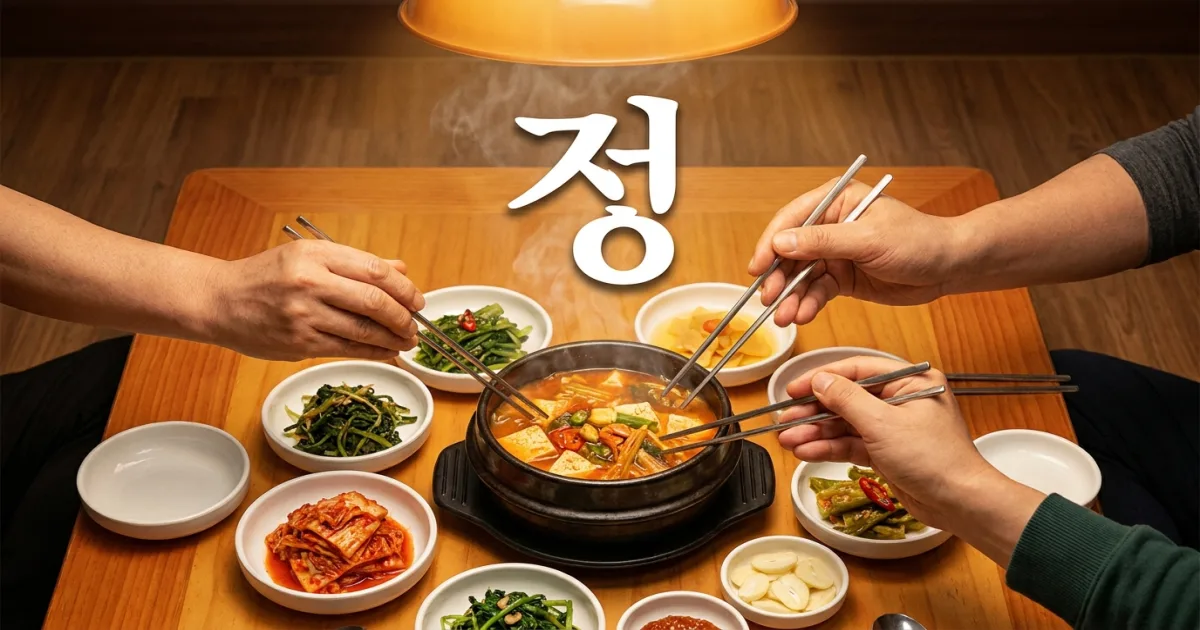
정
"jeong" — the bond that builds up between people who keep showing up for each other
extra side dishes · cooking your meat for you · waving the money away · waiting until you're safely inside
Three Real Moments of 정 in Korea
The easiest way to understand 정 is to see it in action. Three scenes every foreigner in Korea eventually notices:
1. The BBQ Ajumma
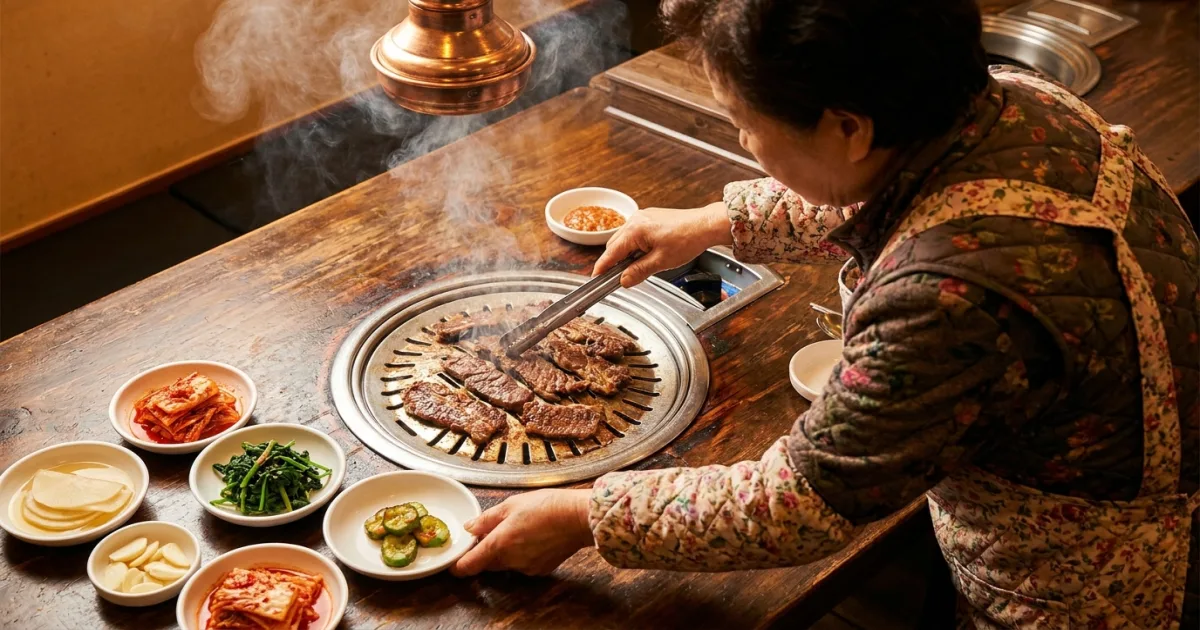
You sit down at a Korean BBQ place. The ajumma (older woman who runs the table) walks over, sees you struggling with the tongs, and just takes over. She cooks the meat at exactly the right time, cuts it for you, and brings two banchan dishes you didn't order. You try to thank her — she waves you off. This is 정. She's not being paid extra. She's not performing customer service. She's looking after you the way she'd look after a family member who came over for dinner.
2. The Market Grandma
At a traditional market, you pick out some kimchi or dried fish. You hold out the money. The grandma running the stall waves it away. "괜찮아요. 외국인이잖아." ("It's okay. You're a foreigner.") You insist. She insists harder. Eventually you stop insisting and she nods, satisfied. This is 정. The transaction stopped being about the kimchi. It became about you — a stranger far from home she's decided to take care of for one moment.
3. The Taxi Driver Who Waits
Late at night, a Korean taxi drops you at your apartment building. In most countries, the driver pulls away the second the door closes. In Korea, he often doesn't. He waits — sometimes with the hazards on — until he sees you walk to the entrance and go inside. Only then does he drive off. This is 정 too. He's a stranger. He'll never see you again. He waits anyway.
Why 정 Doesn't Translate
English has three near-misses:
- "Affection" — too narrow. Affection is what you feel for someone you already love. 정 builds even between people who don't particularly like each other, but who've shared enough life together.
- "Loyalty" — too cold. Loyalty is a duty. 정 is felt — a warm pull, not a rule to follow.
- "Bond" — too general. A bond can be anything. 정 is specifically the bond that accumulates from repeated small acts of care.
Korean has 정 because Korean society used to run on it. For centuries, neighbors were the safety net. You shared food, watched each other's kids, helped each other through hard winters. The bond that built up from all that didn't have a name in English because English-speaking societies organized themselves differently. Korea named the feeling. English never had to.
The Phrases That Use 정
정 rarely shows up alone. It lives inside a small set of verb phrases — learn these and you'll start hearing 정 everywhere in K-dramas.
| Phrase | Romanization | Meaning |
|---|---|---|
| 정이 들다 | jeong-i deulda | To grow attached / develop 정 with someone over time |
| 정을 주다 | jeong-eul juda | To give your 정 to someone — to start caring |
| 정이 가다 | jeong-i gada | To feel 정 going out toward someone — naturally drawn to care |
| 정이 떨어지다 | jeong-i tteoreojida | To lose 정 — when the warmth between you dies |
정이 들다 — "Growing Into 정"
The most common phrase. 정이 들다 literally means "정 enters" — it's the slow process of growing attached to someone or something. You don't decide to do it. It happens because you kept showing up.
- 한국에 정이 많이 들었어요. (I've grown really attached to Korea.)
- 이 동네에 정이 들어서 떠나기 싫어요. (I've grown 정 with this neighborhood — I don't want to leave.)
- 처음엔 싫었는데 같이 일하면서 정이 들었어요. (I disliked him at first, but working together, 정 grew.)
Notice the last one — you can have 정 with someone you don't even like. That's the part English can't say.
정이 떨어지다 — "정 Falls Off"
The opposite. When someone you used to care about does something that empties out the warmth, Koreans say 정이 떨어졌다 — your 정 fell off. It's heavier than "I'm disappointed." It means the slowly built-up bond has collapsed.
- 그 사람 행동에 정이 떨어졌어요. (His behavior killed my 정 for him.)
정 in Reply 1988 and K-Dramas
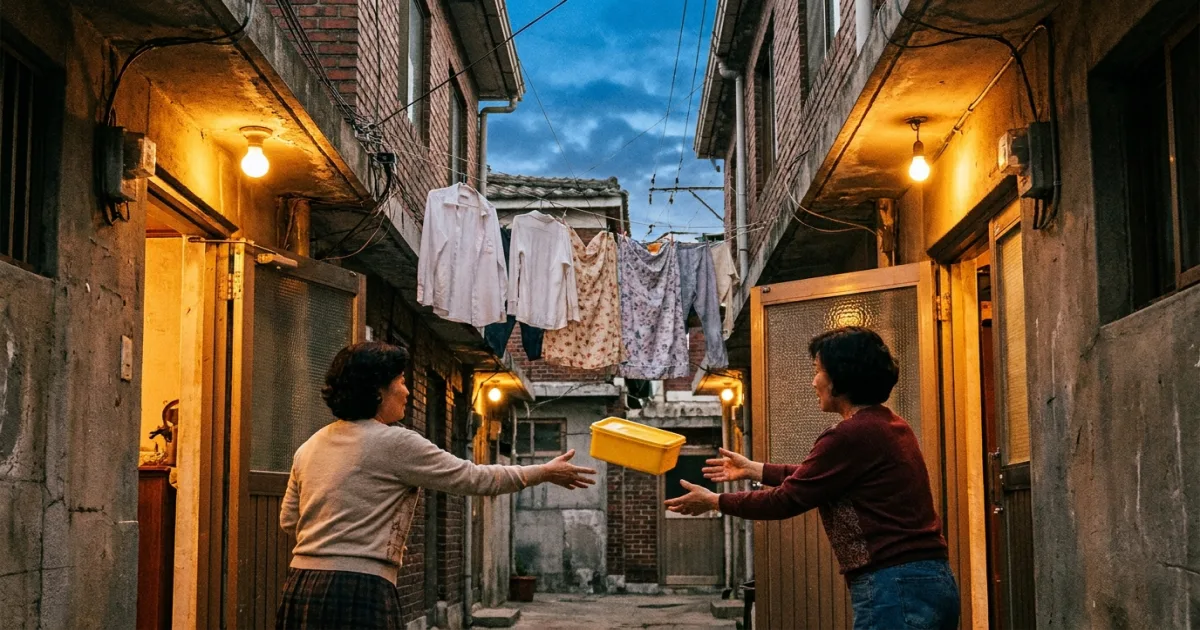
If you've watched Reply 1988, you've already watched 16 hours of 정. The whole show is about a 1980s Seoul alley where five neighbor families share everything: food passed across walls, kids raised by everyone, moms running into each other's kitchens. Nobody says the word "정" much. They don't have to. Every scene is a demonstration.
Other dramas that center 정:
- My Mister — the slow 정 that builds between Dong-hoon and the neighborhood bar, the cleaning crew, his coworkers. Almost the entire show is 정 forming.
- Itaewon Class — Saeroyi looking after his employees long past what's reasonable. That's 정.
- Crash Landing on You — the village in North Korea adopting Yoon Se-ri into their lives. That's 정 forming in fast-forward.
The Trap — When NOT to Use 정
One important rule: you don't claim 정. You let it grow.
Foreigners sometimes say "우리 정 있죠?" ("We have 정, right?") to a Korean person they just met, trying to be warm. Koreans will smile politely, but they cringe a little inside. You don't announce 정 like that. It would be like saying "We're best friends, right?" on a first meeting — too much, too fast, slightly off.
The right way is to let 정 form: keep showing up, share small things, and one day months or years later, the other person will say "정이 들었네" ("Look, 정 has grown") — and you'll know it happened.
How to Pronounce 정
- Hangeul: 정
- Romanization: jeong
- IPA: [tɕʌŋ]
- Sound: roughly "jong" with a softer "j" — start with English "j," let the vowel sit between "o" and "u," and end with a soft "ng." Many English speakers default to "jay-ong" — that's not it. One syllable, not two.
Common Phrases Using 정
| Phrase | Translation | When you'd hear it |
|---|---|---|
| 정이 들었어요 | "I've grown attached" | Leaving a place or saying bye to people you've shared time with |
| 정 많은 사람 | "A 정-rich person" | Describing someone warm, generous, looking-after-everyone |
| 정 떨어졌어 | "My 정 is gone" | After someone you used to care about does something cold |
| 한국 정 | "Korean 정" | Talking about Korean culture's particular warmth |
| 정 없다 | "No 정" | Describing someone cold or transactional |
Common Mistakes Foreigners Make
- Translating it as "love." 정 can include love but isn't the same as it. You can have 정 with your favorite neighborhood restaurant. You can't love your favorite restaurant the way you love a person.
- Claiming 정 with strangers. Saying "우리 정 있죠?" on first meeting feels off to Koreans. 정 forms — it isn't declared.
- Confusing 정 with 사랑 (sarang, love). 사랑 is the romantic or intense love. 정 is the slower, warmer, more obligation-shaped bond. You can have 정 without 사랑 and vice versa.
- Missing 정 when you see it. The BBQ ajumma, the market grandma, the taxi driver — many foreigners experience these moments as "Korean people are so nice." That's true, but it's specifically 정. Naming it lets you see the whole pattern.
Putting It All Together
정 is the Korean feeling for the bond that builds when people keep looking after each other in small ways. English split this feeling across "affection," "loyalty," "warmth," and "bond" — and lost what made it specific. Korean kept it whole.
Three takeaways:
- 정 grows — you can't claim it. It builds from repeated small acts of care over time.
- You've seen it everywhere in Korea — the extra side dishes, the refused money, the taxi waiting. Now you have the word for it.
- The phrases matter — 정이 들다 (grow attached), 정 많은 사람 (a warm person), 정이 떨어지다 (lose the bond).
Next: explore more untranslatable Korean concepts with 눈치 (nunchi), or dive into emotional vocabulary with 시원하다 (siwonhada).
Want a native speaker to walk you through how 정 actually plays out in Korean conversation — what to say to a Korean host family, how to receive 정 without breaking it? Free 100-minute trial with KTalk Live pairs you one-on-one with a real Korean teacher.
Ready to stop reading and start speaking?
Practice what you just learned with a native Korean teacher — free for 100 minutes. No card, no commitment.