Want to practice this with a native Korean teacher?
100-min free trial — no card required.
Every K-drama fan knows this moment. You're watching the confession scene — the one you've waited 12 episodes for — and your eyes flick down to the bottom of the screen. The subtitles say "I've liked you for a long time."
But something about the actor's voice tells you the English version is missing something. The way he said 좋아해 (joahae) felt heavier than "like." More vulnerable than "love." And you wonder: what am I actually missing?
That moment is why thousands of K-drama and K-pop fans have started learning 한국어 (Hanguk-eo — the Korean language) in 2026. Not for a test score. Not for a resume. Because they want to understand the thing they love without a translator standing between them and the real meaning.
Here's what actually happens when you stop reading subtitles — and everything else that opens up along the way.
The Moment You Stop Looking Down
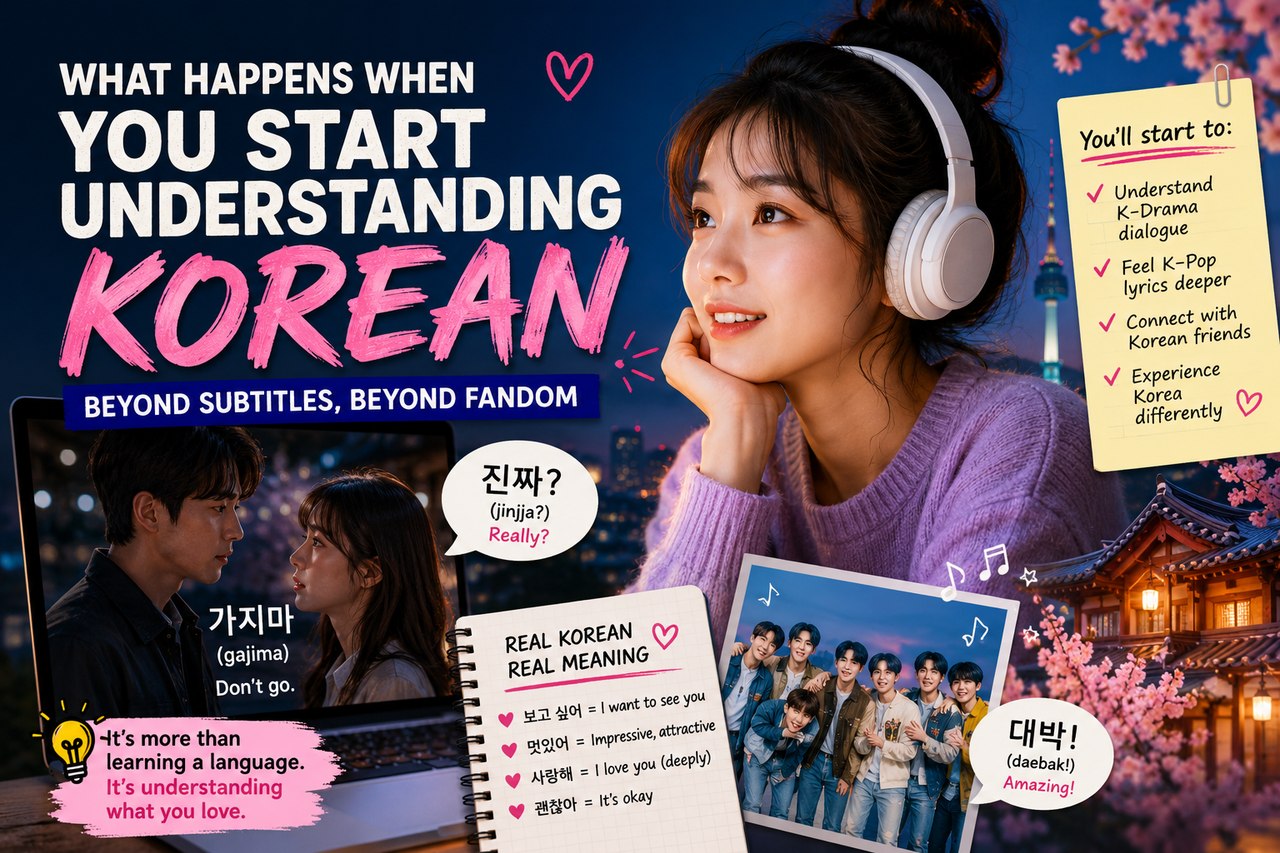
Around month two or three, something shifts. You're watching a new episode of your favorite drama and you realize you haven't glanced at the bottom of the screen in five minutes. You understood 진짜? (jinjja? — really?) without thinking. You caught 괜찮아 (gwaenchana — it's okay) before the subtitle appeared. The character said 가지마 (gajima) and your stomach tightened before you read "don't go."
This isn't fluency. But it's the first time Korean stops feeling like a code you're decoding and starts feeling like a language you're hearing.
Korean learners who stick with it report this shift happening between weeks 8 and 14 — around the same time Hangul (the Korean alphabet) becomes automatic and common drama vocabulary starts to stick without flashcards.
What K-Pop Lyrics Actually Say (vs. What Translations Miss)
Translation apps and lyric videos give you the literal meaning. But Korean — especially in music — is packed with wordplay, cultural references, and emotional registers that don't survive translation.
Here are three lines from popular songs where knowing even basic Korean changes the experience:
보고 싶어 (bogo sipeo) — Translations say "I miss you," but it literally means "I want to see you." The Korean expression is visual and immediate. It's not about absence — it's about the ache of wanting someone in front of you.
멋있어 (meosisseo) — Translated as "you're so cool," but it carries "stylish," "impressive," and "attractive" simultaneously. "Cool" flattens a word that Koreans use to describe someone's entire presence — the way they carry themselves, dress, and act.
사랑해 (saranghae) — "I love you" in English, but far heavier in Korean than casual English "love." Many K-drama confession arcs build tension because 사랑해 is such a weighty word. When a character finally says it, the emotional charge comes from the cultural weight, not just the plot.
When fans learn Korean, they start catching these layers. A song you've heard fifty times suddenly has a second meaning. A drama scene that felt sweet now feels devastating — because you heard the word choice the translator smoothed over.
Why Korean Friends React Differently When You Actually Try
Koreans are surrounded by international fans who love their culture. But there's a difference between someone who consumes Korean content and someone who tries to speak the language.
When you say 안녕하세요 (annyeonghaseyo — hello) to a Korean friend instead of "hi," something small shifts. When you can text 진짜 대박 (jinjja daebak — seriously amazing) instead of "that's so cool," the conversation moves from "international fan" to "person who genuinely cares about my culture."
Korean learners consistently say the same thing: the friendships they build through language exchange feel deeper and last longer than the ones built purely on shared fandom. Speaking someone's language — even at a basic level — signals something that consumption alone cannot.
The Things That Happen After 3 Months That Nobody Mentions
Most "should I learn Korean" articles list the same benefits: jobs, travel, TOPIK scores. Those are real. But the things learners actually talk about in language exchange groups are different — and more motivating.
1. Your Brain Starts Processing Korean Differently
At first, Korean sounds like a stream of syllables. Around month three, your brain starts separating words. You hear 괜찮아요 (gwaenchanayo) as one word, not four random sounds. This is called segmentation, and it's the first major neurological milestone in learning any language. Research consistently links second-language learning to improved memory, concentration, and cognitive flexibility — but the moment it feels real is when your brain stops panicking at native-speed speech.
2. You Understand Idol Livestreams Before the Fan Translations Drop
Waiting 24 hours for fan subtitles on a V Live or Weverse post becomes optional. You catch the greeting, the casual comments, the inside jokes. Even understanding 30% of a live broadcast feels like having a backstage pass that most international fans never access.
3. Korean Restaurant Orders Become Adventures, Not Stress
Walking into a Korean restaurant and ordering in Korean — even basic phrases — changes the experience. Staff often open up. You might get menu recommendations. You might hear "와, 한국어 잘하시네요!" (wa, hangugeo jalhasineyo! — wow, your Korean is good!). Even if your Korean is barely conversational, the attempt earns curiosity and warmth that English-only ordering never does.
4. You Start Noticing Cultural Patterns, Not Just Words
Korean grammar encodes social hierarchy. The verb ending changes depending on who you're talking to. When you learn Korean, you stop just reading subtitles and start understanding why characters speak differently to their boss, their friend, and their grandmother. This cultural literacy makes K-dramas richer and real-world interactions smoother.
5. Travel Becomes a Different Experience Entirely
Seoul with English gets you through the tourist neighborhoods. Seoul with basic Korean unlocks the restaurants with no English menu, the markets where prices are lower when you ask in Korean, the elderly shopkeeper who lights up when you say 감사합니다 (gamsahamnida — thank you) instead of "thanks." Travel shifts from observation to participation.
What K-Drama Dialogue Teaches You That Textbooks Don't
Textbooks teach you to say "저는 학생입니다" (jeoneun haksaengimnida — I am a student). K-dramas teach you to say "미쳤어?" (michyeosseo? — are you crazy?), "그만해!" (geumanhae! — stop it!), and "어떡해" (eotteokhae — what do I do?).
In other words, textbooks give you the classroom. Dramas give you the language people actually speak. The rhythm, the interruptions, the way emotions compress grammar into something raw and immediate.
The key is using both. Textbooks build the foundation. Dramas build the instinct.
Beyond Entertainment: The Doors That Actually Open
Most learners don't start with career goals. They start with BTS or Crash Landing on You. But here's what the data shows: after 6–12 months of consistent study, the same learners start noticing doors that K-dramas never promised.
Study opportunities. South Korean universities offer hundreds of scholarships for international students. Korean language ability — even intermediate level — significantly strengthens applications for exchange programs, undergraduate degrees, and graduate research.
Career differentiation. Companies like Samsung, Hyundai, LG, Naver, and Kakao have global operations. A candidate with Korean language skills — even at a conversational level — stands out in international business, marketing, technology, and tourism roles. Most applicants speak English and maybe Spanish. Korean is rarer. Rarer means more visible.
TOPIK certification. The Test of Proficiency in Korean is globally recognized and opens pathways for university admission, employment in Korea, and long-term visa eligibility. Learners who start with K-dramas often find themselves registering for TOPIK within a year — because the language becomes a credential, not just a hobby.
Global community. Korean speakers connect across South Korea, the United States, Canada, Australia, Japan, Southeast Asia, and Europe. The Korean diaspora is worldwide. Speaking Korean means you can make a friend in Seoul, Sydney, or São Paulo.
How to Start Without Textbooks
If you're a K-drama or K-pop fan wondering whether to start learning Korean, here is the path that works for culture-driven learners:
1. Learn Hangul first. It takes 3–7 days, not months. The Korean alphabet was deliberately designed to be easy. Skip romanization as soon as possible — it holds you back.
2. Pick 5 words per drama episode. Write down words you hear repeatedly. 사랑 (sarang — love), 약속 (yaksok — promise), 기다려 (gidaryeo — wait). These stick because you encountered them in an emotional context.
3. Speak from day one. Even if it's just repeating lines from a drama. The pronunciation muscles in your mouth need practice. Korean sounds that don't exist in English (like the tight ㄲ in 까지) require physical training, not just mental understanding.
4. Join live classes with real teachers. Self-study gets you far. But speaking to an actual Korean speaker — who corrects your pronunciation in real time and explains why something sounds unnatural — is what turns knowledge into ability.
KTalk Live helps students learn Korean through live online classes with experienced native-speaking teachers. Students practice speaking from the first lesson, get immediate feedback on pronunciation, and follow a structured path whether they're starting from zero or building toward TOPIK.
Your first Korean words don't have to be perfect. They just have to be spoken.
Ready to hear the K-drama dialogue instead of reading it? Book a trial class.
Ready to stop reading and start speaking?
Practice what you just learned with a native Korean teacher — free for 100 minutes. No card, no commitment.