
Want to practice this with a native Korean teacher?
100-min free trial — no card required.
If you watch K-dramas, you've heard it. In Goblin (도깨비), the high-school heroine Eun-tak doesn't call the gorgeous, 900-year-old immortal hero by his name. She calls him "아저씨" (ajeossi) — "mister."
So does 아저씨 mean "handsome guy"? Not exactly. In fact, calling the wrong person 아저씨 can be a small insult. Here's what the word really means — and the two types every K-drama fan should know.
What Does Ajeossi (아저씨) Actually Mean?
The dictionary answer is simple: 아저씨 (ajeossi) = a middle-aged man. The closest English word is "mister." You use it for an adult man you don't know — a shopkeeper, a taxi driver, a stranger on the street.
You'll also see it romanized "ajusshi" — that's the spelling used for the famous 2010 film of the same name. Same word, two spellings.
But here's the part the dictionary leaves out: 아저씨 carries a picture. When a Korean hears the word, a very specific image pops into their head — and it comes in two very different versions.
The Two Types of Ajeossi
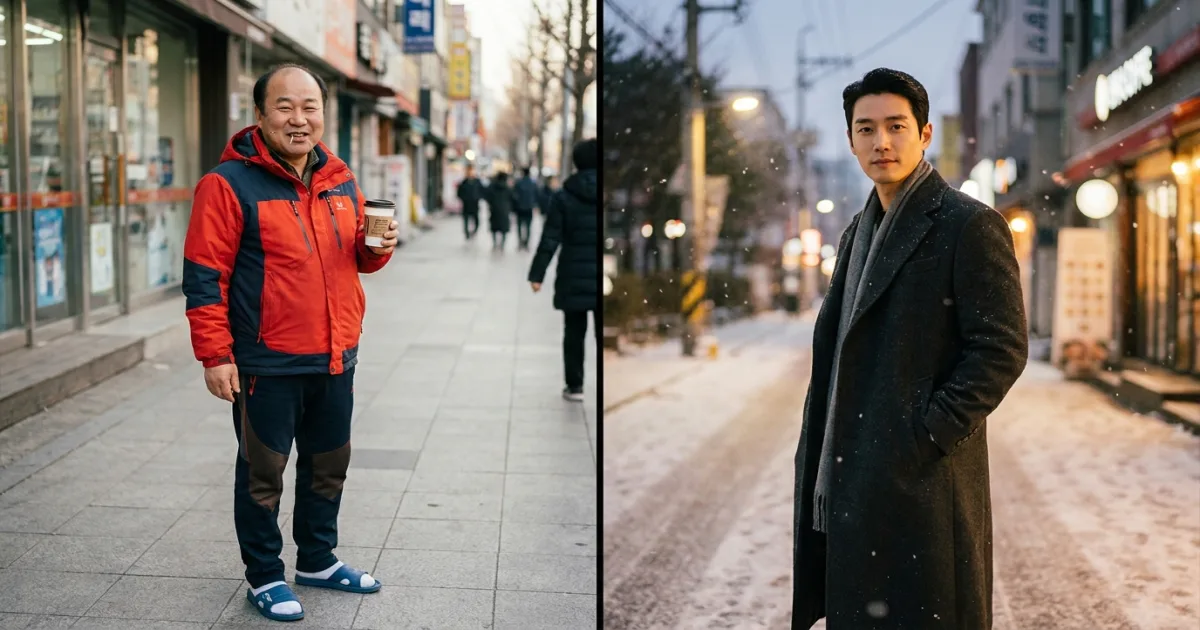
Type 1: The 그냥 아저씨 (Just a Regular Ajeossi)
This is the image most Koreans picture first. The 그냥 아저씨 (geunyang ajeossi, "just an ordinary ajeossi") practically has a uniform:
- A brightly colored hiking jacket — worn everywhere, even when he's not hiking
- A comfortable round belly
- A cup of instant "mix coffee" in one hand
- A toothpick in the corner of his mouth
- Slide sandals with white socks
- Hands clasped behind his back as he walks (we call this 뒷짐, dwitjim)
He's friendly, he loves dad jokes and old trot songs, and he is the warm, slightly uncool uncle of Korean society. Lovable — but not exactly your bias.
Type 2: The 잘생긴 아저씨 (The Handsome Ajeossi)
Then there's the other kind. 잘생긴 (jalsaenggin) means "handsome," so 잘생긴 아저씨 is "the handsome ajeossi" — a man who is technically middle-aged but undeniably gorgeous. Korea has a deep appreciation for this category, and K-content is full of him.
This is the 아저씨 from Goblin. A high-school girl calls a beautiful, 900-year-old immortal "아저씨" — which is exactly why it's so charming. To a teenager, any grown man is an 아저씨, no matter how good-looking he is.
The Movie Literally Called "Ajeossi"
If you want the definitive 잘생긴 아저씨, watch the 2010 action film 《아저씨》 (released internationally as The Man from Nowhere), starring Won Bin (원빈). He plays a quiet former agent who runs a pawnshop, and the little girl next door, So-mi, calls him "아저씨."
Notice the pattern: in both Goblin and Ajeossi, a young girl calls a beautiful older man 아저씨. That's the whole point — the word isn't about looks. It's about age and relationship.
So When Does a Man Become an Ajeossi?
There's no official age. But culturally, 아저씨 starts somewhere around 40 — and honestly, it's more of a vibe than a number. Marriage, kids, and that first hiking jacket all push a man into 아저씨 territory faster than his birthday does.
This is why the word is sensitive. Call a man in his early 30s "아저씨" and he may not be happy — you've just told him he looks middle-aged.
Ajeossi vs Oppa vs Hyung: Who Do You Call What?
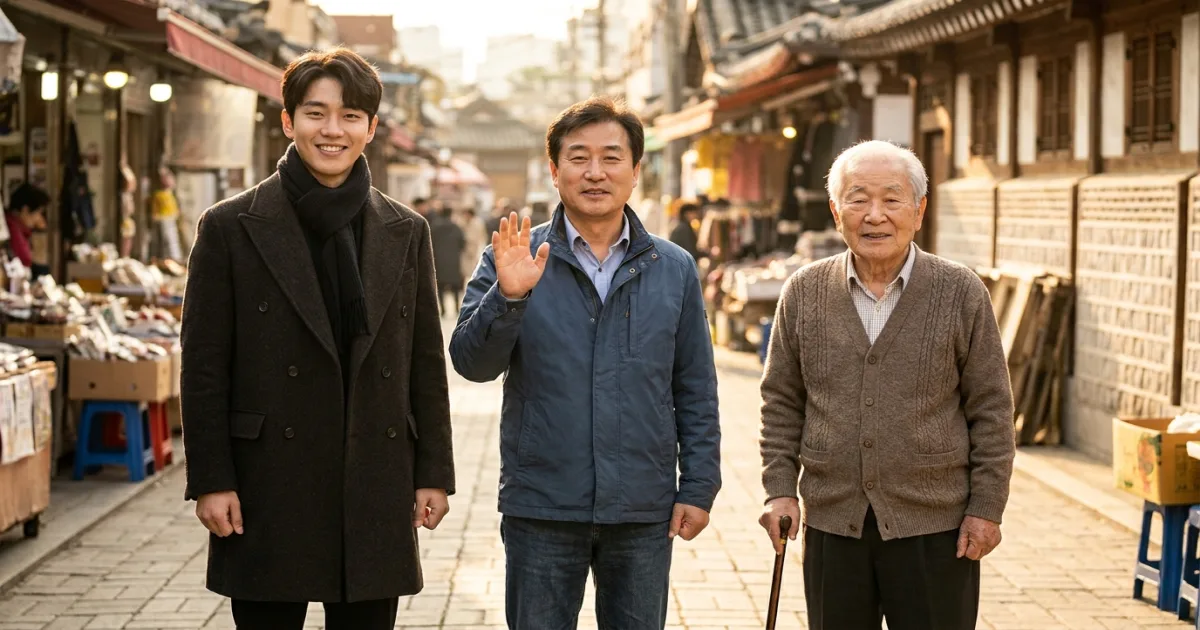
Here's the part that actually saves you from awkward mistakes. Korean has different words for men depending on your gender, his age, and your relationship:
| Word | Who you say it to | Said by |
|---|---|---|
| 오빠 (oppa) | A male who is a little older | A woman — to a brother, boyfriend, or favorite idol |
| 형 (hyung) | An older male | A man — to an older brother or friend |
| 아저씨 (ajeossi) | A middle-aged man (~40+) | Anyone — usually a stranger |
| 할아버지 (harabeoji) | An elderly man (grandfather age) | Anyone |
| 저기요 (jeogiyo) | Anyone — "excuse me," totally safe | Anyone, when you're not sure |
So if you're a K-pop fan: is BTS's Jungkook an 아저씨? No! He's young — he's your 오빠, not your 아저씨. (Want the full story on that word? Read What Does Oppa Mean?)
How to Pronounce 아저씨
아저씨 is pronounced "ah-juh-ssi" — IPA /a.dʑʌ.s͈i/. Three light, even syllables:
- 아 (ah) — like the "a" in "father"
- 저 (juh) — a soft "juh," like the start of "jut"
- 씨 (ssi) — a tense "ssee," with a slightly harder "s" than the English "see"
The "ssi" at the end is the same syllable used in the polite name-suffix 씨 (like "Minho-ssi") — but don't confuse them; in 아저씨 it's just part of the word.
Common Mistakes to Avoid
- Calling a young man 아저씨. If he looks under ~40, you've just aged him a decade. Use 오빠 (if you're a woman and there's rapport) or play it safe with 저기요.
- Using 아저씨 for an elderly man. A grandfather-aged man is 할아버지, not 아저씨.
- Thinking 아저씨 is rude. It isn't — for a genuinely middle-aged stranger it's completely normal and polite. It only stings when the age doesn't fit.
- Assuming "handsome" changes the word. A gorgeous middle-aged man is still an 아저씨 — a 잘생긴 아저씨. Looks don't move the line; age does.
Putting It Together
아저씨 is one of those words that looks simple in a dictionary and turns out to carry a whole world of culture. It means "a middle-aged man," yes — but it also paints a picture, splits into the 그냥 and the 잘생긴, and quietly tells you something about Korean ideas of age and respect.
When you can hear the difference between an 아저씨, an 오빠, and a 할아버지, Korean stops feeling like a textbook and starts feeling like real life — the way it actually sounds in your favorite dramas.
Learn Real Korean, the K-Drama Way
At K Talk, this is exactly how we teach — real words from the shows you already love, with the cultural nuance that makes them stick. Want to try it? Book a free 100-minute Korean class and learn Korean like this, live with a real teacher.
Ready to stop reading and start speaking?
Practice what you just learned with a native Korean teacher — free for 100 minutes. No card, no commitment.