
Want to practice this with a native Korean teacher?
100-min free trial — no card required.
Ever feel like you're missing the inside jokes while watching your favorite K-drama? You're not just imagining it. Beyond the subtitles lies a vibrant world of slang in korean, the secret ingredient that makes conversations feel real, funny, and deeply cultural. Learning these expressions isn't just about sounding cool; it’s about finally understanding the heart of everyday Korean life.
This guide is your key to unlocking that world. We'll dive into the phrases and abbreviations that textbooks often miss, helping you connect with the language on a whole new level. Ready to go from a passive viewer to an active, in-the-know learner? Let's get started!
Why Learning Korean Slang Is a Game-Changer
Think of slang as your secret weapon for fluency. It bridges the gap between formal, textbook Korean and the lively, fast-paced conversations you hear on the streets of Seoul or in binge-worthy K-dramas. Mastering a bit of slang helps you:
- Connect on a Deeper Level: Using slang correctly is like sharing a cultural nod—it shows you understand the nuances beyond basic vocabulary.
- Sound More Natural: You’ll start to sound less like you’re reciting a lesson and more like you’re genuinely chatting with friends.
- Finally Understand K-Dramas: Those quick, witty comebacks and cultural references will finally click, making your viewing experience even richer.
Let’s explore the trendy abbreviations and must-know phrases that will elevate your Korean skills from standard to standout.
The Vibe: Understanding How Korean Slang Works
Before you start memorizing words, it helps to understand why Korean slang exists. Think of it less as a vocabulary list and more as a cultural handshake. It’s the language of friendship, a way for younger generations to build community, express identity, and keep up with ever-changing trends.
New slang in korean pops up as fast as a new TikTok meme. In fact, one linguistic study found that creating abbreviations and mashing up words are the most popular ways new slang is born, often spreading online overnight. You can read more about this fast-paced linguistic evolution at atlantis-press.com.
This rapid evolution is all about connection and sounding authentic, as this infographic shows.
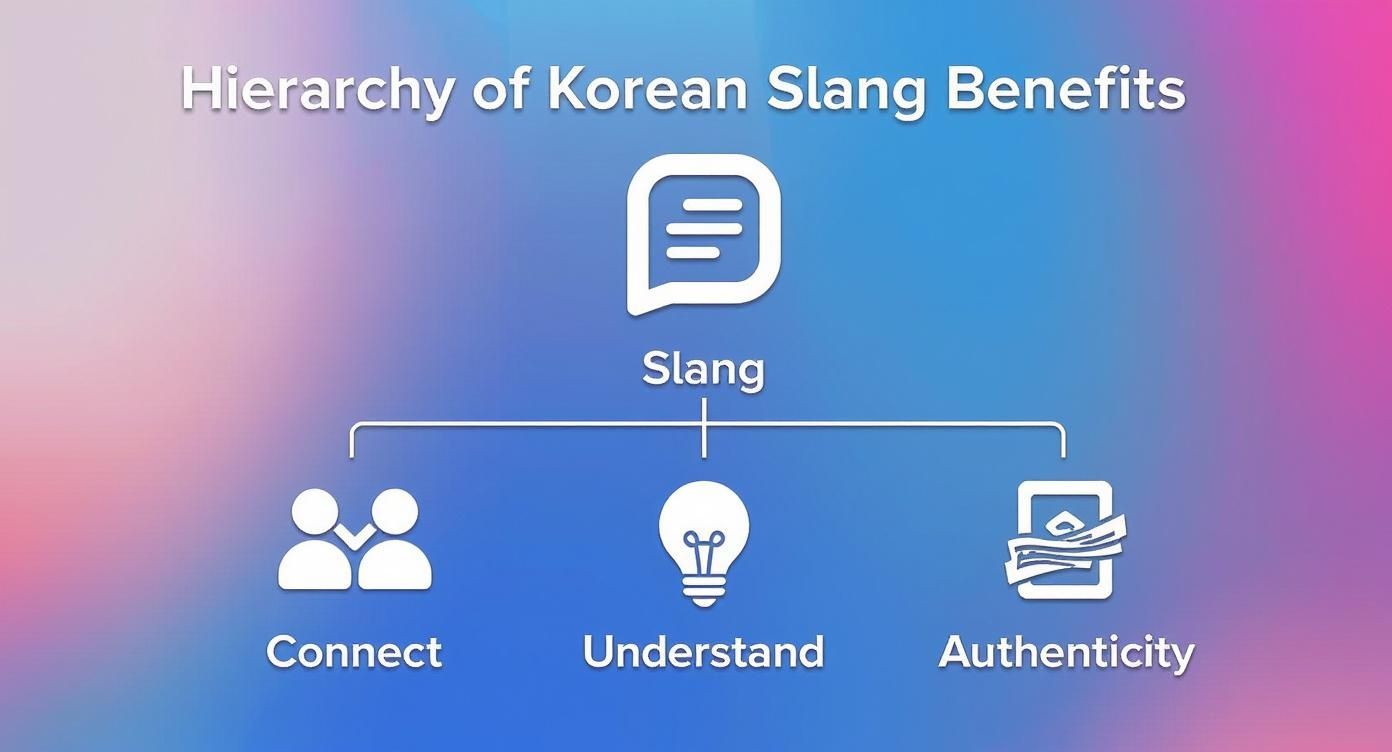
The key takeaway? Slang is your ticket to deeper cultural immersion. Once you get the vibe, you'll be able to use these phrases with the confidence of a native speaker.
Essential Slang You Can Use Today
Ready to start sounding a bit more like a local? This is your starter pack. We’re going to cover some of the most common, everyday slang words you'll hear all the time. If you’ve ever watched a K-drama or listened to K-pop, these will definitely sound familiar. Think of this section as your cheat sheet for conversational shortcuts that will give you an instant confidence boost.
Here’s a simple table with each term's meaning, pronunciation, and a real-world example. We're focusing on low-risk, high-impact words, so you can start using slang in korean from day one without any awkward missteps.
| Korean Slang | Pronunciation | Meaning & When to Use It | Example Sentence |
|---|---|---|---|
| 대박 (Daebak) | day-bak | Awesome! / Amazing! / Wow! Use it to show surprise or excitement about something great. | 와, 이 음식 진짜 대박! (Wow, this food is really amazing!) |
| 짱 (Jjang) | jjang | The best / Cool. A classic slang term that's still widely used to say something is top-notch. | 너 오늘 스타일 짱이다! (Your style is the best today!) |
| 헐 (Heol) | heol | What?! / No way! / OMG. A versatile expression for shock, surprise, or disbelief. | 헐, 진짜? 그럴 리가! (What, really? That can't be!) |
| 꿀잼 (Kkul-jaem) | kkool-jem | Super fun. A combination of 꿀 (honey) and 재미 (fun), meaning something is "as fun as honey is sweet." | 이 드라마 완전 꿀잼이야! (This drama is super fun!) |
| 노잼 (No-jaem) | no-jem | Not fun / Boring. The opposite of 꿀잼, combining the English "no" with 재미 (fun). | 그 영화는 진짜 노잼이었어. (That movie was so boring.) |
Level Up: Slang to Sound Like a Local
You’ve got the basics down—now it's time to level up. Using these intermediate slang in korean expressions will show you’re not just reciting phrases; you’re truly engaging with the culture. These clever abbreviations and trendy terms are what will make your Korean friends do a double-take and say, "Wow, your Korean is good!"
They reveal your understanding of the subtle humor and context that often gets lost in translation. In fact, a 2021 survey of Korean teenagers found that 73.1% use slang in their daily chats, mostly because it’s faster and everyone else is doing it. Curious about how this shapes the language? The Asian News Network has a fascinating article on the topic.
When you start weaving these terms into your conversations, you're no longer just speaking Korean—you're connecting with it.
The Role of Konglish in Modern Slang
You can't fully grasp modern Korean slang without talking about Konglish (콩글리쉬). This isn't just borrowing English words; it's a creative mashup where English terms are adopted, transformed, and given entirely new meanings that are unique to the Korean context.
For example, the English word "fighting!" is used in Korean as 화이팅 (hwaiting) to mean "Good luck!" or "You can do it!" Another popular one is 셀카 (sel-ca), a mashup of "self" and "camera," which simply means "selfie."
This creative blend is so common that it’s become a hot topic. A 2019 report noted over 100 cases of confusing "misused" English in public signs and media are reported annually, sometimes creating a communication gap between generations. You can learn more about the findings on Konglish use in public discourse if you're interested. For any learner today, understanding Konglish isn't just a bonus—it's essential.
Your Action Plan to Master Korean Slang
Okay, you have a list of cool slang words. Now what? Knowing them is one thing, but using them naturally is the real goal. To master slang in korean, you need a practical plan that combines learning with real-world practice. Don't worry—it's more fun than it sounds!

Here are three simple steps to get you started:
- Become a Slang Detective: Re-watch your favorite K-dramas with Korean subtitles on. Your mission? To spot slang in the wild. Pay attention to who says what and in what context. This will teach you the natural timing and tone.
- Immerse Yourself in Pop Culture: Dive into the content that young Koreans consume daily. Follow popular Korean influencers on Instagram, read fun webtoons, and watch hilarious variety shows on YouTube. These are goldmines for the latest slang.
- Practice Speaking Fearlessly: This is the most important step! The key to fluency is practice. Find a language exchange partner or join an online community where you can try out new words without pressure. Platforms like Ktalk.live are perfect for this, connecting you with native speakers for real-time conversation that builds genuine confidence.
Common Questions About Korean Slang
Jumping into the world of Korean slang is exciting, but it’s natural to have questions. Knowing the dos and don'ts will help you use these phrases confidently and appropriately. Here are answers to a few common queries from learners.
Is it rude to use Korean slang?
Context is everything in Korean. With close friends your age or younger, using slang is totally fine—it actually helps build camaraderie.
However, avoid it in formal situations: at work, with anyone older than you (even by a year!), or with people you’ve just met. Korean culture places a high value on respect, which is shown through different speech levels. When in doubt, always stick to standard, polite Korean.
Pro Tip: Think of slang like an inside joke. It’s perfect for your inner circle but might not land well with your boss or your friend’s grandmother. Always gauge the relationship and setting first.
How can I keep up with new slang?
Korean slang evolves at lightning speed. To stay current, you need to immerse yourself in what Koreans are watching and sharing right now.
- Follow Korean Creators: Jump on TikTok and Instagram to see slang used in real-time captions, comments, and videos.
- Watch Variety Shows: Tune into the latest Korean variety shows on YouTube, where hosts and guests use slang naturally and constantly.
- Read Webtoons: Webtoons are a fantastic and fun way to see the newest terms used in realistic, everyday dialogue.
The secret isn’t memorizing lists; it’s consistent, daily exposure to the living language.
Can beginners learn Korean slang?
Absolutely! You don’t have to wait until you're an advanced speaker. While mastering grammar is crucial, adding a few simple slang words can make learning more engaging and fun.
Start with widely understood basics like 대박 (daebak). Using a common slang term correctly is a huge confidence booster and makes you feel more connected to the language. Just make sure you understand the context before you try it out in a conversation.
Conclusion
Learning slang in korean is your passport to a more authentic and exciting language journey. It transforms you from a student reciting phrases into a speaker who truly connects with the culture. Every new word you learn—from 대박 to 꿀잼—brings you one step closer to understanding the heart of modern Korea. Don’t be afraid to make mistakes; what matters most is your progress and your passion for learning.
Your Korean adventure starts now. Keep watching, keep listening, and most importantly, keep speaking!
🌟 Ready to start your Korean journey? Join Ktalk.live — where global learners connect, speak, and grow together! Book your free trial class today!
Ready to stop reading and start speaking?
Practice what you just learned with a native Korean teacher — free for 100 minutes. No card, no commitment.