
Want to practice this with a native Korean teacher?
100-min free trial — no card required.
If you're serious about learning to write in Korean, you can't just skim past the basics. Your journey starts with a rock-solid understanding of Hangul, the Korean alphabet. Before you can even think about crafting sentences, you need to get intimate with how the individual letters are drawn and how they fit together.
Building Your Hangul Foundation
It’s tempting to blitz through the alphabet to get to the "fun" part of making words. I've seen countless learners make this mistake, and it always comes back to bite them. Think of Hangul less as a list of characters to memorise and more as a beautifully logical system. Getting this right from the start is non-negotiable.
If you don't nail these fundamentals, even perfectly spelled words can end up looking clumsy or even be difficult for a native speaker to read.
Mastering Stroke Order
Unlike the English alphabet, where you can get away with some creative flair, Korean characters follow a strict, standardised stroke order. It’s always top to bottom, left to right. This isn’t just about being neat; it’s about efficiency. Following the correct order builds muscle memory, which is what will eventually allow you to write quickly and smoothly without thinking.
Grab some simple practice worksheets and start tracing. Focus on one character at a time, repeating it until the motion feels second nature. It might feel a bit tedious, but this deliberate practice is what stops bad habits from ever forming.
This infographic gives you a great visual overview of the key pieces involved in building your Hangul skills.
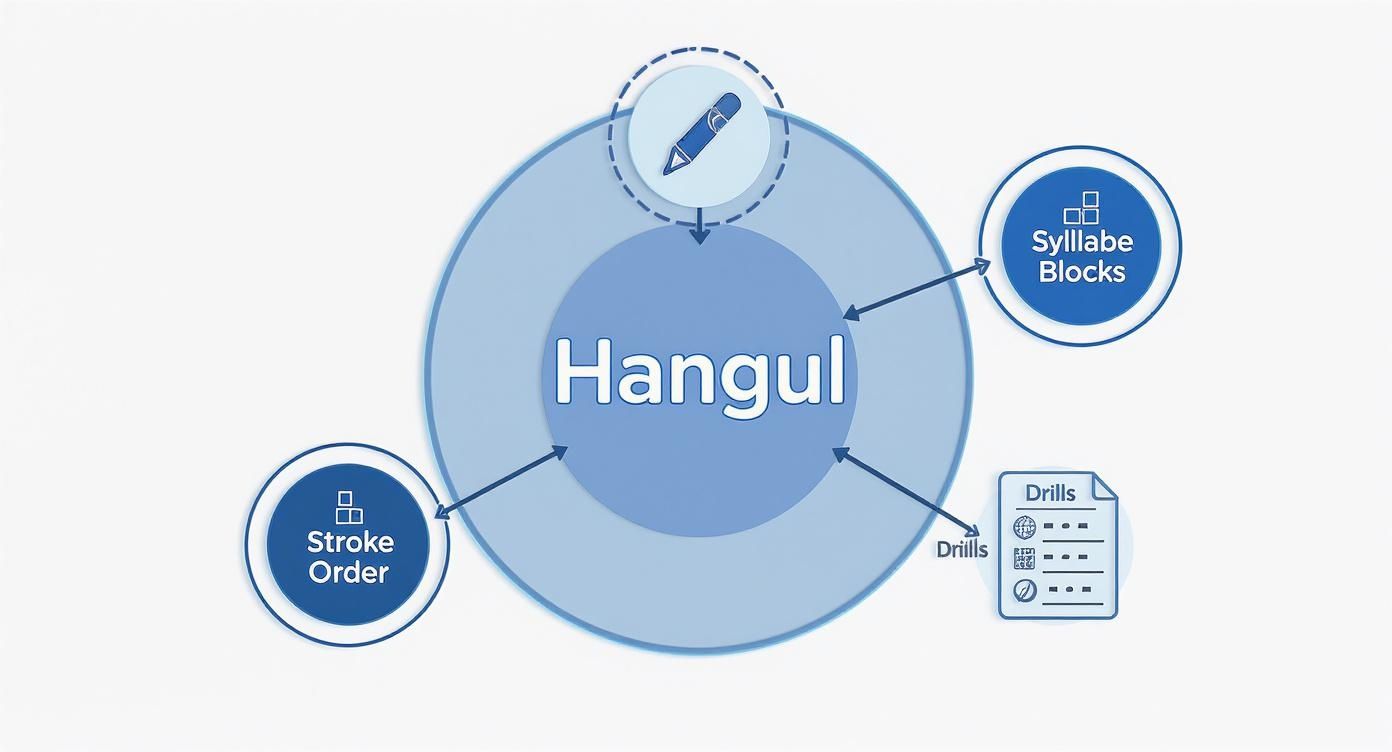
As you can see, it's a connected process. Correct stroke order, understanding syllable structure, and consistent practice all work together to give you a strong writing base.
Understanding Syllable Blocks
Here's where Hangul gets really unique. The letters, called 자모 (jamo), aren't written in a long line. Instead, they're neatly bundled into syllable blocks, with each block fitting into an imaginary square.
Take the word 한글 (Hangul), for example. It's made of the letters ㅎ (h), ㅏ (a), ㄴ (n), ㄱ (g), ㅡ (eu), and ㄹ (l). But you write them as two distinct blocks: 한 (han) and 글 (geul).
Getting a feel for this block structure is absolutely essential for proper spacing and making your writing look natural. You’re not just writing letters; you're building words, block by block. A great exercise is to start by combining one consonant and one vowel, then add a final consonant (a batchim) to see how the block's shape shifts to accommodate it. This is a core part of learning how to practise Korean writing the right way.
The sheer simplicity and logic of Hangul are why it’s often praised as one of the most scientific writing systems ever created. Its accessibility has had a massive real-world impact on literacy in Korea.
This isn't just a fun fact; the alphabet's design was a game-changer for the nation. Back in 1945, South Korea’s adult literacy rate was a startlingly low 22%. Fast forward to today, and that figure has skyrocketed to an incredible 97.9%. It’s a powerful testament to what a well-designed writing system can achieve. You can discover more insights about South Korean educational history and its impact on literacy.
To get started, you need a clear focus. This table breaks down what you should be concentrating on during your initial Hangul practice.
Essential Hangul Practice Focus Areas
| Component | Focus Area | Recommended Practice Method |
|---|---|---|
| Individual Characters | Correct stroke order for all 14 consonants and 10 vowels. | Use stroke-order worksheets and trace each character repeatedly. |
| Syllable Construction | How letters combine to form a single syllable block. | Combine a consonant and vowel (e.g., 가, 너, 도), then add a final consonant (e.g., 각, 넌, 돌). |
| Spacing and Flow | Maintaining consistent size and spacing between syllable blocks. | Write simple words and short sentences, focusing on keeping the blocks uniform. |
| Muscle Memory | Writing characters quickly and accurately without thinking. | Timed drills: write the entire alphabet or specific words as neatly as possible within a set time. |
By focusing on these specific areas, you build a much stronger foundation than if you were to just randomly try writing words. This structured approach will pay off immensely as you move on to more complex writing.
From Letters to Your First Sentences
Okay, you've got a handle on the individual Hangul characters. This is where the real fun starts. Now, it's time to connect those letters into syllable blocks and form actual words. This is that magic moment when the abstract shapes on your page start to transform into real communication.
The trick is to start small with simple, high-frequency vocabulary. Kick things off with single-syllable words and work your way up. This slow-and-steady approach lets you really nail syllable construction without getting swamped.
Building Your First Words
The easiest way to get going is by writing words you probably already know—things you see every day. Think about basic nouns that are easy to picture in your head.
- 물 (mul) - water
- 산 (san) - mountain
- 책 (chaek) - book
- 집 (jip) - house
As you write these out, you're not just copying. You're physically reinforcing how the initial consonant, the vowel, and the final consonant (batchim) all snap together inside one block.
One thing to watch out for is spacing. This trips up almost every new learner. Unlike English, where we space between words, in Korean, you need to remember that the entire syllable block acts as one unit, with spaces separating the full words.
Understanding Basic Sentence Structure
Once you can comfortably write a few dozen words without thinking too hard, you're ready to string them into sentences. Korean grammar can look a bit daunting at first glance, but the basic sentence structure is actually quite logical. The fundamental pattern you need to burn into your brain is Subject-Object-Verb (SOV).
This is a big shift from English's Subject-Verb-Object (SVO) order. For instance, we say "I eat an apple," but in Korean, the thought process is "I apple eat" (저는 사과를 먹어요). Getting this core difference down is absolutely crucial if you want your writing to make sense.
Your main job in the early days is just getting comfortable with the SOV word order. Don't stress about complex grammar rules just yet. Start with the most basic patterns and have fun swapping nouns and verbs to see what happens.
This foundational approach is deeply ingrained in the Korean educational system. The Ministry of Education has refined its curriculum over years to teach Hangul systematically, from the first characters to using them in daily life. If you're curious, you can learn more about South Korea's curriculum approach and see why it's so effective.
A fantastic way to practise is to use simple sentence frames and just plug in different words. This technique, known as pattern drilling, is a powerhouse for building both your vocabulary and your grammatical instincts.
Let's try it with a basic introductory sentence:
- 저는 [noun]입니다. (Jeoneun [noun]-imnida) - I am a [noun].
Now, all you have to do is swap in the nouns you've learned:
- 저는 학생입니다. (Jeoneun haksaeng-imnida) - I am a student.
- 저는 의사입니다. (Jeoneun uisa-imnida) - I am a doctor.
- 저는 요리사입니다. (Jeoneun yorisa-imnida) - I am a cook.
Just like that, you can create dozens of perfectly correct and useful sentences. This method gives you an immediate sense of accomplishment and makes your practice feel genuinely rewarding right from the start.
Daily Exercises for Writing Fluency
When it comes to learning a language, consistency beats cramming every single time. It's far better to spend just ten focused minutes each day than to try and force a marathon session once a week. The real trick is to find engaging little exercises that you can weave into your daily routine—things that make you actually want to practice Korean writing.
These short, sustainable activities are perfect for building that crucial muscle memory, helping you gradually start thinking in Korean. They can transform writing from a chore into a natural, almost effortless habit.
Start a Simple Daily Journal
One of the most powerful habits you can build is daily journaling. I'm not talking about writing long, complex essays. Just aim for two or three simple sentences about your day. What did you eat for lunch? Who did you talk to? What are you doing tonight?
For instance, an entire entry could be as simple as this:
- 오늘은 날씨가 좋아요. (Oneul-eun nalssiga joayo.) - The weather is nice today.
- 점심으로 김치찌개를 먹었어요. (Jeomsim-euro kimchi-jjigae-reul meogeosseoyo.) - I ate kimchi stew for lunch.
- 지금 한국 드라마를 볼 거예요. (Jigeum hanguk deurama-reul bol geoyeyo.) - I am going to watch a K-drama now.
This low-pressure activity gently forces you to pull vocabulary from your memory and use basic grammar in a way that’s personally meaningful. Over time, these small entries build on each other, creating a powerful feedback loop that makes what you've learned truly stick.
The goal of daily journaling isn’t perfection; it’s consistency. By simply documenting your day, you connect the Korean language to your real life, making vocabulary and sentence structures stick much more effectively.
This drive for continuous improvement is deeply embedded in South Korean culture. Even native speakers often supplement their education to sharpen their language skills. It's a testament to the value placed on learning that in 2021, private education spending in South Korea hit a record 23.4 trillion won. More than 75.5% of students were participating in some form of private tutoring to improve their studies, which includes Korean writing. If you're curious, you can discover more insights about Korean education trends to see just how seriously this is taken.
Master Listening and Writing with Transcription
Transcription is a fantastic, two-for-one exercise that sharpens both your listening and writing skills at the same time. The idea is simple: listen to a bit of Korean audio and write down exactly what you hear. It’s an incredible way to practice Korean writing while tuning your ear to the nuances of the spoken language.
The key is to start with materials that have clear audio and an available script you can check later.
- K-pop Lyrics: Pick a slower ballad from an artist you like. Listen to it line by line, write down the lyrics, and then look them up online to see how you did.
- K-drama Dialogue: Find a short, clear scene from a drama you're watching. Play one line of dialogue, pause it, write it down, and then move on to the next.
- Audio for Learners: Beginner-level podcasts or audio clips from language apps are perfect. They're usually spoken slowly and with clear pronunciation.
This exercise forces you to pay close attention to everything—pronunciation, word spacing, and the natural flow of a sentence. It builds a direct bridge between the sounds you hear and the characters you write, which is a common hurdle for many learners.
Comparison of Daily Writing Exercises
Not every exercise clicks with every learner. To help you find what works best for you, here’s a quick comparison of a few daily writing activities you can try.
| Exercise Type | Primary Skill Developed | Time Commitment | Best For |
|---|---|---|---|
| Daily Journaling | Vocabulary recall, basic sentence structure, self-expression | 5-10 minutes | Beginners looking to build a consistent and personal writing habit. |
| Transcription | Listening comprehension, spelling, word spacing | 10-15 minutes | Learners who want to connect spoken Korean to its written form. |
| Sentence Mining | Grammar patterns, natural phrasing, vocabulary in context | 10-15 minutes | Intermediate learners aiming to make their writing sound more native. |
| Social Media Posts | Casual language, slang, interactive communication | 5-10 minutes | Anyone wanting to practice modern, everyday Korean in a social setting. |
Ultimately, the "best" exercise is the one you can stick with. Try a few of these out for a week and see which one you enjoy the most. Mixing and matching is also a great way to keep your practice sessions fresh and engaging.
The Best Tools for Your Korean Writing Practice
https://www.youtube.com/embed/mgxU231d6K4
Writing into a void is one of the quickest ways to get frustrated and lose motivation. To really see progress, you need feedback. Thankfully, we have some fantastic digital tools that can give you the structure and corrections you need to make huge leaps in your writing ability.
Folding the right apps and websites into your study routine doesn't just make it more effective—it makes it a whole lot more fun.
Get Real-Time Feedback from Native Speakers
Language exchange apps are, without a doubt, a total game-changer. Forget wondering if your sentences sound natural. You can get instant, real-world corrections from native Korean speakers who are just as eager to learn your language.
Platforms like HelloTalk and Tandem were built specifically for this. The idea is simple: you write short posts or journal entries in Korean, and native speakers will gently correct your grammar, word choice, and phrasing.
Here’s a look at the HelloTalk interface. Users can post "Moments" for their language partners to see, comment on, and correct.
Getting this kind of immediate, friendly feedback is priceless. It's how you start to pick up on the subtle nuances that textbooks just can't teach you. You move past stilted, academic Korean and start writing in a way that sounds genuinely natural.
Must-Have Digital Dictionaries and Translators
Let’s be clear: you should never rely completely on translators. But when used strategically, they can be incredibly helpful.
Your absolute go-to should be Naver Dictionary. It's so much more than a simple dictionary. It provides incredibly detailed definitions, tons of example sentences from real sources, and audio pronunciations. For understanding the true meaning and usage of a word, it blows generic translators out of the water.
When you're really in a bind with a full sentence or a tricky phrase, Papago is your best bet. It’s also made by Naver and is widely considered the most accurate machine translator for Korean.
My best advice: Use translators to check your work, not to do it for you. Try writing the sentence yourself first. Then, pop it into Papago to see if the translation into English matches what you were trying to say. This little trick helps you spot your own mistakes without building a bad habit.
This approach turns a passive tool into an active part of your learning process, empowering you to find and fix your own weak spots.
Don't Forget Workbooks and Writing Prompts
As great as these digital resources are, there's still a place for good old-fashioned workbooks. Many Korean language textbooks come with companion workbooks filled with writing exercises that build in difficulty, giving you a clear, structured path to follow.
If you’re feeling a bit more creative, look for websites that offer daily or weekly Korean writing prompts. This is a great way to take the pressure off. Instead of staring at a blank page wondering what to write about, you can jump right into focusing on how to write it.
Finally, a quick practical tip: make sure you have a Korean keyboard installed and ready to go on your computer and phone. You'll want to practise both handwriting and typing to become a truly well-rounded communicator in Korean.
Getting Feedback and Fixing Common Mistakes
Writing on your own is a great start, but let's be honest—practice without feedback can just mean you're getting really good at making the same mistakes over and over. To really level up, you need a fresh pair of eyes to spot the errors that have become invisible to you. This is how you stop guessing and start making real, tangible progress.
So, where do you find this crucial feedback? You could connect with a tutor or join a local language exchange. A fantastic, and often faster, option is to use platforms like HelloTalk or Tandem. On these apps, you can post short sentences or diary entries and get corrections from native Korean speakers, sometimes within minutes. Don't hesitate to put your work out there; you'll find most people are genuinely happy to help.
The real magic happens when you move beyond simply accepting a correction. You need to dig in and understand why it was wrong in the first place. This is what separates passive learning from active improvement and helps you build that all-important skill of self-editing.
Identifying Common Particle Mix-Ups
Ah, Korean particles. They're one of the first major hurdles for most learners. While Hangul is celebrated for its logic, the grammar it expresses can feel worlds away from English. Particles are a prime example, as they often don't have a clean, one-to-one translation.
Let's talk about the two biggest offenders: the topic markers 은/는 (eun/neun) and the subject markers 이/가 (i/ga). To a beginner, they can seem almost identical, but their nuances completely change the feel of a sentence.
- 은/는 (Topic): Use this to introduce what you're talking about or to create a comparison. It’s like saying, "Speaking of [noun]..." or "As for [noun]..."
- 이/가 (Subject): This one pinpoints the subject who is doing the action or introduces new information into the conversation.
Here’s a classic example that shows how a small particle change makes a big difference:
- Incorrect: 제가 학생은 아니에요. (Je-ga haksaeng-eun anieyo.)
- Correct: 저는 학생이 아니에요. (Jeo-neun haksaeng-i anieyo.) - As for me, I am not a student.
In the correct sentence, 저는 smoothly sets up "I" as the topic of discussion. Mastering this distinction is a huge step toward making your Korean sound less like a textbook and more like a real conversation.
Correcting Verb Endings and Spacing
Two other dead giveaways of a beginner's writing are mismatched verb endings and awkward spacing. Every verb you write needs to be conjugated to match the social context. Using a casual ending in a formal email, for example, is a cultural misstep that can make you seem unprofessional or even rude. It's a tough habit to build, but a critical one.
Spacing is another subtle but vital detail. Unlike English where we separate every single word, Korean groups words into blocks based on their function. A common mistake is to either put a space after every syllable block or smash them all together.
The key to improvement is pattern recognition. Once you've had a specific mistake corrected a few times—like using the wrong particle or verb ending—you'll start to spot it in your own writing before anyone else does.
This cycle of writing, getting feedback, and self-correcting is the secret to breaking through plateaus. A practical tip is to keep a dedicated "mistake journal." Every time you get a correction, jot down the error, the fix, and a quick note on why it was wrong. This kind of focused review burns the right patterns into your brain, making your journey to fluency a whole lot smoother.
Got Questions About Writing in Korean? We've Got Answers.
As you start your Korean writing journey, you're bound to run into a few questions. That’s completely normal. Sometimes, a few quick answers can clear up confusion and keep you moving forward. Let's tackle some of the most common things learners wonder about.
Getting a handle on these points will help you practice smarter, not just harder. Think of this as your go-to guide for those "am I doing this right?" moments.
How Long Does It Take to Get Good at Writing in Korean?
This is the big one, isn't it? The honest answer is that there's no magic number. Your progress really comes down to one thing: consistency.
A focused 20-30 minute practice session every single day will do more for you than a multi-hour cram session on the weekend. It's about building a habit.
Stick to that daily routine, and you’ll likely see a real difference in how your handwriting looks and how comfortably you can form basic sentences in about two to three months. Becoming truly fluent is a much longer game, of course, but you can build that solid foundation surprisingly fast if you just keep at it.
Should I Start With Handwriting or Typing?
Start with handwriting. No question. While typing is a practical skill for modern life, the physical act of writing Hangul is where you build a real connection with the language.
- It Builds Muscle Memory: When you practice the proper stroke order and learn how to shape letters into neat syllable blocks, you're wiring that information directly into your brain. This makes writing feel more automatic over time.
- It Boosts Your Reading: The hands-on process of forming each character actually helps you recognise it faster when you see it on a page.
Once you get the hang of writing by hand and feel pretty good about it, that’s the perfect time to start learning the Korean keyboard layout. You'll have the fundamentals down, making the transition to typing much smoother.
Hangul is famous for being an incredibly logical writing system, but Korean grammar can be a real beast for English speakers. Grounding yourself in the alphabet by hand first gives you a solid base before you dive into the more complicated grammar rules.
What’s the Best Way to Practice Particles Correctly?
Ah, Korean particles. The topic markers 은/는 and subject markers 이/가 are a classic sticking point for almost every learner. Trying to memorise them all at once is a recipe for a headache.
A much better way is to zero in on just one pair of particles at a time. Find a handful of simple sentences that use them perfectly. Then, start playing around with those sentences by swapping in different nouns. This exercise helps you develop an instinct for how they feel and function.
After you've written a few of your own, post them on a language exchange app. Be specific and ask a native speaker to check your particle usage. Getting that kind of targeted feedback is one of the quickest ways to master this tricky part of the language.
Ready to stop guessing and start getting real-time feedback from expert tutors? K-talk Live offers a free 100-minute trial class where you can practice speaking and writing in a supportive, small-group setting. Book your free spot today and take the next step toward Korean fluency.
Ready to stop reading and start speaking?
Practice what you just learned with a native Korean teacher — free for 100 minutes. No card, no commitment.