
Want to practice this with a native Korean teacher?
100-min free trial — no card required.
Ever wondered how to say please in Hangul? Picture this: you're standing in a bustling Seoul café, ready to order your first iced americano. You know the word for coffee, but what about "please"? Do you use juseyo? Or is it jebal? Getting this small but mighty word right is a game-changer for any Korean learner.
Learning how to say "please" isn't just about being polite; it's about connecting with Korean culture on a deeper level. Unlike in English, where a simple "please" works almost everywhere, the Korean language asks you to choose the right phrase for the right moment. This guide will walk you through the nuances, helping you move beyond textbook phrases and into conversations that feel natural and respectful. By the end, you'll know exactly which "please" to use, every single time.
Your Everyday Go-To: 주세요 (Juseyo)
If you learn only one way to say please in Hangul, make it 주세요 (juseyo). Think of it as your friendly, all-purpose "please" for daily life. It's the most common and versatile way to make polite requests, making it a must-know phrase for every beginner.

The phrase literally means "please give," and you use it when asking for an object or a simple service. It strikes the perfect balance—respectful but not overly formal—which is why it's ideal for everyday situations like ordering food, shopping, or hailing a taxi.
How to Use Juseyo
The magic of 주세요 (juseyo) is in its simple structure. It combines a verb with a polite ending to show respect:
- 주다 (juda): The basic verb "to give."
- -세요 (-seyo): A polite honorific ending attached to verbs.
Together, they form 주세요 (juseyo), adding a layer of politeness essential in Korean culture. It’s no surprise this phrase is a cornerstone of a language spoken by over 81 million people worldwide. To learn more about the language's background, check out the Korean language's history and global reach.
Quick Tip: Want to sound even more natural? Add the word 좀 (jom), meaning "a little," before 주세요. For example, "물 좀 주세요" (mul jom juseyo) feels a touch softer and friendlier than just "물 주세요" (mul juseyo).
Juseyo in Action: Common Examples
Using juseyo is incredibly easy. Just state the noun (the item you want) and follow it with 주세요 (juseyo). This simple formula works in countless scenarios.
| Hangul Request | Romanization | English Meaning | Where to Use It |
|---|---|---|---|
| 커피 주세요 | Keopi juseyo | Coffee, please | At a café |
| 물 좀 주세요 | Mul jom juseyo | Some water, please | At a restaurant |
| 이거 주세요 | Igeo juseyo | This one, please | Pointing at an item in a shop |
| 영수증 주세요 | Yeongsujeung juseyo | The receipt, please | After making a purchase |
| 봉투 주세요 | Bongtu juseyo | A bag, please | At a convenience store or market |
The Urgent and Emotional Please: 제발 (Jebal)
Now, let's explore a different kind of "please." While 주세요 (juseyo) is for polite requests, 제발 (jebal) carries a much heavier, more emotional weight. If you're a fan of K-dramas, you've definitely heard this one during a dramatic, heart-wrenching scene.
That’s your biggest clue! 제발 (jebal) isn't for asking for more water; it's for pleading, begging, or making a desperate appeal. Think of it less as "please" and more like "I'm begging you!" or "For goodness' sake!"

Using it for a simple request, like asking for the time, would sound incredibly dramatic and out of place. It signals a deep sense of urgency or desperation.
When to Use Jebal Correctly
Because of its intensity, save 제발 (jebal) for serious situations. Knowing when to use it shows a real grasp of Korean cultural nuance. The golden rule is to ask yourself: am I making a simple request, or an emotional plea?
Here are a few classic scenarios where 제발 (jebal) fits perfectly:
- Pleading with someone not to leave:
- 제발, 가지 마세요. (Jebal, gaji maseyo.) – Please, don't go.
- Begging for forgiveness:
- 제발 용서해주세요. (Jebal yongseohaejuseyo.) – Please, forgive me.
- Asking someone to stop doing something hurtful:
- 제발 그만해! (Jebal geumanhae!) – Please, just stop!
Cultural Insight: In daily life, Koreans almost never use jebal when asking for a menu or directions. It would just feel strange. For regular interactions, juseyo is always the natural choice.
Getting this distinction right is a huge step in learning to say please in hangul like a native. When in doubt, stick with a different phrase. Mastering these subtleties comes with practice, and talking with native speakers can make all the difference. That's where services like the free trial classes offered at K-talk Live can help you build true fluency.
The Formal and Respectful Please: 부탁드립니다 (Butakdeurimnida)
For situations that require a higher level of formality, 부탁드립니다 (butakdeurimnida) is your best choice. This is the most respectful way to say "please" when asking for a significant favour, service, or action—not an object. It carries a deeper meaning, closer to “I humbly ask this favour of you.”
This phrase combines two parts:
- 부탁 (butak): A noun meaning "favour" or "request."
- 드립니다 (deurimnida): The humble, formal version of the verb "to give."
Together, they create a powerful, polite expression that shows deep respect.
When to Use Butakdeurimnida
Save this phrase for moments that count. It's the go-to expression when speaking with a boss, an elder, or anyone in a professional setting. For example, a 2023 survey in South Korea found that 57% of people see foreign languages used in official documents and business materials, highlighting the importance of proper language in professional life. You can read more about language use in South Korean institutions if you're curious.
Here are a few classic examples:
- In the office:
- 잘 부탁드립니다. (Jal butakdeurimnida.) – "I look forward to working well with you." This is a cornerstone phrase used when starting a new job or joining a team.
- Making a formal request:
- 도와주시길 부탁드립니다. (Dowajusigil butakdeurimnida.) – "I request your help, please." A very polite way to ask for assistance from a senior colleague or official.
Pro Tip: Avoid the common mistake of using this phrase to ask for an item. You'd never say "커피 부탁드립니다" (keopi butakdeurimnida) to order a coffee. For that, stick with the classic "커피 주세요" (keopi juseyo).
Choosing the Right 'Please' in Korean: A Quick Guide
You now have the three main ways to say 'please' in Korean! Knowing the words is one thing, but choosing the right one in a real conversation is where the magic happens. The key is context: are you asking for a thing, a favour, or making an emotional plea?
Comparing Your Options Side-by-Side
This little table makes it easy to see them all at a glance.
| Korean Phrase | Politeness Level | Best Used For | Example Sentence (Hangul/Romanization) |
|---|---|---|---|
| 주세요 | Standard/Polite | Everyday requests for objects or simple services. | 김밥 하나 주세요. (Gimbap hana juseyo.) |
| 제발 | N/A (Emotional) | Urgent, desperate, or emotional pleas. | 제발 도와주세요! (Jebal dowajuseyo!) |
| 부탁드립니다 | Formal/Humble | Requesting favours, help, or actions in a professional or respectful context. | 잘 부탁드립니다. (Jal butakdeurimnida.) |
Seeing them laid out like this really helps clarify the distinct role each one plays, doesn't it? Running through little scenarios in your head is a fantastic way to build the confidence you need for any situation.
Politeness Beyond Words: Actions Matter Too
In Korea, being truly polite—예의 (ye-eui)—goes beyond words. It's a language of actions, body language, and awareness of who you're speaking to. Pairing the right please in Hangul with the right gestures is how you truly show respect.
For instance, when a cashier hands you change, it's polite to accept it with two hands, especially if they are older than you. A slight bow of the head when you say "hello" or "thank you" is another simple, everyday sign of courtesy.
These non-verbal signals are woven into the cultural fabric, much like Hangul itself. The Korean alphabet was created in 1443 by King Sejong the Great to be so simple that anyone could learn it. His vision was a massive success, leading South Korea to a 98% literacy rate today. You can discover more these fascinating Hangul facts.
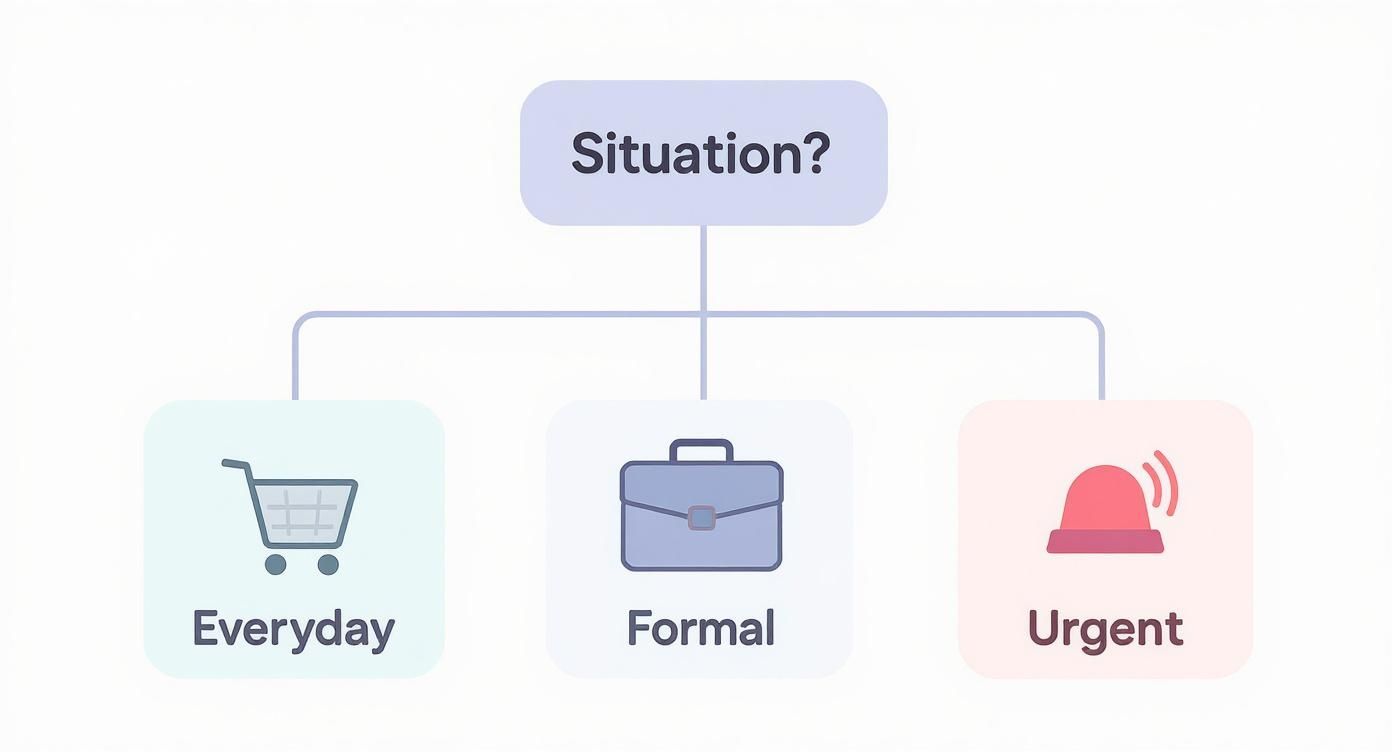
As you can see, the context of your request is everything. Choosing the right phrase is key to showing you understand and respect the culture.
Your Korean Journey Starts Now
You've just unlocked the key differences between the three most common ways to say "please" in Korean! To summarize: 주세요 (juseyo) is for everyday requests, 제발 (jebal) is for desperate pleas, and 부탁드립니다 (butakdeurimnida) is for formal favours.
Getting these right is a game-changer. It separates a beginner from someone who truly understands the feel of the language. Don't just memorize them—use them! Every word you learn brings you one step closer to confidence. Keep going—your Korean journey starts now!
🌟 Ready to start your Korean journey? Join Ktalk.live — where global learners connect, speak, and grow together! Find a class that fits your life at https://ktalk.live.
Ready to stop reading and start speaking?
Practice what you just learned with a native Korean teacher — free for 100 minutes. No card, no commitment.