Want to practice this with a native Korean teacher?
100-min free trial — no card required.
Learning Korean might seem challenging at first—but with the right approach, it becomes a fun and rewarding journey! While apps and videos are great, your most important tool will be a good Korean study book. Think of it as your personal roadmap, guiding you from learning your first Hangul character to confidently building your own sentences. Let's explore how to find the perfect book for your journey and make the most of it.
Why a Korean Study Book Is Your Most Important Tool
Sure, language apps are fun, and YouTube is great for listening. But a well-designed textbook offers something they can't: a structured, progressive learning path. It’s the backbone of your study routine, ensuring you don’t accidentally skip critical grammar rules or essential vocabulary.
This systematic approach is what builds real confidence. A book breaks down the massive task of learning Korean into manageable, step-by-step lessons. Each chapter builds on the one before it, creating a solid foundation for everything else you'll learn.
The right book keeps you focused. It gives your learning a clear direction and serves as a reliable friend you can always turn to when you're stuck.
Finding Your Perfect Match: Types of Korean Books
The world of Korean study books is surprisingly vast! Picking the right one is less about finding the single "best" book and more about choosing the right coach for your specific goals. Your choice should match where you are now and where you want to go.
South Korea has a powerhouse publishing industry committed to creating top-notch educational materials. Understanding the main categories is the first step to making a smart choice for your study plan.
Integrated Textbooks for All-in-One Learning
Think of these as your boot camp. An integrated Korean study book is a complete package, bundling grammar, vocabulary, reading, and listening practice all in one place. They're perfect for beginners who need a clear structure.
- What you get: A balanced curriculum with lessons, exercises, and usually a workbook or audio files.
- Who they're for: Beginners and self-starters who need a single, reliable resource. Famous series like Ewha Korean or Sogang Korean are great examples.
Specialised Books for Targeted Skills
Once you have the basics down, you’ll notice areas where you need more practice. That's where specialised books come in. They help you strengthen weak spots or prepare for a specific challenge, like an exam.
The South Korean publishing market is a giant—it hit around $5.8 billion in 2021, with educational books making up over 60% of that. This means you have an incredible selection of high-quality resources. You can learn more about the industry on researchandmarkets.com.
Here are the most common types:
- Grammar Guides: These dive deep into how sentences are built, how verbs change—like -고 싶어요 (-go sip-eo-yo, "I want to...")—and what all those little particles mean.
- Vocabulary Builders: These expand your word bank, often organized by themes like food or travel.
- TOPIK Preparation Books: If you're planning to take the Test of Proficiency in Korean (TOPIK), these are essential. They are packed with mock exams and smart test-taking strategies.
What to Look For in a Great Korean Study Book
Let's be honest, not all Korean study books are created equal. A great book feels less like a textbook and more like a patient guide. The grammar explanations should be crystal clear, using everyday examples you'd genuinely hear on the streets of Seoul.
A good book avoids dense, academic jargon and uses explanations that just click. It presents new information clearly and then provides the tools you need to practice and internalize it.
The infographic below breaks down the main types of Korean learning books. Think of it as a roadmap for your journey, helping you see how you might start with an all-in-one guide and later branch out.
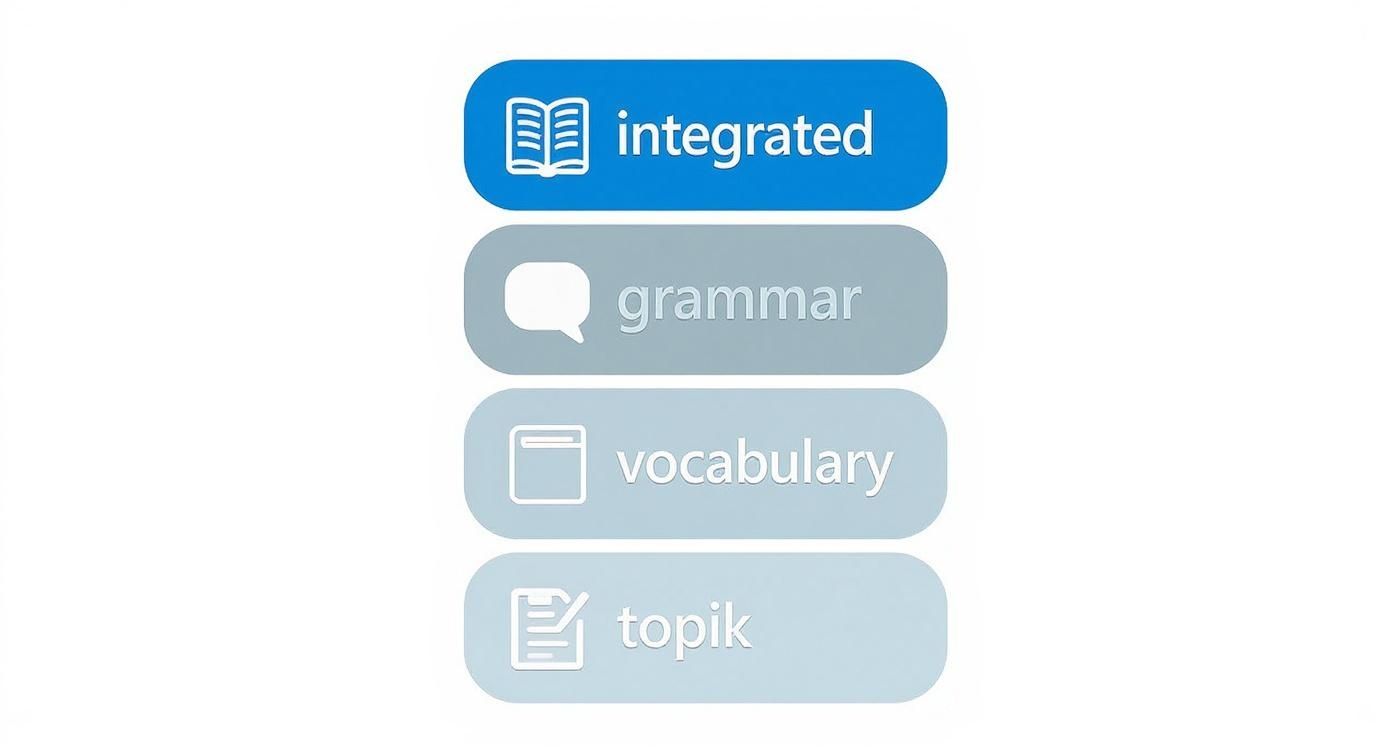
The path often moves from general study to focusing on specific skills like grammar, vocabulary, or acing the TOPIK exam as your confidence grows.
Key Features for Effective Learning
Certain features are absolute game-changers for making progress. One of the most vital is an audio component. Reading Hangul is a great first step, but you can’t get the sound right without hearing it. Listening to a native speaker pronounce tricky words like 의사 (uisa, doctor) or 회사 (hoesa, company) is the only way to nail natural pronunciation.
Practice exercises are just as crucial. The best exercises force you to use active recall—digging into your memory to build sentences or answer questions. This is how you make information stick.
The table below breaks down the most important features to look for.
Comparing Features in Korean Study Books
| Feature | Why It Matters | Best For Learners Who... |
|---|---|---|
| Audio Component | Helps you master pronunciation, intonation, and listening skills from day one. | ...are serious about speaking naturally and want to avoid common pronunciation mistakes. |
| Practice Exercises | Reinforces learning through active recall, moving knowledge from passive to active. | ...learn by doing and want to actively apply grammar rules and new vocabulary. |
| Clear Grammar | Breaks down complex rules into simple, understandable concepts with real examples. | ...get easily overwhelmed by dense, academic explanations and prefer a straightforward approach. |
| Cultural Notes | Provides context for why things are said a certain way (e.g., honorifics). | ...want to understand Korean culture and communicate in a more natural, respectful way. |
| Vocabulary Lists | Organises new words by theme or lesson, making them easier to review and memorise. | ...are focused on expanding their word bank systematically. |
| Answer Key | Allows you to check your work, identify mistakes, and learn from them independently. | ...are self-studying and need a reliable way to measure their understanding. |
Finally, the best books weave cultural context into the lessons. Language doesn't exist in a bubble. Understanding why you use different levels of formality makes the experience richer and more memorable.
Top Book Recommendations by Level
Walking into a bookstore can be intimidating. The most important thing is to choose a Korean study book that fits your current level. This way, you stay motivated without feeling overwhelmed.
It helps to know that Korea’s publishing industry is massive, with around 38,170 publishing companies. All that competition means tons of high-quality material is out there. You can get a better sense of Korea’s publishing landscape at 2seasagency.com.
Even with all those choices, a few names always pop up for a reason. They work.
For Absolute Beginners
When you're starting from scratch, you need a book that makes learning feel like a win.
Talk To Me In Korean (TTMIK) Grammar Textbooks: If you’ve looked for Korean resources, you’ve heard of TTMIK. Their books have a super friendly, conversational style that breaks down grammar into small chunks. It’s perfect for self-study.
Ewha Korean Language Series (Book 1 & 2): Developed by Ewha Womans University, this is a classic, structured textbook. It’s an all-in-one package covering speaking, listening, reading, and writing—great if you thrive on a clear curriculum.
For Intermediate Learners
Once you’ve got the basics, it’s all about building on that foundation with more complex grammar.
- Korean Grammar in Use (Beginner to Intermediate): Many learners call this the "grammar bible." It offers crystal-clear explanations for almost every grammar point, complete with tons of example sentences. It's the perfect companion for clearing up tricky rules.
For Advanced Learners
At this stage, you need to push yourself with real-world language, specialized vocabulary, and nuance.
- Korean Grammar in Use (Advanced): The final book in this series gets into the weeds of Korean grammar. It covers complex structures you'll find in literature, news articles, and formal discussions. If you're serious about reaching fluency, this one is non-negotiable.
How to Actively Learn with Your Book
So, you’ve got a great Korean study book. That’s a fantastic first step! But the real progress begins when you stop passively reading and start actively doing. Don't worry if you make mistakes—even Koreans do sometimes! What matters most is progress.
Make the Material Your Own
One of the best tricks is to connect new information to your own life. When you see an example sentence, tweak it to be about you.
For example, the book says:
- 저는 사과를 좋아해요. (jeo-neun sa-gwa-reul joh-a-hae-yo.) - I like apples.
Make it true for you:
- 저는 커피를 좋아해요. (jeo-neun keo-pi-reul joh-a-hae-yo.) - I like coffee.
- 제 친구는 K-pop을 좋아해요. (je chin-gu-neun ke-i-pab-eul joh-a-hae-yo.) - My friend likes K-pop.
This tiny change anchors the grammar to your personal experiences, making it more memorable.
Turn Practice into Performance
Those exercises at the end of each chapter are your rehearsal for real-life conversations. Instead of quietly writing the answers, try speaking them out loud. This trains your mouth and brain to work together, building the muscle memory needed for fluent conversation.
Even 15-20 minutes a day of active, hands-on practice leads to real, noticeable progress.
Beyond the Book: The Power of Speaking Practice
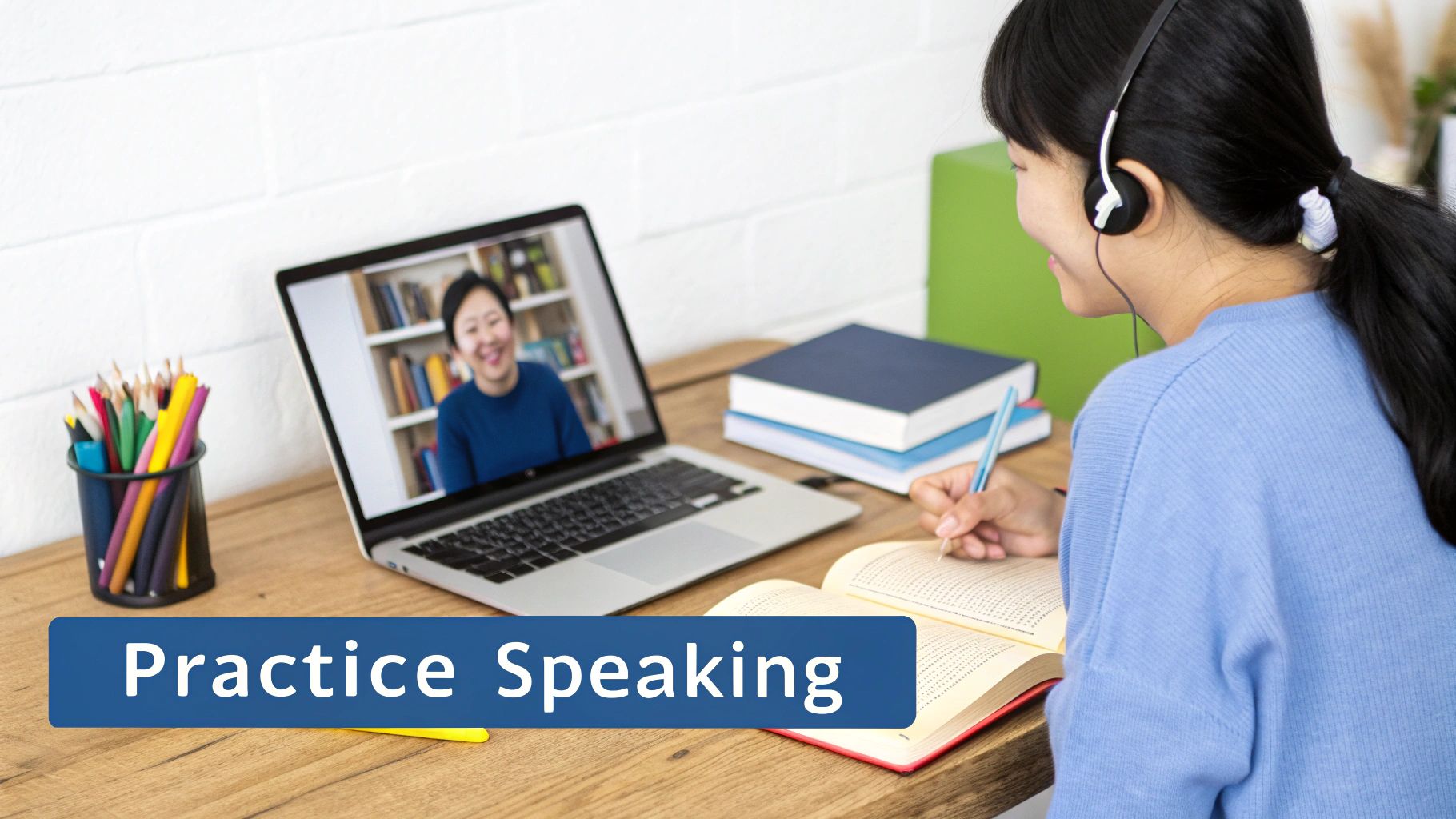
A great Korean study book lays the groundwork, but fluency comes alive in a real conversation. Think of it this way: your book is a map, showing you the routes and rules. Live speaking practice is actually getting in the car and driving. The map gives you the theory, but driving teaches you how to handle real-life situations.
From Passive Knowledge to Active Skill
The magic happens when you start using what you've learned. Speaking with a native tutor forces your brain to grab those words and grammar points and put them into action. This process turns passive understanding into an active skill. You stop translating in your head and start thinking in Korean.
The Korean language learning market is expected to grow to over USD 2.6 billion by 2034, largely thanks to the global explosion of K-pop and K-dramas. This growth shows a clear demand for learning methods that go beyond just a book. You can read more about this trend at gminsights.com.
This is where a platform like K-talk Live comes in. It’s the perfect space to take what you’ve learned from your textbook and put it to the test. In small, live classes, you can work on your pronunciation, get immediate feedback, and build the confidence to speak naturally.
Your Korean Journey Starts Now
So, what's next? You now know how to find the right Korean study book and, more importantly, how to use it effectively. The 'perfect' book is the one that clicks with you—your goals, your habits, and how you learn best.
Your book is the foundation, but remember, true fluency is built by actually using the language. Every page you turn is a genuine step forward. Every word you learn brings you one step closer to confidence. Keep going—your Korean journey starts now!
🌟 Ready to start your Korean journey? Join K-talk Live — where global learners connect, speak, and grow together
Ready to stop reading and start speaking?
Practice what you just learned with a native Korean teacher — free for 100 minutes. No card, no commitment.