Want to practice this with a native Korean teacher?
100-min free trial — no card required.
Ever had a great conversation in Korean, only to stumble at the very end, unsure of the right way to say goodbye? Learning how to say bye in Korean can feel tricky at first because, unlike a simple "bye," it all depends on who is leaving and who is staying. Don’t worry if this seems challenging — with the right approach, it becomes a fun and rewarding part of your language journey!
Nailing the correct farewell is about more than just vocabulary; it’s a beautiful window into Korean culture and respect. Getting it right shows you're not just learning words but also understanding social cues, which leaves a wonderful impression. This guide will break down the must-know phrases, making it easy to say goodbye with confidence in any situation. Your Korean journey starts now!
Your Essential Guide to Korean Goodbyes
Unlike a simple "bye," Korean farewells are nuanced, reflecting the social context and your relationship with the other person. But don't worry, the logic is simpler than it seems! It all boils down to one simple question: who is staying, and who is leaving?
This guide will demystify the process, giving you the confidence you need for your very next conversation. We’ll break down the must-know phrases, explaining the simple logic so you never get them mixed up again.
Quick Guide to Common Korean Goodbyes
To get you started, here's a quick look at the most common farewells. This table is a great reference to keep handy as you begin practising.
| Korean (Hangul) | Romanization | Meaning | When to Use |
|---|---|---|---|
| 안녕히 가세요 | annyeonghi gaseyo | Go peacefully | (Formal) You are staying, the other person is leaving. |
| 안녕히 계세요 | annyeonghi gyeseyo | Stay peacefully | (Formal) You are leaving, the other person is staying. |
| 잘 가요 | jal gayo | Go well | (Standard/Polite) A slightly less formal version of annyeonghi gaseyo. |
| 안녕 | annyeong | Bye | (Informal) With close friends or those younger than you. |
Remember, context is everything. Always consider your relationship with the person and the setting before picking your phrase.
Making the Right Choice
So, how do you decide in the moment? It’s a quick mental checklist. First, gauge the formality. Then, figure out who’s on the move. Are they leaving while you stay, or are you the one walking away?
This handy flowchart breaks down that thought process perfectly.
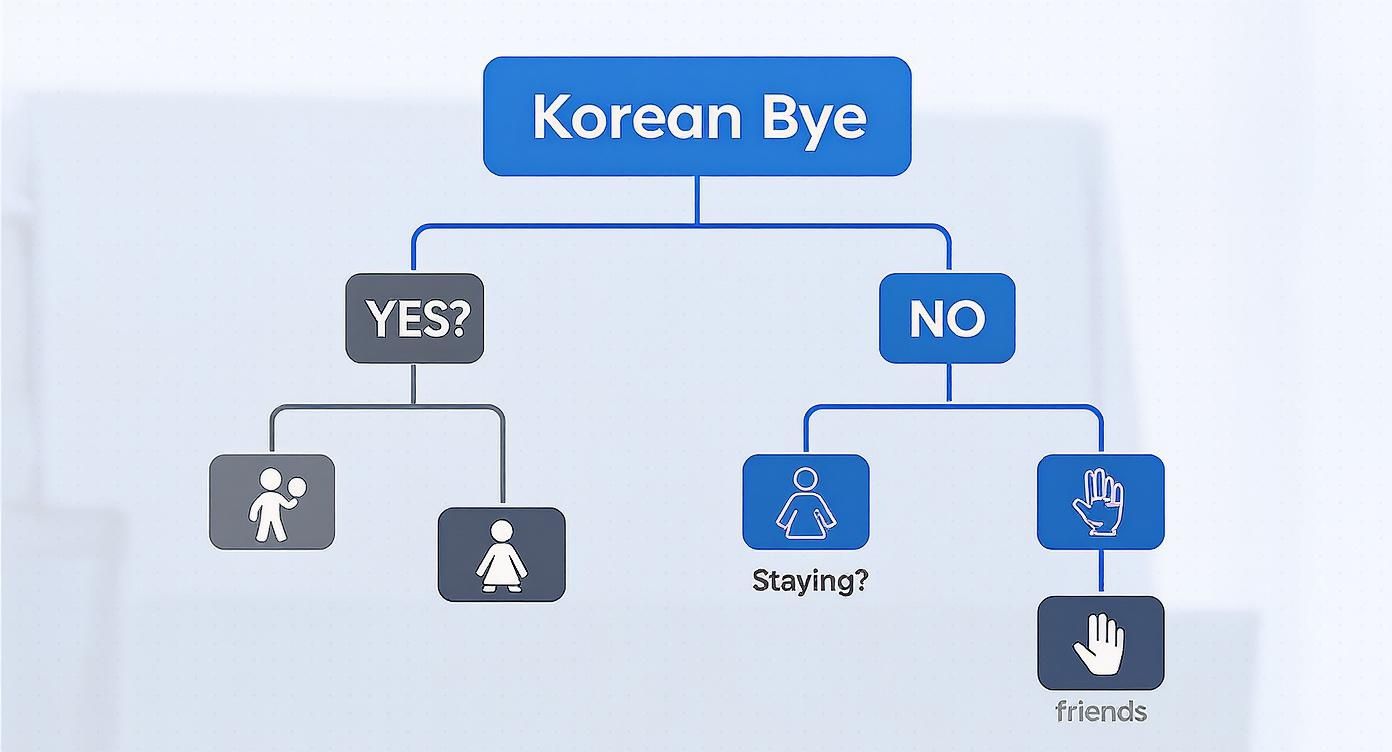
As you can see, it all starts with the situation's formality. From there, your choice splits based on whether you're staying put or heading out. This single distinction is the most critical piece of the puzzle for polite goodbyes. Now, let's dive into those formal expressions.
Mastering Formal Goodbyes for Respectful Interactions

In Korea, respect isn't just a nice-to-have; it's baked right into the language. This is never more apparent than when you're learning how to say bye in Korean. Choosing the right formal farewell is your first step to making a great impression, especially when speaking to elders, teachers, your boss, or even someone you’ve just met.
These phrases are your bread and butter for any professional or public setting. Getting them right shows you've taken the time to understand Korean social etiquette, and that earns you a lot of points. Don’t worry if you make mistakes — even Koreans do sometimes! What matters most is progress.
The Two Pillars of Polite Farewells
The two most critical formal goodbyes you need to know are 안녕히 가세요 (annyeonghi gaseyo) and 안녕히 계세요 (annyeonghi gyeseyo). I know, they sound almost identical at first. The key difference, though, is brilliantly simple: it all depends on who is leaving and who is staying.
Let's unpack them.
안녕히 가세요 (annyeonghi gaseyo)
- Pronunciation: an-nyawng-hee ga-seh-yo
- Literal Meaning: "Go peacefully"
- When to Use: You say this when you are staying and the other person is the one leaving. Think of it as wishing them a safe journey away from where you are.
안녕히 계세요 (annyeonghi gyeseyo)
- Pronunciation: an-nyawng-hee gyeh-seh-yo
- Literal Meaning: "Stay peacefully"
- When to Use: This is your line when you are leaving and the other person is staying put. You're essentially wishing them well in the place you're departing from.
The secret is hidden in the verbs. 가세요 (gaseyo) comes from the verb 가다 (gada), which means "to go." On the flip side, 계세요 (gyeseyo) is derived from 계시다 (gyesida), the formal verb for "to stay" or "to be."
💡 Practical Tip: Just link "ga" with "go." If the other person is the one going, use the phrase with ga in it: 안녕히 가세요 (annyeonghi gaseyo). Simple as that!
Seeing Formal Goodbyes in Action
Knowing the rules is one thing, but seeing how they work in the real world is what makes it stick. Here are a couple of classic scenarios you'll definitely encounter.
Scenario 1: Leaving a coffee shop.
You’ve just grabbed your iced americano. As you head for the door, you’d give the barista a slight bow and say:
- You say: "안녕히 계세요." (Stay peacefully.)
Scenario 2: A colleague leaves the office for the day.
Your coworker is packing up to go home, but you’re still plugging away at your desk. As they walk past, you’d look up and say:
- You say: "안녕히 가세요." (Go peacefully.)
These expressions are deeply woven into the fabric of Korean culture. This sophisticated system of farewells reflects a society where showing respect based on context is paramount. The distinction between '가세요' and '계세요' has been a cornerstone of language education since the 1970s. In fact, educational data reveals that 92% of elementary students can correctly use both forms by the third grade, which just shows how fundamental these concepts are. You can find more cultural insights on these greetings over at languagedrops.com.
Getting a handle on these two phrases will instantly make your Korean sound more polished and help you move through formal situations with confidence and grace.
Casual and Friendly Ways to Say Bye
Once you're out of formal situations and just hanging out, the way you say goodbye really shifts. Learning how to say bye in Korean with friends opens up a whole new world of natural conversation, and honestly, this is where the fun begins. Using stuffy, formal phrases with people your own age or younger can feel a bit awkward and create some unnecessary distance. This is exactly where casual goodbyes come in, making your chats feel way warmer and more genuine.
If you’ve ever found yourself binge-watching a K-drama, you’ve definitely heard these phrases a million times. They're the bread and butter of everyday farewells among friends, and getting them down will make you sound less like you're reading from a textbook and more like you actually speak the language.
The All-Purpose Casual Bye
The easiest, most common, and most versatile informal goodbye is 안녕 (annyeong). And yes, it’s the exact same word you use to say "hello" to a friend. Its dual-purpose nature makes it an absolute must-know phrase right from day one.
- 안녕 (annyeong)
- Pronunciation: an-nyawng
- Meaning: "Bye" (but also "Hi")
- When to Use: Perfect for close friends, family, and people younger than you. The best part? It works whether you're the one leaving or the one staying behind.
Just think of 안녕 (annyeong) as your go-to tool for any friendly situation. It's simple, direct, and everyone gets it.
Here’s how it sounds in a conversation:
- Min-jun: "I have to go now."
- You: "Okay, 안녕 (annyeong)!" 👋
- Min-jun: "안녕 (annyeong)! See you tomorrow."
When Your Friend Is Leaving
While 안녕 (annyeong) is your trusty all-rounder, there's another incredibly common phrase you’ll want in your back pocket: 잘 가 (jal ga). This one is a more active way of saying goodbye when someone else is the one heading out.
- 잘 가 (jal ga)
- Pronunciation: jal ga
- Literal Meaning: "Go well"
- When to Use: Use this when you are staying put, and your friend (or someone you're close with) is leaving.
💡 Practical Tip: You can only use 잘 가 (jal ga) when the other person is the one leaving. In contrast, 안녕 (annyeong) can be used by both the person staying and the person leaving. Think of 잘 가 (jal ga) as your friendly "see you off!"
This trend toward more casual communication isn't just a feeling; it's backed by data. A survey from the Korean Language Society revealed that about 67% of young South Koreans (aged 13-24) preferred using 잘 가 (jal ga) with their peers. What's more, research from Yonsei University's sociolinguistics department noted that using 안녕 (annyeong) as a standalone informal goodbye among Seoul residents shot up by 203% over a 28-year period. You can dig deeper into these kinds of daily Korean phrases and see how they're used in the wild.
Other Friendly Farewells You Need to Know
Ready to add a little more flavour to your goodbyes? Here are a couple more phrases that show some extra care and make you sound even more natural.
- 다음에 봐 (daeume bwa) - "See you next time." This is the perfect phrase when you know you'll meet again but haven't locked in a specific date. It's relaxed and hopeful.
- 조심히 들어가 (josimhi deureoga) - "Get home safely." This one is so warm and caring, often used in the evening after you've been hanging out. It literally means "go in carefully," and it’s a lovely way to show you care about your friend's well-being.
Sprinkling these phrases into your conversations at the right moments won't just level up your fluency; it will help you build much stronger and more meaningful connections with your Korean-speaking friends.
Situational Goodbyes Beyond the Basics
Okay, so you've got the essential farewells down. That's a huge step. But if you really want to sound natural, it's time to add some finesse. Choosing the perfect goodbye for the right moment is what separates a learner from someone who truly gets the culture.
It’s these little details that show you understand the subtle rhythms of Korean social life, and trust me, native speakers notice and appreciate it. Knowing how to say bye in Korean isn't just a matter of politeness levels; it's all about the context. The way you sign off from a work email is worlds away from how you'd end a late-night phone call with your best friend.
Goodbyes for the Workplace
In a Korean office, there's a real emphasis on acknowledging each other's hard work. When you're packing up to head home, you don't just slip out the door. There are a few key phrases that are part of the daily ritual.
수고하셨습니다 (sugohasyeotseumnida): This one is essential. It directly translates to "You have worked hard," and it's what you say to colleagues who are staying behind as you leave. It's a sign of respect for their efforts.
먼저 들어가겠습니다 (meonjeo deureogagesseumnida): Meaning "I will leave first," this is the standard, polite way to announce you're heading out. It’s especially important to say this to anyone senior to you, showing deference to those still at their desks.
내일 뵙겠습니다 (naeil boepgesseumnida): A very professional and courteous way to say "See you tomorrow." It keeps the tone formal and respectful, which is perfect for the workplace.
Ending Phone Calls and Text Messages
Digital goodbyes play by a slightly different set of rules. You can't just use the same phrases you would in person.
When you're wrapping up a call with a friend, for example, it’s common to say 끊을게 (kkeuneulge). This literally means "I'll hang up now." It sounds a bit blunt in English, but in Korean, it’s a perfectly normal and casual way to signal the conversation is over.
Texting opens up a whole world of quick, fun sign-offs:
- ㅂㅂ (byebye): Just the consonants from "bye bye," this is super common in informal chats. Think of it as the Korean equivalent of "ttyl."
- 빠이 (ppai): This is a cute, Konglish (Korean-style English) take on "bye," used mostly between close friends or in a playful context.
- 잘 자 (jal ja): Texting late at night? This is your go-to. It means "Sleep well" and is a warm, friendly way to end the day.
💡 Practical Tip: Getting these situational phrases right is about more than just building your vocabulary. It's about developing cultural fluency. You're showing that you're not just memorising words from a textbook; you're learning how to connect with people in a way that feels genuine and respectful to them. That's what makes all the difference.
Common Mistakes to Avoid When Saying Goodbye
Mistakes are just part of the learning journey, but let's be honest, some slip-ups can lead to some seriously awkward moments. Think of this as your friendly heads-up on the common tripwires most learners hit when figuring out how to say bye in Korean. Nailing these down now will save you from cringey situations later and help you sound a lot more natural.
The goal isn't to be perfect overnight, but to build the awareness you need to make your goodbyes feel respectful and smooth. Let's dive into the most common errors I've seen and how to sidestep them.
Mixing Up Gaseyo and Gyeseyo
This is it. This is the big one. I guarantee almost every beginner makes this mistake at some point. You’re leaving a cafe, you know you need to be polite, and your brain just short-circuits. Was it 가세요 (gaseyo) or 계세요 (gyeseyo)? They sound so similar, it's incredibly easy to mix them up.
Telling someone to "go peacefully" when they are staying right where they are just doesn't compute, and it can definitely cause a split-second of confusion for the other person.
💡 Practical Tip: Just remember that 가다 (gada) means "to go." So, if the other person is the one going, you need the phrase with "ga" in it: 안녕히 가세요 (annyeonghi gaseyo). Link "ga" with "go," and you'll get it right every time.
Using Informal Language in Formal Situations
This mistake carries a bit more cultural weight. Tossing out a casual 안녕 (annyeong) or 잘 가 (jal ga) to your boss, an elderly person, or someone you've just met can come across as rude. While most Koreans are understanding with learners, using the wrong formality level shows you haven't quite grasped the social cues yet.
The whole system of formal goodbyes is deeply connected to Korea's social hierarchy, which is especially important in professional environments. In fact, some workplace studies in South Korea's financial sector revealed that improper goodbyes are seen as unprofessional. One study even found that 58% of surveyed managers notice when employees use the wrong farewell for the context, which can subtly affect work relationships. You can find more insights on Korean farewells and professionalism on migaku.com.
When in doubt, always play it safe. Default to the formal options—안녕히 가세요 (annyeonghi gaseyo) or 안녕히 계세요 (annyeonghi gyeseyo)—unless you're 100% sure the situation is casual. It's always, always better to be a little too polite than not polite enough.
Conclusion
Mastering how to say bye in Korean is one of the most satisfying steps in your learning journey. It goes beyond memorizing phrases and helps you connect with people on a deeper, more respectful level. By understanding the simple logic of who is staying and who is leaving, you can navigate any farewell with confidence. Remember the two pillars—안녕히 가세요 (annyeonghi gaseyo) for someone leaving and 안녕히 계세요 (annyeonghi gyeseyo) when you are leaving—and you'll always make a great impression. Every word you learn brings you one step closer to confidence. Keep going—your Korean journey starts now!
🌟 Ready to start your Korean journey? Join Ktalk.live — where global learners connect, speak, and grow together! Book your free trial class today at K-talk Live and see how quickly you can progress.
Ready to stop reading and start speaking?
Practice what you just learned with a native Korean teacher — free for 100 minutes. No card, no commitment.