
Want to practice this with a native Korean teacher?
100-min free trial — no card required.
Ever wonder why a simple question like “How are you?” can feel so different in a new language? In English, it’s a quick hello. But in Korean, this simple greeting is a window into a culture of respect, and knowing how to ask it correctly is your first big step toward having natural, meaningful conversations. It might seem tricky at first, but with the right approach, it becomes a fun and rewarding part of your language journey.
This guide will walk you through the essential ways to say how are you in Korean. We’ll cover everything from the polite, formal phrases you’d use with a teacher to the warm, casual questions you’d ask a close friend. You’ll learn not just what to say, but why you’re saying it—and that’s the secret to truly connecting with people. Let's get started!
Understanding Formal vs. Informal Korean Speech
Before we dive into the phrases, let’s talk about the single most important rule in Korean conversation: politeness levels. It’s like the difference between asking a friend “What’s up?” and asking your boss “How are you doing today?” Getting this right is a huge part of learning how are you in Korean and showing respect.
In Korean, there are two main speech styles: the formal style, 존댓말 (Jondaetmal), and the informal style, 반말 (Banmal). Choosing the right one isn't just a grammar rule; it's a sign of cultural awareness that sets the tone for your whole conversation.
When to Use Jondaetmal (Formal Speech)
Jondaetmal is your go-to for anyone older than you, in a position of authority (like a teacher or boss), or someone you’ve just met. It’s always better to start with Jondaetmal to show respect.
A perfect example is 잘 지내세요? (Jal jinaeseyo?), which is a polite, formal way to ask how someone is. With over 98% of South Koreans using the standard formal language in daily life, mastering Jondaetmal is essential. You can learn more about the growing popularity of the Korean language to see why these standard phrases are so important.
When to Use Banmal (Informal Speech)
On the flip side, Banmal is reserved for your inner circle—close friends, family, and people younger than you. The casual version of our example phrase is 잘 지내? (Jal jinae?). But be careful! Using this with a stranger or an elder can come across as very rude. It’s always smarter to start with Jondaetmal and switch to Banmal only if you're invited to.
This handy flowchart breaks down the decision for you.
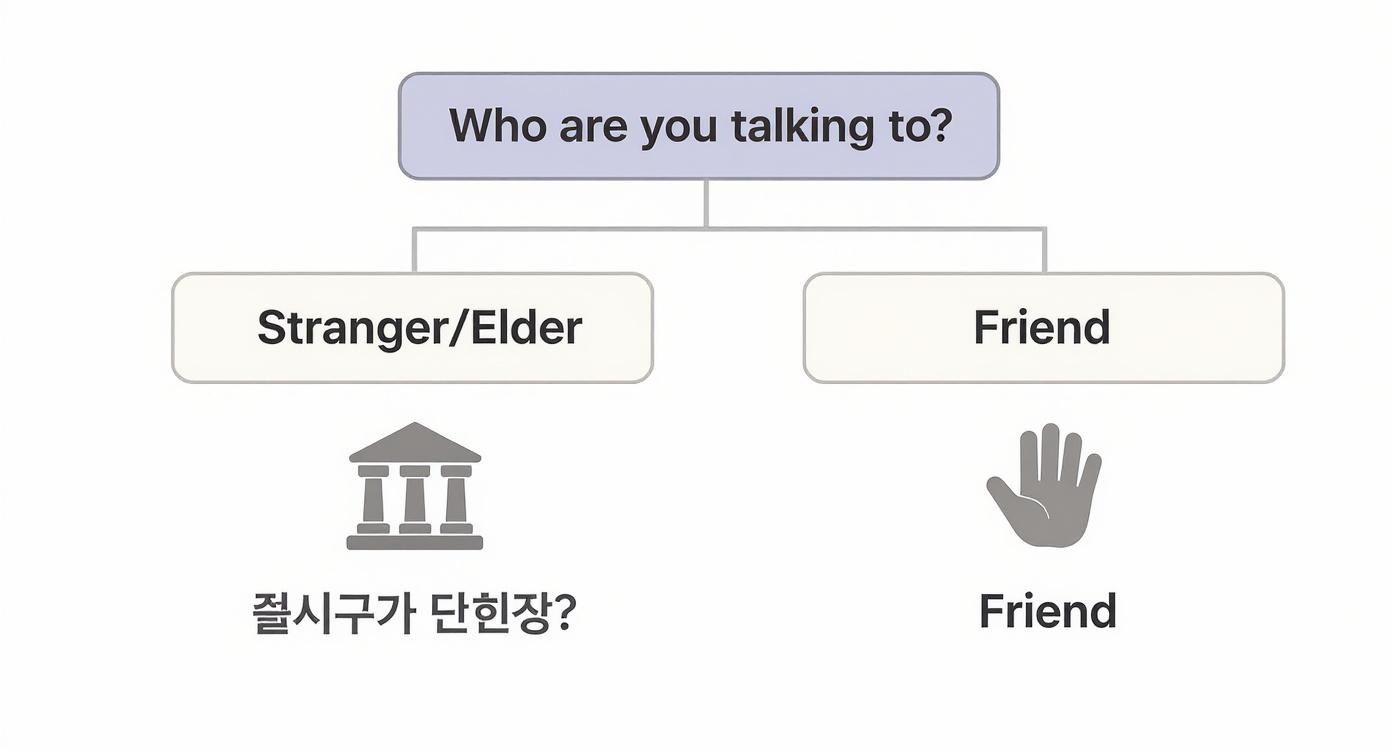
This distinction is deeply woven into Korean culture. In fact, reports show over 90% of South Koreans are conscious of these politeness levels. You can read more about Korean language reports to understand its cultural weight.
Key Takeaway: When in doubt, always use the formal Jondaetmal (존댓말). It’s a sign of respect, and it’s always better to be a little too polite than accidentally too casual.
The Most Common Ways to Ask "How Are You?"
Now that you understand formality, let's explore how Koreans actually check in with each other. While a direct translation exists, native speakers often use more natural, caring phrases that are deeply rooted in their culture.
For Polite and Formal Situations
These are your safest bets for most encounters, especially with people you don't know well.
- 안녕하세요? (Annyeonghaseyo?): This is the universal, all-purpose greeting. It means "hello," but it carries the same weight as a polite "How are you?" in English. You can never go wrong with this one.
- 잘 지내세요? (Jal jinaeseyo?): This is the most direct translation of "How are you?" and literally means "Are you living well?" Use this with elders, teachers, or someone you respect that you haven't seen in a little while.
- 어떻게 지내세요? (Eotteoke jinaeseyo?): This means "How have you been?" It’s perfect for reconnecting with someone you haven't seen for a few weeks or months. It invites a more detailed response.
For Casual and Friendly Check-ins
With close friends and family, the language becomes warmer and more direct.
- 밥 먹었어요? (Bap meogeosseoyo?): This is the ultimate sign of affection. It literally means, "Have you eaten?" but what it really means is, "Are you doing okay? I care about you." In a country where food security was once a major concern, this question became a way to check on someone's well-being. It's a beautiful expression of care.
- 잘 지내? (Jal jinae?): This is the casual, Banmal version of Jal jinaeseyo?. Reserve this for your close friends or people younger than you.
- 요즘 뭐해? (Yojeum mwohae?): A friendly, modern way to ask, "What have you been up to these days?" It's a great conversation starter to catch up on someone's current life, work, or hobbies.
How to Respond Like a Pro
Asking is one thing, but what do you say when someone asks you? Knowing a few simple responses will help you keep the conversation flowing smoothly. Remember to match the formality level of the question!
Quick Guide to Common Responses
This table breaks down the most useful replies, from feeling great to just being so-so.
| Korean Response | Romanization | English Meaning | Best Used When... |
|---|---|---|---|
| 네, 잘 지내요. | Ne, jal jinaeyo. | Yes, I am well. | The classic, polite response to Jal jinaeseyo? |
| 좋아요. | Joayo. | I'm good. | A friendly and positive reply for colleagues or acquaintances. |
| 그냥 그래요. | Geunyang geuraeyo. | I'm so-so / Just okay. | An honest and natural way to say you're having an average day. |
| 요즘 좀 바빠요. | Yojeum jom bappayo. | I've been a little busy these days. | A common and relatable response that can open up the conversation. |
After you answer, it's polite to ask them back! You can simply say their name followed by 씨는요? (ssi-neun-yo?), which means "And you, [Name]?" For example: "민준 씨는요?" (Minjun-ssi-neun-yo?).
Common Mistakes to Avoid
Every language learner makes mistakes—it's how we grow! But here are a few common slip-ups you can easily sidestep to avoid awkward moments.
- Using Banmal (Informal Speech) Too Soon: This is the biggest mistake. Greeting a new boss or an elder with a casual 잘 지내? (Jal jinae?) can come across as disrespectful. Always start with the formal Jondaetmal.
- Directly Translating "What's Up?": English slang like "What's up?" doesn't have a direct, natural-sounding equivalent in Korean greetings. Stick to culturally appropriate phrases like 밥 먹었어요? (Bap meogeosseoyo?) for that friendly vibe.
- Overusing "Jal Jinaeseyo?": Unlike the English "How are you?", this phrase isn't used every single day with the same person. It implies you haven't seen them in a while. For daily greetings, a simple, warm 안녕하세요? (Annyeonghaseyo?) is perfect.
Don’t worry if you make mistakes—even Koreans do sometimes! What matters most is that you're trying and learning.
Your Korean Journey Starts Now
Learning how to say how are you in Korean is so much more than memorizing phrases. It’s about understanding the heart of Korean culture—its deep respect for relationships and genuine care for others. By choosing the right words for the right person, you’re not just speaking a new language; you’re building real connections.
Every word you learn brings you one step closer to confidence. Keep practicing these greetings, listen to how native speakers use them, and don’t be afraid to try them out. Your Korean adventure is just beginning, and you’re already on the right path. Keep going!
🌟 Ready to start your Korean journey? Join Ktalk.live — where global learners connect, speak, and grow together! Sign up for free.
Ready to stop reading and start speaking?
Practice what you just learned with a native Korean teacher — free for 100 minutes. No card, no commitment.