Want to practice this with a native Korean teacher?
100-min free trial — no card required.
Have you ever wondered if you're saying "thank you" correctly in Korean? Learning a new language is an exciting adventure, and mastering simple yet powerful phrases like "thank you" is your first step toward connection. It’s more than just words; it’s a way to show respect and build genuine relationships.
Learning how to say thank you in Korean is essential because politeness is deeply embedded in the culture. Getting it right shows you care, and it opens doors to more meaningful conversations. With the global interest in Korean culture booming, there's never been a better time to start. South Korea's international student population has soared, hitting its target of 300,000 students two years early, which shows just how many people are diving into the language.
This guide will walk you through the different ways to express gratitude, from the most formal situations to casual chats with friends. Don’t worry if it seems like a lot at first—every word you learn brings you one step closer to confidence.

The Two Formal Ways: Gamsahamnida vs. Gomapseumnida
When you first dip your toes into Korean, you'll immediately find two very formal ways to say "thank you": 감사합니다 (gamsahamnida) and 고맙습니다 (gomapseumnida). For a beginner, they seem almost identical, and you can often use them interchangeably without any issues.
However, as you get more comfortable, you'll start to notice the subtle differences. It's a bit like choosing between "I appreciate it" and "Thank you so much" in English—both work, but one might feel more fitting depending on the situation. The real difference comes down to their origins.
- 감사합니다 (gamsahamnida) is based on the word 감사 (gamsa), which comes from Chinese characters (感謝). This gives it a more formal and official feel.
- 고맙습니다 (gomapseumnida) comes from the native Korean adjective 고맙다 (gomapda), meaning 'to be thankful'. Many native speakers feel it sounds a bit warmer and more personal.
This is why gamsahamnida is often the default choice in highly formal situations—think business presentations, public announcements, or when speaking to someone of high status. It’s the go-to for showing maximum respect.
So, Which One Should You Use?
While both are perfectly polite, let the context be your guide. Gomapseumnida tends to have a slightly softer, more personal touch. It’s what you might say to a teacher who offers extra help or an elder who kindly gives you their seat.
On the other hand, you'd almost certainly stick with gamsahamnida when addressing your company's CEO or giving a speech. It maintains a clear and respectful distance.
Key Takeaway: If you're ever unsure, gamsahamnida is the safest, most formal option. But when you want to add a bit more personal warmth, gomapseumnida is a fantastic choice.
Quick Comparison: Gamsahamnida vs. Gomapseumnida
Here’s a simple table to help you choose the right "thank you" at the right time.
| Feature | 감사합니다 (Gamsahamnida) | 고맙습니다 (Gomapseumnida) |
|---|---|---|
| Origin | Sino-Korean (from Chinese characters) | Pure/Native Korean |
| Formality | Highest level, very formal | High level, formal but slightly softer |
| Feeling | Official, respectful, sometimes impersonal | Sincere, warm, personal |
| Best Used | Business, public speaking, with high-status individuals | With respected elders, teachers, or in polite daily interactions |
Don't overthink it at the start. The fact that you're making an effort will always be appreciated. As you practice with tools like Ktalk.live, you’ll develop a natural feel for which phrase fits best.
Everyday Gratitude: Polite and Casual Forms
You've got the most formal ways to say thank you in Korean down. Great job! Now, let's explore how to express thanks in more relaxed, everyday situations. In Korea, choosing the right level of politeness shows that you understand and respect the social cues that are so important in the culture.
Let’s move one step down from the super-formal phrases we just covered.
The Everyday Polite "Thank You"
Meet 고마워요 (gomawoyo). This is your standard polite way to say thank you. It comes from the same pure Korean root as gomapseumnida but uses the 요 (yo) ending. This small syllable is a conversational marker for politeness, making it less stiff and more natural-sounding.
You can use gomawoyo almost anywhere and feel confident you're being appropriate:
- When a shopkeeper gives you your change.
- When a stranger holds a door open for you.
- When a colleague helps you with a small task.
It strikes a fantastic balance—friendly and warm, but still perfectly respectful. It's an absolute must-have for daily life.
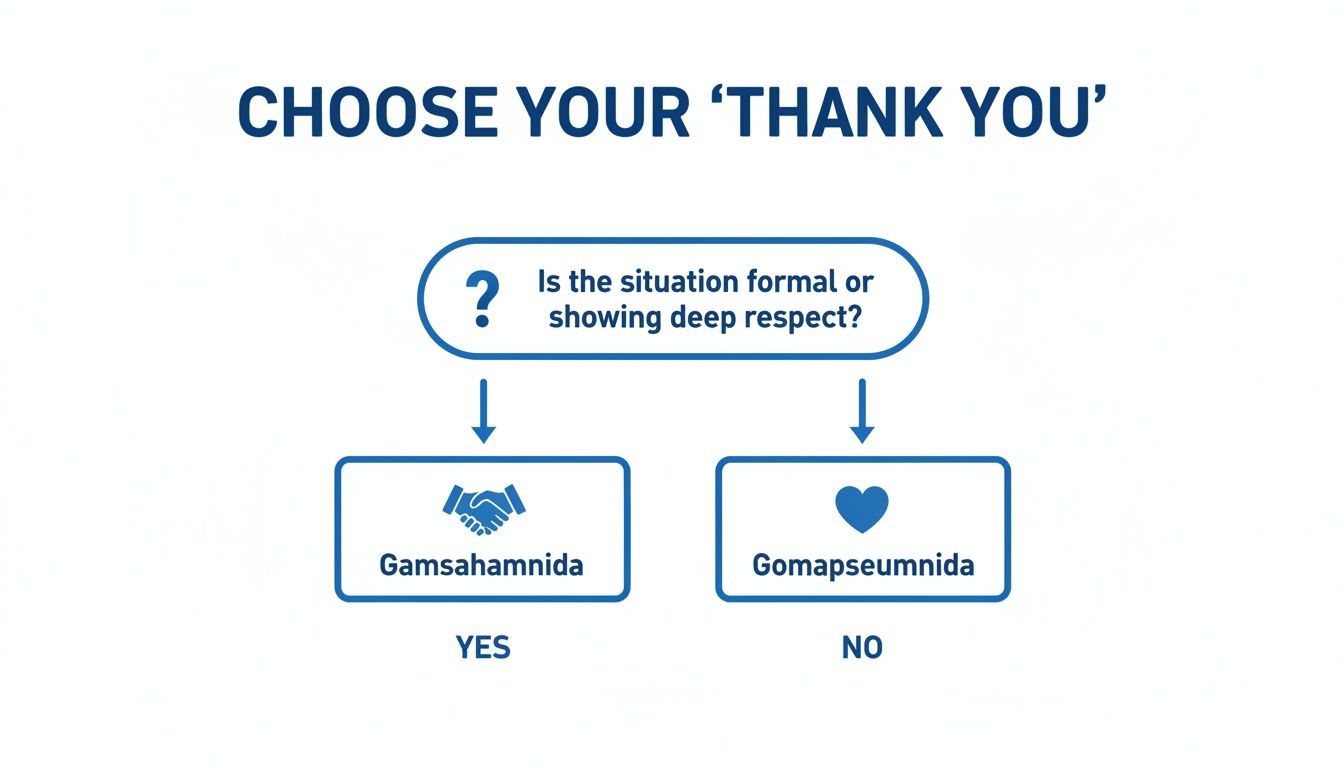
As you can see, your choice really depends on the social context and who you're talking to.
The Casual "Thanks" for Close Friends
Finally, we have the most casual version: 고마워 (gomawo). Save this one for people you're really close with—your best friends, siblings, or someone clearly younger than you. The key difference here is dropping the polite 요 (yo) ending, which shifts the phrase from polite to informal.
Crucial Tip: Be careful not to use gomawo with elders, strangers, or in any professional setting. Without the right relationship, it can sound rude because it ignores the social hierarchy.
Using gomawo signals a comfortable, established friendship. It’s what you’d say when your best friend grabs you a coffee.
Let's put this into practice:
Scenario 1: At the Office
Your boss praises your work.
✅ You say: 감사합니다. (Gamsahamnida.)
This shows respect to someone in a higher position.Scenario 2: At a Café
The barista hands you your latte.
✅ You say: 고마워요. (Gomawoyo.)
Perfectly polite and friendly for a daily interaction.Scenario 3: With a Friend
Your close friend helps you study.
✅ You say: 고마워! (Gomawo!)
This casual thanks is warm and shows your closeness.
Learning to switch between these levels shows a much deeper understanding of Korean culture. This ability to adapt helps you build better connections. At Ktalk.live, our small-group classes are the perfect place to practice these nuances.
Sounding More Natural: Beyond the Basics
You’ve got the essential ways to say thank you in Korean down pat. Fantastic! Now it's time to make your Korean sound even more natural and authentic.
Think about it—in English, we say more than just "thanks." We use phrases like "thanks a million" or "I really appreciate it." Adding these extra layers to your Korean will show people you've gone the extra mile.
Adding Sincerity to Your Thanks
Sometimes, a simple "thank you" isn't enough. For moments when you're truly touched, you can add emphasis with the word 정말 (jeongmal), which means 'really' or 'truly'.
Just place it right before your 'thank you' phrase:
- 정말 고맙습니다 (jeongmal gomapseumnida) - Thank you so much.
- 정말 고마워요 (jeongmal gomawoyo) - I'm really grateful.
Using 정말 (jeongmal) instantly adds a layer of sincerity that feels warm and personal.
How to Respond When Someone Thanks You
So, what happens when someone thanks you? Your textbook might suggest 천만에요 (cheonmaneyo) for "You're welcome," but you'll almost never hear this in a real conversation. It's very formal and a bit old-fashioned.
Instead, Koreans typically respond with more humble phrases. The most common one is 아니에요 (anieyo).
아니에요 (anieyo) literally means "it is not." In this context, it’s a gentle way of saying, "Oh, it was nothing" or "Don't mention it."
If you find yourself in a very formal setting, you might use 별말씀을요 (byeolmalsseumeullyo). This humble expression means, "Please don't say such things," suggesting the other person's thanks are unnecessary.
Gratitude in Specific Situations
Korean etiquette also has unique phrases for specific moments, especially around food. Before eating a meal someone has prepared for you, it's customary to say 잘 먹겠습니다 (jal meokgetseumnida).
This phrase translates to "I will eat well." It's a beautiful expression of appreciation that shows respect to your host or the chef.
Mastering these culturally specific phrases is a game-changer. The Korean language learning market is exploding, projected to grow from $7.54 billion in 2025 to an astounding $46.69 billion by 2035. For anyone interested in a career connected to Korea, these nuanced expressions are essential. You can read the full research about the Korean language learning market on fundamentalbusinessinsights.com.
More Than Words: The Importance of Body Language
In Korea, saying "thank you" often involves more than just words. Your body language—especially a bow—communicates a level of respect that words alone can't always capture. When you pair your words with the right physical gesture, your gratitude feels much more genuine.
The act of bowing, known as 인사 (insa), is woven into daily life for greetings, apologies, and showing thanks. When you say 감사합니다 (gamsahamnida) and add a bow, you’re completing the gesture and showing true humility.

Different Bows for Different Situations
Not all bows are the same. The depth of your bow changes depending on who you're talking to. Nailing this detail shows you've really taken the time to understand the culture.
Here are three main types of bows you'll use when saying thank you in Korean:
The Nod (목례 - mongnye): A quick, casual dip of the head at about a 15-degree angle. It's perfect for informal moments—like thanking a shopkeeper. This goes well with a simple 고마워요 (gomawoyo).
The Standard Bow (보통례 - botongnye): Your everyday formal bow, bending from the waist at roughly a 30 to 45-degree angle. This is the go-to bow when thanking a boss, teacher, or elder. It's the perfect companion to a formal 감사합니다 (gamsahamnida).
The Deep Bow (큰절 - keunjeol): Reserved for moments of profound respect or deep gratitude, this is a full 90-degree bow. You won't use this often; it’s typically seen during major holidays like Chuseok or in very formal ceremonies.
Cultural Insight: When you bow, let your gaze fall naturally downwards. Holding direct eye contact during a bow, especially with someone older, can seem confrontational.
Common Mistakes to Avoid
We all make mistakes when learning a new language—it’s part of the process! But when it comes to saying "thank you," a few common slip-ups can create awkward moments. Let’s walk through how to avoid them so you can express gratitude with confidence.
The biggest mistake beginners make is mixing up politeness levels. Using the informal 고마워 (gomawo) with an older person or your boss is a huge no-no. It can come across as rude because it ignores the social hierarchy built into the language.
A Simple Rule to Live By: When in doubt, always be formal. You can never go wrong with 감사합니다 (gamsahamnida). It's always better to be too polite than accidentally disrespectful.
Another common trap is translating English sayings directly. Phrases like "thanks a million" don't have a direct equivalent and will likely cause confusion. Instead, stick to authentic Korean expressions like 정말 고맙습니다 (jeongmal gomapseumnida).
Navigating Cultural Nuances
Understanding the culture behind the words is what truly makes a difference. This is especially true when responding to thanks.
As mentioned, the direct translation for "you're welcome," 천만에요 (cheonmaneyo), is rarely used. A more natural and humble response is 아니에요 (anieyo), which means 'it's nothing,' or even a simple 네 (ne), which works as a polite acknowledgement.
With the number of TOPIK test-takers soaring to 550,000, it's clear that more learners than ever are striving for genuine fluency. You can see the latest trends in Korean language proficiency on Korea.net. Getting these cultural details right is a massive step forward on your journey.
Your Questions Answered (FAQ)
Even after learning the basics, it's normal to have a few lingering questions. Let's tackle some of the most common ones so you can express your gratitude with complete confidence.
Can I Use Gamsahamnida and Gomapseumnida Interchangeably?
For the most part, yes. In daily polite situations, people will understand you perfectly. However, it's good to remember that 감사합니다 (gamsahamnida) feels slightly more formal and is the best choice for business settings. In contrast, 고맙습니다 (gomapseumnida) often comes across as a bit warmer and more personal.
What Is the Most Common Way to Say "You're Welcome"?
While your textbook might say 천만에요 (cheonmaneyo), you will rarely hear this in real conversations. The most natural and common response is 아니에요 (anieyo), which means "it's nothing." This is a humble and friendly way to acknowledge someone's thanks. Another common reply is a simple 네 (ne), which acts as a polite acknowledgement.
Is It Okay to Say "Kamsa" as a Shortcut?
You might see younger Koreans use 감사 (kamsa) in text messages. Think of it as the Korean equivalent of "thx." Because it's very casual slang, you should only use it with close friends your age or younger. For a casual but polite thank you, stick with the proper informal phrase, 고마워 (gomawo).
How Do I Write "Thank You" in Korean Hangul?
Getting comfortable with how these phrases look in Hangul is a huge step forward. Here are the key phrases written out:
- Formal: 감사합니다 (gamsahamnida)
- Standard Polite: 고마워요 (gomawoyo)
- Informal: 고마워 (gomawo)
Try practicing writing them. It helps build a deeper connection with the words and will make your learning journey much smoother.
Every word you learn brings you one step closer to confidence. By understanding not just what to say, but why you're saying it, you're well on your way to mastering the art of expressing thanks in Korean. Keep going—your journey is just beginning!
🌟 Ready to start your Korean journey? Join Ktalk.live — where global learners connect, speak, and grow together! https://ktalk.live
Ready to stop reading and start speaking?
Practice what you just learned with a native Korean teacher — free for 100 minutes. No card, no commitment.