Want to practice this with a native Korean teacher?
100-min free trial — no card required.
Have you ever wondered if you're saying "thank you" correctly in Korean? Learning to express gratitude is often the first step in any language journey, and in Korean, it's your key to unlocking polite and respectful conversations. The most important phrase to know is 감사합니다 (gamsahamnida). If you remember just one, make it this one! It’s your safest and most versatile option for almost any situation, perfect for when you're talking to strangers, elders, or anyone in a formal setting.
This guide is designed to help you master the art of saying thank you. We'll break down the different levels of formality and give you practical tips to get the thank you in Korean pronunciation just right. Don't worry if it seems tricky at first—every word you learn brings you one step closer to confidence!
The 3 Essential Ways to Say Thank You
Diving into Korean can feel like learning a new set of social rules, but expressing gratitude is straightforward once you get the hang of it. Politeness in Korean is all about who you're talking to. Think of it like the difference between saying "Thanks a bunch!" to a friend versus "I sincerely appreciate it" to your new boss.
As a beginner, you only need to know three core phrases to cover just about every situation:
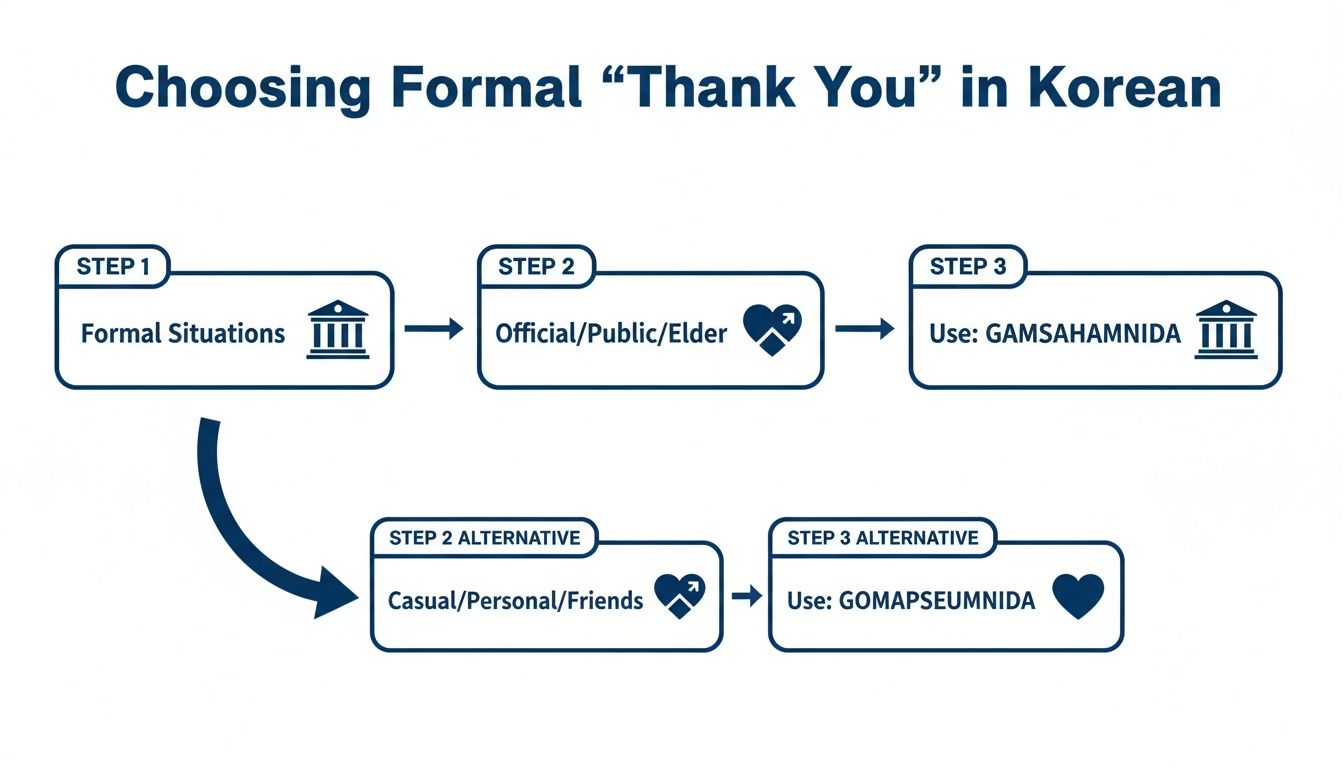
- Formal: For strangers, people older than you, and professional or service settings.
- Standard/Polite: A great middle-ground for people you know but aren't close with, like colleagues.
- Casual/Informal: Just for your close friends, younger siblings, and family.
This table is your quick-reference guide. Keep it handy as we dive deeper into the pronunciation and nuances of each phrase.
| Hangul (Korean Script) | Romanization | Simplified Pronunciation | Formality and When to Use |
|---|---|---|---|
| 감사합니다 | Gamsahamnida | gahm-sah-hahm-ni-da | Most Formal. Your go-to for elders, strangers, staff, teachers, and in professional settings. |
| 고맙습니다 | Gomapseumnida | go-map-seum-ni-da | Standard/Polite. Also formal, but feels a bit warmer. Use with colleagues or familiar adults. |
| 고마워 | Gomawo | go-mah-wo | Casual/Informal. Only for close friends, family, and people younger than you. |
Mastering these three will give you the confidence to show your appreciation in almost any context. Now, let's break down how to actually say them correctly.
Formal Gratitude: Gamsahamnida vs. Gomapseumnida
So, you've got two formal ways to say "thank you": 감사합니다 (gamsahamnida) and 고맙습니다 (gomapseumnida). On the surface, they seem interchangeable, and honestly, you can often use either without anyone batting an eye. But if you want to sound more like a seasoned speaker, it helps to know the subtle difference in feel between the two.
Gamsahamnida (감사합니다): The Go-To for Formal Settings
Gamsahamnida (감사합니다) is your most formal, all-purpose "thank you." It’s built from the Sino-Korean word 감사 (gamsa), which means "gratitude." Because of its origins, it carries a more official and respectful tone.
This makes it the perfect phrase for situations that call for a higher level of politeness:
- In professional settings: Think business meetings or when addressing a senior executive.
- With public officials: When thanking a police officer, a government employee, or a speaker at an event.
- When you're just not sure: If you're ever in doubt, gamsahamnida is always the safe, respectful bet. It shows you're making a conscious effort to be polite.
Gomapseumnida (고맙습니다): The Heartfelt Thank You
Now, let's talk about gomapseumnida (고맙습니다). This one comes from a native Korean root word, 고맙다 (gomapda), meaning "to be thankful." For this reason, many Koreans feel it has a warmer, more personal touch. It’s just as polite, but feels a little less stiff.
Gomapseumnida is an excellent choice when you want to express sincere gratitude in a polite context. For instance, you’d use it when a coworker goes out of their way to help you, or when an acquaintance gives you a thoughtful gift. Getting the thank you in Korean pronunciation right is crucial, but picking the word that fits the feeling of the moment takes your Korean to the next level.
How to Master Korean Pronunciation Step-by-Step
Perfecting your pronunciation of 'thank you' in Korean isn't about memorizing strange new sounds. It's about understanding how to make them. Think of it like learning a new dance move—it’s all about the mechanics. Let's break down the two main formal phrases, syllable by syllable.
Breaking Down Gamsahamnida (감사합니다)
This is probably the first "thank you" you'll learn. The secret to getting it right is to start slow to build that muscle memory.
- 감 (gam): This sounds a lot like the English word "calm," just starting with a 'g' sound.
- 사 (sa): Simple and clean. This is pronounced just like the 'sa' you hear in "salsa."
- 합 (ham): Here's the tricky part! Although it's written with a 'ㅂ' (bieup), it becomes a soft, unreleased 'p' sound. Imagine you're about to say "hop" but stop right as your lips close, without letting out that puff of air.
- 니 (ni): Pronounced exactly like the English word "knee."
- 다 (da): This sounds like the 'da' in "darling."
Put it all together: gahm-sah-hahp-ni-da. The most common hurdle for English speakers is that soft 'p' in the middle. Nail that, and you'll sound much more authentic.
Breaking Down Gomapseumnida (고맙습니다)
This phrase uses some of the same sound rules we just covered. Let's walk through it.
- 고 (go): Super simple. It's pronounced just like the English word "go."
- 맙 (map): Just like with '합' (hap), the final 'ㅂ' softens into a 'p' sound. This syllable should sound like the English word "mop."
- 습 (seum): Here it is again! The final 'ㅂ' softens. This syllable sounds like "seum," where the "eum" part is similar to the 'um' in "stadium."
- 니 (ni): Same as before, sounds just like "knee."
- 다 (da): And again, it's the 'da' from "darling."
The full phrase sounds like: go-map-seum-ni-da. Practice saying it slowly, focusing on closing your lips for those 'p' sounds without pushing out a hard puff of air. This mindful practice is what separates mimicking from genuine pronunciation.
Beyond Words: The Body Language of Gratitude
In Korea, saying "thank you" is often about more than just the words. Real gratitude is shown, not just spoken. Your body language gives your words weight and sincerity, so even a perfectly pronounced "thank you" can fall flat without the right gesture.

The most essential non-verbal cue is the bow. Think of it as a spectrum of gestures that signal different levels of respect.
- The Head Nod: A quick, slight tilt of your head. It's the most casual way to show thanks, perfect for a cashier or a close friend.
- The 30-Degree Bow: Your go-to respectful bow, bending from the waist. It’s standard for formal settings, like thanking a teacher or an elder. This bow pairs perfectly with 감사합니다 (gamsahamnida).
- The Deep Bow (45 Degrees+): Save this one for moments of deep gratitude or for a very sincere apology.
The depth of your bow is a direct signal of the respect you're showing. A deeper bow always communicates greater sincerity. Nailing this is just as important as mastering your thank you in Korean pronunciation.
Casual Thanks: How to Thank Your Friends
Hanging out with your friends and saying gamsahamnida? It’s going to sound a little stiff. That level of formality can create a weird sense of distance when you’re trying to be relaxed and comfortable.
This is where 고마워 (gomawo) comes in. Think of it as the casual "thanks" you'll use with the people you're closest to.
Pronounced go-mah-wo, it's perfect for when a friend grabs you a coffee or lends you a book. It’s warm, friendly, and signals a close relationship. Just remember, this one is strictly for your inner circle—close friends, family, and people younger than you. Saying it to an elder would come across as impolite.
A practical tip for showing gratitude among friends is to reciprocate. If a friend treats you to lunch, a natural Korean response is to promise to treat them next time. You'll often hear Koreans say, '다음에 내가 살게' (daeume naega salge), which means, "Next time, it's on me!" This shows gratitude in a way that keeps the friendship dynamic and balanced.
Conclusion
Mastering how to say "thank you" in Korean is more than just learning vocabulary—it's about understanding culture, showing respect, and building genuine connections. Whether you choose the formal 감사합니다 (gamsahamnida), the warm 고맙습니다 (gomapseumnida), or the friendly 고마워 (gomawo), each phrase is a step toward more confident communication.
Don’t worry if you make mistakes—even native speakers do sometimes! What matters most is your progress and your willingness to learn. Every word you learn brings you one step closer to fluency. Keep going—your Korean journey starts now!
🌟 Ready to start your Korean journey? Join Ktalk.live — where global learners connect, speak, and grow together! Book a free trial class and get real-time feedback from experienced tutors.
Ready to stop reading and start speaking?
Practice what you just learned with a native Korean teacher — free for 100 minutes. No card, no commitment.