Want to practice this with a native Korean teacher?
100-min free trial — no card required.
Ever felt that tiny bit of panic when you’re trying to be polite in a new language? If you're learning Korean, you might wonder, "What's the right way to say please in Korean?" It's a great question, because getting this right is your key to smooth, respectful conversations. The good news is, it's easier than you think! Learning how to say "please" correctly not only helps you get what you need but also shows you respect Korean culture.
This guide will walk you through the essential phrases, from everyday requests to more formal situations, so you can speak with confidence. Don’t worry if it seems like a lot at first—every word you learn is a step toward fluency. Let's dive in!
Your Go-To Phrase for Please in Korean
You know that little flutter of panic when you’re in a foreign country and need to ask for something? In Korean, that feeling often comes from worrying about politeness levels. But it doesn't have to be that stressful. For anyone starting out, the single most important word for 'please' is 주세요 (juseyo).
So, what makes this phrase so special? It's all in the grammar. Juseyo comes from the verb 주다 (juda), which means 'to give'. The polite ending -세요 (-seyo) is tacked on, transforming it into a respectful request. This simple combination is a perfect window into how politeness is built right into the Korean language, a topic you can dive deeper into by exploring Korea's linguistic and cultural profile.
Essentially, when you say "물 주세요" (mul juseyo), you're literally saying "water, give-politely," but it functions exactly like saying "water, please" in English. It's clear, it's respectful, and everyone will know what you mean.
Why Juseyo Is the Perfect Starting Point
If you're just dipping your toes into the Korean language, making juseyo your first priority is a brilliant move. It keeps things simple while making sure you always sound polite. Just stick it after any noun, and you've made a request.
Here’s why it works so well:
- It’s a true all-rounder: Use it at restaurants, cafés, shops, or even in a taxi.
- It’s safely polite: That -seyo ending shows respect, which is crucial when talking to elders or people you don't know.
- It’s easy to say: The pronunciation, joo-seh-yo, is pretty straightforward for most English speakers to pick up.
By getting comfortable with this one phrase, you open up a whole world of basic, confident communication. Think of it as the cornerstone for building a more refined understanding of all the ways to say please in Korean.
Understanding Why Formality Matters in Korean
If you've ever dipped your toes into learning Korean, you've probably noticed something curious: a simple English word like "please" seems to have a whole bunch of different translations. What gives? The answer gets right to the heart of Korean culture: formality and respect.
Think of it this way—you don't talk to your boss the same way you talk to your best friend, right? You naturally adjust your tone, word choice, and even your body language. Korean takes this a step further by weaving these social distinctions directly into the grammar. The language has different "levels" of speech.
This system of honorifics dictates the vocabulary and verb endings you choose based on who you're talking to. It all comes down to their age, social rank, and how close your relationship is. Getting this right isn't just about sounding smart; it's a fundamental way of showing you're socially aware and respectful.
The Korean language has been shaped by deep-seated social structures over centuries, and this politeness system is a direct result. With a literacy rate of about 99% for those over 15, the country has a very standardised approach to language education, meaning everyone learns the polite forms like 주세요 (juseyo) from the get-go. To get a better sense of this, you can read more about Korea's linguistic standards and see how deep these roots run.
Navigating Different Social Contexts
So, how do you pick the right "please"? Before you even speak, you have to do a quick mental check of the situation. Are you in a business meeting or just ordering a coffee? That context changes everything.
Here’s a simple breakdown:
- To Elders and Superiors: Always, always use polite or formal language. This is non-negotiable for teachers, your boss, older relatives, or anyone senior to you.
- To Strangers and Staff: Politeness is your best friend. When you're talking to a shopkeeper, a waiter, or just asking someone for directions, the polite forms are the safest and most appropriate choice.
- To Close Friends and Family: Once you're comfortable with people your age (or younger), you can relax and switch to more casual, informal language.
For most everyday requests, this little mental flowchart is all you need.
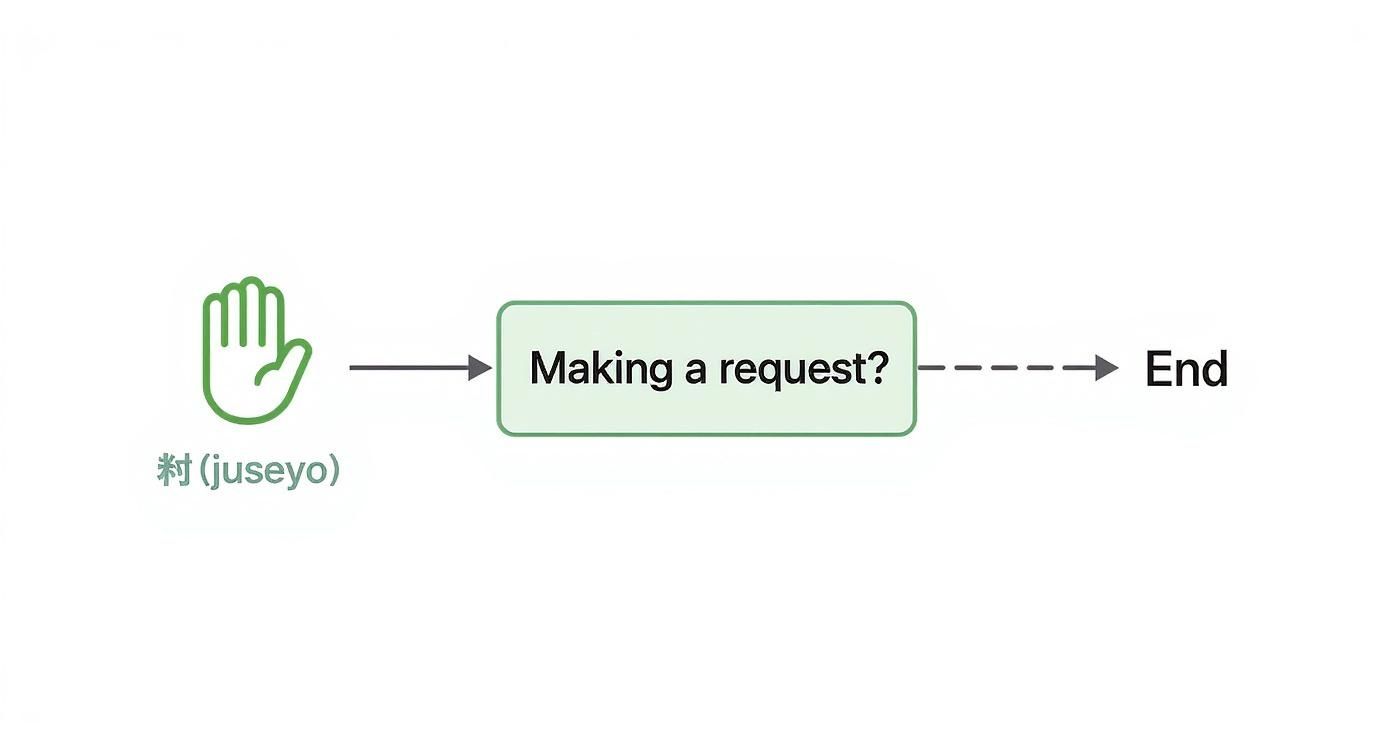
As you can see, when you're simply asking for something, the polite form is almost always the right answer.
Why Mastering Formality Is a Game Changer
I know, it sounds like a lot to remember. But trust me, getting a handle on these different levels of politeness is what will take your Korean from "textbook" to "natural." It shows people you've put in the effort to understand and respect their culture.
Using the right form helps you avoid common pitfalls, like accidentally sounding rude to an elder or coming off as weirdly stiff and formal with a close friend.
Don't stress about getting it perfect right away. Most Koreans are incredibly patient and forgiving with learners. The important thing is to be aware that these levels exist and to try your best. That effort alone will go a long way in helping you build genuine connections. Now that you have this foundation, we can dive into the specific phrases you'll use.
Getting to Grips with Juseyo for Everyday Requests
Now that we've touched on formality, let's zoom in on what will become your most-used phrase: 주세요 (juseyo). Think of this as your Swiss Army knife for making polite requests in Korea. It's incredibly versatile and will see you through countless daily situations, from ordering coffee to asking for help.
It’s the first version of "please" every Korean learner should master.
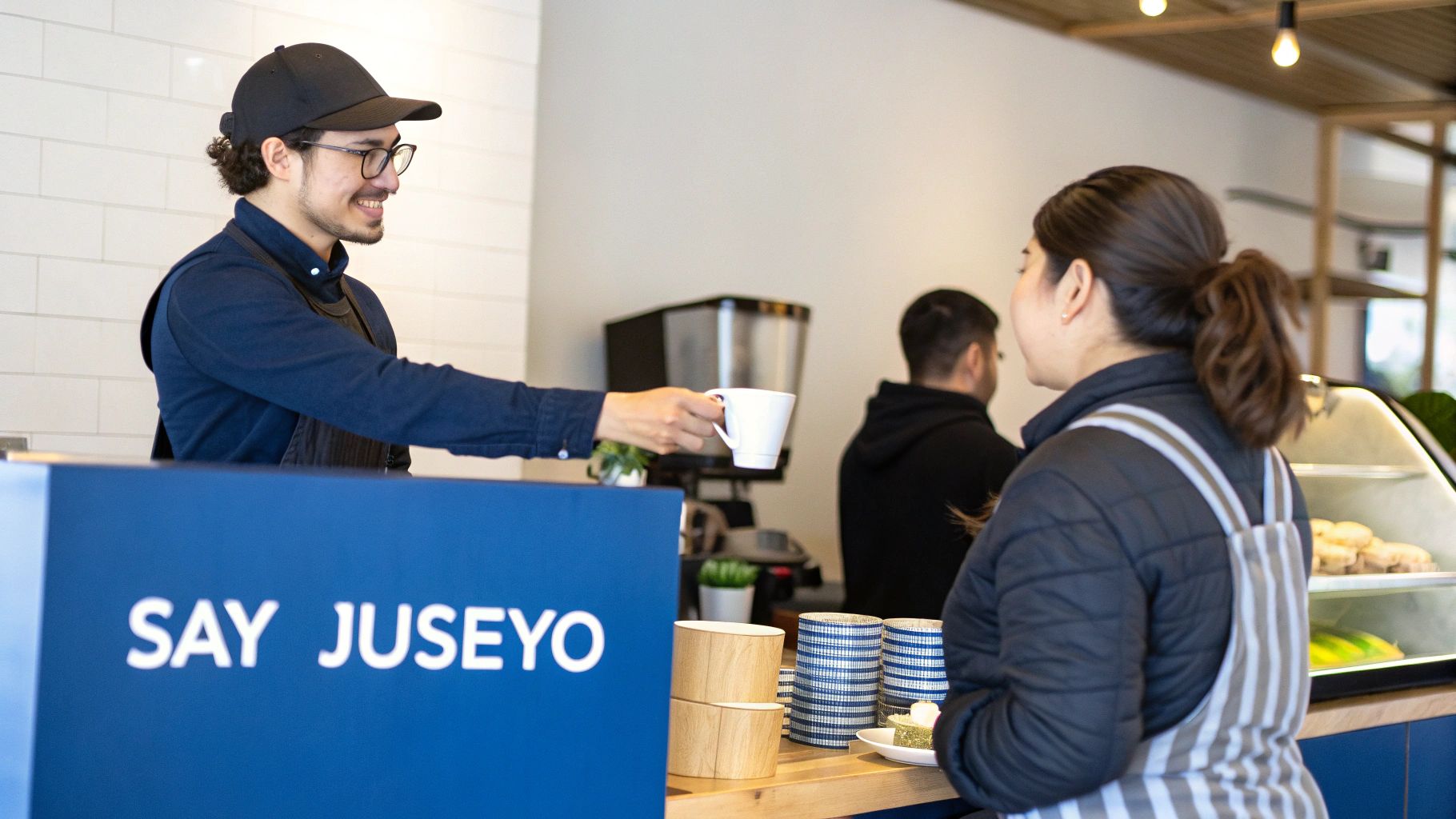
The real beauty of juseyo is its dual function. You can use it to ask for a physical item, and you can also use it to ask someone to do something for you. This flexibility is what makes it so powerful.
How to Ask for Things with Juseyo
This is probably the most common way you'll use please in Korean. The formula is wonderfully simple: just say the name of the item you want, followed by 주세요 (juseyo). It's a clear, polite, and direct way to ask for something.
Here are a few examples you'll likely use on day one:
- At a café: 커피 주세요. (Keopi juseyo.) — Coffee, please.
- At a restaurant: 물 주세요. (Mul juseyo.) — Water, please.
- While shopping: 영수증 주세요. (Yeongsujeung juseyo.) — Receipt, please.
Pro Tip: Seriously, don't overthink it. This (Noun + Juseyo) pattern is your golden ticket. Learn the Korean word for what you need, tack on juseyo, and you’re good to go.
How to Ask for Actions with Juseyo
Things get a little more interesting when you want to ask someone to do something for you. Here, juseyo attaches to a verb. The structure changes slightly, with the verb ending becoming -아/어 주세요 (-a/eo juseyo).
Let's take the verb "to help," which is 돕다 (dopda). To ask someone for help, you'd say 도와주세요 (dowajuseyo). It’s a lifesaver phrase for when you're feeling a bit lost or overwhelmed.
Here’s what that might look like in a conversation:
You (looking at a map): 저기요, 도와주세요. (Jeogiyo, dowajuseyo.) — Excuse me, please help.
A friendly local: 네, 무엇을 도와드릴까요? (Ne, mueoseul dowadeurilkkayo?) — Yes, how can I help you?
A Quick Note on Jusipsio
While you’ll be using juseyo 99% of the time, you might hear its more formal, slightly stiffer cousin: 주십시오 (jusipsio). This is the super-polite version, reserved for situations that demand a high level of formal respect.
You won't be using it with your friends or the local shopkeeper. Instead, you'll hear it in places like:
- Public announcements: Like on the subway or in a department store.
- Formal customer service: Think high-end hotels or airline staff.
- Military settings: Where strict hierarchies and formality are essential.
For all your day-to-day travels and chats, juseyo is perfect. It hits that sweet spot of being respectful without sounding like you're making a public broadcast. As you get more practice with resources like K-talk Live, you'll start to feel the difference instinctively.
Using Jebal for Urgent or Emotional Pleas
Here’s where a lot of learners get tripped up. While 제발 (jebal) also translates to 'please', it is absolutely not the word you want to use when ordering a coffee. Think of 제발 (jebal) as carrying a heavy emotional weight; it’s packed with urgency and desperation.
It’s the Korean equivalent of pleading, "Please, I'm begging you!" It’s dramatic, serious, and really only comes out when you're asking for a huge favour or find yourself in a really tight spot. If you use it for something casual, you’ll sound strangely intense.

Getting this distinction right is crucial if you want to sound natural. In fact, using jebal for a simple request is probably one of the most common—and most awkward—mistakes beginners make. It just leaves the other person feeling confused.
When Is It Appropriate to Use Jebal
So, when would you actually pull jebal out of your vocabulary toolkit? You’ll hear it all the time in K-dramas during those tense, emotional scenes, but it definitely has its place in real life, too.
Save jebal for moments of genuine desperation or when you're making a truly heartfelt plea. The focus here is on emotion, not just a simple transaction.
Here are a few scenarios where jebal would fit perfectly:
- A heartfelt plea: 제발, 한 번만 더 기회를 주세요. (Jebal, han beonman deo gihwereul juseyo.) — Please, give me just one more chance.
- Begging someone not to leave: 제발, 가지 마세요. (Jebal, gaji maseyo.) — Please, don't go.
- In a serious emergency: 제발, 도와주세요! (Jebal, dowajuseyo!) — Please, help me! (This implies true urgency, not just needing help with your shopping bags).
The key takeaway is simple: Juseyo is for items and favours; jebal is for feelings and emergencies. Stick to this rule, and you'll avoid one of the most common and awkward mix-ups in the Korean language.
Comparing Juseyo and Jebal
Let's draw a really clear line in the sand to make sure this difference sticks. Imagine you're at a friend's house and feeling a bit thirsty.
- You say: 물 주세요. (Mul juseyo.) — "Water, please."
- Meaning: This is a totally normal, polite request. Your friend goes and gets you a glass of water. No drama.
Now, picture the exact same situation, but this time you say:
- You say: 제발, 물 주세요. (Jebal, mul juseyo.) — "Please, I'm begging you, give me water."
- Meaning: This sounds like you've just crawled through a desert for three days and are on the verge of collapse. Your friend is going to be extremely confused and probably a bit worried about you.
Grasping this contrast is a huge step forward in your learning journey. It shows you're moving beyond just translating words and are starting to understand the cultural and emotional context behind them—a skill you can really sharpen with the interactive lessons over at Ktalk.live.
Navigating Formal Requests with 부탁합니다 (Butakhamnida)
When you're ordering a coffee or asking a friend to pass the salt, 주세요 (juseyo) is perfect. But step into a business meeting, a formal interview, or send a professional email, and you'll quickly find that juseyo doesn't quite have the weight you need. For these situations, you need a different kind of please in Korean.
Enter 부탁합니다 (butakhamnida). This isn't just a simple "please." Think of it more like, "I humbly make this request" or "I ask this of you." It carries a sense of gravity and respect that's essential in professional or formal settings, showing you understand the social etiquette required.
When Should You Use Butakhamnida?
Save this phrase for when the stakes are a bit higher than your daily latte. It’s not for casual requests; it’s for when you're asking for someone's time, effort, expertise, or cooperation in a more official capacity. Using it signals that you're taking the request, and the relationship, seriously.
Here are a few classic scenarios where 부탁합니다 (butakhamnida) is the perfect fit:
- Signing off a business email: It's a common and polite way to conclude an email where you've asked for a document, a review, or a meeting.
- Wrapping up a presentation: At the end of a pitch, you might use it to ask the audience for their positive consideration or support.
- Asking a colleague for a significant favour: When you need a coworker to help with a big project or a complex task, butakhamnida shows you appreciate the effort you're asking for.
One of the most useful phrases you'll learn is a variation of this:
잘 부탁합니다. (Jal butakhamnida.)
This is a wonderfully flexible expression. Depending on the context, it can mean "Please take good care of me," "I look forward to working with you," or "Please look upon my request favourably." You'll hear it constantly when meeting a new team or starting a new project.
A Slightly Softer Alternative: 부탁해요 (Butakaeyo)
Just like most Korean expressions, this one isn't a one-size-fits-all. If you find yourself in a situation that's professional but not rigidly formal, you can use the standard politeness form: 부탁해요 (butakaeyo).
Imagine you're asking a senior colleague, who you know fairly well, for a bit of help. 부탁해요 (butakaeyo) strikes the perfect balance. It’s still completely respectful, but it feels a little softer and more approachable than the very formal butakhamnida.
Adding 부탁합니다 (butakhamnida) to your Korean toolkit is a game-changer for navigating professional spaces. It demonstrates a much deeper grasp of cultural nuance and gives you the right words to make important requests with the respect they deserve. Getting comfortable with these nuances is something you can really hone through practice in structured environments, like the small-group classes at Ktalk.live.
Common Mistakes to Sidestep When Saying 'Please'
Getting the hang of the different ways to say please in Korean can feel a little like learning a secret handshake at first. But don't worry—a few common slip-ups trip up most learners, and knowing what they are will help you navigate conversations with a lot more confidence.
Let's walk through the most frequent mistakes so you can avoid those slightly awkward moments and sound more like a natural speaker from day one.
Mistake 1: Using 'Jebal' for Everything
This is, without a doubt, the number one mistake I see. Learners find out that 제발 (jebal) means "please," and they start using it everywhere—ordering a coffee, asking for a bag at the store, you name it. The problem is, this creates some seriously intense and confusing interactions.
The Wrong Way:
- At a café: 커피 제발 (Keopi jebal).
Why it's so strange: This sounds like you are desperately begging for coffee. Imagine clasping your hands together, a tear in your eye, pleading, "Coffee, I beg of you!" The barista would be completely bewildered.
The Right Way:
- At a café: 커피 주세요 (Keopi juseyo).
Why this works: This is the standard, polite way to ask for something. It’s your bread and butter for any kind of service situation, from restaurants to shops.
Think of it this way: 주세요 (juseyo) is for everyday requests. 제발 (jebal) is for desperate, emotional pleas. Keep those two lanes separate, and you've already cleared the biggest hurdle.
Mistake 2: Using 'Juseyo' When You Need to Be More Formal
While 주세요 (juseyo) is your trusty friend for most daily interactions, it can sound a bit too casual in a highly formal environment. If you're in a business meeting, giving a presentation, or making a formal request to a senior colleague, you'll want to level up your politeness.
The Wrong Way:
- At the end of a formal proposal email: 검토해주세요 (Geomtohaejuseyo) — "Please review it."
Why it misses the mark: It's not outright rude, but it lacks the weight and deep respect that a formal business setting requires. It can make you sound a little less professional than you intend.
The Right Way:
- Ending that same email with: 검토 부탁합니다 (Geomto butakhamnida).
Why this is better: 부탁합니다 (Butakhamnida) strikes the perfect tone of formal respect. It shifts your request from a simple "please do this" to a a more humble and professional "I would like to formally request your review."
Avoiding these two main pitfalls will make a huge difference in how you communicate. It shows you're not just learning words, but that you're also picking up on the important social cues behind them—a skill you can really sharpen in the interactive classes at Ktalk.live.
Fixing Common Mistakes with 'Please' in Korean
| Common Mistake | Why It's Incorrect | What to Say Instead |
|---|---|---|
| "물 제발 (Mul jebal)" when asking for water at a restaurant. | This sounds like you're in a desert, pleading for your life. It's far too dramatic for a simple request. | "물 좀 주세요 (Mul jom juseyo)" - This is a polite and standard way to ask for water. |
| Using "도와주세요 (Dowajuseyo)" in a formal business email asking for assistance. | It's a bit too informal and direct for a professional context. It sounds more like a personal cry for help. | "도움 부탁드립니다 (Doum butakdeurimnida)" - This is much more formal and respectful. |
| Saying "부탁합니다 (Butakhamnida)" to a close friend. | This is overly formal and creates distance. It would sound very strange and stiff between friends. | "부탁해 (Butakhae)" or "해줘 (Haejwo)" - This is the casual, friendly way to ask for a favour. |
| Asking a store clerk "이거 주십시오 (Igeo jusipsio)" for an item. | While extremely polite, -십시오 (sipsio) is usually reserved for public announcements or very formal speeches, not one-on-one service interactions. | "이거 주세요 (Igeo juseyo)" - This is the perfect level of politeness for shopping. |
Keep this little cheat sheet in mind as you practice. Catching these small but important distinctions is what will truly make your Korean sound natural and polished.
Your Korean 'Please' FAQ
You've made it this far! You've got the main phrases down, you understand formality, and you know which common mistakes to sidestep. But sometimes, a few specific questions still linger.
Let's run through a quick-fire round to tackle those last-minute queries and really lock in your understanding of how to say please in Korean.
What's the Most Casual Way to Say "Please"?
When you're hanging out with close friends, your partner, or someone younger, you can drop the polite -요 (-yo) ending. This is where things get really informal.
So, 주세요 (juseyo), which is for asking for an item, gets shortened to just 줘 (jwo). If you're thirsty and want to ask your buddy for a drink, a simple "물 줘" (mul jwo) is all you need. It’s direct and perfectly natural for those relaxed, close-knit relationships.
How Do I Add 'Juseyo' to Other Verbs?
Great question. You don't just stick 주세요 (juseyo) onto the end of any verb. Instead, you use a special grammar pattern: -아/어 주세요 (-a/eo juseyo). This attaches directly to the verb stem and turns it into a request for someone to do that action for you.
Here’s the rule: if the last vowel in the verb stem is ㅏ (a) or ㅗ (o), you use -아 주세요 (-a juseyo). For every other vowel, you'll use -어 주세요 (-eo juseyo).
Let's take the verb "to read," which is 읽다 (ikda). To ask someone, "Please read it," you'd combine it to make 읽어 주세요 (ilgeo juseyo). See how that works?
Is It Actually Rude to Forget to Say "Please" in Korea?
In a word, yes. Politeness is a huge part of Korean culture and social etiquette. Omitting a polite form like 주세요 (juseyo) when you’re talking to someone older, a stranger, or staff in a shop can definitely come across as abrupt or even disrespectful.
When in doubt, always err on the side of caution. It’s far better to be a little too polite than not polite enough.
Can I Just Tack 'Yo' Onto a Verb to Make a Request?
This is a classic learner mistake! Simply adding -요 (-yo) to a verb doesn't magically turn it into "please." All -요 (-yo) does is make a regular statement polite.
For instance, "읽어요" (ilgeoyo) just means "(I/you/they) read" in a polite way. It’s not a command or a request. To actually ask someone to read something for you, you absolutely need the -아/어 주세요 (-a/eo juseyo) structure we talked about earlier.
Learning to say please in Korean is about more than just one word; it’s about understanding the culture of respect behind the language. By mastering 주세요 (juseyo) for daily life, 제발 (jebal) for urgent pleas, and 부탁합니다 (butakhamnida) for formal situations, you’re well on your way to speaking Korean with nuance and confidence. Every polite request you make is a chance to practice and connect. Keep going—your Korean journey is just beginning!
🌟 Ready to put it all into practice? Join Ktalk.live — where global learners connect, speak, and grow together! Sign up for your free trial class today.
Ready to stop reading and start speaking?
Practice what you just learned with a native Korean teacher — free for 100 minutes. No card, no commitment.