Want to practice this with a native Korean teacher?
100-min free trial — no card required.
Ever wondered how to start a conversation in Korean? Learning how to say hi in Korean is your first and most important step. Think of 안녕하세요 (Annyeonghaseyo) as your golden key to unlocking Korean culture. This single phrase is your all-purpose tool for making a great first impression. It’s polite, respectful, and you can use it just about anywhere—from greeting a new colleague to ordering your morning coffee.
If you only learn one greeting, make it this one. It’s the perfect, safe-for-all-occasions way to start. In this guide, we'll walk you through the essential greetings, from the universally polite Annyeonghaseyo to the casual Annyeong for friends. We’ll also cover pronunciation, cultural tips, and when to use each phrase so you always sound natural and respectful.
Ready to take your first step? Let’s get started!
Annyeonghaseyo: Your All-Purpose Korean Greeting
If you only have time to learn one Korean greeting, make it 안녕하세요 (Annyeonghaseyo). This is the single most important, all-purpose phrase you can have in your pocket. Think of it as your Swiss Army knife for polite conversation in Korea—it works almost everywhere.
This is your go-to greeting for pretty much any situation. Meeting your new teacher? Check. Ordering a latte? Perfect. Greeting a store clerk or anyone older than you? Absolutely. It has a built-in level of respect that makes it the safest and most reliable choice whenever you're unsure about social dynamics. By mastering this one phrase, you're set for most of your daily interactions.
Breaking Down the Pronunciation
Let's sound it out together, piece by piece: An-nyeong-ha-se-yo.
- 안 (An): Sounds like "ahn," as in the start of "ahn-dante."
- 녕 (nyeong): This is one fluid sound. Imagine the "nyon" in "canyon" but with a soft 'g' at the end.
- 하 (ha): Simple! Just like a "ha" in English.
- 세 (se): Sounds just like the English word "say."
- 요 (yo): Exactly like saying "yo."
Put it all together in a smooth flow: Ahn-nyong-ha-say-yo. For a little extra flair that makes you sound more natural, add a slight, friendly lift in your tone on that final "yo."
The global rise of Korean culture has sparked a huge wave of interest in learning the language. In fact, the market for Korean language learning has grown to over USD 7.2 billion and is still expanding. You can learn more about this boom on GMI Insights. This shows how many people are discovering the joy of connecting with Korean culture through its language.
This simple decision tree is a great visual guide for picking the right greeting.
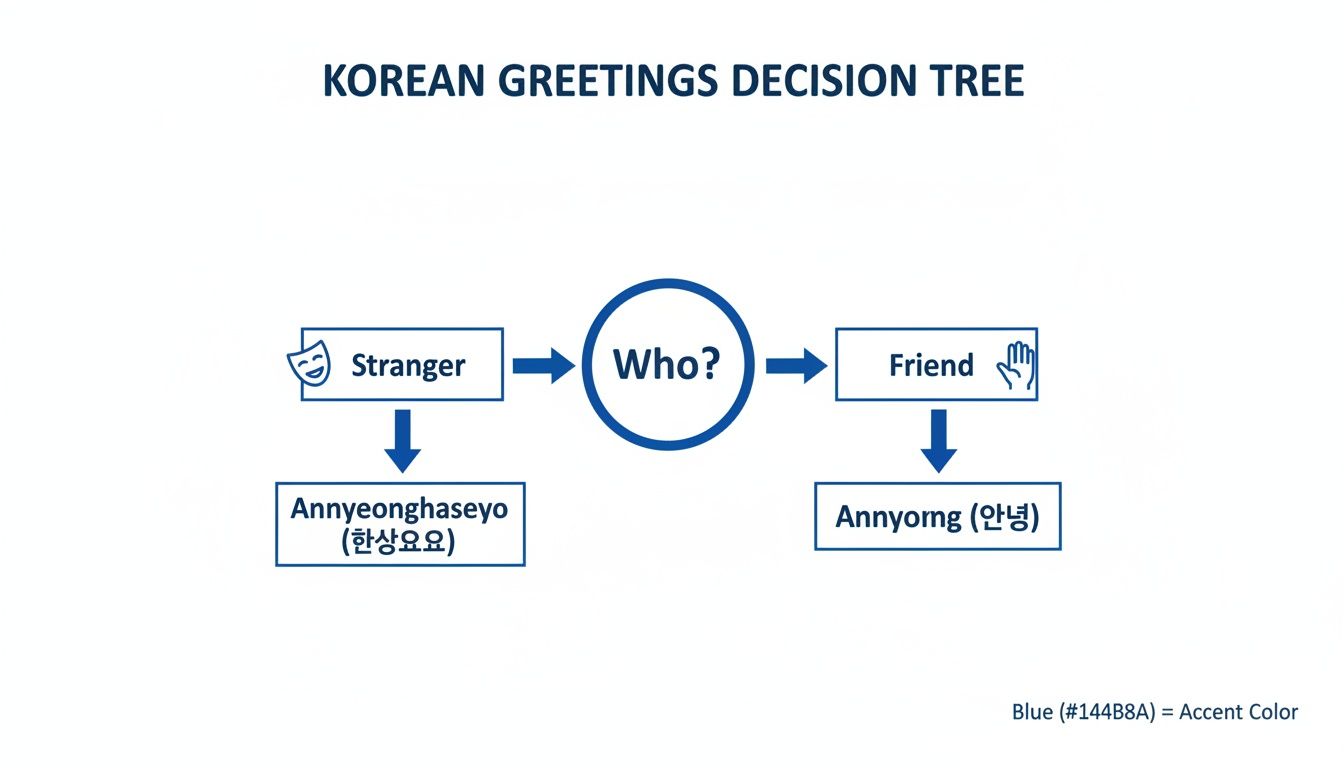
As you can see, Annyeonghaseyo is your trusty default for anyone you don't know well, while the more casual Annyeong is saved for close friends.
The Bow: An Essential Sign of Respect
When you say hi in Korean, the words are often just one part of the greeting. The bow is a non-verbal gesture that's vital for showing respect.
For a standard, polite greeting like Annyeonghaseyo, a simple, clean nod of the head while you say it is all you need. It’s a small detail, but it shows you understand and respect the culture, making your hello feel much more genuine.
Annyeong: The Casual "Hi" for Friends
Okay, you've mastered the standard polite greeting. Now it's time to learn how to talk to your friends like a local. For those casual, everyday moments, all you need is 안녕 (Annyeong). It's short, sweet, and perfect for the right company.
Think of Annyeong as the Korean version of saying a quick "hey" or "what's up?" to someone you know well. It instantly sets a warm, friendly tone. You’ll hear it everywhere—in K-dramas, between students, and any time friends get together.
When to Use Annyeong (and When Not To)
Understanding a bit of Korean culture is super important here. Using Annyeong in the wrong situation can feel a little jarring or even disrespectful, so you want to get the timing right.
It’s your go-to greeting for:
- Close friends and people you’re really comfortable with.
- Classmates or coworkers who are the same age as you.
- Anyone who is younger than you.
- Someone who has told you it's okay to speak casually (반말/banmal) with them.
Cultural Tip: When in doubt, always start with the more formal Annyeonghaseyo. If the other person replies with a simple Annyeong, that's usually your green light to switch to more casual language.
Knowing when not to use Annyeong is just as crucial. You'd never use it with elders, your boss, teachers, or strangers. For example, greeting a shop owner with a quick Annyeong would come across as quite impolite. In those cases, sticking with Annyeonghaseyo shows that you're being respectful.
Here's a fun fact: Annyeong is a handy multi-purpose word. Much like "ciao" in Italian, you can use it to say both "hello" and "goodbye" to your friends. It’s a versatile little word you'll use all the time.
Annyeonghasimnikka: The Most Formal Greeting
Sometimes, you need to show the highest level of respect. This is where 안녕하십니까 (Annyeonghasimnikka) comes into play. Think of it as the black-tie tuxedo of Korean greetings—you save it for those really important, high-stakes moments.
This is the most formal way to say hi in Korean. You won't use it to greet a cashier, but it’s absolutely essential for a job interview, a major business presentation, or when speaking to someone of very high status.
Nailing this greeting shows you've done your homework and have a real grasp of Korean social etiquette. It sends a clear message: "I understand the importance of this situation and I have immense respect for you."
Understanding Formal Speech Levels
What makes Annyeonghasimnikka so much more formal than Annyeonghaseyo? It all comes down to the final syllable.
The -simnikka (습니다/ㅂ니까) ending belongs to the hasipsio (하십시오체) speech level, which is the highest rung on the ladder of politeness in Korean. It instantly elevates your greeting from everyday polite to exceptionally respectful.
- 안녕하세요 (Annyeonghaseyo): Your go-to for most daily interactions where politeness is needed.
- 안녕하십니까 (Annyeonghasimnikka): Reserved for official occasions and highly formal settings.
This distinction is crucial in the professional world. South Korea is a huge draw for international talent, with over 305,000 foreign students studying in the country, many of whom stay for their careers. You can read more about this on ICEC Monitor.
For anyone navigating the Korean workplace, knowing when to use Annyeonghasimnikka is a game-changer. It's almost always accompanied by a deep, 45-degree bow, reinforcing the gesture of deep respect.
Greetings for Specific Times and Situations
Once you've got the basics down, you can add nuance to your greetings. Using the right phrase for the right situation is a surefire way to sound more like a native speaker. It makes your Korean feel much more natural and shows you're paying attention to context.
Answering the Phone
If you’ve ever watched a K-drama, you've definitely heard this one. 여보세요 (Yeoboseyo) is the go-to phrase for answering the phone in Korea.
Think of it exactly like saying "Hello?" when you pick up a call. It's the standard way to kick off a phone conversation, whether you're calling your best friend or receiving a call from an unknown number.
Is There a Korean "Good Morning"?
Technically, yes. The direct translation is 좋은 아침 (Jo-eun achim).
But here’s the thing: in day-to-day conversation, most Koreans just stick with the versatile 안녕하세요 (Annyeonghaseyo). While you might hear Jo-eun achim between close friends or see it in writing, it's not nearly as common as its English counterpart. Annyeonghaseyo works perfectly fine, even at 8 AM.
Pro Tip: When in doubt, just use Annyeonghaseyo in the morning. It's always a safe, polite, and natural choice that shows you understand Korean social etiquette.
Let's quickly recap these situational phrases:
여보세요 (Yeoboseyo)
- Pronunciation: Yuh-boh-say-yo
- When to Use: Only when on the telephone. You'd never use this to greet someone face-to-face.
좋은 아침 (Jo-eun achim)
- Pronunciation: Joh-eun ah-chim
- When to Use: A casual "good morning" best saved for people you know well. It’s not wrong, just less common than the standard greeting.
Getting these little details right is what will elevate your Korean. It shows you’re not just memorizing words, but that you're picking up on the cultural context, too.
Quick Guide to Korean Greeting Etiquette
Knowing how to say hi in Korean is more than just memorizing words. It's about showing respect through your actions. The culture behind the greeting is just as important as the phrase itself, and getting this right will make your interactions feel much more genuine.
When it comes to non-verbal cues, the bow is king. In most daily situations, a simple nod of the head while saying Annyeonghaseyo is all you need to show respect. This small gesture instantly shows that you appreciate and understand Korean customs.
Common Etiquette Mistakes to Avoid
For new learners, a few common slip-ups can create awkward moments. Keep these in mind to make a fantastic first impression.
- Using Informal Language with Elders: This is a big one. Never use the casual Annyeong with someone older than you, a teacher, or a store owner. Always stick with Annyeonghaseyo.
- A One-Handed Handshake: In business settings, a handshake might accompany a bow. Always offer your right hand, and gently support it with your left hand at the wrist or forearm.
- Forgetting to Bow: Even a slight nod makes a huge difference. Skipping the gesture can make your greeting feel a little cold or incomplete.
Interest in Korean culture is exploding worldwide. In the United States, language-learning apps saw a 22% jump in users studying Korean, and college enrolments for Korean courses showed the highest growth rate of any foreign language at 38%. You can read more about this trend on Chosun.com.
By paying attention to these cultural details, your greetings will carry so much more meaning.
Frequently Asked Questions
As you start using your new Korean greetings, you're bound to have a few questions. Let's clear up some of the most common sticking points for new learners so you can speak with more confidence.
Can I just use Annyeonghaseyo all the time?
Absolutely. When in doubt, 안녕하세요 (Annyeonghaseyo) is your go-to greeting. It’s always a safe, polite, and respectful choice for anyone you don't know well, someone older than you, or in any formal setting. While the casual 안녕 (Annyeong) is just for close friends, Annyeonghaseyo is never wrong.
How important is bowing when I say hi?
It's very important! Bowing adds a layer of sincerity to your greeting and shows respect for Korean culture. For most day-to-day situations, a simple, slight nod of the head as you say Annyeonghaseyo is perfect. A deeper bow is reserved for showing high respect to elders or in formal business meetings.
Can I use Annyeong to say goodbye?
Yes, you can! The casual greeting 안녕 (Annyeong) is like "ciao" in Italian—it works for both "hello" and "goodbye" among close friends. Just remember to keep it casual!
Your Korean Journey Starts Now
Learning to say "hi" is the first step on an exciting adventure into a new language and culture. Each greeting you master, from the polite Annyeonghaseyo to the friendly Annyeong, builds your confidence and opens doors to new connections. Don’t worry about being perfect; what matters most is your willingness to try. Every word you learn brings you one step closer to fluency. Keep going—your Korean journey starts now!
🌟 Ready to start your Korean journey? Join Ktalk.live — where global learners connect, speak, and grow together
Ready to stop reading and start speaking?
Practice what you just learned with a native Korean teacher — free for 100 minutes. No card, no commitment.