
Want to practice this with a native Korean teacher?
100-min free trial — no card required.
Ready to make a great first impression in Korean? Let's get straight to it.
The most straightforward way to introduce yourself is with three key phrases: 안녕하세요 (Annyeonghaseyo), followed by 제 이름은 [Your Name]입니다 (Je ireumeun [Your Name]-imnida), and finishing with 만나서 반갑습니다 (Mannaseo bangapseumnida).
This simple script handles your "hello," "my name is," and "nice to meet you" all in one go. It's polite, standard, and a perfectly safe bet for any first meeting.
Your First Korean Introduction In 60 Seconds

We're going to dive right into the practical stuff you can use today. The goal isn’t to drown you in grammar but to arm you with a confident, clear, and culturally on-point introduction. Think of this as your essential toolkit, whether you're meeting a new friend, joining a language exchange, or just trying to order a coffee in Seoul.
Let's break down the three most important phrases. Get these down, and you’ll make that first interaction a positive one.
The Core Phrases
You can build your entire introduction on just three foundational sentences. Here’s a closer look at each one.
Greeting "Hello": The most versatile greeting you'll ever need is 안녕하세요 (Annyeonghaseyo). It’s polite, friendly, and works in just about any situation, from casual meet-ups to more formal settings.
Stating Your Name: To share your name, the phrase is 제 이름은 [Your Name]입니다 (Je ireumeun [Your Name]-imnida). You just slot your name right into the middle. For example, "제 이름은 Alex입니다" (Je ireumeun Alex-imnida). This is the formal, respectful way to do it.
Saying "Nice to Meet You": The perfect way to close your intro is with a warm 만나서 반갑습니다 (Mannaseo bangapseumnida). It translates to "It is nice to meet you" and shows you’re polite and happy to be there.
These three phrases create a complete and respectful self-introduction. Before you start worrying about adding your job or nationality, commit these to memory. This is your most important first step.
Key Takeaway: When meeting someone for the first time in Korea, always start with polite or formal language. Sticking with 안녕하세요 (Annyeonghaseyo) and sentences ending in -입니다 (-imnida) is always a safe and respectful choice.
Here's a quick reference table to help you get these phrases down. Keep an eye on the romanisation to help with your pronunciation. Notice these are all "Standard Polite," which makes them perfect for those initial encounters.
Essential Korean Introduction Phrases
| English Phrase | Korean (Hangul) | Romanization | Formality Level |
|---|---|---|---|
| Hello | 안녕하세요 | Annyeonghaseyo | Standard Polite |
| My name is... | 제 이름은 ...입니다 | Je ireumeun ...imnida | Formal |
| Nice to meet you | 만나서 반갑습니다 | Mannaseo bangapseumnida | Standard Polite |
With these three phrases in your back pocket, you're more than ready to handle your first Korean introduction with confidence.
Building Your Core Introduction Phrases
Okay, you’ve nailed the greetings. Now, let's give your introduction some real substance.
Moving beyond a simple "hello" is how you turn a brief exchange into a genuine conversation. This is where you share a little about who you are—where you're from, what you do. It's surprisingly easy. In Korean, it often just means tacking the right ending onto a noun.
The two workhorse endings you'll use constantly are -입니다 (-imnida) and -이에요/-예요 (-ieyo/-yeyo).
The Two Most Important Sentence Endings
Think of these endings as different tools for different social settings. Picking the right one is key to sounding natural and showing the proper respect.
-입니다 (-imnida): This is your go-to formal ending. You'll pull this one out in professional settings, when speaking to your boss, or addressing someone much older than you. When in doubt, -입니다 is always the safest bet.
-이에요/-예요 (-ieyo/-yeyo): This is the standard polite ending you'll hear everywhere. It strikes the perfect balance between friendly and respectful, making it perfect for most daily interactions—from meeting new people to chatting with a shopkeeper.
So what's the deal with -이에요 (-ieyo) versus -예요 (-yeyo)? The rule is beautifully simple and depends entirely on how the previous word ends.
- If the noun ends in a consonant, you’ll use -이에요 (-ieyo).
- If the noun ends in a vowel, you’ll use -예요 (-yeyo).
Let's see how this works. The word for student is 학생 (haksaeng). It ends with the consonant sound 'ㅇ' (ng), so you'd say 학생이에요 (haksaeng-ieyo). On the other hand, the word for singer, 가수 (gasu), ends with the vowel 'ㅜ' (u), so you'd say 가수예요 (gasu-yeyo).
In South Korea, introducing yourself involves understanding and using the unique honorific and polite language structures deeply embedded in Korean culture. For instance, the most common polite forms for saying "I am" in a self-introduction are '-imnida' and '-yeyo/-ieyo,' which are attached to the noun describing one's occupation or status. A key phrase is '학생이에요' (haksaeng-ieyo), meaning "I am a student." This construction showcases not just linguistic grammar but reflects social hierarchy and respect, essential cultural elements. Discover more insights on Korean introductions at Go! Go! Hanguk.
Stating Your Nationality
One of the first things new acquaintances might be curious about is where you're from. The formula is simple: take your country's name and add the word 사람 (saram), which means "person."
For instance:
- 미국 (miguk) = America
- 미국 사람 (miguk saram) = American person
Then you just pop your chosen sentence ending on the back.
- Formal: 저는 미국 사람입니다 (Jeoneun miguk saram-imnida).
- Standard Polite: 저는 미국 사람이에요 (Jeoneun miguk saram-ieyo).
Here’s a quick table to help you build your own sentence on the fly.
| Country (English) | Country (Korean) | Nationality Phrase (Hangul) |
|---|---|---|
| Canada | 캐나다 (kaenada) | 캐나다 사람 (kaenada saram) |
| United Kingdom | 영국 (yeongguk) | 영국 사람 (yeongguk saram) |
| Australia | 호주 (hoju) | 호주 사람 (hoju saram) |
| Germany | 독일 (dogil) | 독일 사람 (dogil saram) |
| Philippines | 필리핀 (pillipin) | 필리핀 사람 (pillipin saram) |
Just find your country, add 사람 (saram), and finish it off with 입니다 (imnida) or 이에요 (ieyo). It’s a straightforward way to cover a key part of learning how to introduce yourself in Korean.
Talking About Your Profession
Next up is what you do for a living. The pattern here is exactly the same as for your nationality. You simply state your job title and add the right ending.
The structure is: 저는 [Your Job]입니다/이에요/예요 (Jeoneun [Your Job]-imnida/ieyo/yeyo).
Let's run through a few common examples.
For a Student
- The word is 학생 (haksaeng). That ends in a consonant.
- Standard Polite: 저는 학생이에요 (Jeoneun haksaeng-ieyo).
For a Teacher
- The word is 선생님 (seonsaengnim), which also ends in a consonant.
- Formal: 저는 선생님입니다 (Jeoneun seonsaengnim-imnida).
For a Company Employee
- A very common term is 회사원 (hoesawon). Yep, another consonant.
- Standard Polite: 저는 회사원이에요 (Jeoneun hoesawon-ieyo).
For a Freelancer
- The word is 프리랜서 (peuriraenseo). This one ends in a vowel.
- Standard Polite: 저는 프리랜서예요 (Jeoneun peuriraenseo-yeyo).
See? By just learning a handful of nouns for countries and jobs, you've massively expanded what you can say. You've gone from just a name to sharing real details about yourself, making that first conversation in Korean so much more interesting.
Navigating Korean Politeness and Culture
Getting the words right is just the start. To truly nail your Korean introduction, you need to understand the culture of respect that underpins every conversation. Without this context, even a perfect sentence can come across as awkward or, even worse, disrespectful.
Korean society places a huge emphasis on social hierarchy, which is mostly determined by age and status. This isn't just a background concept; it's baked right into the language. The way you speak to an elder, a boss, or someone you’ve just met is completely different from how you’d chat with a close friend.
This is where you'll run into 존댓말 (jondaetmal) and 반말 (banmal). Getting this right is the secret to making a fantastic first impression.
Understanding Jondaetmal and Banmal
Think of 존댓말 (jondaetmal) as your default mode. It’s the polite, standard speech you'll use with strangers, people older than you, and anyone in a position of authority, like a teacher or manager. The endings we've already covered, -입니다 (-imnida) and -이에요/-예요 (-ieyo/-yeyo), are your go-to jondaetmal forms.
Then there’s 반말 (banmal), the informal or casual way of speaking. This is reserved for your close friends, people your age (after you've both agreed to it), and those younger than you. Jumping into banmal without permission is a big no-no and can make you seem rude.
Crucial Tip: When in doubt, always use jondaetmal. It's much better to be a little too polite than accidentally disrespectful. A native speaker will never mind you using polite language, but using casual speech at the wrong time can create real awkwardness.
Switching from jondaetmal to banmal is a sign that a relationship is getting closer. It's a mutual step, usually started by the older person who might ask, "Can we speak comfortably?" (말 편하게 해도 돼요?). Until you get that green light, stick with the polite forms.
To help you get the polite endings right every time, here’s a quick guide for choosing between -yeyo and -ieyo.
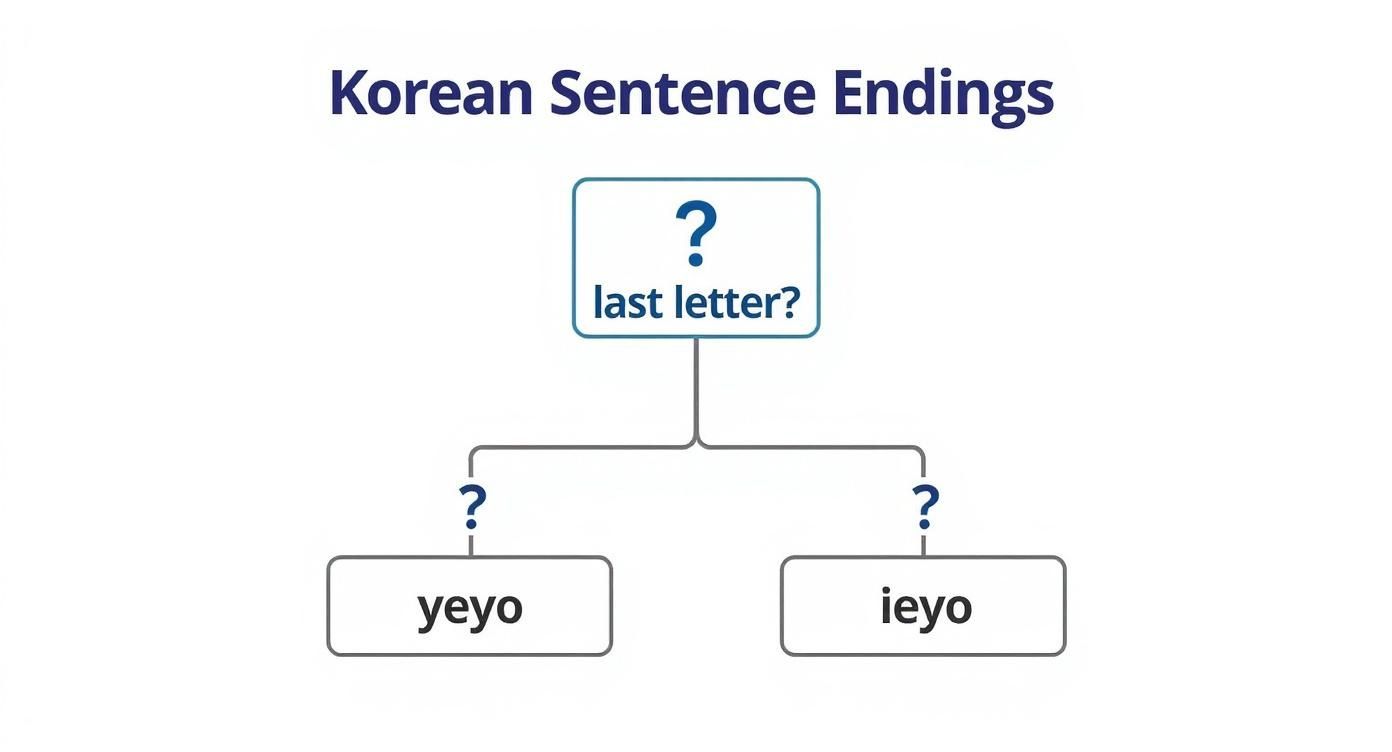
This little cheat sheet takes the guesswork out of the grammar so you can focus on making a great impression.
Korean Politeness Levels for Introductions
The politeness level you choose will change depending on who you're talking to. This table breaks down the three main speech styles you'll encounter.
| Formality Level | Key Characteristics | When to Use | Example Ending |
|---|---|---|---|
| Formal (하십시오체) | Most polite and respectful. Often used in public announcements, presentations, and news broadcasts. | Speaking to a large audience, in military settings, or in extremely formal business situations. | -입니다 (-imnida) |
| Standard (해요체) | Polite but conversational. The most common style for everyday interactions with adults you don't know well. | Meeting new people, speaking with colleagues, interacting with store staff, talking to older people. | -이에요/-예요 (-ieyo/-yeyo) |
| Informal (해체) | Casual and friendly. Used between people who have a close relationship. | Talking with close friends, siblings, or people who are younger than you. | -이야/-야 (-iya/-ya) |
As you can see, the Standard (해요체) style is your safest and most versatile option for introductions, striking the perfect balance between respect and friendliness.
Non-Verbal Communication is Key
Your body language can say just as much as your words. In Korea, a respectful introduction almost always includes a bow. The depth of your bow shows your level of respect.
- For Peers or Casual Encounters: A simple, quick nod of the head is all you need.
- For Elders or Formal Settings: A deeper bow from the waist, about 45 degrees, shows humility and high respect.
Handshakes are also common, especially in business. When you shake hands, use your right hand and gently support your right wrist or forearm with your left hand. It's a small gesture that signals a great deal of respect.
These cultural details aren’t just pointless formalities. They show you're considerate and aware. The Korean language, Hangul, was famously created in 1443 to be easy and logical, making it quite straightforward to learn key phrases. You can learn more about the nuances of Korean culture from resources like Commisceo Global.
By blending the right words with the right actions, you prove you've done more than just memorise a few lines—you’ve made an effort to understand the culture. That thoughtfulness will go a long way in helping you build real connections.
Adding Personality to Your Introduction
Alright, you've nailed the basics of a polite Korean introduction. Now for the fun part: moving beyond the script and actually letting your personality show. Sharing what you love to do is the single best way to turn a stiff, formal exchange into a real conversation.
This is how you start building connections. When you mention that you love binge-watching K-dramas or are trying to nail a K-pop dance, you give the other person something to grab onto. It’s an open invitation for them to share their passions, shifting the dynamic from a simple greeting to the start of a genuine friendship.
Sharing Your Hobbies
The most direct route is using the word 취미 (chwimi), which literally means "hobby." The sentence structure is super simple, letting you plug in just about any activity you can imagine.
The key phrase is:
제 취미는 [hobby]이에요/예요 (Je chwimineun [hobby]-ieyo/yeyo).
Translation: "My hobby is [hobby]."
Let's break it down with a couple of quick examples. Just remember the rule: use -이에요 (-ieyo) if the hobby ends in a consonant, and -예요 (-yeyo) if it ends in a vowel.
- If your hobby is reading (독서, dokseo), which ends in a vowel:
- 제 취미는 독서예요 (Je chwimineun dokseo-yeyo). - My hobby is reading.
- If you're into hiking (등산, deungsan), which ends in a consonant:
- 제 취미는 등산이에요 (Je chwimineun deungsan-ieyo). - My hobby is hiking.
It’s a simple but powerful sentence. Dropping this in right after your name and where you're from adds an immediate personal touch.
Pro Tip: Don't hesitate to use English loanwords (Konglish) for your hobbies. So many English terms for modern activities are perfectly understood and used daily in Korea. For example, saying "My hobby is running" (제 취미는 러닝이에요, Je chwimineun reoning-ieyo) sounds completely natural.
Expressing What You Like
An even more conversational way to talk about your interests is to just say what you like. Instead of framing it as an official "hobby," you can use the verb 좋아해요 (joahaeyo), meaning "to like." In a casual chat, this often sounds more fluid and natural.
The structure looks like this:
저는 [noun]을/를 좋아해요 (Jeoneun [noun]-eul/reul joahaeyo).
This means, "I like [noun]."
The little particles -을 (-eul) and -를 (-reul) are object markers—they signal what you like. The rule is similar to what we’ve seen before:
- Use -을 (-eul) after a noun ending in a consonant.
- Use -를 (-reul) after a noun ending in a vowel.
Let's say you're a big fan of K-culture. You could say:
- 저는 K팝을 좋아해요 (Jeoneun K-pabeul joahaeyo). - I like K-pop. (K-pop ends in a consonant)
- 저는 한국 드라마를 좋아해요 (Jeoneun hanguk deuramareul joahaeyo). - I like Korean dramas. (Drama ends in a vowel)
This approach is incredibly versatile. You can swap in anything—food, music, places, you name it. It's a fantastic tool for finding common ground with someone new.
Sparking a Two-Way Conversation
Of course, sharing your interests is only half the story. To keep the momentum going, you have to show you're interested in them, too. Asking about their hobbies is the perfect way to do that.
Here are a few simple but effective questions you can have ready:
Ask About Hobbies Directly:
- 취미가 뭐예요? (Chwimiga mwoyeyo?) - What is your hobby? It’s straightforward, friendly, and gets right to the point.
Ask What They Like Doing:
- 뭐 하는 거 좋아해요? (Mwo haneun geo joahaeyo?) - What do you like to do? This one is a bit more open-ended and feels very natural.
Turn the Question Around:
- [Name] 씨는요? ([Name] ssi-neun-yo?) - How about you, [Name]? After you’ve shared your own hobby, this is a smooth and polite way to pass the conversational baton.
For instance, you could say: "저는 여행을 좋아해요. 민준 씨는요?" (Jeoneun yeohaengeul joahaeyo. Minjun ssi-neun-yo?), which means, "I like travelling. How about you, Minjun?" That simple follow-up shows you’re curious and turns a monologue into a real dialogue.
With these phrases in your back pocket, you’re ready to move far beyond a basic "hello." You can now start real conversations, discover shared interests, and truly begin to build connections.
Putting It All into Practice: Real-World Korean Introductions

Alright, you've got the phrases down. But knowing the words is one thing; using them in the wild is where the real magic happens. Let's shift from memorising lines to navigating actual conversations. The key to how to introduce yourself in Korean isn't just what you say, but how and when you say it.
The way you’d chat with a new classmate is worlds apart from how you'd greet a friend's grandmother. Every situation demands a different blend of politeness, vocabulary, and cultural nuance.
Let's dive into three common scenarios you're likely to encounter. I’ll break down some sample dialogues to show you exactly what to say, and more importantly, why it works.
Scenario 1: Meeting a Classmate at Language School
Picture this: it's your first day at a Korean language school in Seoul. You find a seat next to someone who looks about your age, and you've got a few minutes before the teacher starts. Perfect time to make a friend.
The Vibe: This setting is pretty casual, but it's still a school. Since you're peers meeting for the first time, the standard polite speech style, 해요체 (haeyoche), is your best bet. It’s friendly without being too informal.
Here’s how it might go:
- You: 안녕하세요. 저는 [Your Name]이에요. 만나서 반가워요.
- (Annyeonghaseyo. Jeoneun [Your Name]-ieyo. Mannaseo bangawoyo.)
- Hello. I'm [Your Name]. Nice to meet you.
- Your Classmate: 아, 네! 안녕하세요. 저는 김민지예요.
- (A, ne! Annyeonghaseyo. Jeoneun Kim Minji-yeyo.)
- Oh, hey! Hello. I'm Kim Minji.
- You: 민지 씨는 어디에서 왔어요?
- (Minji ssi-neun eodieseo wasseoyo?)
- Where are you from, Minji?
- Your Classmate: 저는 부산에서 왔어요. [Your Name] 씨는요?
- (Jeoneun Busaneseo wasseoyo. [Your Name] ssi-neun-yo?)
- I'm from Busan. And you, [Your Name]?
Why this works:
- -이에요/예요 (-ieyo/yeyo): You both use these standard polite endings. It’s the go-to for pretty much any new acquaintance.
- -씨 (-ssi): Tacking 씨 (ssi) onto Minji's name is a polite, neutral way to address a peer you’ve just met. Think of it as a respectful default.
- -요? (-yo?): Keeping that polite -요 (-yo) at the end of your questions maintains a friendly but respectful tone.
This quick little chat builds an instant connection while ticking all the right social boxes. Easy.
Scenario 2: Introducing Yourself at a Professional Event
Okay, let's change gears completely. You're at a networking event, maybe a business dinner. The stakes are higher, and first impressions are everything. This is where you need to bring out the formal speech style, 하십시오체 (hasipsioche).
The Vibe: It's a professional setting. You’re meeting colleagues, potential clients, or senior managers. Using formal language isn't just polite; it shows you’re serious and respect their position.
A Quick Insight: Did you know that around 15% of foreigners in South Korea are actively learning the language? For many, mastering practical skills like self-introductions is a top priority because it’s so fundamental to fitting in. Being able to introduce yourself correctly can genuinely affect your sense of social inclusion. You can read the full research about language learning and social inclusion to learn more.
Here’s how to handle it:
- You: 안녕하십니까. 처음 뵙겠습니다. 제 이름은 [Your Name]입니다.
- (Annyeonghasimnikka. Cheoeum boepgetseumnida. Je ireumeun [Your Name]-imnida.)
- Hello. It's a pleasure to meet you for the first time. My name is [Your Name].
- The Other Person: 네, 반갑습니다. 저는 박서준입니다. 어느 회사에서 오셨습니까?
- (Ne, bangapseumnida. Jeoneun Park Seojun-imnida. Eoneu hoesa-eseo osyeosseumnikka?)
- Yes, it's a pleasure. I'm Park Seojun. Which company are you from?
- You: 저는 [Company Name]에서 왔습니다. 만나 뵙게 되어 영광입니다.
- (Jeoneun [Company Name]-eseo watsseumnida. Manna boepge doeeo yeonggwang-imnida.)
- I am from [Company Name]. It is an honour to meet you.
Why this works:
- -입니다 (-imnida) / -습니까? (-seumnikka?): Notice how all the sentences use these formal endings. In a professional context, this is non-negotiable.
- 처음 뵙겠습니다 (Cheoeum boepgetseumnida): This is a classic, very humble way of saying "Nice to meet you." It’s perfect for first-time meetings, especially with someone senior to you.
- 영광입니다 (Yeonggwang-imnida): Saying "It's an honour" might feel a bit much in English, but in Korean, it's a powerful way to convey deep respect and make a fantastic impression.
Nailing these phrases shows you don't just speak Korean; you understand Korean business culture.
Scenario 3: Meeting a Friend's Grandparent
And now for the ultimate test of respect: meeting an elder. In Korean culture, showing deep reverence for your elders is absolutely fundamental. Your language—and your body language—needs to reflect that.
The Vibe: You're meeting your friend's grandparent. Age is the single most important factor here, so you’ll need to use the highest level of formal, honorific language.
Here’s how to get it right:
- Your Friend: 할머니, 이쪽은 제 친구 [Your Name]이에요.
- (Halmeoni, ijjogeun je chingu [Your Name]-ieyo.)
- Grandma, this is my friend, [Your Name].
- You (with a deep bow): 안녕하십니까, 할머님. 저는 [Your Friend's Name]의 친구, [Your Name]입니다. 만나 뵙게 되어 반갑습니다.
- (Annyeonghasimnikka, halmeonim. Jeoneun [Friend's Name]-ui chingu, [Your Name]-imnida. Manna boepge doeeo bangapseumnida.)
- Hello, Grandmother. I am [Friend's Name]'s friend, [Your Name]. It is a great pleasure to meet you.
- Grandmother: 아이고, 그래. 반갑다. 멀리서 왔겠구나.
- (Aigo, geurae. Bangapda. Meolliseo watgetguna.)
- Oh, my. How nice to meet you. You must have come from far away.
Why this works:
- Deep Bow: Your first move, even before you say a word, should be a deep, respectful bow. This non-verbal cue speaks volumes.
- -님 (-nim) Suffix: You don't just say halmeoni (grandma), you say 할머님 (halmeonim). That little honorific suffix, -님, adds a huge layer of respect.
- Consistent Formal Language: You stick with the formal -입니다 (-imnida) ending from start to finish to show deference.
Once you can switch between these different modes, you're no longer just reciting phrases. You're truly communicating, showing respect, and building real connections. That's what it's all about.
Common Questions About Korean Introductions
Once you start trying out your new Korean skills, you're bound to run into a few tricky situations. It happens to everyone! Think of this as your quick-start guide for navigating those awkward moments like a pro.
Let's break down some of the most common hurdles I've seen students face when introducing themselves in Korean.
"What If My Name Is Impossible to Pronounce?"
This is probably the number one worry I hear from new learners, but trust me, Koreans are incredibly understanding. You’ve got a couple of easy ways to handle this.
First, try to approximate your name using Korean syllables. A name like "Jessica," for instance, becomes a very straightforward 제시카 (Jesika). This one simple trick can make a massive difference.
Another great option is to pick a Korean nickname. It’s a friendly and common approach. Just introduce it right after your real name, like this:
- "제 이름은 Christopher입니다. 편하게 Chris라고 불러주세요."
- (Je ireumeun Christopher-imnida. Pyeonhage Keuriseu-rago bulleo-juseyo.)
- "My name is Christopher. Please feel free to call me Chris."
Doing this isn't just practical; it shows you're making a genuine effort to connect, which always goes a long way.
The Single Biggest Mistake Foreigners Make
If there’s one mistake to avoid, it's this: using informal language, or 반말 (banmal), way too soon. In many cultures, switching to a casual tone is a quick way to show friendliness. In Korea, however, it can come across as disrespectful if you haven’t built up that rapport first.
The golden rule here is simple: always start with formal or polite speech (존댓말, jondaetmal). Stick to those -입니다 (-imnida) and -이에요/-예요 (-ieyo/-yeyo) endings. You should only switch once someone older or more senior gives you the green light to speak comfortably.
My Advice: It is always, always better to seem a little too polite than accidentally rude. No one will ever fault you for using respectful language. But dropping into casual speech at the wrong time can create a social awkwardness that's tough to shake.
"They Introduced Themselves... Now What?"
Knowing how to respond is just as critical as your own introduction. When someone tells you their name, your reply is what keeps the ball rolling and shows you're engaged.
The first thing you should do is acknowledge their greeting and return the sentiment.
- If they say: 만나서 반갑습니다 (Mannaseo bangapseumnida).
- You can reply: 네, 저도 만나서 반갑습니다 (Ne, jeodo mannaseo bangapseumnida).
- This simply means, "Yes, it's nice to meet you, too."
From there, your goal is to show you're interested. Ask a simple follow-up question. Did they mention their job? Ask about it. Did they say where they're from? You could ask something like:
- 한국 어디에서 왔어요? (Hanguk eodieseo wasseoyo?) – "Where in Korea are you from?"
This little act turns a static introduction into a real conversation and opens the door for a much better connection.
Ready to stop just reading about introductions and actually practice them with real-time feedback? At K-talk Live, our small-group online classes are the perfect place to build that real-world speaking confidence. Our tutors guide you through practical scenarios in a supportive setting, giving you the personalized help you need. Sign up for a free 100-minute trial class and start your Korean speaking journey today at https://ktalk.live.
Ready to stop reading and start speaking?
Practice what you just learned with a native Korean teacher — free for 100 minutes. No card, no commitment.