
Want to practice this with a native Korean teacher?
100-min free trial — no card required.
Ever walked into a bustling café in Seoul and felt a little overwhelmed? Learning Korean can feel challenging at first, but mastering small, everyday interactions is a fun and rewarding way to start! A huge part of modern Korean culture happens in its vibrant cafés, making it the perfect place to practice.
This guide will walk you through everything you need to know, from the most basic word for coffee in Korean to ordering your perfect drink with confidence. Don't worry if you're a beginner—we'll break it down into easy, practical steps. Your journey to ordering 커피 (keopi) like a local starts now!
Your First Word: How to Say Coffee in Korean
Before you can dive into the amazing world of Korean cafés, you need the magic word: 커피 (keopi). The best part? It sounds almost identical to the English word "coffee," making it one of the easiest and most satisfying words for beginners to learn. Knowing how to say coffee in Korean is your first step toward ordering confidently.
Breaking Down the Pronunciation
Let's look at the Hangul and get the sound just right.
- Korean (Hangul): 커피
- Romanization: keopi
- Pronunciation Tip: The best way to say it is "koh-pee." The first sound, "ㅋ" (k), has a slight puff of air with it—it's what linguists call an "aspirated" sound. The second part, "피" (pi), sounds just like saying the English letter "P."
You don't need to worry about complex tones here. Since 커피 (keopi) is a loanword from English, Koreans pronounce it in a way that will feel very familiar. It's the perfect word to build your confidence from the get-go.
Think of it this way: The moment you say "keopi," you've already started a successful conversation. It’s a small win that opens the door to bigger ones.
Building Your Essential Café Vocabulary
Alright, now that you have 커피 (keopi) down, let's add some more useful words. The great news is that a huge chunk of Korean café vocabulary comes directly from English! You’ll be surprised how many words you already recognise, which gives you a massive head start.
Think of it like ordering a pizza. You have your base—the coffee—and now you're just adding the toppings to get exactly what you want. This makes learning much faster and helps you order with more confidence.
The Most Common Coffee Orders
Let's dive into the drinks you'll see on practically every menu board from Seoul to Busan. Notice how the English words are adapted into Hangul characters.
- Americano: 아메리카노 (ah-meh-ri-ka-no)
- Latte: 라떼 (ra-tte) — The 'r' here is soft, somewhere between an 'l' and an 'r' sound.
- Cappuccino: 카푸치노 (ka-pu-chi-no)
- Mocha: 모카 (mo-ka)
See? They're basically phonetic spellings of the English words. If you just say them with a bit of a Korean accent, you'll be understood perfectly. It's a fantastic shortcut for learners.
Specifying Temperature and Size
Next up, you'll need to say if you want your drink hot or cold. This is crucial because iced drinks are incredibly popular in Korea, even in the middle of winter!
Temperature Modifiers:
- Hot: 따뜻한 (tta-tteu-tan)
- Iced: 아이스 (a-i-seu) — Another easy one! It sounds just like the English word "ice."
Pro Tip: Koreans love shortening words. For an iced Americano, you'll hear people just say "아아" (a-a), which is short for 아이스 아메리카노 (aiseu amerikano). For a hot one, it's "뜨아" (tteu-a), from 뜨거운 아메리카노 (tteugeoun amerikano), a more formal word for "hot."
Finally, there's size. Most local spots keep it simple, but you can always just point if you're unsure. Getting this basic vocabulary down is your ticket to ordering coffee in Korean without breaking a sweat.
Putting It All Together: Ordering and Paying
Knowing the individual words for your favourite coffee is one thing, but stringing them together into a complete thought is where you'll really start to feel confident. Let’s walk through the simple sentence patterns you'll need to handle the whole café experience in Korea. You might be surprised at how simple it is!

If you only learn one phrase for ordering in Korea, make it this one: 주세요 (ju-se-yo). This little gem is your go-to polite way of saying, "Please give me..." or "I'll have..." It's the magic key to almost any café transaction.
The Golden Rule for Ordering
The beauty of ordering in Korean is its simplicity. The structure is incredibly straightforward: just say what you want, and add 주세요 (ju-se-yo) at the end. That's it!
Let's put it into practice with the words we just learned:
- 아이스 아메리카노 주세요. (Aiseu amerikano juseyo.) – "Iced Americano, please."
- 따뜻한 라떼 주세요. (Tta-tteu-tan ratte juseyo.) – "A hot latte, please."
This simple plug-and-play formula works for pretty much anything on the menu.
When you master [Your Drink] + 주세요, you're doing more than just memorising a line. You're internalising a flexible and fundamental sentence pattern. This structure pops up all the time in daily Korean conversation, so it’ll serve you well far beyond the café doors.
From Ordering to Paying
After you've placed your order, the next step is paying. The phrases you need are direct and easy to remember.
To ask for the total, you just need one question:
- 얼마예요? (Eol-ma-ye-yo?) – "How much is it?"
This is a universally useful phrase you can pull out in shops, markets, and restaurants. When you're ready to pay, all you need to do is mention your payment method. Since credit cards are very common in South Korea, this next phrase is a must-know:
- 카드로 계산할게요. (Ka-deu-ro gye-san-hal-ge-yo.) – "I'll pay by card."
With just these few key sentences, you're equipped to handle the entire interaction with ease.
Understanding Modern Korean Café Culture
In South Korea, a café is so much more than just a place to grab a quick coffee in Korean. It’s the modern-day living room, a vibrant hub that functions as the heartbeat of social life. Cafés are where students camp out for marathon study sessions, professionals hold informal meetings, and friends catch up for hours on end.
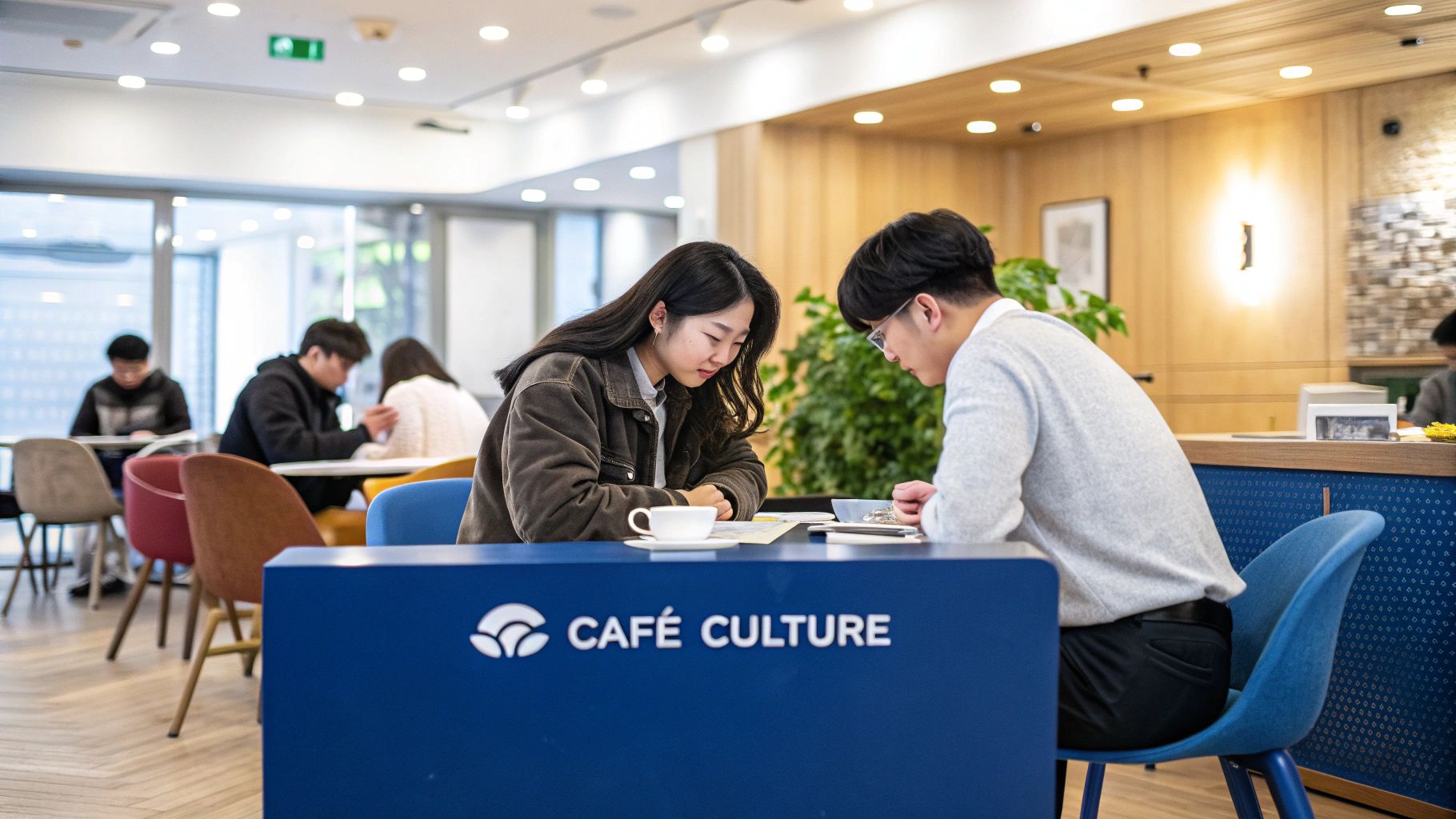
This central role in daily life helps explain the incredible density of coffee shops. If you take a walk through Seoul, it feels like there’s one on every corner. The number of cafés across the country exploded to over 102,000 by 2023, creating a massive $1.5 billion market. You can dig into more data about Korea's booming coffee market to see just how big this trend has become.
The Different Types of Korean Cafés
The sheer variety of cafés is one of the most exciting parts of the culture. You’ll find everything from huge franchises to tiny, independent roasteries. But what really sets the scene apart are the famous themed cafés.
- Character Cafés: Step into the world of beloved characters like Kakao Friends.
- Animal Cafés: Hang out with cats, dogs, or even raccoons while enjoying your latte.
- Aesthetic Cafés: These spots are all about the vibe—minimalist, vintage, or industrial—and are perfect for your Instagram feed.
Navigating Café Etiquette
While every place has its own personality, a few unwritten rules will help you blend in. Knowing these little customs can make your visit feel much more natural.
One of the biggest cultural differences you’ll notice is that in many independent or busy cafés, it’s common to find a seat before you place your order. This unspoken rule ensures you actually have a spot to sit during peak hours.
Once you’ve claimed your table (often by leaving a non-valuable item like a notebook on it), you can head to the counter. Here are a couple of other things to keep in mind:
- One Person, One Drink Rule: Many cafés operate on a "one person, one item" policy.
- Self-Service is Standard: Look for a station with water, napkins, and sugar. You're also expected to return your tray when you're finished.
- Vibrating Pagers: You'll almost always be handed a pager that will buzz and light up when your order is ready to be picked up.
Customizing Your Order Like a Pro
Alright, you've got the basics down. Now, let's get your coffee exactly how you like it. Nailing these small customizations will not only get you the perfect cup but also make you sound like you know your way around a local café. It’s the difference between being a tourist and feeling like a local.
Making Specific Requests
Let's look at some of the most common ways to tweak your order. You just tack your request onto your main order.
- Less ice, please: 얼음 적게 주세요. (Eoreum jeokge juseyo.)
- Add an extra shot, please: 샷 추가해 주세요. (Syat chugahae juseyo.)
- Takeaway / To-go, please: 테이크아웃으로 주세요. (Teikeu-a-useuro juseyo.) or 포장해 주세요. (Pojanghae juseyo.)
So, let's say you want an iced latte, but you don't want it watered down, and you're taking it to go. You can string these phrases together smoothly.
아이스 라떼, 얼음 적게, 테이크아웃으로 주세요. (Aiseu ratte, eoreum jeokge, teikeu-a-useuro juseyo.)
Saying this clearly shows the barista you can build a full, detailed order. For any Korean learner, that's a huge confidence boost.
Requesting Dairy Alternatives and Sweetness Levels
With all the different milk and syrup options out there, knowing how to ask for them is super helpful. Dairy-free choices are becoming more common in South Korea.
If you're avoiding dairy, you'll want to know these words:
- Soy Milk: 두유 (duyu)
- Oat Milk: 오트 우유 (oteu uyu)
- Almond Milk: 아몬드 우유 (amondeu uyu)
To get a latte made with soy milk, you'd simply ask: 두유 라떼 주세요. (Duyu ratte juseyo.)
Want to control the sweetness? Easy. If you just want a little bit of syrup, you can say 시럽 조금만 넣어 주세요 (sireop jogeumman neo-eo juseyo), which means "Please put in just a little syrup." Getting comfortable with these phrases will completely change your café visits.
Conclusion
You now have the words, phrases, and cultural tips to order coffee in Korean with total confidence. Remember, every cup of 커피 (keopi) you order is a small victory—a chance to practice your skills in a low-pressure, real-world setting. Don't worry about getting it perfect. The most important thing is to try! Each time you do, you're building confidence and getting one step closer to fluency. Every word you learn brings you closer to confidence. Keep going—your Korean journey starts now!
🌟 Ready to start your Korean journey? Join Ktalk.live — where global learners connect, speak, and grow together
Ready to stop reading and start speaking?
Practice what you just learned with a native Korean teacher — free for 100 minutes. No card, no commitment.