Want to practice this with a native Korean teacher?
100-min free trial — no card required.
Ready to start talking about your schedule in Korean? Learning the weekdays in Korean is one of the most practical first steps for any beginner, and you'll use these words constantly. It’s your ticket to making plans, scheduling appointments, and chatting about everyday life. Getting these down might seem tricky at first, but with the right approach, it’s a fun and rewarding journey!
The good news is that there’s a simple, predictable pattern that makes memorizing them much easier than you might think. Let’s dive in and unlock the secrets to mastering the Korean week.
Your Quick Guide to the Korean Weekdays
Learning the days of the week is a foundational skill you'll find yourself reaching for again and again. You'll be using words like 월요일 (Monday), 화요일 (Tuesday), and 금요일 (Friday) in no time.
What makes it so simple? A single, repeating word.
The Magic Word: 요일 (yo-il)
Here's the secret: every single day of the week in Korean ends with the same two syllables: 요일 (yo-il). This handy word simply means "day of the week."
Once you spot this repeating pattern, your job becomes much simpler. You just need to learn the unique first syllable for each of the seven days. Think of 요일 (yo-il) as the constant foundation and the first syllable as the unique identifier.
These first syllables aren't random, either. They're rooted in traditional East Asian cosmology, connecting each day to a celestial body—the moon, sun, and five visible planets. This naming system became standard during Korea's Joseon period and was formally adopted with the Gregorian calendar in 1896. It's such a fundamental part of the language that it's often taught within the first 100 words for beginners. If you're curious about Korea's official calendar, you can find more details on the country's working days and holidays.
Here’s a quick-reference table to get you started. As you look it over, notice how that "yo-il" ending stays the same for every single day.
The Seven Weekdays in Korean at a Glance
| English Day | Hangul (Korean) | Romanization |
|---|---|---|
| Monday | 월요일 | Wol-yo-il |
| Tuesday | 화요일 | Hwa-yo-il |
| Wednesday | 수요일 | Su-yo-il |
| Thursday | 목요일 | Mok-yo-il |
| Friday | 금요일 | Geum-yo-il |
| Saturday | 토요일 | To-yo-il |
| Sunday | 일요일 | Il-yo-il |
This table is your new best friend! Bookmark it, print it out, or make some flashcards. We'll be breaking down each day one by one.
Discover the Cosmic Story Behind Each Weekday
Ever wondered why Monday is 월요일 (wol-yo-il) in Korean? It’s not just a random name—the answer is written in the stars. The names for the weekdays in Korean come from ancient East Asian cosmology, which assigns each day to a specific celestial body.
This cosmic connection gives us a powerful story to help with memorization. Instead of brute-forcing a list of vocabulary, you can link each day to a powerful image, making it all stick so much better.
From Planets to Weekdays
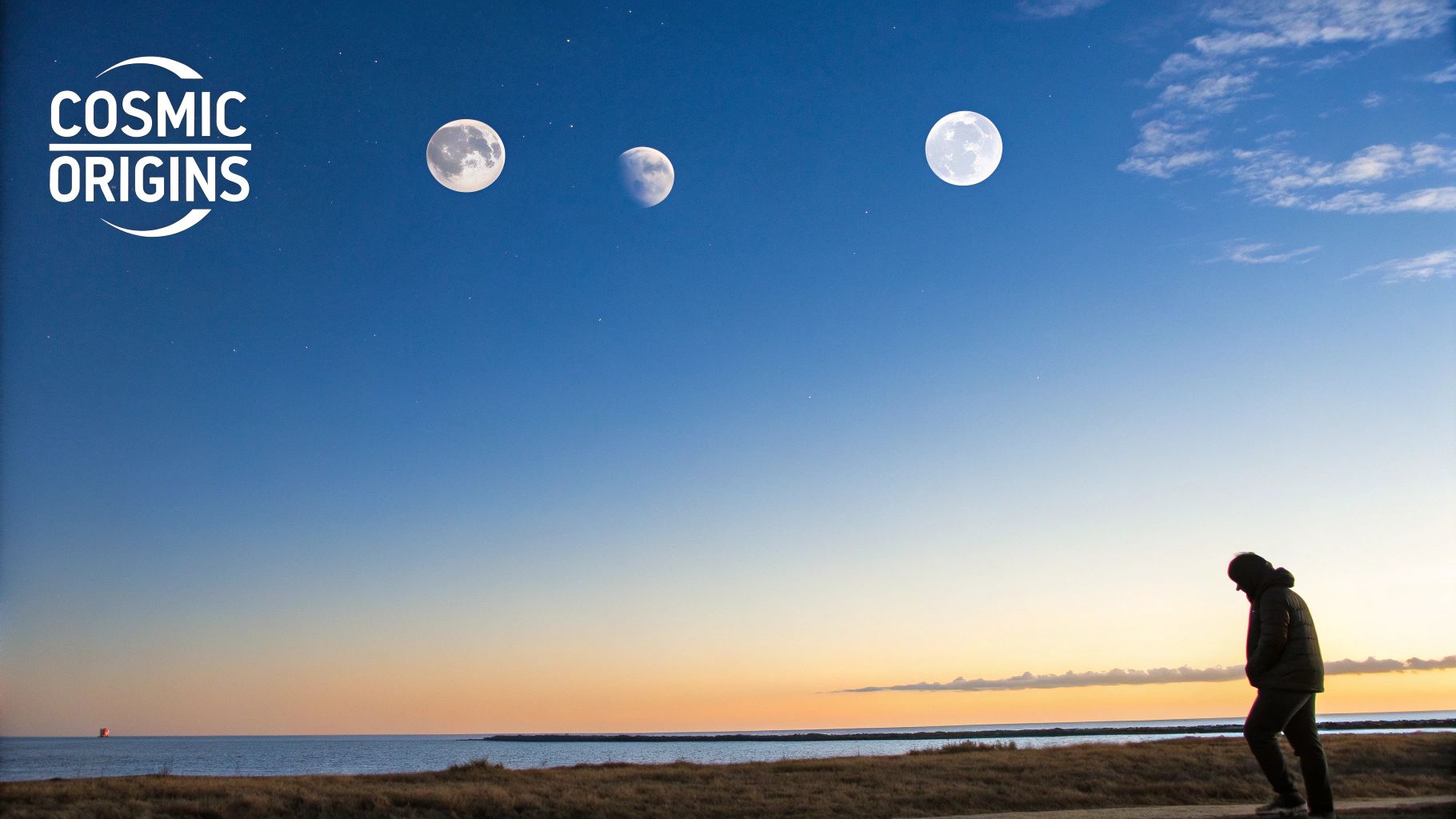
This ancient system maps the seven days of the week to the five visible planets, plus the sun and the moon. The first syllable of each weekday comes from the Korean word for its celestial ruler, a concept that originates from Hanja (Chinese characters adapted into Korean).
Let's walk through this cosmic calendar day by day. Thinking of it this way is a fantastic mnemonic device that turns a simple vocab lesson into a fascinating cultural journey.
- Monday is Moon Day: 월 (wol) comes from the Hanja character for the Moon (月). So, 월요일 (wol-yo-il) is literally "Moon Day."
- Tuesday is Fire Day: 화 (hwa) is from the character for Fire (火), representing the fiery red planet, Mars. This makes 화요일 (hwa-yo-il) "Fire Day."
- Wednesday is Water Day: 수 (su) corresponds to Water (水), the element tied to the planet Mercury. So, 수요일 (su-yo-il) is "Water Day."
Pro Tip: Creating a strong mental hook is key here. When you think of Tuesday, picture the fiery surface of Mars. For Monday, imagine a bright, shining moon.
This neat pattern continues right through the week, giving each day its own ancient and elemental identity.
Completing the Cosmic Cycle
The rest of the days follow the exact same logic, connecting each one to another fundamental element from the old cosmological system. Learning the weekdays in Korean this way feels a bit like you're unlocking a secret code hidden in the sky.
Here’s how the rest of the week plays out:
- Thursday is Wood Day: 목 (mok) comes from the character for Wood or Tree (木), which represents Jupiter. That makes 목요일 (mok-yo-il) "Wood Day."
- Friday is Gold Day: 금 (geum) is from the character for Gold or Metal (金), linked to the beautiful planet Venus. And so, 금요일 (geum-yo-il) is "Gold Day."
- Saturday is Earth Day: 토 (to) corresponds to Earth or Soil (土), representing the planet Saturn. This gives us 토요일 (to-yo-il) as "Earth Day."
- Sunday is Sun Day: Finally, 일 (il) comes from the character for the Sun (日), making 일요일 (il-yo-il) "Sun Day."
By learning these cosmic origins, you're doing more than just memorizing words. You're connecting with a piece of cultural history that has survived for centuries. It's a method that makes the vocabulary meaningful, turning abstract syllables into a story you're unlikely to forget.
Putting Your New Korean Vocabulary into Practice
You've nailed the names for the days of the week in Korean—that's a huge first step! But the real fun begins when you start weaving them into actual conversations. This is where you shift from just knowing words to really speaking the language. Let's dive into the grammar you'll need to start talking about your weekly plans like a pro.
One of the first things you'll need to do is say you're doing something on a certain day. Thankfully, Korean has a simple but super useful particle for that.

Adding the Time Particle '에' (e)
To say you’re doing something on a specific day, all you need to do is attach the particle 에 (e) to the end of the weekday. It's a tiny addition, but it completely changes the meaning and makes your sentence work.
Think of 에 (e) as the direct Korean equivalent of "on" when you're talking about time. For example, you know that 월요일 (wol-yo-il) is "Monday." Pop 에 (e) on the end, and 월요일에 (wol-yo-il-e) becomes "on Monday." Easy, right?
Here’s how it looks with a few other days:
- 화요일에 (hwa-yo-il-e) - On Tuesday
- 금요일에 (geum-yo-il-e) - On Friday
- 일요일에 (il-yo-il-e) - On Sunday
You can stick 에 (e) onto any day of the week to pinpoint when something is happening. This is your bread and butter for making plans and scheduling things, so getting comfortable with it early will pay off big time.
Making Simple Statements with '은/는' (eun/neun)
What if you just want to state what day it is? For that, you'll need a different tool: the topic-marking particles 은 (eun) or 는 (neun). These little guys attach to a noun to signal, "Hey, this is what we're talking about!"
Choosing between them is simple and based on the last sound of the word before it:
- Use 은 (eun) if the word ends in a consonant.
- Use 는 (neun) if the word ends in a vowel.
Let’s try it out. The Korean word for "today" is 오늘 (oneul). See that 'ㄹ' at the end? That’s a consonant, so we need to add 은 (eun).
오늘은 금요일이에요.
(Oneul-eun geum-yo-il-i-e-yo.)
Today is Friday.
In this sentence, 오늘은 (oneul-eun) establishes "today" as our topic, and the rest of the sentence, 금요일이에요 (geum-yo-il-i-e-yo), tells us something about it. The ending 이에요 (i-e-yo) is just a polite way to say "is." You can swap in any day of the week to say what day it is.
Getting a feel for both 에 (e) and 은/는 (eun/neun) is key. You'd use 에 (e) to say, "I'm going to the movies on Saturday," but you'd use 는 (neun) to say, "Tomorrow is Thursday." Mastering both particles will unlock a whole new level of practical, everyday Korean.
Understanding the Rhythm of a Korean Week
Learning the weekdays in Korean is more than just memorising a list. To really get it, you need to feel the rhythm of a typical week in South Korea. Life for millions is shaped by a demanding work and school culture, and this cycle dictates everything from the morning rush hour to how people unwind.
Just like in many other countries, the standard Korean week kicks off on Monday and wraps up on Friday. These days are often packed with long hours for students and office workers, building a real sense of anticipation for the weekend.

From Hard Work to 'Burning Friday'
The Monday-to-Friday grind isn't just a social norm; it's written into law. The legal workweek in South Korea is based on a 40-hour schedule. After reforms that started in 2018, the total weekly hours are now capped at 52—that's 40 regular hours plus a maximum of 12 for overtime. This shift has made a difference, as average annual working hours have dropped by about 10.1% over the last decade. You can read more about the specifics of Korean working hours at joinhorizons.com.
This intense weekly structure gives rise to a famous cultural phenomenon: 불금 (Bulgeum).
불금 (Bulgeum), which literally translates to "Burning Friday," captures that electric feeling of freedom when the workweek finally ends. It’s the designated time for 회식 (hoesik)—company dinners that are a huge part of office culture—and blowing off steam with friends.
Getting a handle on Bulgeum is crucial to understanding the weekly flow. It’s the moment the country collectively switches gears, moving from the serious, focused energy of the weekdays to the personal freedom of the weekend. It’s a cultural release valve, often celebrated with good food, drinks, and staying out late.
The Social Calendar
The line between 평일 (pyeong-il), or weekdays, and 주말 (jumal), the weekend, is drawn very clearly in Korean life. Here’s a quick look at how things generally play out:
- Weekdays (월요일 to 금요일): These days are all about productivity. Social plans, like those company dinners or a quick coffee with a friend, are usually squeezed in after work. The vibe is very much focused and goal-oriented.
- Weekends (토요일 and 일요일): This is personal time, pure and simple. It's reserved for hobbies, visiting family, short trips, or just catching up on rest. Big social events like weddings and day-long outings are almost always scheduled for a Saturday or Sunday.
Understanding this rhythm helps you see that the names of the days aren't just words. They carry the weight of the entire week's schedule and mood. Learning the weekdays in Korean is your first step to tuning into the real pulse of daily life in Korea.
Simple Tricks to Make the Korean Weekdays Stick
Alright, you've got the story behind each day, which is half the battle. Now, let's make sure those new words actually move in and stay put. Memorising the weekdays in Korean doesn't have to feel like a chore. With a couple of smart tricks, you can weave them right into your daily routine.
The whole point is to shift these words from your "cram-it-in" short-term memory to your "I-just-know-it" long-term memory. The best way to do that? Active and consistent practice.
Use the Planet Power Mnemonics
Honestly, the easiest way to lock these in is to lean hard on their cosmic origins. Creating a strong mental picture is one of the most powerful memory hacks out there, and it works like a charm for language learning. When you think of a day, don't just try to remember the sound—remember the story and the element.
- Monday (월요일): Picture a giant, bright Moon dominating the night sky.
- Tuesday (화요일): Imagine the fiery-red planet Mars, a huge ball of Fire.
- Wednesday (수요일): Think of flowing Water, maybe a river on Mercury.
- Thursday (목요일): Visualize a massive, ancient Tree or a sturdy piece of Wood, just like the giant Jupiter.
- Friday (금요일): Envision a gleaming piece of Gold or metal, reflecting the beauty of Venus.
- Saturday (토요일): Feel the rich Earth or soil between your fingers, like the rings of Saturn.
- Sunday (일요일): Feel the warm, life-giving rays of the Sun on your face.
Make It a Daily Habit
When it comes to learning new vocab, consistency is your superpower. Find small ways to bring the Korean weekdays into your life every single day.
A simple but surprisingly effective trick is to start your morning by announcing the day in Korean. Just say it out loud: "오늘은 월요일이에요 (Oneul-eun wol-yo-il-i-e-yo)" for "Today is Monday." This tiny act connects the word to a real-world context, reinforcing it in your brain.
Pro Tip: Feeling brave? Change your phone or calendar's language setting to Korean for a week. This kind of immersion forces you to see and use the words constantly. You'll be surprised how quickly you pick them up without even trying.
Interestingly, the whole idea of the 'weekday' is a hot topic in Korea right now. As work-life balance becomes a bigger priority, the traditional five-day grind is being questioned. A recent survey even found that a whopping 86.7% of tech workers are in favour of a shorter workweek. You can read more about how the four-day workweek is gaining momentum in Korea's tech industry.
Your Korean Weekdays Questions Answered
Once you start trying to use the Korean weekdays in real conversations, you'll probably run into a few tricky spots. That’s totally normal! Every learner wonders about these things, so let’s tackle some of the most common questions head-on.
Think of this as your practical guide to smoothing out the little details that will make your Korean sound that much more natural.
How Do You Ask What Day It Is?
One of the first things you'll want to ask is, "What day is it today?" It's a perfect, everyday question to start practising your new vocabulary.
The most common and polite way to ask this is:
오늘은 무슨 요일이에요?
(Oneul-eun museun yo-il-i-e-yo?)
What day of the week is it today?
Let’s quickly pull that sentence apart. 오늘 (oneul) means "today," and 무슨 (museun) means "what" or "which." The great thing is, you can easily swap out 오늘 (oneul) for "tomorrow" (내일, naeil) or "yesterday" (어제, eoje) to ask about those days, too.
How Are Weekdays Abbreviated on Calendars?
If you’ve ever glanced at a Korean calendar, you might have noticed single Hangul characters marking the days. This is a very common shorthand, and once you see the pattern, it’s incredibly easy to read.
Koreans just take the first syllable from each weekday’s name. You’ll see this all the time on phone calendars, in planners, and on scheduling apps.
- 월 (Wol) - Monday
- 화 (Hwa) - Tuesday
- 수 (Su) - Wednesday
- 목 (Mok) - Thursday
- 금 (Geum) - Friday
- 토 (To) - Saturday
- 일 (Il) - Sunday
Learning to spot these single characters will make reading any kind of schedule in Korean a piece of cake.
Do Korean Weeks Start on Sunday or Monday?
This is an excellent question because the answer isn't always the same. Traditionally, and on many printed wall calendars, you'll often see the week starting on Sunday (일요일).
However, in the modern day-to-day of business, school, and digital life, the week almost always begins on Monday (월요일), just as it does in many other parts of the world. My advice? When you see a new calendar, just give it a quick check. But for all practical planning, it’s safe to think of Monday as the start of the working week.
You're Ready to Talk About the Week!
Congratulations! You've just unlocked a huge piece of everyday Korean. Learning the weekdays in Korean is more than just memorizing seven words; it’s about understanding the rhythm of life and culture in Korea. You now have the tools to make plans, schedule meetings, and talk about your weekend like a pro. Every word you learn brings you one step closer to confidence. Keep going—your Korean journey starts now!
🌟 Ready to start your Korean journey? Join Ktalk.live — where global learners connect, speak, and grow together! https://ktalk.live
Ready to stop reading and start speaking?
Practice what you just learned with a native Korean teacher — free for 100 minutes. No card, no commitment.