
Want to practice this with a native Korean teacher?
100-min free trial — no card required.
Ever notice how often characters in K-dramas kick off a conversation by mentioning the weather? It's not just a filler line! Talking about the weather in Korean is a genuine, everyday way people connect, making it a fantastic skill for any learner to pick up. Learning how might seem challenging at first — but with the right approach, it becomes a fun and rewarding journey!
This guide is your complete toolkit for going from simply understanding weather talk to confidently starting these conversations yourself. By the end, you'll be able to chat about a beautiful sunny day or grumble about the sticky summer humidity just like a local.
Why Weather Talk is Your Korean Conversation Starter

Think of it as the ultimate icebreaker. Mastering weather-related small talk is a simple, low-pressure way to practice your skills and connect with native speakers on a topic everyone understands.
Mastering this topic helps you:
- Practise core grammar concepts in a simple, low-pressure way.
- Easily connect with native speakers on a topic everyone relates to.
- Build a solid foundation for tackling more complex conversations down the road.
We’re not just going to give you a list of words. The goal is to give you a practical skill that makes you sound more natural and feel more at ease when speaking. Let’s start with the essential words and build up your skills step by step.
Your Foundational Korean Weather Vocabulary
Before you can get into a conversation about a beautiful spring day or a freezing winter evening, you need the right building blocks. This is where we’ll lay the groundwork with must-know nouns and adjectives for any chat about the weather in Korean.
Think of this vocabulary as the basic colors on your artist's palette. Once you have them down, you can start painting a full picture of any day’s forecast. Getting these words locked in is your first, and most important, step.
The Four Seasons
In Korea, the four seasons are incredibly distinct and a huge part of the culture. Knowing how to name them is key for any weather-related small talk. Each season has its own unique vibe, from the famous cherry blossoms in spring to the heavy snows of winter.
- 봄 (bom): Spring
- 여름 (yeoreum): Summer
- 가을 (gaeul): Autumn/Fall
- 겨울 (gyeoul): Winter
Essential Korean Weather Vocabulary
Now, let's get into the words you'll use to describe what's actually happening outside. This quick-reference table has the absolute essentials you’ll hear and use constantly.
| English | Hangul (Korean) | Romanization |
|---|---|---|
| Weather | 날씨 | nalssi |
| Sun | 해 | hae |
| Rain | 비 | bi |
| Snow | 눈 | nun |
| Cloud | 구름 | gureum |
| Wind | 바람 | baram |
| Sky | 하늘 | haneul |
| Fog | 안개 | angae |
An interesting quirk in Korean is that you say "rain comes" (비가 와요) or "snow comes" (눈이 와요). We'll dive deeper into that grammar later, but for now, just focus on getting these key terms into your memory.
Core Weather Adjectives
Now that you can name the elements, it's time to describe them. Is it hot or cold? Clear or cloudy? These descriptive words (adjectives) are what bring your conversations to life. Learning how to use these is what separates stating a fact ("It is sunny") from sharing an experience ("Wow, it's so warm today!").
| English | Hangul (Korean) | Romanization |
|---|---|---|
| To be hot | 덥다 | deopda |
| To be cold | 춥다 | chupda |
| To be warm | 따뜻하다 | ttatteuthada |
| To be cool | 시원하다 | siwonhada |
| To be clear | 맑다 | makda |
| To be cloudy | 흐리다 | heurida |
You'll be reaching for these adjectives all the time, so they are definitely worth practicing. They're the key to expressing how the weather actually feels to you.
How to Describe the Weather Like a Native Speaker
Alright, you've got the basic words down. Now for the fun part: turning those single words into actual conversations. This is where you’ll start to feel like you’re really speaking Korean.
We'll start with the essentials—describing the weather using common words like 'to be hot' (덥다) and 'to be cold' (춥다). Think of these as the building blocks for all your future small talk. Getting these right is how you go from just knowing words to truly expressing yourself.
Putting Verbs into Action
Here’s a cool thing about Korean: many words we think of as adjectives, like 'hot' or 'cold', actually work like verbs. To use them, you just need to change their ending to make them polite and present-tense.
The most common polite ending you'll use is -아요/어요 (-ayo/eoyo). Let's see how this transforms our weather words:
- 덥다 (deopda) → 더워요 (deowoyo) - It's hot.
- 춥다 (chupda) → 추워요 (chuwoyo) - It's cold.
- 따뜻하다 (ttatteuthada) → 따뜻해요 (ttatteuthaeyo) - It's warm.
- 시원하다 (siwonhada) → 시원해요 (siwonhaeyo) - It's cool/refreshing.
- 맑다 (makda) → 맑아요 (malgayo) - It's clear.
- 흐리다 (heurida) → 흐려요 (heuryeoyo) - It's cloudy.
Don’t worry if you make mistakes — even Koreans do sometimes! What matters most is progress.
Adding a Little More Flavour
Want to sound even more like a local? Add adverbs to show how hot or cold it is. These little words pack a punch, adding nuance and emotion just like they do in English. Just pop them right before the verb.
Let’s use two incredibly useful adverbs: 너무 (neomu), which means 'too' or 'very', and 조금 (jogeum), which means 'a little' or 'a bit'.
Now, let's mix them with the verbs we just learned:
- 너무 더워요 (neomu deowoyo) - It's very hot.
- 조금 추워요 (jogeum chuwoyo) - It's a little cold.
- 날씨가 너무 맑아요 (nalssiga neomu malgayo) - The weather is very clear.
Mastering this simple Adverb + Verb structure instantly multiplies what you can say. You can now describe a whole range of feelings about the weather, not just the basics.
This is super practical, especially when you consider the dramatic seasons in a city like Seoul. For example, historical data shows August is Seoul's hottest month, with average highs hitting around 29°C. That’s definitely 너무 더워요 (neomu deowoyo) weather! You can check out more historical weather patterns for Seoul on Visual Crossing.
Asking and Answering Questions About the Weather
Alright, you've got the building blocks. Now, let's put them together and start having real conversations. This is where your Korean skills really start to shine, moving from just knowing words to actually using them for small talk.
Let's dive into the exact phrases you'll need to start and respond to chats about the weather in Korean.
How to Ask About Today's Weather
There’s one go-to question that works every time. The most natural way to ask is:
- 오늘 날씨가 어때요? (Oneul nalssiga eottaeyo?) - How is the weather today?
Let’s quickly break that down so you know exactly what you’re saying:
- 오늘 (Oneul): Today
- 날씨가 (Nalssiga): Weather (with the subject particle -가)
- 어때요? (Eottaeyo?): How is it?
This simple formula, [Time] + 날씨가 어때요?, is polite, incredibly common, and easy to remember.
Crafting Your Answer
Answering is just as straightforward. You simply take the vocabulary and grammar we’ve already covered and plug it in. Just combine 날씨가 (nalssiga) with one of the descriptive verbs you learned.
Here are a few ready-to-use examples:
- 날씨가 너무 더워요. (Nalssiga neomu deowoyo.) - The weather is very hot.
- 조금 흐려요. (Jogeum heuryeoyo.) - It's a little cloudy.
- 오늘은 아주 맑아요. (Oneureun aju malgayo.) - Today is very clear.
If it's obvious you're talking about the weather, you don't even need to say "날씨가" (nalssiga). Replying with a simple "더워요" (It's hot) sounds completely natural.
Asking About the Past and Future
So, what if you want to chat about yesterday’s downpour or tomorrow's forecast? Good news—you only need to make two small tweaks: change the time word and adjust the verb ending.
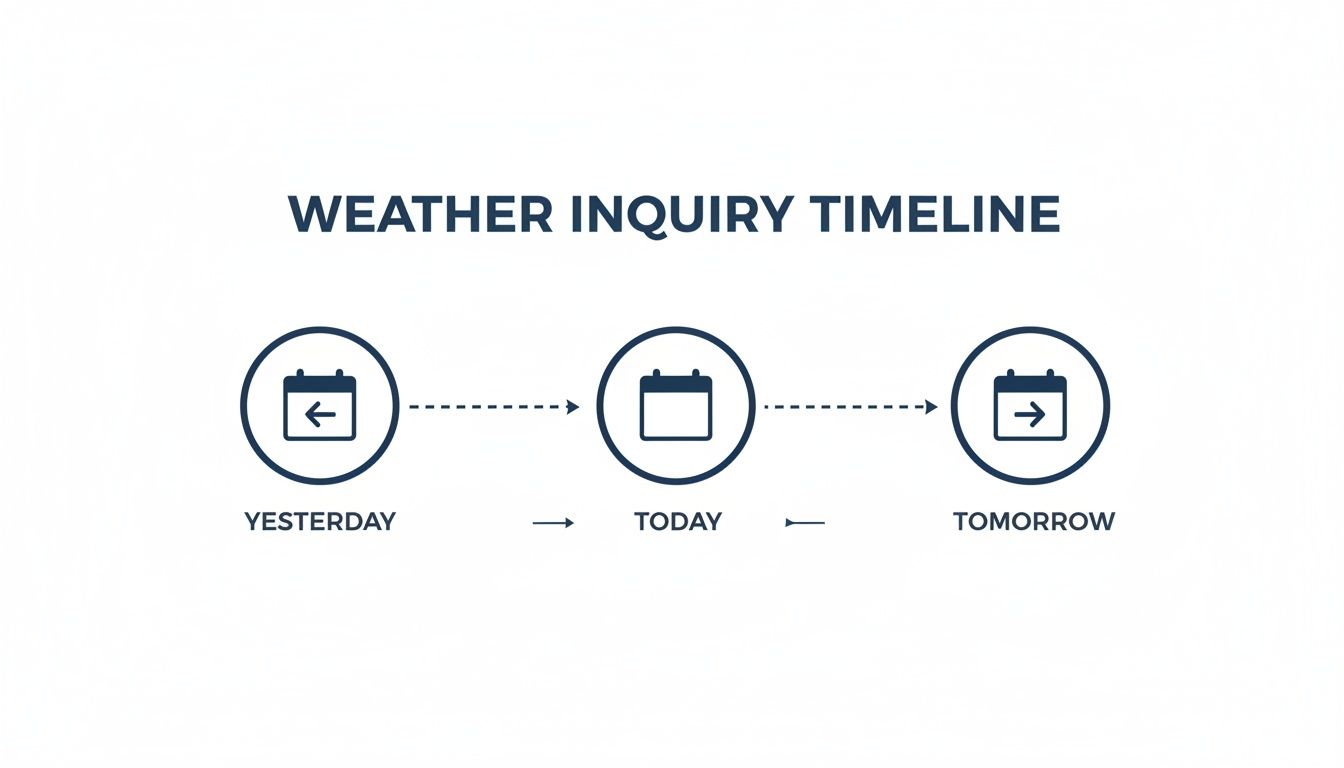
To ask about yesterday, you just switch to the past tense:
- 어제 날씨는 어땠어요? (Eoje nalssineun eottaesseoyo?) - How was the weather yesterday?
And to ask about tomorrow, you use a future tense that implies a bit of a guess:
- 내일 날씨는 어떨까요? (Naeil nalssineun eotteolkkayo?) - What do you think the weather will be like tomorrow?
With just these three question formats, you’re equipped to have a solid, basic conversation about the weather. These mini-dialogues are the perfect first step in turning what you know into something you can actually do.
Understanding Korea's Four Distinct Seasons
To really master talking about the weather in Korean, you need to feel for the country's four distinct seasons. They're not just slight shifts in temperature; each season dramatically changes daily life, the food people eat, and what comes up in conversation.
Hot Summers and Cold Winters
Korean summers, or 여름 (yeoreum), are famous for being hot and intensely humid. A huge part of summer is the monsoon season, known as 장마 (jangma), which usually hits from late June to late July. Expect lots of heavy, persistent rain—you'll hear locals talking about it all the time. On the flip side, Korean winters, or 겨울 (gyeoul), can be seriously cold and dry, with temperatures often plunging far below freezing.
The Beloved Spring and Autumn
While summer and winter can be intense, spring and autumn are the seasons everyone looks forward to. Spring, called 봄 (bom), is all about pleasant warmth and the famous cherry blossoms. Then there's autumn, or 가을 (gaeul), which is just as loved for its crystal-clear blue skies, cool breezes, and incredible fall colors. Most people would agree these are the absolute best times to be in Korea.
Just to give you a bit more context, South Korea's climate sees some major swings in rainfall. Records show that precipitation has averaged 1,293.55 millimetres per year since 1901. If you're curious about the historical data, you can see more details on the Trading Economics website.
Sounding Like a Local: Taking Your Korean Weather Chat to the Next Level
Once you've got the basics down, you're ready for the fun part: learning the little phrases that make you sound less like you’re reading from a script and more like a native speaker. These are the expressions you'll hear in K-dramas and on the streets of Seoul.
Making Predictions Like a Pro
One of the easiest ways to level up your small talk is to share your hunches. Instead of just saying "it will rain," you can say what you think is going to happen. The go-to grammar for this is -(으)ㄹ 것 같다 (-(eu)l geot gata). It’s a handy little pattern that means "it seems like" or "I think it will."
Here’s how it works:
- 비가 올 것 같아요. (Biga ol geot gatayo.) - Looks like it’s going to rain.
- 내일은 더울 것 같아요. (Naeireun deoul geot gatayo.) - I think it’ll be hot tomorrow.
- 눈이 올 것 같아요. (Nuni ol geot gatayo.) - It seems like it's going to snow.
Chatting About Modern Weather Woes
In Korea, weather talk isn't just about sunshine and rain. Two topics pop up all the time because they can really affect your day: humidity and fine dust.
Humidity (습도 - seupdo): Get ready to hear about this a lot during Korea's sticky summer months. The phrase you'll need is 습도가 높아요 (seupdoga nopayo), which simply means "the humidity is high."
Fine Dust (미세먼지 - misemeonji): On some days, especially in the spring, air quality is the main topic of conversation. To chime in, you can say 미세먼지가 심해요 (misemeonjiga simhaeyo), meaning "the fine dust is severe."
Bringing these up shows you're in tune with what locals are actually talking about. For a deeper dive into these seasonal shifts, check out this overview of South Korea's year-round climate on WeatherSpark.
Putting It All Together: Your Next Steps
You now have a complete starter kit for talking about the weather in Korean. You’ve got the vocabulary, the grammar, and even some cultural context to make your small talk sound natural. But knowing is only half the battle. The real magic happens when you start using this knowledge. Don't let it just sit in your notebook.
Every word you learn brings you one step closer to confidence. Keep going — your Korean journey starts now! Try striking up a conversation today by asking a friend, “오늘 날씨 어때요?” Every conversation, no matter how small, is a huge step forward on your path to fluency.
🌟 Ready to start your Korean journey? Join Ktalk.live — where global learners connect, speak, and grow together! Book your free trial class today!
Ready to stop reading and start speaking?
Practice what you just learned with a native Korean teacher — free for 100 minutes. No card, no commitment.