Want to practice this with a native Korean teacher?
100-min free trial — no card required.
Thinking about studying, working, or even making a life in Korea? If so, your first major milestone is almost certainly the Test of Proficiency in Korean, better known as TOPIK. But this isn't just another language exam; it’s the gold standard for proving your Korean skills to universities, employers, and the world. For many, finding a quality topik test online for practice is the first step on this exciting journey. Learning how the official test works is your key to success, and this guide is here to help you unlock every detail.
What Is the TOPIK Test and Why Does It Matter?
Simply put, TOPIK is the official exam that measures how well non-native speakers can understand and use Korean. It's not about memorizing grammar rules from a textbook; it’s designed to evaluate how you handle real-world communication through listening, reading, and writing. Don’t worry if that sounds intimidating—it’s a journey every learner takes, one step at a time!
For anyone serious about their ambitions in Korea, TOPIK is more than just a piece of paper—it’s a key. A good score can open doors to university admissions, give you a serious leg-up in the job market, and is often a non-negotiable part of visa applications.
The Growing Global Importance of TOPIK
The rise of the Korean Wave has had a massive ripple effect on language learning. As K-pop and K-dramas captivate audiences everywhere, the desire to learn Korean has exploded, and with it, the demand for TOPIK.
The numbers don't lie. The exam has seen phenomenal growth, with a record-breaking 550,000 people sitting for the test by September of the latest reporting year—the most since it started back in 1997. This surge, highlighted in an analysis from The Korea Times, shows just how much Korea's cultural and economic influence has grown.
Understanding the Two Main Tests
The TOPIK is cleverly split into two different levels. This ensures you’re tested on material that actually matches your current ability. Picking the right one is your first big decision.
- TOPIK I (Levels 1-2): This is the starting point for beginners. It tests the absolute basics of listening and reading. Can you introduce yourself (안녕하세요, annyeonghaseyo)? Can you order a coffee and understand the price? That’s the focus here.
- TOPIK II (Levels 3-6): Geared towards intermediate and advanced learners, this exam is a whole different beast. It adds a challenging writing section to the listening and reading components, testing your ability to handle complex subjects you'd encounter in a university lecture or a professional workplace.
Knowing which test to aim for helps you focus your efforts, whether that means finding a good topik test online for practice or enrolling in a course that gives you the structured support you need.
Understanding TOPIK Levels and Scoring
So, how does the TOPIK test actually work? It’s not a simple pass/fail situation. Think of it more like a ladder with six rungs, or levels (급, geup), where each one represents a higher command of the Korean language. Your final score on either the TOPIK I or TOPIK II exam places you on one of these levels.
This system is great because it gives you a really clear benchmark of your current skills. It shows you exactly where you are on your language journey and what you need to focus on to climb to the next rung.
TOPIK I: The Foundation for Beginners
If you're just starting out, TOPIK I is for you. It's designed specifically for beginner-level learners and covers Level 1 and Level 2. The test itself is pretty straightforward, with just two sections: Listening (듣기, deutgi) and Reading (읽기, ilggi). The whole thing is scored out of 200 points.
Level 1 (80+ points): Nailing this level means you can handle the absolute basics. We're talking about simple greetings, introducing yourself, and understanding conversations about everyday things like food (음식, eumsik), family (가족, gajok), and shopping. You've got the survival skills down.
Level 2 (140+ points): Reaching Level 2 shows you can manage routine social encounters. You can confidently ask for directions, make a purchase in a shop, or understand short public announcements. It proves you have a solid, practical grasp of Korean for daily life.
TOPIK II: For Intermediate and Advanced Learners
Once you've got the fundamentals under your belt, TOPIK II is the next mountain to climb. This exam is a whole different ball game, covering the more advanced Levels 3 through 6. It’s significantly tougher and adds a Writing (쓰기, sseugi) section to the Listening and Reading components, bringing the total possible score up to 300 points.
For many, a high score here isn't just for bragging rights—it’s a key requirement for getting into a Korean university or landing a professional job in Korea.
Mastering TOPIK II isn’t just about knowing vocabulary and grammar. It’s about proving you can think, reason, and express complex ideas entirely in Korean. That’s the skill that universities and employers are really looking for.
To give you a clearer picture, here’s a full breakdown of how the scoring works across both tests.
TOPIK Levels and Score Requirements
This table shows the score needed to achieve each level in TOPIK I and TOPIK II, helping learners understand their targets.
| Test | Level | Score Range | General Proficiency |
|---|---|---|---|
| TOPIK I | 1 | 80 - 139 | Basic communication for survival (greetings, shopping) |
| TOPIK I | 2 | 140 - 200 | Routine daily conversations and social functions |
| TOPIK II | 3 | 120 - 149 | Comfortable in most daily life situations; can understand social media/signs |
| TOPIK II | 4 | 150 - 189 | Can understand news articles and perform general professional tasks |
| TOPIK II | 5 | 190 - 229 | Proficient enough for professional work or specialised academic study |
| TOPIK II | 6 | 230 - 300 | Near-native fluency; can discuss complex and abstract topics |
As you can see, the jump between levels, especially in TOPIK II, is pretty significant.
The Higher Levels of Proficiency
The four levels within TOPIK II represent a huge leap in ability. Here’s what they mean in practical terms:
- Level 3 (120+ points): You can get by without much trouble in day-to-day life. You can understand the gist of signs, ads, and what people are talking about on social media.
- Level 4 (150+ points): At this stage, you're able to read news articles and grasp social commentary. You can also handle tasks related to general office work.
- Level 5 (190+ points): You're now proficient enough to work in a professional Korean environment or pursue specialised studies at a university.
- Level 6 (230+ points): This is the peak—the near-native fluency level. You can understand and express yourself on abstract, complex, and unfamiliar topics with precision and ease.
Getting a handle on this scoring system is your first step toward building a smart study plan. It lets you set a realistic goal and find the right tools—like a great practice TOPIK test online—to help you reach it.
Paper or Digital? Choosing the Right TOPIK Test for You
First things first, let's clear up a common point of confusion. When you hear "TOPIK test online," it's not a casual exam you can take from your couch. This term refers to the official Internet-Based Test (IBT), which, just like the traditional Paper-Based Test (PBT), is a serious, proctored exam held at a designated test centre.
So, the real choice isn't about taking the test at home, but about the format you'll use on exam day: a computer or a paper booklet.
Before you even think about IBT vs. PBT, your first big decision is which level to take: TOPIK I or TOPIK II. This handy flowchart breaks it down based on where you are in your Korean learning journey and what you want to achieve.
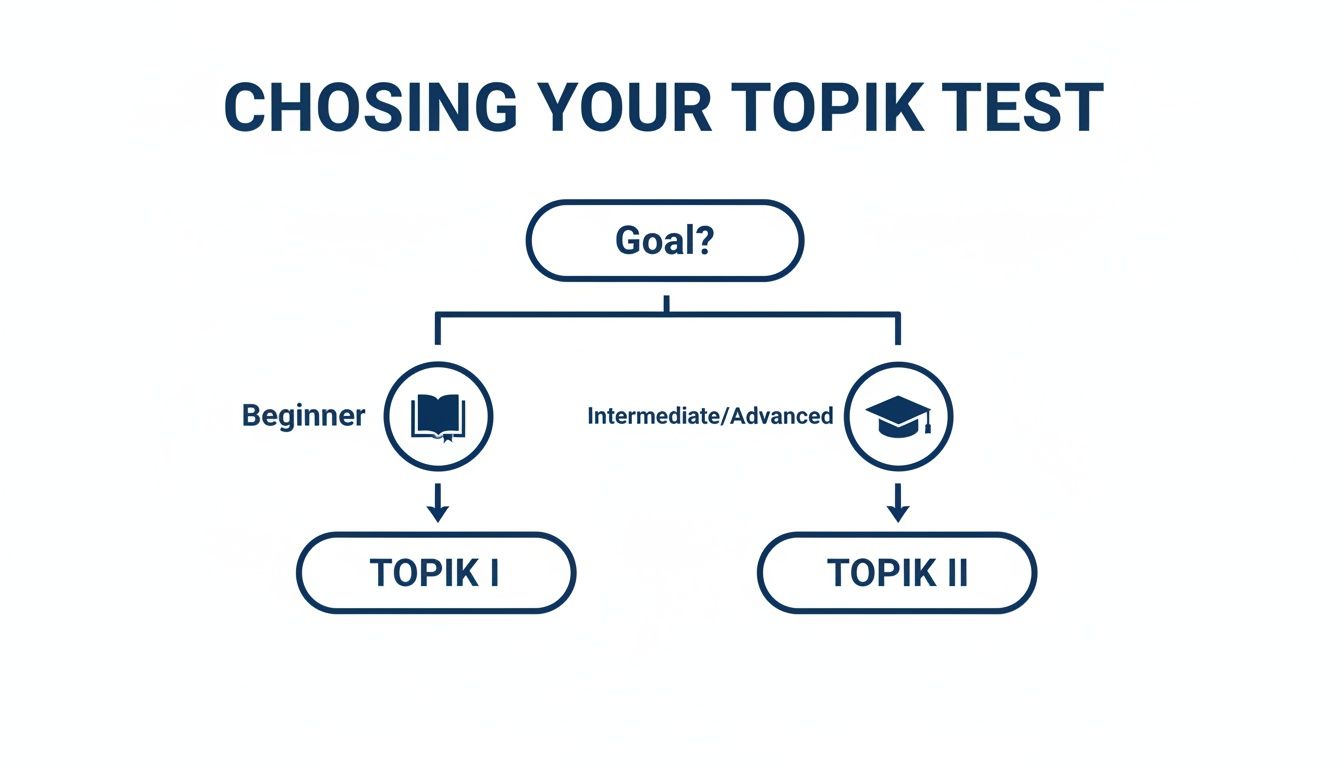
As you can see, if you're just starting out, TOPIK I is your target. For anyone aiming for university admission, specific jobs, or simply a high level of fluency, TOPIK II is the way to go.
Key Differences: IBT vs. PBT
The on-the-day experience is where these two formats really differ. Each has its pros and cons, and one might suit your style better than the other.
- The Medium: The IBT is all on a computer screen, while the PBT is the classic pen-and-paper exam with a test booklet and answer sheet.
- The Speaking Test: This is a big one. The IBT is rolling out a speaking section, which is a completely separate component not found in the PBT.
- Getting Your Results: One of the best perks of the IBT is speed. You can often get your listening and reading scores much faster, sometimes almost instantly. PBT results, on the other hand, will have you waiting for several weeks.
- Availability: The PBT has been the standard for years and is available almost everywhere. However, the IBT network is growing fast and popping up in more and more countries.
This move to a digital format is a significant leap. The IBT was officially launched in 13 countries, including Korea, after a mock exam in 2021 with 400 participants proved it was ready for prime time. You can learn more about these global TOPIK developments to see how the test is evolving.
So, Which One Should You Pick?
This really comes down to your personal comfort and what's available near you.
If you're a quick typist and spend your days navigating digital screens, the IBT will likely feel comfortable and maybe even more efficient. But if you’re someone who likes the physical act of holding a booklet and striking through answers with a pen, the PBT is probably a better bet for you.
You also have to consider the practical side. Jump on the official TOPIK website and see which formats are offered at the test centres in your area. While the IBT is the future, the PBT is still the go-to option in many places.
Ultimately, there’s no wrong answer here. Both formats lead to the exact same official certification. The goal is to choose the environment where you'll feel most confident and perform your best.
How to Register and Get Ready for Test Day
Let's be honest, sometimes figuring out the TOPIK registration can feel like a pre-test. But don't let it intimidate you! We’ll walk through it step-by-step so you can get it done and focus on what actually matters: studying. Having a clear plan for registration and test day means you'll walk into that exam room feeling confident and prepared.
Your Step-by-Step Registration Guide
First things first, registration happens entirely on the official TOPIK website. Head over there and find the exam schedule for your country. The key here is to act fast. Registration periods open a few months before the test, but seats—especially in popular cities—get snapped up almost instantly. Seriously, put a reminder in your calendar for the day it opens. 🗓️
Once you're on the site on registration day, the process is pretty logical. Here’s a quick breakdown of what you'll do:
- Create an Account: If you don't have one already, you'll need to sign up. This is your personal portal for everything related to the test.
- Pick Your Test: Decide whether you're taking TOPIK I or TOPIK II. Be sure about this choice, because you often can't change it later without starting over.
- Choose a Test Centre: You'll see a list of available test locations. Have your ideal spot in mind, but it’s smart to have a second or third choice ready.
- Upload Your Photo: Get a passport-style digital photo ready beforehand. It needs to be recent and clear, with a plain background. They're quite strict about the photo requirements!
- Confirm and Pay: Look over all your information one last time. The final step is payment, which locks in your spot. You have to pay on the same day you register.
After you get that confirmation email, take a deep breath—you're officially registered!
What to Expect on Test Day
Knowing the logistics for test day is just as crucial as knowing your grammar and vocabulary. The last thing you want is a last-minute panic because you forgot your ID.
Remember, the goal on test day is to create a calm, focused environment for yourself. Handling the small details beforehand allows your brain to concentrate entirely on the Korean questions in front of you.
Here’s a simple checklist to make sure your morning is stress-free:
- Valid Identification: You absolutely must bring your official test admission slip (수험표, suheompyo) and a valid photo ID like a passport. The name on your ID has to be an exact match to your registration. No exceptions.
- Permitted Items: For the paper-based test, you can bring your own correction tape. A water bottle is usually fine, but it will need to be kept under your desk during the exam.
- Prohibited Items: This is a big one. All electronic devices are strictly banned. Your phone, smartwatch, and anything else with a screen must be completely turned off (not just on silent) and given to the invigilator before the test starts.
By breaking down everything from finding a practice topik test online to knowing exactly what to pack for exam day, you can clear away a lot of the anxiety.
Your Actionable 4-Week TOPIK Study Plan

Feeling a bit swamped by everything you need to study for the TOPIK? That’s perfectly normal. The secret isn't cramming; it's breaking the challenge down into manageable, bite-sized pieces. This structured four-week plan is designed to do just that, guiding you from a shaky start to a confident stride into the test centre.
Week 1: Build Your Vocabulary Foundation
Your first week is all about words. A solid vocabulary is the bedrock for everything else. The goal isn’t just to learn the most common words on the TOPIK exam, but to make sure you actually remember them.
Focus on core nouns, verbs, and adjectives. Try putting new words into simple sentences. For instance, instead of just drilling "학교" (hakgyo), practice saying, "저는 학교에 가요" (Jeoneun hakgyo-e gayo), which means "I go to school."
- Daily Goal: Learn 20-30 new vocabulary words.
- Actionable Tip: Use flashcard apps like Anki or Quizlet. Their spaced repetition systems are fantastic for locking words into your long-term memory.
- K-talk Live Tip: Pop into a free trial class to hear how native speakers use these words in natural, flowing conversations.
Week 2: Master Grammar and Listening
With a growing word bank, it’s time to shift your attention to grammar patterns and listening skills. This week is all about seeing how Korean sentences fit together and training your ear to catch the important details.
Start with common grammar points like particles (은/는, 이/가) and essential verb endings (-아요/어요, -(으)ㄹ 거예요). To practice listening, try Korean podcasts or news clips. The idea is to get used to the natural speed of the language.
The goal isn't to understand every single word you hear. It's about training your ear to pick out the main idea, key phrases, and the overall tone of the conversation.
Week 3: Practice with Mock Tests
Now for the real fun—putting your skills into practice. Week three is all about timed mock tests. This is absolutely crucial for getting comfortable with the exam’s timing, layout, and question styles. It’s also the best way to pinpoint your strengths and weaknesses.
If you’re aiming for TOPIK II, this is the perfect time to start working on the writing section. Get familiar with the two prompt types and practice structuring your thoughts clearly under pressure.
Week 4: Review and Simulate Test Day
The final week is for review and refinement. Circle back to your notes, paying special attention to vocabulary and grammar points that gave you trouble. Re-do questions you got wrong on practice tests to really understand your mistakes.
Your main objective this week is to simulate the actual test environment. Find a quiet spot and complete a full, timed practice test without interruptions. This builds the mental stamina you'll need on the day and helps calm those pre-test jitters.
Sample 4-Week TOPIK I Study Plan
This table breaks down a possible study schedule for beginners targeting the TOPIK I exam. Remember to adjust it based on your own pace and strengths!
| Week | Focus Area | Daily Goal (1-2 hours) | K-talk Live Tip |
|---|---|---|---|
| Week 1 | Core Vocabulary | Learn 20 new words related to daily life (greetings, food, places). Use flashcards and write simple sentences. | Ask your instructor in a Beginger Korean course for the 100 most common nouns to get started. |
| Week 2 | Basic Grammar & Listening | Master particles (이/가, 은/는, 을/를) and verb endings (-아요/어요). Listen to slow-paced dialogues. | Pay attention to how instructors naturally use particles in class. Try to shadow their pronunciation. |
| Week 3 | Reading & Mock Tests | Complete one section of a TOPIK I practice test daily (Listening or Reading). Time yourself! | Review incorrect answers from practice tests with a native tutor in a 1-on-1 session to clarify misunderstandings. |
| Week 4 | Full Review & Simulation | Take a full timed TOPIK I mock test. Review all notes, focusing on weak areas. Get a good night's sleep. | Do a final Q&A session with your teacher to clear up any last-minute doubts before the big day. |
Conclusion
We've covered everything from what the TOPIK is to how you can create a winning study plan. It might seem like a huge challenge, but passing this exam is absolutely within your reach with the right preparation and mindset. Knowing the test format is half the battle, but the real secret is consistent, smart practice. Whether you choose the classic paper-based exam or a topik test online (IBT), a solid study routine will carry you across the finish line. Every word you learn brings you one step closer to confidence. Keep going—your Korean journey starts now!
🌟 Ready to start your Korean journey? Join Ktalk.live—where global learners connect, speak, and grow together!
Got Questions About the TOPIK Test? We've Got Answers.
Jumping into the world of TOPIK can feel a bit overwhelming, and it's natural to have questions. Let's clear up some of the most common things people ask.
Can I Take the Official TOPIK Test from Home?
This is a big one, and the short answer is no. You can't take the official TOPIK test from the comfort of your home.
It's a common misunderstanding, especially with the introduction of the Internet-Based Test (IBT). But whether you're taking the classic Paper-Based Test (PBT) or the newer IBT, you have to be physically present. Both are formal, supervised exams held at designated, secure test centres.
How Long Are My TOPIK Scores Valid?
Your TOPIK scores have a shelf life. The certificate you receive is valid for two years, starting from the day your results are released.
Keep this two-year window in mind. If you're planning to use your score for something important like a university application or a visa, they'll almost certainly require a certificate that hasn't expired.
What Is the Best Way to Practice for the Writing Section?
The writing section trips a lot of people up, but the best way to tackle it is through consistent practice and getting solid feedback. Start by looking at model answers from past exams to get a feel for the right structure, tone, and vocabulary. Then, start writing your own answers to different prompts.
The real game-changer is getting feedback from a native speaker or a qualified tutor. They'll catch the subtle mistakes in grammar and phrasing you might not see yourself. That personalised advice is what really helps you improve and score higher.
Ready to stop reading and start speaking?
Practice what you just learned with a native Korean teacher — free for 100 minutes. No card, no commitment.