Want to practice this with a native Korean teacher?
100-min free trial — no card required.
Dreaming of studying in Seoul or landing a job with a Korean company? If so, you've likely heard of the Test of Proficiency in Korean (TOPIK). It’s the official certificate that can turn those dreams into reality. But before you can ace the test, you need to know the official TOPIK test dates and how to secure your spot.
Don’t worry if the process seems a bit confusing at first! This guide is here to walk you through everything, step-by-step. We'll break down the annual schedule, share tips for a stress-free registration, and help you build a solid plan. Let's get you ready for success!
Why Your TOPIK Journey Starts with a Calendar

Before you even think about cracking open a textbook or downloading a flashcard app, your first move should be to pull up the calendar. Seriously. The single most important first step is getting a handle on the annual test schedule.
Missing a registration window isn't a small hiccup; it can genuinely set your plans back by months.
This guide is here to be your roadmap. We’ll break down everything you need to know about the exam schedule and walk you through the registration process, which can sometimes feel a bit stressful. Let's build a solid plan to get you where you want to go.
Knowing the schedule helps you:
- Swap pre-test anxiety for real confidence.
- Choose the test that actually matches your skill level.
- Make sure you never, ever miss a critical deadline.
The Complete Annual TOPIK Test Schedule
Trying to prepare for the TOPIK without knowing its annual rhythm is like trying to catch a train with no timetable. You might get lucky, but you're more likely to end up stressed and running late. The good news is that while specific dates change every year, the overall pattern is incredibly consistent, letting you plan months, or even a full year, in advance.
It's important to understand that the topik test dates aren't just picked at random. They're strategically set to line up with South Korea’s academic and professional calendars, giving you clear, predictable targets to aim for.
The Six Key Testing Windows in Korea
Here in South Korea, the TOPIK exam happens six times a year. This regular schedule means you always have another opportunity on the horizon, taking some of the pressure off a single test day.
Generally, you can count on the tests happening in these months:
- January: A great option if you're targeting early university applications.
- April & May: This is a peak period, popular with both students and job seekers.
- July: Catches the second major wave of university admissions.
- October & November: Lines up perfectly with year-end corporate hiring and final school application deadlines.
This predictable cycle is your best tool for long-term planning. You can pick a target test date and work backwards, mapping out a study schedule that fits your life without any last-minute cramming.
Why Timing Is Everything
The whole point of this schedule is to support your goals. The six annual sessions are timed to hit major deadlines for university admissions and hiring seasons. For example, the January and July tests are perfectly placed for academic applications, whereas the May and November exams are often aimed at people entering the job market.
Now for the reality check: registration usually opens about two months before the exam, and it is fiercely competitive. I've seen spots in big cities like Seoul get completely booked up within just a few hours. The demand got so high that the government had to start staggering registration days by region to keep the servers from crashing and give everyone a fair shot. The Korean Ministry of Education sometimes posts updates on these procedures.
To give you a clearer picture, here’s a general overview of what the annual paper-based test (PBT) schedule usually looks like in South Korea. Just remember, this is a typical guide—always, always double-check the official TOPIK website for the exact dates, as they do change each year. International schedules are also completely different.
Typical Annual TOPIK Schedule At a Glance (Korea)
This table outlines the typical yearly cycle for TOPIK exams held in South Korea, helping you plan your preparation and application timeline.
| Test Session (Exam Number) | Typical Test Month | Typical Registration Period | Typical Results Announcement |
|---|---|---|---|
| 98th TOPIK | January | December (Previous Year) | February |
| 99th TOPIK | April | February | May |
| 100th TOPIK | May | March | June |
| 101st TOPIK | July | May | August |
| 102nd TOPIK | October | August | December |
| 103rd TOPIK | November | September | December |
Getting comfortable with this calendar is genuinely the first step to taking control of your TOPIK journey. It transforms the test from a daunting, abstract goal into a concrete date on your calendar you can confidently work towards.
How to Navigate the TOPIK Registration Process
Let’s be honest: for many people, the TOPIK registration can feel more daunting than the test itself. Securing a spot, especially in a popular city, is a race against the clock that requires planning, speed, and a little bit of strategy. Think of it as the first challenge on your TOPIK journey, where being prepared gives you a huge advantage.
This section is your playbook for getting registered without all the stress. We'll walk through everything from setting up your account to finalising your payment, so you can hit ‘submit’ with confidence.
Your Pre-Registration Checklist
The key to a smooth registration day is getting all your ducks in a row before it starts. When the website is crawling under heavy traffic and spots are vanishing by the second, you won’t have time to hunt for your passport photo.
Here’s what you need to have on hand:
- An Account: Get this done early. Head over to the official TOPIK website at www.topik.go.kr and create your account well before registration opens. Don't leave it for the last minute.
- Personal Details: Have your full name (exactly as it appears on your official ID), date of birth, and contact info typed out in a separate document. This makes it easy to copy and paste, saving you precious time.
- A Digital Photo: The photo has strict requirements—it's usually a passport-style headshot with a white background. Double-check the required file size and format on the TOPIK site and have it saved and ready to upload.
Having these items prepared is like a chef doing their mise en place. When all your ingredients are prepped and ready, the actual cooking is smooth, fast, and far less chaotic.
A little bit of prep work transforms a frantic scramble into a calm, controlled process.
The timeline below gives you a bird's-eye view of the entire process, from the day you register to the day you finally get your results.
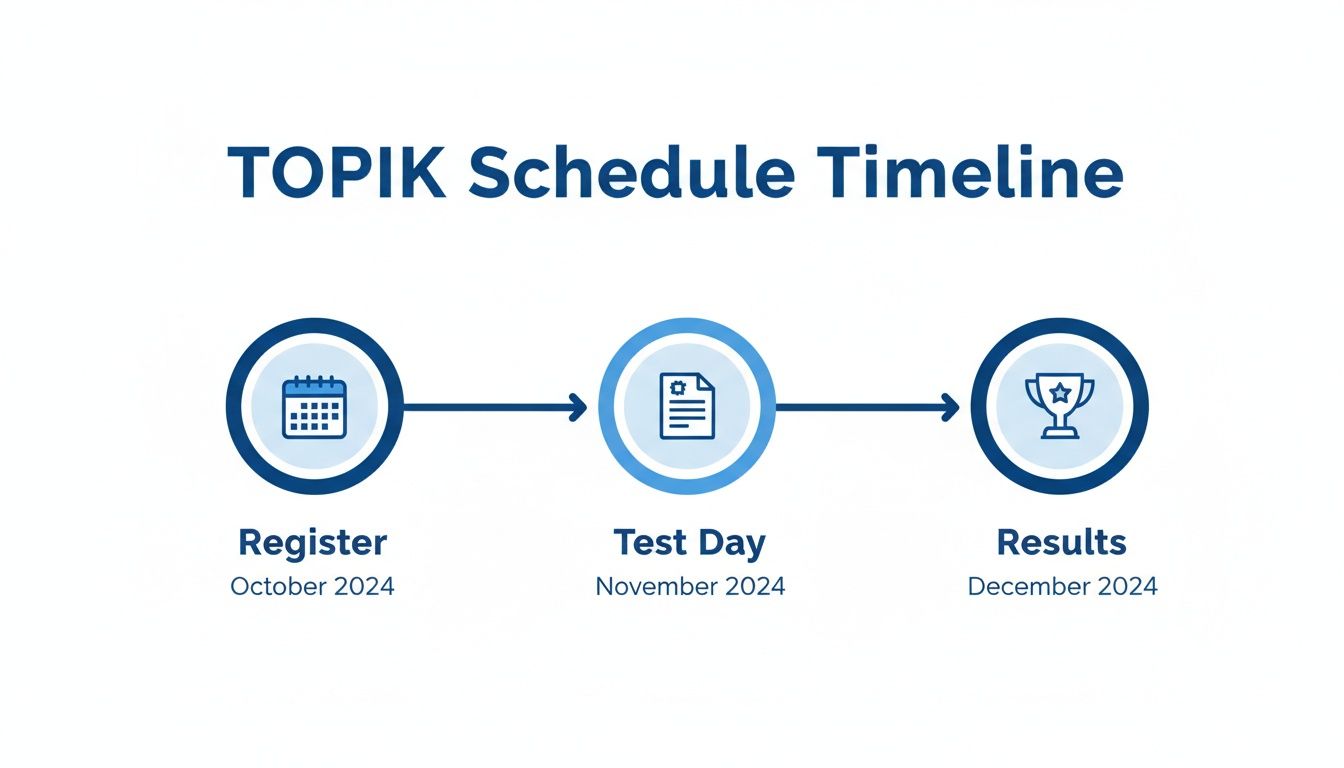
As you can see, each step is its own distinct phase. Mark these dates on your calendar!
Winning the Registration Battle
In high-demand areas like Seoul, people call registration a "battle" for a good reason. Test centres can fill up completely within minutes. The single most important thing you can do is know the exact moment registration opens. Set an alarm and be at your computer, ready to go.
If the site is slow or crashing from the traffic, take a deep breath and keep refreshing. Don't give up. It’s also crucial to have your payment details handy, because your spot isn’t officially reserved until the payment goes through. Some seasoned test-takers even open the site on multiple browsers to improve their odds.
By following this guide, you can dodge common pitfalls like entering incorrect information or having a payment fail. This prep work lets you secure your spot and get back to what really matters: studying for the exam. Once you have that test date confirmed, platforms like K-talk Live offer structured courses to help you get fully prepared.
Choosing Your Level: TOPIK I vs. TOPIK II
Before you even circle any TOPIK test dates on your calendar, there's a big decision you need to make: which test are you actually taking? Picking between TOPIK I and TOPIK II isn't just a small detail—it's about making sure the exam you sit for genuinely matches your current skills and future goals.
Think of it like this: TOPIK I is about proving you can build a solid foundation, while TOPIK II is for showing you can construct the entire house.
TOPIK I: The Foundation for Beginners
TOPIK I is specifically for beginner-level learners. It’s designed to test whether you've mastered the fundamentals of Korean, covering proficiency Levels 1 and 2.
The exam itself is pretty straightforward and sticks to the absolute essentials. It's broken down into just two parts:
- Listening (듣기): Can you understand basic, everyday conversations and simple public announcements?
- Reading (읽기): Can you make sense of short letters, public signs, and simple written texts?
If you've been working on core grammar and have a vocabulary of around 800 to 2,000 words, this is the test for you. Passing TOPIK I is a great way to formally confirm that you have a handle on survival Korean for everyday situations.
TOPIK II: The Test for Intermediate to Advanced Learners
Now, TOPIK II is a different beast entirely. It’s a much more challenging exam aimed at intermediate and advanced learners, covering the higher proficiency Levels 3 through 6. This is the one you’ll need for serious academic or professional pursuits in Korea.
The structure is more complex and adds a crucial third section that really tests your active language skills:
- Listening (듣기): You'll be dealing with longer, more nuanced dialogues and even academic-style lectures.
- Reading (읽기): Forget simple signs. This section includes complex articles, news reports, and literary texts.
- Writing (쓰기): This is the big one. You'll need to produce structured short-answer responses and compose a full-length, well-reasoned essay.
Taking this test is a must for anyone who needs to prove they can use Korean in a formal setting. In fact, passing TOPIK has become a non-negotiable requirement for many things, like university admission (usually Level 3 or higher), certain spousal visas, and even landing a job at major Korean companies like Samsung.
A huge number of test-takers are aiming for higher education, which is why study abroad is consistently a top reason people take the exam. You can actually see just how much foreign student numbers have grown over the years on Statista to get a sense of the trend.
Ultimately, choosing the right test comes down to being honest about where you are on your language journey and where you want to go. Pick the exam that will be a true stepping stone, not an impossible leap.
Finding Your Local TOPIK Test Dates Around the World
While South Korea runs a neat and tidy six-test schedule each year, the calendar for international test-takers is a completely different story. If you're planning to take the exam outside of Korea, the first thing you need to know is that the global TOPIK test dates are not standardised.
This is where your local organisers become your best friends. Your mission, should you choose to accept it, is to find the official institution in your country that handles the TOPIK exam. This is almost always a Korean Embassy, a Korean Cultural Centre, or a partner university. These are the only places that will have the ground-truth on local schedules, registration steps, and those all-important deadlines.
Why Do International Schedules Vary So Much?
The simple answer? It all comes down to local demand and logistics. The frequency of the TOPIK test can be wildly different from one country to the next.
For example, a country with a huge community of Korean learners, like Japan or Vietnam, might offer the test several times a year. On the other hand, a country in Europe or South America with a smaller group of applicants might only host the exam once or twice, annually. This is precisely why you need to get your hands on this information as early as possible.
It's no secret that interest in the Korean language has exploded. To keep up, test sites have expanded from just a handful of countries in the late 90s to over 62 countries today—with more on the way. The number of overseas test-takers has skyrocketed, which really shows how much K-culture has captured the world's attention. You can read more about this incredible growth over at The Korea Times.
How to Find Your Local Test Information
Getting the right details straight from the source is the only way to make sure you don't miss a rare chance to take the test in your home country. By knowing exactly where to look, you can skip the confusion and plan around the correct local schedule.
Here’s a quick action plan to find your local TOPIK info:
- Start with the Embassy: The website for the Embassy of the Republic of Korea in your country is your best first stop. Hunt for sections about education, culture, or general announcements.
- Check Korean Cultural Centres: If your city is lucky enough to have a Korean Cultural Centre (KCC), head straight to their website. They are often directly in charge of organising the TOPIK.
- Search University Language Departments: In some cases, local universities with robust Korean language programs are tapped to be official test centres.
Relying on information from your designated local organiser is the only way to guarantee you have the correct dates, fees, and registration instructions. International schedules are set independently and will not match the dates published for Korea.
Taking this step early ensures you’re perfectly in sync with your country's specific timeline, so there's zero chance of missing out.
Building Your Study Plan Around Your Test Date

Once you’ve officially circled that test date on your calendar, the vague goal of "studying for the TOPIK" suddenly gets very real. It’s no longer a distant idea; it's a deadline. This is the perfect time to switch gears from general Korean learning to laser-focused exam preparation. The best way to tackle this? Work backwards.
Start from the exam date and map out your study journey week by week. This simple trick turns what feels like a mountain of material into small, achievable hills. By setting clear weekly and monthly goals, you create a structured countdown that builds momentum and helps you avoid that dreaded last-minute cram session.
Tailoring Your Plan to Your Test Level
Let's be clear: your study plan will look completely different depending on whether you’re aiming for TOPIK I or TOPIK II. A one-size-fits-all approach is a recipe for disaster because the two exams test vastly different skills. You need a plan that tackles the specific challenges of your level head-on.
For TOPIK I learners, the first few weeks are all about building a rock-solid foundation.
- Weeks 1-4: Go all-in on mastering Hangul (한글) if you haven't already. Your main goal here is to build a core vocabulary of at least 800-1,000 essential words. Think flashcard apps, simple children's stories, and labelling things around your house.
- Weeks 5-8: Now it's time to dive into basic grammar patterns. Focus on how to build simple sentences (e.g., 저는 학생입니다 - jeoneun haksaeng-imnida, "I am a student.") and start getting your ears tuned to the language with beginner-level listening exercises.
- Final Weeks: This is when you pivot to practice. Get your hands on past TOPIK I papers and get comfortable with the question formats, especially the timing for the Listening and Reading sections.
On the other hand, preparing for the much tougher TOPIK II demands a more complex strategy right from the get-go.
Structuring Your TOPIK II Countdown
Your TOPIK II plan needs dedicated time slots for each of the three sections: Listening, Reading, and the infamous Writing section. Balance and consistency are your best friends here.
A sample monthly schedule might look something like this:
Month 1: The Foundation Phase
- Dust off and review intermediate grammar (think connecting clauses, reported speech, and nuanced particles).
- Start seriously expanding your vocabulary, focusing on words you'd see in news articles or academic texts.
- Challenge yourself by listening to Korean news podcasts or watching dramas without subtitles.
Month 2: The Application Phase
- This is non-negotiable: start writing one short essay (쓰기 53번) and one long essay (쓰기 54번) every single week.
- Work through TOPIK II reading passages, pushing yourself to improve both your speed and your understanding.
- Actively listen for different accents and speaking speeds in your practice materials.
Month 3: The Simulation Phase
- Take a full, timed mock test every weekend. This is absolutely critical for building the mental stamina you'll need for a three-hour exam.
- Use your mock test results to pinpoint your weak spots, then spend the weekdays drilling down on those specific areas.
Remember, the goal isn't just to know Korean; it's to prove you know it under pressure. Consistent, timed practice is what turns your knowledge into a high score on test day.
This backward-planning approach transforms your prep from a fuzzy ambition into a clear, actionable countdown to success.
Your Path to TOPIK Success Starts Now
So there you have it—a complete playbook for navigating the TOPIK schedule. You're now set to pinpoint your ideal test date, get through registration without a hitch, and build a study plan that actually works for you. The logistics are no longer a mystery.
Think of the TOPIK as a marathon, not a sprint. Every bit of planning you do now is a crucial step toward the finish line. You're not alone in this, either. A recent test session saw a massive 72,079 applicants across 46 countries, a clear sign of just how many people are on this same journey. You can read more about this growing interest in The Korea Times.
Every word you learn brings you one step closer to confidence. Take this momentum and turn it into action—your Korean journey starts now!
🌟 Ready to start your Korean journey? Join Ktalk.live—where global learners connect, speak, and grow together!
Frequently Asked Questions (FAQ)
Sorting out the when, where, and how of the TOPIK exam can feel like a test in itself. Let's tackle some of the most common questions we see from students so you can focus on what really matters—preparing for the test.
How Early Should I Register for the TOPIK Test?
The real answer? You need to be ready to pounce the second registration opens. While it usually starts about two months before the exam date, slots in popular locations like Seoul or other major cities can vanish in a matter of minutes. Seriously, it's that competitive.
Set a calendar reminder for the exact start time. Before that day comes, make sure you have all your documents, a recent digital photo, and your payment details ready to go. Being prepared is the only way to guarantee you'll snag a spot.
What Happens if I Miss the Registration Deadline?
Unfortunately, there’s no wiggle room here. The TOPIK registration deadlines are firm, and they don’t accept late applications. If you miss that window, you'll have to set your sights on the next test date. This is exactly why mapping out the year with the official schedule is so critical.
Pro Tip: Always pick your target test date, but also pencil in a backup date for the next session. If life gets in the way or you miss the deadline, you won't lose momentum.
This little bit of planning ahead can save you a world of stress and keep your Korean learning goals on track.
Can I Change My Test Centre or Date After Registering?
Changing things after you’ve booked is tricky, and the policies can be different depending on where you're taking the test. As a general rule, you cannot change your test date to a different exam session. Your only real option would be to cancel your registration (and probably only get a partial refund) and then go through the whole registration process again for a future date.
As for switching your test centre, there's sometimes a very short correction period right after registration closes where this might be possible, but don't count on it. Always, always double-check the specific cancellation and change policies with your local test administrator before you hit that final confirmation button.
🌟 Ready to start your Korean journey? Join Ktalk.live—where global learners connect, speak, and grow together
Ready to stop reading and start speaking?
Practice what you just learned with a native Korean teacher — free for 100 minutes. No card, no commitment.