Want to practice this with a native Korean teacher?
100-min free trial — no card required.
Ever dreamed of studying in Seoul or landing a fantastic job with a Korean company? If you're nodding your head, the Test of Proficiency in Korean (TOPIK) is your golden ticket. The best part? You can now take the TOPIK Korean test online. This modern Internet-Based Test (IBT) offers more flexibility and delivers your results much faster than the traditional paper version. Learning Korean might seem challenging at first, but with the right approach, it becomes a fun and rewarding journey! This guide is here to walk you through the entire process, step by step. With a solid plan, you’ll see that the TOPIK is a challenge you can absolutely conquer.
What Is the TOPIK Exam Anyway?
Simply put, TOPIK is the official, globally recognized exam that measures how well non-native speakers can use the Korean language. Think of it as the Korean equivalent of the TOEFL or IELTS for English—it’s the one certificate that officially proves your language skills for university, work, or personal goals. Passing this exam can genuinely open doors for you.
- University Admissions: Most Korean universities require at least a TOPIK Level 3 or 4 from international students.
- Career Advancement: A good score makes your resume stand out to Korean companies, both in Korea and globally.
- Visa Requirements: For certain long-term visas, achieving a specific TOPIK level is mandatory.
Don’t worry if it sounds intimidating—we're here to break it all down for you.

Why a High TOPIK Score Is Your Golden Ticket
So, you’re thinking about taking the Test of Proficiency in Korean, or TOPIK. That’s a great step! But let's be clear: this isn't just another language test. It’s a powerful credential, officially administered by the National Institute for International Education (NIIED), that serves as the global standard for Korean language skills.
Think of it as the key that unlocks some serious doors—academic, professional, and personal. A high score proves you’ve put in the work and have the skills to back it up.
The exam is split into two main parts. TOPIK I is for beginners, covering Levels 1 and 2, while TOPIK II is for intermediate to advanced learners (Levels 3-6) and dives deep into your reading, listening, and writing abilities. There's also a separate TOPIK Speaking test to assess conversational fluency.
The Real-World Power of Your Score
A TOPIK score is far more than just a number on a piece of paper. It’s a practical tool that can directly impact your future. For anyone looking to study or work in Korea, it's often the first hurdle you need to clear.
- University Admission: If you plan to enroll in an undergraduate program at a Korean university, a TOPIK Level 3 is typically the bare minimum. For competitive courses or graduate school, you'll almost certainly need a Level 4 or higher.
- Scholarship Opportunities: Eyeing a prestigious scholarship like the Global Korea Scholarship (GKS)? A strong TOPIK score can make your application stand out.
- Visa and Residency: Certain visas, like those for employment or permanent residency, list a specific TOPIK level as a requirement. It’s their way of checking if you can truly integrate into Korean society.
A Marker of Growth and Global Interest
The Hallyu wave has done more than just spread K-pop and K-dramas; it's also created a massive global demand for learning Korean. The TOPIK's popularity has exploded right alongside it.
The growth has been absolutely explosive. By 2019, the annual number of applicants had surged to 375,871. That brought the cumulative total of test-takers to an incredible 2.54 million since the exam first started.
This insane growth tells a story. As you can see from this fascinating breakdown of TOPIK statistics, the competition is real, and the certification is more valued than ever.
Getting Registered for the Online TOPIK
The first real step on your TOPIK journey is tackling registration and technical setup. It might sound a bit dry, but getting this right saves a massive headache later on. Everything happens through the official TOPIK website, so let's walk through what you need to do.
This is your home base for the entire process. It's where you'll find official dates, announcements, and, most importantly, the registration portal for the TOPIK Korean test online.
My advice? Bookmark this site now. Check it often, especially as test season approaches, so you're the first to know when registration dates are posted.
How to Snag a Spot on Test Day
I'm not exaggerating when I say that registering for the TOPIK feels like trying to get tickets for a BTS concert. The available slots can vanish in minutes. The secret is doing all the prep work before the registration window even opens.
First, create an account on the official TOPIK site well ahead of time. You'll need to fill out your personal details and upload a passport-style photo.
A Tip from Experience: Get your digital photo properly sized and ready to upload days in advance. When the site opens for registration, it slows to a crawl under the heavy traffic. The last thing you want is to be wrestling with a photo file while watching all the test slots disappear.
Your Essential Pre-Test Tech Check
Once your spot is secured, it's time to make sure your computer is ready for the big day. The online TOPIK isn't taken in a regular browser like Chrome or Firefox. It uses a special secure browser to ensure the integrity of the exam.
You'll need to download this software directly from the TOPIK website. Install it and run the system check that comes with it. The NIIED has a list of specific technical requirements your computer must meet.
- Operating System: Make sure you're on a compatible version of Windows or macOS.
- Webcam: Your webcam needs to be working and provide a clear picture for the proctor.
- Microphone: A good, working microphone is non-negotiable for proctoring checks.
Running a full simulation a few days before the exam is crucial. Open the secure browser, check your camera feed, and test your mic. If something isn't working, you'll have time to troubleshoot without panicking.
Crafting Your Personalized TOPIK Study Plan
Passing the TOPIK Korean test online isn’t about cramming; it’s about having a smart, strategic plan. A well-structured study schedule turns a massive goal into small, achievable daily tasks, helping you build momentum and confidence week by week. The key is to study smarter, not just harder.
This timeline lays out the essential phases for tackling the TOPIK IBT, from registration to test day.
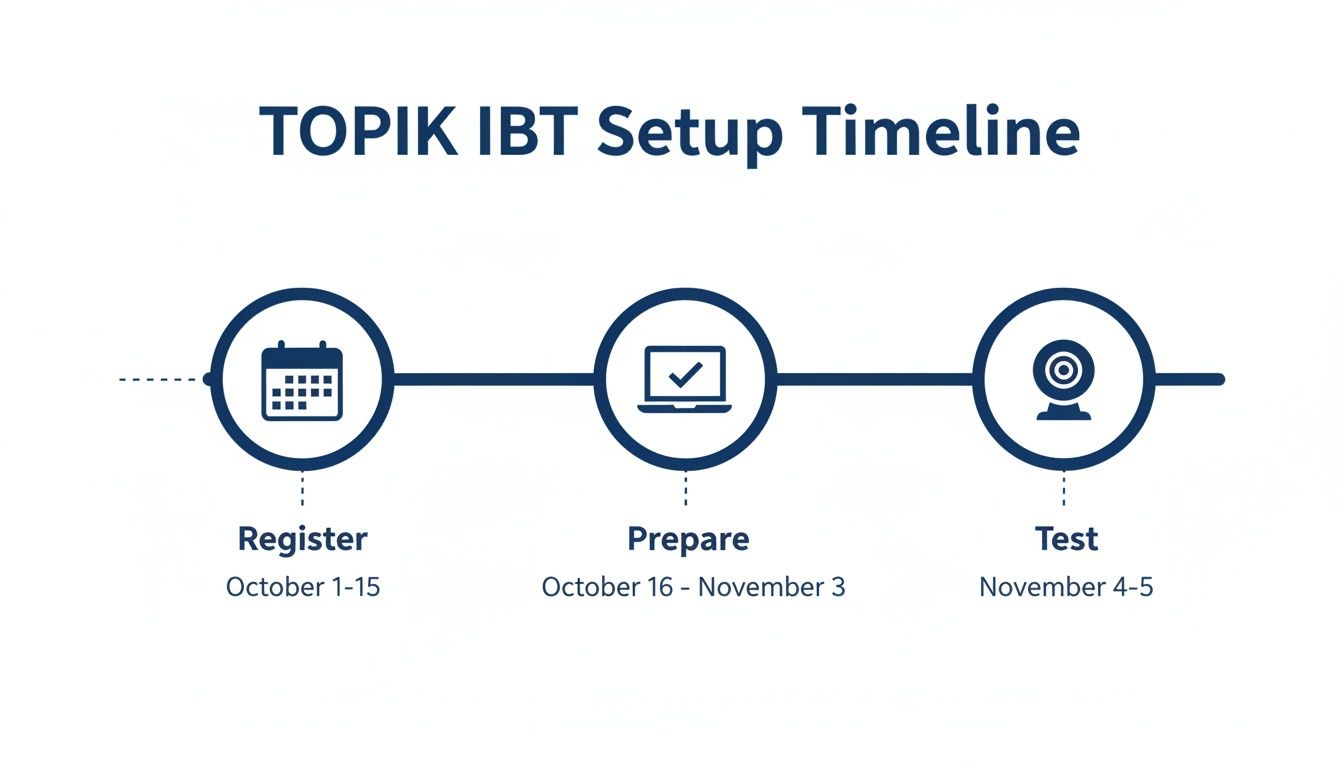
Seeing the journey mapped out helps you manage your time and avoid last-minute panic.
Why Aiming for Level 4 Matters
For international students, a high TOPIK score, particularly Level 4 or above, can completely change your academic and career opportunities in South Korea. The honest truth? Many students struggle to get there. A recent analysis revealed that only 38% of international students in Korea hold a TOPIK Level 4 or higher. Nailing that level can unlock prestigious scholarships and even let you skip required language credits. You can dig into the numbers by checking out the full report on kcampus.kr.
Building a Solid 3-Month Study Timeline
A three-month plan is a great sweet spot—enough time to cover everything without burning out. Here’s a sample structure you can adapt for TOPIK II.
| Month | Reading Focus | Listening Focus | Writing Focus |
|---|---|---|---|
| Month 1 | Build core vocabulary and grammar. Practice one reading section per week. | Listen to short, clear audio. Focus on identifying the main topic. | Master the structure for the short essay (Questions 51-52). |
| Month 2 | Increase reading speed. Complete full practice tests under timed conditions. | Listen to longer dialogues. Practice taking quick notes on key details. | Learn the structure for the long essay (Question 54). Brainstorm and outline ideas. |
| Month 3 | Review your most difficult passages. Zero in on inference questions. | Do daily listening drills with past exam audio. Practice identifying the speaker's tone. | Write two full essays per week and get them reviewed. Focus on advanced vocabulary. |
Mastering Each Section with Smart Techniques
Simply grinding through practice tests won't cut it. You need specific strategies for each part of the exam.
Reading Strategies
- Scan First, Read Later: Before diving into a passage, scan the questions. This primes your brain on what to look for.
- Focus on Connectors: Pay close attention to words like 하지만 (hajiman - but/however) and 그래서 (geuraeseo - so/therefore). They often signal a shift in argument or a conclusion.
Listening Strategies
- Predict the Content: Read the multiple-choice options before the audio starts. They often give huge clues about the topic.
- Note-Taking is Key: For longer dialogues, jot down key numbers, places, or reasons. Your notes are a vital safety net.
Writing Strategies
- Follow the Formula: Both the short and long essays have expected structures. For the long essay, a clear introduction, body paragraphs, and a conclusion are non-negotiable.
- Use Transitional Phrases: Weave in phrases like 첫째 (cheotjjae - firstly), 또한 (ttohan - also), and 결론적으로 (gyollonjeogeuro - in conclusion) to make your writing flow logically.
Essential Resources and Test-Day Strategies
Having a solid study plan is a great start, but the right resources and a clear head on test day are what truly separate a good score from a great one. This is especially true for the TOPIK Korean test online, where navigating the digital format is a skill in its own right.
Curating Your Study Toolkit
With countless resources out there, it's easy to get overwhelmed. The trick is to choose a few high-quality tools and stick with them.
Your number one resource should be official past TOPIK papers. They are the gold standard. Beyond that, here are a few other recommendations:
- Vocabulary Apps: Mobile apps like Memrise or Anki are brilliant for drilling vocabulary on the go.
- Grammar Guides: A reliable grammar book or website is non-negotiable for clearing up confusing sentence structures.
- Korean News or Podcasts: Listening to real-world Korean trains your ear to handle natural speed and intonation.
Interest in learning Korean has exploded, largely thanks to the Hallyu wave. The number of annual test-takers went from just 2,692 in 1997 to a massive 375,871 by 2019, as you can read on Statista.com. This shows why the demand for structured online prep is so high.
The K-talk Live Advantage
Self-study resources are fantastic, but they often miss one critical piece: feedback. It's almost impossible to spot your own writing mistakes without an expert eye.
At K-talk Live, our small-group classes are designed specifically to fill this gap. You get personalized attention from experienced tutors who can pinpoint your weaknesses and give you actionable advice—something you just can’t get from a book.
Mastering Your Mindset on Test Day
You've put in the hours, and now it's game day. Your performance hinges just as much on strategy and mindset as it does on your Korean knowledge. Staying calm and focused is half the battle.
Time management is everything. If you’re stuck on a question, make an educated guess, flag it, and move on. You don't want to sacrifice five easy points for one tricky one.
For the IBT, get comfortable with the interface beforehand.
- Use the Highlight Tool: Mark keywords in reading passages to help you focus.
- Keep an Eye on the Clock: The on-screen timer is your friend. Glance at it periodically to stay on pace.
- Practice Typing in Korean: If you’re not a fast Korean typist, start practicing now. Your typing speed can directly impact your essay quality.
Your Journey to Korean Fluency Starts Now
We've walked through everything from understanding the TOPIK's value to mastering test-day strategies. Passing this exam is a huge accomplishment, but it's a key milestone, not the final destination. Think of it as a stepping stone on your bigger journey to fluency—one that unlocks exciting new opportunities in Korea. Every word you learn brings you one step closer to confidence. Keep going—your Korean journey starts now!
Common Questions About the Online TOPIK
As you gear up for the big day, it's normal to have a few questions. The TOPIK has a lot of moving parts, especially the online version. Let’s clear the air and tackle some of the most common questions we hear from learners.
How Is the Online TOPIK Different from the Paper Test?
The biggest difference is the medium. The TOPIK Korean test online, or IBT, is entirely on a computer. You’ll read on a screen and type your writing answers. The content—question types, topics, difficulty—is identical to the Paper-Based Test (PBT).
A huge plus for the IBT is convenience. It usually has more test dates, and you get your results much faster, which can be a game-changer for tight application deadlines.
What Score Do I Need to Pass Each TOPIK Level?
You don't "pass" or "fail" the TOPIK. Instead, your final score determines which proficiency level you've achieved.
- TOPIK I (Levels 1-2): Scored out of 200 points.
- Level 1: 80+ points
- Level 2: 140+ points
- TOPIK II (Levels 3-6): Scored out of 300 points.
- Level 3: 120+ points
- Level 4: 150+ points
- Level 5: 190+ points
- Level 6: 230+ points
You sign up for either TOPIK I or TOPIK II, and your performance lands you one of the levels within that test's range.
How Long Are My TOPIK Scores Valid?
Your TOPIK results are valid for exactly two years from the day your scores are officially released. Plan your test date carefully with your application deadlines in mind, as there are no extensions.
Can I Really Prepare for the TOPIK by Myself?
Absolutely. Self-study is a fantastic way to build a solid foundation. However, it has blind spots, especially with writing. It's almost impossible to catch your own mistakes—like awkward phrasing or subtle grammatical errors—without feedback.
The most effective strategy is often a hybrid one. Use self-study to build your knowledge base, then use structured, guided learning to hone your interactive skills and get the expert feedback you need to excel.
🌟 Ready to start your Korean journey? Join K-talk Live — where global learners connect, speak, and grow together! Book your free trial class today.
Ready to stop reading and start speaking?
Practice what you just learned with a native Korean teacher — free for 100 minutes. No card, no commitment.