Want to practice this with a native Korean teacher?
100-min free trial — no card required.
Staring at a TOPIK exam paper for the first time can feel a little intimidating. You might wonder, "Where do I even begin?" But here’s a secret: that paper isn't just a test; it's your personal roadmap to Korean fluency. Think of it as the official blueprint showing you exactly what skills you need, where you're strong, and where you can improve.
Understanding how to use this blueprint is the first—and most important—step to acing the exam and reaching your language goals. Don’t worry, it’s not as complicated as it looks! With the right approach, that paper will become your most powerful study tool. Let's break it down together.
What Is a TOPIK Exam Paper?
So, what exactly is this document? A TOPIK exam paper is the official test booklet you'll use on exam day. It's meticulously designed by South Korea’s National Institute for International Education (NIIED) to measure how well non-native speakers can use the Korean language in real-life situations. It's much more than a random list of questions; every single part is crafted to test specific skills.
The exam itself is split into two levels, and the paper you get depends entirely on where you are in your Korean learning journey.
The Two Main Versions
First thing's first: "TOPIK" isn't one single test. It’s two completely separate exams, and each one has its own unique paper format.
TOPIK I (Beginner Level): If you're aiming for Level 1 or 2, this is your exam. The paper is pretty straightforward, combining just two sections: Listening (듣기, deutgi) and Reading (읽기, ilggi). Every question is multiple-choice, focusing on essential, everyday Korean. You'll tackle the whole thing in one 100-minute session.
TOPIK II (Intermediate-Advanced Level): This one's for learners shooting for Levels 3 through 6, and it’s a big step up. The paper is split into two sessions. The first covers Listening and Writing (쓰기, sseugi), and the second is dedicated entirely to Reading. The writing section is the game-changer here, as you'll have to produce both short-form answers and a full 600-700 character essay.
Breaking Down the Sections
Each section of the paper is designed to test a very specific skill. In Listening, you'll hear dialogues and announcements. In Reading, you'll see everything from ads to short articles. And for TOPIK II, the Writing section is where you prove you can build a logical argument using the right vocabulary and grammar.
By familiarizing yourself with the structure—the number of questions, time limits, and task types—you transform the TOPIK exam paper from an intimidating document into a predictable tool you can confidently use to plan your studies.
Knowing this blueprint is everything. It helps you pinpoint your strengths and weaknesses, manage your study time efficiently, and walk into the exam room feeling in control. Suddenly, the paper isn't a source of anxiety; it’s your best study partner on the path to fluency.
Where Can I Find Past TOPIK Exam Papers?
Getting your hands on authentic practice materials is one of the most important first steps. To truly prepare, you need to work with past papers that look and feel just like the real thing. It’s like being a detective: the better your clues, the sooner you solve the case. And the prize here is hitting your target score.
So, where do you start looking? Always go straight to the source.
The Official TOPIK Website
Your first and best stop for official past papers is the official TOPIK website, run by the National Institute for International Education (NIIED). This is the gold standard because these materials are the real deal. Honestly, the website can be a bit of a maze sometimes, but it’s completely worth the effort.
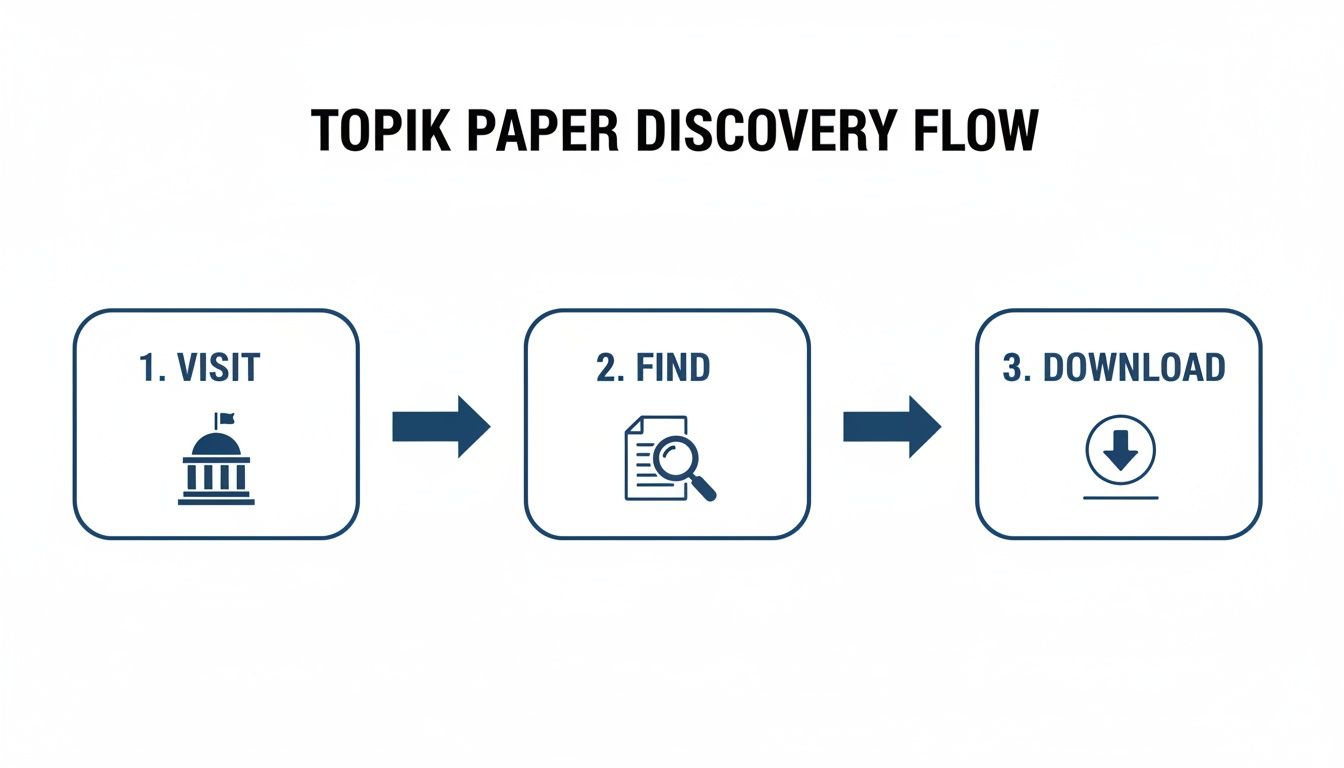
Here’s a quick roadmap:
- Head to the Website: Go to the official TOPIK portal.
- Find the Archive: Look for a section called “정보마당” (jeongbomadang, Information Square) or “기출문제” (gichulmunje, Past Questions).
- Download Everything: You should see a list of past exams, usually as downloadable PDFs. These packs are fantastic—they typically include the question booklet, the answer key, and the all-important audio files for the listening section.
Using these official papers means you're practising with questions that perfectly match the current exam’s format, difficulty, and style.
Trustworthy Alternatives for Past Papers
While the official site is king, a few other places gather these materials and often present them in a much friendlier way.
- University Language Centers: Many Korean universities with top-tier language programs often share TOPIK resources. It’s worth a look on their websites.
- Reputable Online Learning Sites: Websites focused on teaching Korean often do the hard work for you by collecting and organizing past papers. A great example is TOPIK Guide, which neatly compiles official papers.
A quick tip: whenever you use an alternative source, just double-check the paper against the official test number (like the 83rd TOPIK or 90th TOPIK). This ensures you’re working with the real McCoy.
Using official materials isn’t just about practice; it's about conditioning. You’re literally training your brain to recognize the patterns, pacing, and logic of the actual exam.
How to Spot and Dodge Unofficial Sources
The internet is flooded with unofficial mock tests and study guides. Some might be okay, but many are filled with errors, use outdated formats, or have questions that don't reflect the real test.
Here’s what to watch out for:
- No Official Test Number: Real past papers are always labeled with their administration number (e.g., the 96th TOPIK).
- Sloppy Formatting or Typos: Official papers are professionally put together.
- Paying for Old Papers: NIIED releases past papers to the public for free. You should never have to pay to download an old exam.
Sticking to official sources ensures every minute you spend with a TOPIK exam paper is time well spent, bringing you one step closer to your goal. For guided practice with an expert, you can always check out a structured course at K-talk Live.
How to Use a TOPIK Exam Paper Strategically
Finishing a practice test is a good start, but what you do after is what truly makes a difference. Anyone can sit down and work through a TOPIK exam paper, but the real magic happens when you turn that paper into your personal study guide. It’s about shifting your mindset from just doing the test to actively learning from it.
The goal isn't just to get a practice score; it's to uncover exactly where your weak spots are and then systematically fix them. This is the approach that turns an average score into a great one.
And solid preparation is more important than ever. The Korean Wave has created a massive surge in people wanting to prove their language skills. You can read about this in our insightful article about TOPIK's record-breaking numbers, which shows just how competitive it's getting.
Step 1: Simulate Real Exam Conditions
First, you have to treat every practice run like it's the real deal. This isn't just about testing your Korean; it's about building the mental stamina and time management skills you'll need on exam day.
Find a quiet spot, set a timer for the exact time allotted, and put your phone away. It's just you and the test.
This simple flowchart shows you where to find the official papers to get started.
Key Takeaway: The pressure of a ticking clock can make even easy questions feel impossible. By getting used to that pressure now, you're training your brain to stay calm and focused.
Step 2: Adopt Active Review and Analysis
Okay, the timer went off. Now the real work begins. Don't just tally up your score. Become a detective and investigate every single mistake. This is what I call active review.
For every wrong question, ask yourself why. Was it:
- A Vocabulary Gap? (e.g., not knowing 모자라다, mojarada - to be insufficient)
- A Grammar Misunderstanding? (e.g., mixing up -는 척하다, -neun cheokada - to pretend to, with -는 편이다, -neun pyeonida - to tend to)
- A Comprehension Error? Did you miss the author's main point?
- A Careless Mistake? Did you just rush or misread the question?
Figuring out the root cause of your errors is the only way you'll stop making them.
Step 3: Create a Personal Error Log
To take your active review to the next level, start an error log. This can be a simple notebook or a spreadsheet. For every mistake, jot down the question number, why you got it wrong, and the right answer with a clear explanation.
Here’s a simple setup:
| Question # | Section | My Mistake (Reason) | Correct Answer & Why | New Vocabulary/Grammar |
|---|---|---|---|---|
| 32 | Reading | Vocabulary Gap | Didn't know '해소하다' (haesohada - to resolve). The passage was about resolving stress. | 해소하다 - to resolve, relieve |
| 15 | Listening | Grammar Mix-up | I confused past and future tenses in the audio. | -았/었- vs. -(으)ㄹ 것이다 |
When you track mistakes this way, patterns will jump out at you. This insight is gold. It lets you focus your study time on the exact areas where you need the most help. This method transforms each TOPIK exam paper into a personalized roadmap, pointing you directly toward a higher score. If you want expert help analyzing your results, booking a trial class at K-talk Live is a great way to start.
Building Your Study Plan Around Practice Papers
A goal without a plan is just a wish. This couldn't be more true for a high-stakes exam like the TOPIK. It's one thing to download a TOPIK exam paper, but it's another to use it effectively. You need a structured schedule that puts these practice tests at the heart of your preparation, turning random study sessions into a powerful system.
A good plan helps you balance taking full, timed tests with the detailed review and skill-building that lead to real improvement. It helps you make steady progress and shows you where to focus your precious study time.
Tailoring Your Plan to Your Target Level
Your study schedule should look very different depending on your goal. A learner aiming for TOPIK I Level 2 has completely different needs than someone tackling TOPIK II Level 4.
If you're focusing on TOPIK I, your plan should be all about building a solid foundation. You'll spend more time on core vocabulary (단어, daneo) and basic grammar (문법, munbeop).
On the other hand, if you're aiming for TOPIK II, you need to train for endurance and complexity. Your plan must include longer study blocks to handle the extended test time and the challenging writing section.
The best study plan is not one-size-fits-all. It's a dynamic guide that reflects your current level and ultimate goal, using the TOPIK exam paper as a compass to direct your efforts.
Sample Weekly Schedule for a TOPIK II Candidate
So, what does this look like in practice? Let's say you're aiming for Level 4. A structured weekly plan is your ticket to making steady, measurable progress.
Here’s a sample schedule you can adapt:
- Monday & Tuesday (Weakness Workout): Review your error log from the weekend's practice test. Zero in on the grammar points you stumbled on and memorize new vocabulary.
- Wednesday & Thursday (Skill Building): Focus on specific sections. On Wednesday, do timed practice for the Listening section. On Thursday, tackle the Reading section.
- Friday (Writing Practice): The writing section needs dedicated time. Use Friday to write one short-form answer and outline or write a full essay.
- Saturday (Full Mock Exam): Simulate real exam conditions. Find a quiet space, set a timer, and work through an entire TOPIK exam paper.
- Sunday (Active Review): Grade your test and dive deep into your error log. Analyze why you made each mistake to fuel your plan for next week.
This cycle—test, analyze, drill, repeat—is a powerful engine for improvement. To level up, getting expert feedback on your writing can be a game-changer. You can see how this works by booking a free trial class at K-talk Live.
8-Week TOPIK Exam Paper Study Schedule
To help you visualize this over a longer period, here's a sample eight-week schedule. It's designed to ramp up intensity as you get closer to exam day.
| Week | Monday-Tuesday | Wednesday-Thursday | Friday | Saturday | Sunday |
|---|---|---|---|---|---|
| Week 1-2 | Foundational grammar & vocab review based on initial test errors. | Section-specific drills (e.g., Listening Part 1-4). | Writing Practice: Focus on Questions 51 & 52 structure. | Full Timed Mock Test | Deep Error Analysis & Update Error Log. |
| Week 3-4 | Target weak areas identified in Week 1-2 mock tests. | Focus on intermediate question types (e.g., graphs). | Writing Practice: Focus on Question 53 (graph description). | Full Timed Mock Test | Deep Error Analysis & refine study focus. |
| Week 5-6 | Advanced grammar patterns & topic-specific vocabulary. | Timed section practice under pressure. | Writing Practice: Brainstorming & outlining Question 54 (essay). | Full Timed Mock Test | Review & identify patterns in mistakes. |
| Week 7 | Intensive review of error log and most challenging concepts. | Full section simulations back-to-back. | Full writing section practice (Questions 51-54). | Full Timed Mock Test | Final error analysis. Focus on speed. |
| Week 8 | Light review of key concepts and error log. | Rest & mental preparation. | Light review, check exam details. | REST | Exam Day! |
This schedule is a template—adapt it to your own pace. The key is to stay consistent and use the data from your practice tests to guide your efforts.
Analyzing Your Results to Boost Your Score
So, you’ve finished a practice test. Great! But the real work starts now. Just running through a TOPIK exam paper is only half the battle. The other, more critical half is digging into your results to figure out exactly what went wrong and why. This is where you switch gears from being a student to being a detective.
This post-test deep dive is where you’ll see the biggest improvements. Think of each practice paper not as a test, but as a diagnostic tool that tells you precisely what to study next.
From Score to Strategy
It’s tempting to just check your score and move on. Don't do it. Instead, grab your completed paper, the answer key, and a different colored pen. As you go through your answers, don't just mark them right or wrong. For every single mistake, you need to understand the 'why'.
Are you always mixing up the same two grammar points? Do you consistently run out of time in the reading section? Nailing down these specific weaknesses is the only way to fix them for good.
This structured approach is more important than ever. With Korean culture's global boom, the TOPIK exam has gotten seriously competitive. Unfortunately, this pressure has also led to a spike in cheating. This shows how vital it is to build real, solid skills through honest, smart preparation. You can learn more about these trends and the importance of genuine study from this report on TOPIK integrity.
Turning Weaknesses Into Strengths
Once you’ve spotted your patterns, you can build a laser-focused plan. Your analysis is no longer just a list of things you got wrong; it's a personalized roadmap for what to do next.
An error isn't a failure; it's feedback. Each mistake you analyze is a signpost pointing directly to where you can make the biggest gains in your Korean proficiency.
Based on what you find, you can put practical fixes in place:
- For Vocabulary Gaps: Start a new flashcard deck with words you missed. Don't just memorize them—find example sentences so you learn them in context.
- For Grammar Blind Spots: Hunt down that specific grammar point in a textbook or online. Then, write 10-15 of your own sentences using it until it feels natural.
- For Time Pressure: Start timing yourself on individual sections with a slightly shorter deadline to build speed and confidence.
- For Writing Issues: Getting a second pair of eyes is a game-changer. At K-talk Live, our tutors can look over your practice essays and give you clear, actionable feedback.
By consistently analyzing every TOPIK exam paper you complete, you create a powerful feedback loop. It ensures every minute you spend studying is targeted, effective, and gets you one step closer to your goal score.
Common Questions About TOPIK Exam Papers
Once you start digging into past TOPIK papers, it’s totally normal for questions to pop up. Let’s walk through some of the most common things learners ask, so you can stop worrying and get back to what matters—studying.
How Many Past Papers Should I Actually Do?
This is the big one, isn't it? Honestly, there's no magic number. It's not about the quantity of papers you finish, but the quality of your review. A solid goal is to work through 5 to 10 full, timed mock tests before the real thing.
Deeply analyzing five tests and understanding every single mistake is way more powerful than just blazing through twenty of them. Each paper is a tool. Use it to find out where you're struggling and fix those weak spots. That's where real progress happens.
What's a "Good" Practice Score?
You'll know you're in a great spot when your practice scores are consistently 10-15 points higher than the minimum you need for your target level. For example, if you're aiming for Level 4 (which needs a 150), you should be regularly hitting the 160-165 range in your mock tests.
Why the extra buffer? Test-day nerves are real! They can easily knock a few points off your score. Having that cushion from your practice sessions means you can walk in with confidence, knowing you have some wiggle room.
Remember: A practice score is just a snapshot, not a final verdict. It’s feedback to help you figure out what to study next, not a judgment on what you're capable of.
How Do I Beat the Clock in the Writing Section?
The TOPIK II writing section feels like a sprint. The secret isn't writing faster; it's managing your time smarter. You need a game plan.
Here’s a breakdown that works for the 50-minute writing test:
- Questions 51-52 (Fill-in-the-Blanks): Give these 5-7 minutes, max.
- Question 53 (Graph Summary): Allot 10-12 minutes. Your job is to describe the data using standard phrases you’ve practiced.
- Question 54 (The Essay): This leaves you a solid 30 minutes. Break it down: 5 minutes to brainstorm and outline, 20 minutes to write, and the last 5 minutes to proofread.
Drill this timing with every practice paper, and it will become second nature.
Your Korean Journey Starts Now
Working with a TOPIK exam paper is one of the smartest ways to prepare for success. It's more than just a test—it's a tool that helps you understand your own learning, identify your weaknesses, and build a study plan that truly works. Remember, every mistake you find and fix is a step closer to achieving your goal. Don't be afraid to dive deep, analyze your results, and use that knowledge to become a more confident Korean speaker.
Every word you learn brings you one step closer to confidence. Keep going—your Korean journey starts now!
🌟 Ready to start your Korean journey? Join Ktalk.live—where global learners connect, speak, and grow together! Book your free trial class today and feel the difference a structured approach can make.
Ready to stop reading and start speaking?
Practice what you just learned with a native Korean teacher — free for 100 minutes. No card, no commitment.