Want to practice this with a native Korean teacher?
100-min free trial — no card required.
Ever found yourself a bit lost when your favorite K-drama characters are trying to set up a date? Don’t worry, you’re not alone! Learning how to tell the time in Korean might seem challenging at first—especially with two different number systems—but it’s a fun and rewarding journey.
Getting a handle on this practical skill is a huge confidence booster. It’s not just about memorizing numbers; it’s about unlocking a deeper connection to Korean culture and making your daily interactions much smoother. This guide will break it all down step-by-step, making it simple and easy to apply immediately. Let’s get started!
Why Learning Korean Time Is a Game-Changer
Honestly, mastering time in Korean is one of those fundamental skills that smooths out everyday life, whether you're navigating Seoul or just chatting with Korean friends online. You’re not just memorising vocabulary; you're plugging directly into the rhythm of daily Korean life.
It's no secret that interest in the Korean language is exploding, thanks to the global cultural wave known as Hallyu. This isn't just a feeling; it's backed by the record-breaking number of people signing up for Korean proficiency exams.
So, how does telling time fit into this?
- You'll be able to navigate subway timetables and event schedules like a local.
- Making plans with friends or setting up meetings becomes a breeze.
- You’ll finally catch all those time-specific references in K-dramas and movies without missing a beat.
This surge in language learning shows just how important practical skills are. For K-pop fans and business professionals alike, knowing how to ask "What time is it?" is a real-world superpower. You can read more about this trend on koreatimes.co.kr.
Understanding Korea's Two-Number System
The secret to telling the time in Korean boils down to one core rule that really sets it apart from English. Korea actually uses two completely different sets of numbers—one for the hours and a separate one for the minutes.
It might sound complicated, but think of it like this: you have two toolkits. You use one set of tools for the big stuff (the hours) and a different set for the finer details (the minutes). It feels a little strange at first, but with a bit of practice, it becomes second nature. Don’t worry if you make mistakes—what matters most is progress!
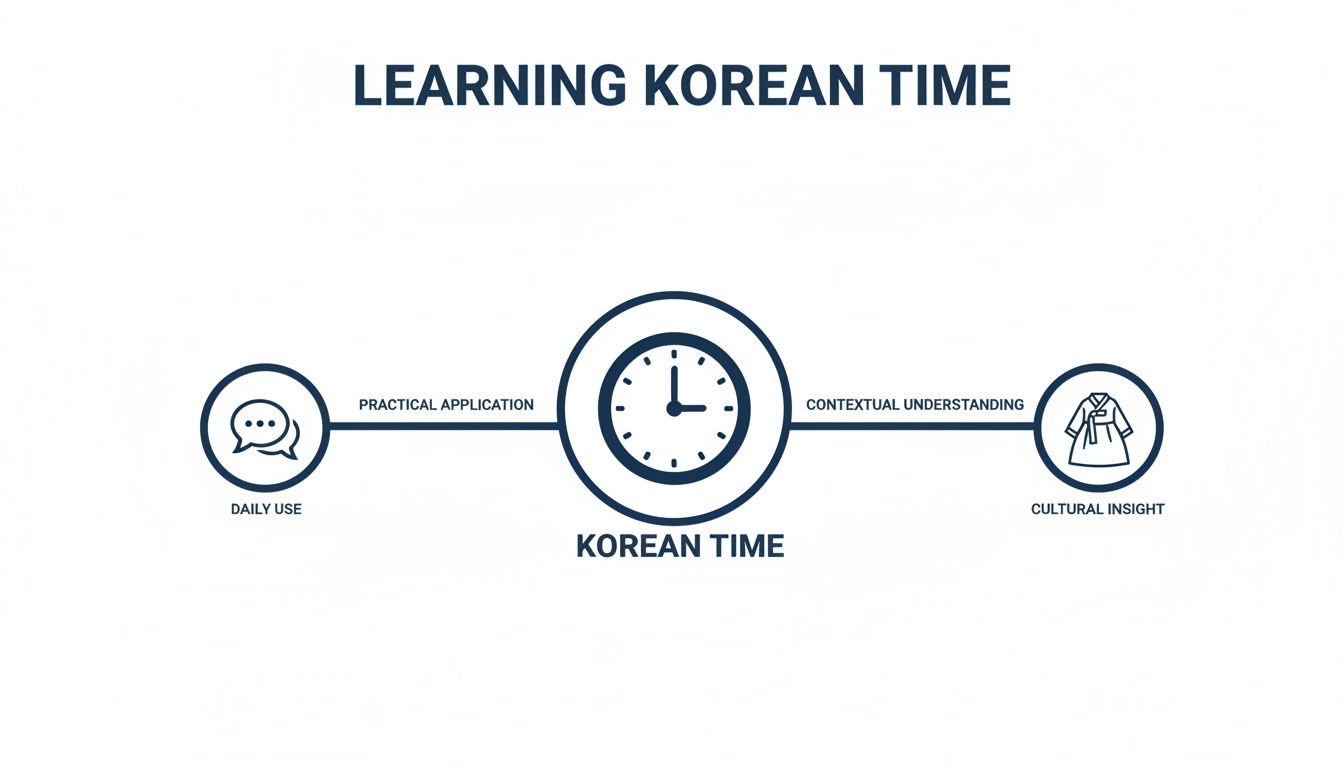
This dual system is the absolute foundation of telling time. Once you get the hang of switching between the two, you're well on your way to sounding like a natural.
The Two Number Systems for Telling Time
So, let's break it down. You'll be using the Native Korean system for the hour and the Sino-Korean system for the minute. The table below covers the essential numbers you'll need for everyday conversations.
| Number | Native Korean (For Hours) | Romanisation | Sino-Korean (For Minutes) | Romanisation |
|---|---|---|---|---|
| 1 | 하나 (hana) | hana | 일 (il) | il |
| 2 | 둘 (dul) | dul | 이 (i) | i |
| 3 | 셋 (set) | set | 삼 (sam) | sam |
| 4 | 넷 (net) | net | 사 (sa) | sa |
| 5 | 다섯 (daseot) | daseot | 오 (o) | o |
| 6 | 여섯 (yeoseot) | yeoseot | 육 (yuk) | yuk |
| 7 | 일곱 (ilgop) | ilgop | 칠 (chil) | chil |
| 8 | 여덟 (yeodeol) | yeodeol | 팔 (pal) | pal |
| 9 | 아홉 (ahop) | ahop | 구 (gu) | gu |
| 10 | 열 (yeol) | yeol | 십 (sip) | sip |
| 11 | 열하나 (yeolhana) | yeolhana | 십일 (sibil) | sib-il |
| 12 | 열둘 (yeoldul) | yeoldul | 십이 (sibi) | sib-i |
| 20 | - | - | 이십 (isip) | i-sip |
| 30 | - | - | 삼십 (samsip) | sam-sip |
| 40 | - | - | 사십 (sasip) | sa-sip |
| 50 | - | - | 오십 (osip) | o-sip |
Getting comfortable with these two columns is your first big step. Let's look at each one more closely.
Native Korean Numbers: Just for the Hours
When you’re talking about the hour, from 1 o'clock to 12 o'clock, you'll always use the Native Korean numbers. These are the original, pure Korean words for counting, used for things like your age, objects, and, of course, the hours on a clock.
For now, you only need to focus on numbers one through twelve. That’s it! You won’t need any higher Native Korean numbers for telling time.
A Quick Tip: Notice that for 1, 2, 3, and 4 (하나, 둘, 셋, 넷), the final consonant is often dropped when followed by a counter word like 시 (si) for 'hour'. So, you'd say 한 시 (han si) for one o'clock, not hana si. We'll dive deeper into this in the next section!
Sino-Korean Numbers: Covering the Minutes
Alright, now let's switch gears to the minutes. For this, you’ll use Sino-Korean numbers, which originally came from Chinese characters. These are the numbers you use for almost everything else in Korea: money, dates, phone numbers, and, importantly for us, the minutes and seconds.
The great thing about the Sino-Korean system is how logical it is. Once you learn the basic building blocks from 1 to 10, you can construct any other number.
Here's how it works:
- The Basics (1-10): 일 (il), 이 (i), 삼 (sam), 사 (sa), 오 (o), 육 (yuk), 칠 (chil), 팔 (pal), 구 (gu), 십 (sip).
- Building Bigger Numbers: Let's say you want to express 25 minutes. You simply combine the word for 'two' (이, i) with 'ten' (십, sip) to get 'twenty' (이십, isip). Then, you just add 'five' (오, o) at the end. The result is 이십오 (isip-o).
- Another Example - 45 Minutes: Following that same pattern, you’d say ‘four-ten-five’, which comes out to 사십오 (sasip-o).
Mastering this switch—Native for hours, Sino-Korean for minutes—is the key. Once it clicks, telling the time in Korean will feel completely natural.
How to Combine Hours and Minutes
Alright, now that we’ve untangled the two Korean number systems, it's time for the fun part: putting them together to actually tell the time in Korean. The formula is wonderfully simple and consistent, so once it clicks, you've pretty much got it down.
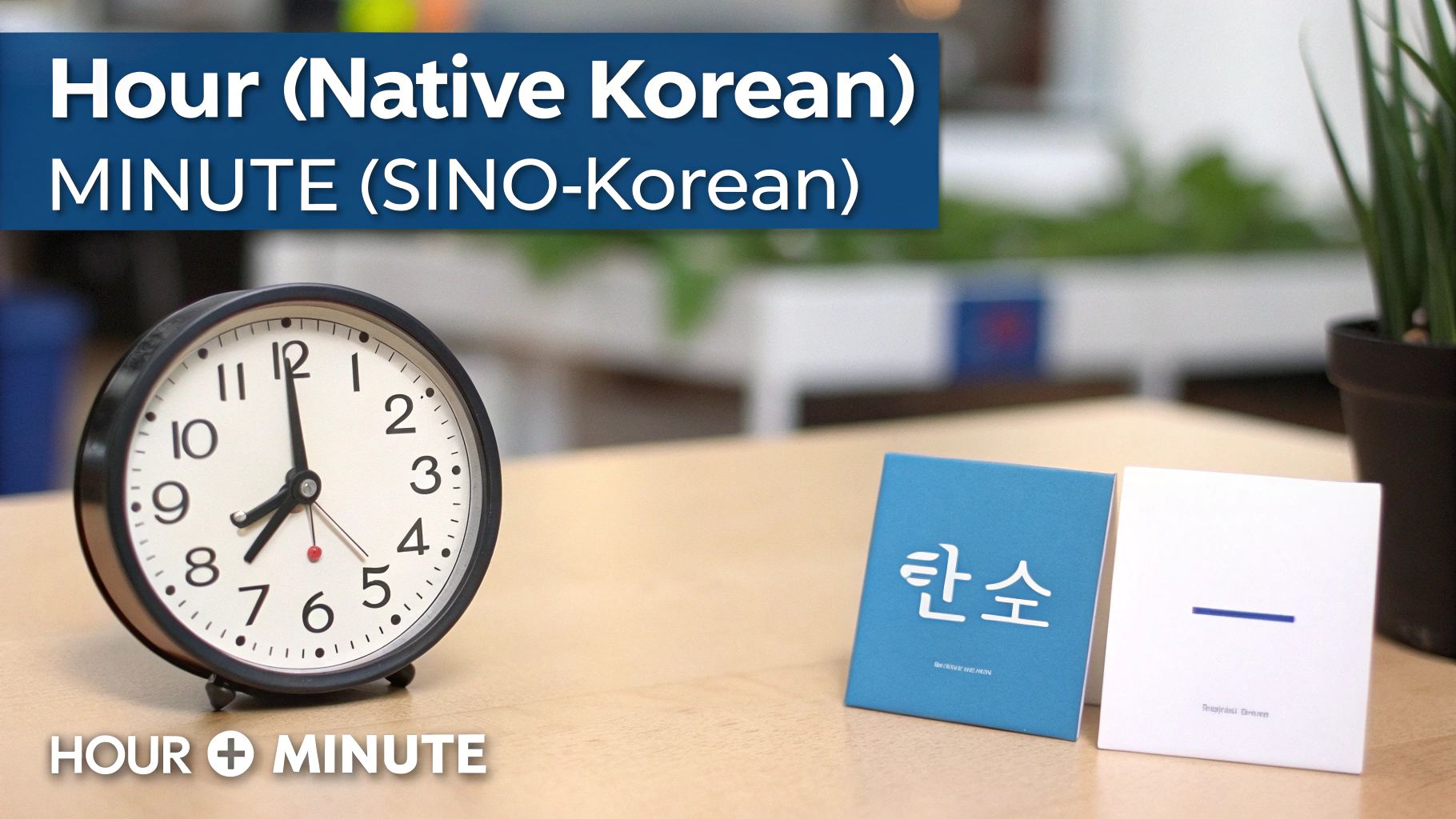
Here’s the basic structure: [Native Korean Hour] + 시 (si) + [Sino-Korean Minute] + 분 (bun).
Just think of 시 (si) as "hour" or "o'clock," and 분 (bun) as "minute." All you have to do is pop the right numbers into that formula. Simple as that.
Putting It All Together
Let's walk through a real example. Say you want to tell someone it's 2:30. You'll grab "two" from your Native Korean list (둘, dul) and "thirty" from the Sino-Korean one (삼십, samsip).
Then, you just attach the counters:
- For the hour: 둘 (dul) + 시 (si) = 둘 시 (dul si)
- For the minute: 삼십 (samsip) + 분 (bun) = 삼십 분 (samsip bun)
Combine them, and you get 둘 시 삼십 분 (dul si samsip bun). It’s that logical!
Mastering practical skills like this is more valuable than ever. With global interest in Korean culture booming, the Korean language learning market in South Korea is projected to hit over USD 2.6 billion by 2034. This growth is fuelled by everything from K-pop fans to professionals aiming for jobs at giants like Samsung and Hyundai, showing just how important fundamentals like telling time really are.
A Crucial Rule for Sounding Natural
Before we get to more practice, there's one small but super important exception you need to know. The first four Native Korean numbers—하나 (hana), 둘 (dul), 셋 (set), and 넷 (net)—actually change their form a little bit when you add the hour counter 시 (si).
Key Takeaway: For hours 1, 2, 3, and 4, you have to use the shortened forms. This is one of those little tricks that makes a huge difference in sounding fluent and not like a textbook.
Here’s the change you need to memorise:
- 1 o'clock: 하나 (hana) becomes 한 (han) → 한 시 (han si)
- 2 o'clock: 둘 (dul) becomes 두 (du) → 두 시 (du si)
- 3 o'clock: 셋 (set) becomes 세 (se) → 세 시 (se si)
- 4 o'clock: 넷 (net) becomes 네 (ne) → 네 시 (ne si)
Don't worry, the other Native Korean numbers (from 5 to 12) stay exactly the same. Five o'clock is just 다섯 시 (daseot si). This little quirk only applies to the first four hours.
More Examples for Practice
Let's build that muscle memory with a few more examples. Keep the formula in mind: Native Hour (shortened if needed) + 시 + Sino-Korean Minute + 분.
- 1:15 → 한 시 십오 분 (han si sibo bun)
- 3:45 → 세 시 사십오 분 (se si sasibo bun)
- 7:20 → 일곱 시 이십 분 (ilgop si isip bun)
- 11:50 → 열한 시 오십 분 (yeolhan si osip bun)
Try saying these out loud. The more you repeat them, the more natural that switch between the two number systems will start to feel.
Using AM PM and Other Essential Vocabulary
You've got the hours and minutes down pat. Fantastic! Now, let's add another layer to make your time-telling skills even more precise. Just like in English, you'll need to clarify if you're talking about the morning or the afternoon.
The main twist? In Korean, these words come before the time, not after. It’s a simple word order flip that makes a world of difference.
Getting this right is a crucial step, especially for the thousands of international students in South Korea who need to navigate daily life. With 48,924 students enrolled in language programmes, mastering practical skills like this is non-negotiable for hitting the proficiency levels universities demand. If you're curious, you can dig into more Korean language study trends on studyinkorea.go.kr.
Distinguishing Morning from Afternoon
To specify AM or PM, you'll need two core words. Think of them as setting the stage before you state the actual time.
- 오전 (ojeon): This means "morning" and covers your AM hours.
- 오후 (ohu): This means "afternoon" and is used for PM.
Let’s put them to work. To say "10 AM," you’d place 오전 (ojeon) right at the front: 오전 열 시 (ojeon yeol si). In the same way, "3 PM" becomes 오후 세 시 (ohu se si).
Key Rule to Remember: Always put 오전 (ojeon) or 오후 (ohu) at the very beginning of the time phrase, right before the hour. This is a simple but rock-solid rule in Korean.
More Must-Know Time Vocabulary
To really sound natural, you'll want to sprinkle in a few more key words beyond just AM and PM. Think of these as the shortcuts and special terms that native speakers use all the time.
Here's a quick-reference table to help you build out that vocabulary.
Essential Korean Time-Related Vocabulary
| English Term | Korean (Hangul) | Romanisation | Example Usage |
|---|---|---|---|
| Noon | 정오 | jeong-o | Let's meet at 정오 (jeong-o) for lunch. |
| Midnight | 자정 | jajeong | I studied until 자정 (jajeong) last night. |
| Half (as in "half past") | 반 | ban | It's 두 시 반 (du si ban), or 2:30. |
| Dawn/Daybreak | 새벽 | saebyeok | I woke up at 새벽 (saebyeok) to watch the sunrise. |
| Morning | 아침 | achim | I eat breakfast in the 아침 (achim). |
| Evening/Dinner time | 저녁 | jeonyeok | What are you doing this 저녁 (jeonyeok)? |
Let's dive a little deeper into the most common ones.
Using 정오 (jeong-o) for 12 PM and 자정 (jajeong) for 12 AM will instantly make you sound more fluent than saying 오후 열두 시 (ohu yeoldu si).
But the real game-changer is 반 (ban), which means "half." Instead of meticulously saying 두 시 삼십 분 (du si samsip bun) for 2:30, you can just say the much cooler, much more common 두 시 반 (du si ban). Seriously, this is a massive fluency booster you’ll hear everywhere.
Adding these terms to your toolkit will make your conversations about time feel less like a textbook exercise and more like the real thing.
Asking for the Time and Responding Naturally
Knowing how to state the time is one thing, but conversations are a two-way street, right? Now, let's flip the script and learn how to ask for the time. This is where your Korean skills really start to come alive in the real world.
The most common, can't-go-wrong way to ask "What time is it?" is 지금 몇 시예요? (Jigeum myeot siyeyo?). This is your go-to phrase—perfect for asking a shopkeeper, an older person, or pretty much anyone you don't know well.
Let’s quickly break that down:
- 지금 (jigeum) means "now."
- 몇 (myeot) is the question word for "what" or "how many."
- 시예요? (siyeyo?) is the polite, question form of "is the hour?"
So, you're literally asking, "Now, what hour is it?" Easy enough!
Casual and Formal Variations
Of course, Korean has different levels of politeness, and asking the time is no exception. While 지금 몇 시예요? (Jigeum myeot siyeyo?) is your safe bet for most situations, you’ll want to adjust your language depending on who you're with.
Talking to a close friend, a classmate your age, or someone younger? You can drop the formality and say 몇 시야? (Myeot siya?). It’s much more casual and friendly. You’ll notice 지금 (jigeum) often gets dropped in casual chats because it’s just assumed you're asking about right now.
How to Respond Like a Native Speaker
So, what happens when someone asks you for the time? You could just state it directly—for example, 세 시 십 분이에요 (se si sip bunieyo) for "It's 3:10." That's perfectly correct.
But if you want to sound more natural, take a cue from native speakers. They often start their response with 지금 (jigeum), just like in the question.
Pro Tip: Kicking off your answer with 지금 (jigeum), meaning "now," instantly makes you sound more conversational. It’s a tiny tweak, but it’s one of those details that really boosts your fluency.
For instance, if it’s 3 o'clock sharp, a very natural answer would be 지금 세 시예요 (Jigeum se siyeyo)—"It's three o'clock now." This little addition makes your Korean feel much less like a textbook and much more like the real thing.
Your Korean Time Questions, Answered
As you start getting the hang of telling time in Korean, you'll naturally run into a few specific questions. I've been there! Let's clear up some of the most common sticking points that trip up learners.
Does Korea Use a 24-Hour Clock?
Funny enough, the answer is both yes and no. It really depends on the situation.
You'll definitely see the 24-hour clock (what some call military time, like 14:00 for 2 PM) used for anything official. Think train schedules, airport departure boards, and formal documents. Using it in these contexts prevents any confusion, which is crucial.
But in everyday conversation? It's all about the 12-hour system. When you're chatting with friends or making plans, you'll almost always hear people use 오전 (ojeon) for AM and 오후 (ohu) for PM to specify the time of day.
How Do I Say Quarter Past or Quarter To?
This is a great question, and it actually reveals a neat little simplification in the Korean language. Unlike in English, there isn't really a common, direct equivalent for "quarter past" or "quarter to."
Koreans just keep it straightforward and say the exact minutes.
- For "quarter past" (like 3:15), you simply say the number 15. It's 세 시 십오 분 (se si sibo bun).
- For "quarter to" (like 2:45), you just say the number 45: 두 시 사십오 분 (du si sasibo bun). Simple as that!
What Is the Difference Between 시 and 시간?
Ah, the classic 시 (si) vs. 시간 (sigan) dilemma. This is a hurdle for almost every learner, but the difference is actually quite logical once you see it. They both involve "hours," but they can't be swapped.
The Key Distinction: Think of 시 (si) as a point on the clock ("o'clock"), while 시간 (sigan) is a duration or an amount of hours ("for two hours").
Here’s a simple way to remember it:
- Asking "When?" Use 시 (si). "Let's meet at two o'clock." → 두 시에 만나요 (Du sie mannayo).
- Asking "How long?" Use 시간 (sigan). "The movie is two hours long." → 영화는 두 시간이에요 (Yeonghwaneun du siganieyo).
How Do I Ask What Time Something Starts?
Okay, so you can ask what time it is now, but what about asking when an event is happening? This is where you'll get a ton of mileage out of one super useful phrase: 몇 시에 시작해요? (Myeot sie sijakaeyo?).
This translates perfectly to, "At what time does it start?" It's a polite and incredibly practical question you can use for pretty much anything—movies, classes, meetings, you name it.
Conclusion
Mastering how to tell the time in Korean is more than just a language lesson—it's your ticket to navigating daily life with confidence. By understanding the two number systems and practicing the key phrases, you've taken a huge step toward fluency. Remember to embrace the small rules, like shortening the first four hours and using words like 반 (ban) for "half past."
Every word you learn brings you one step closer to confidence. Keep practicing, stay curious, and don't be afraid to make mistakes. Your Korean journey starts now!
🌟 Ready to start your Korean journey? Join Ktalk.live — where global learners connect, speak, and grow together! Book your free 100-minute trial class today.
Ready to stop reading and start speaking?
Practice what you just learned with a native Korean teacher — free for 100 minutes. No card, no commitment.