
Want to practice this with a native Korean teacher?
100-min free trial — no card required.
Learning Korean might seem challenging at first, but with the right approach, it becomes a fun and rewarding journey! If you want to spell hello in Korean, the first and most essential phrase to learn is 안녕하세요 (romanised as annyeonghaseyo). This single, versatile greeting is your key to starting almost any conversation in Korea with respect and a friendly tone. It's the perfect first step on your path to speaking confidently, and this guide will show you exactly how to say, write, and use it like a pro.
Your First and Most Important Korean Greeting
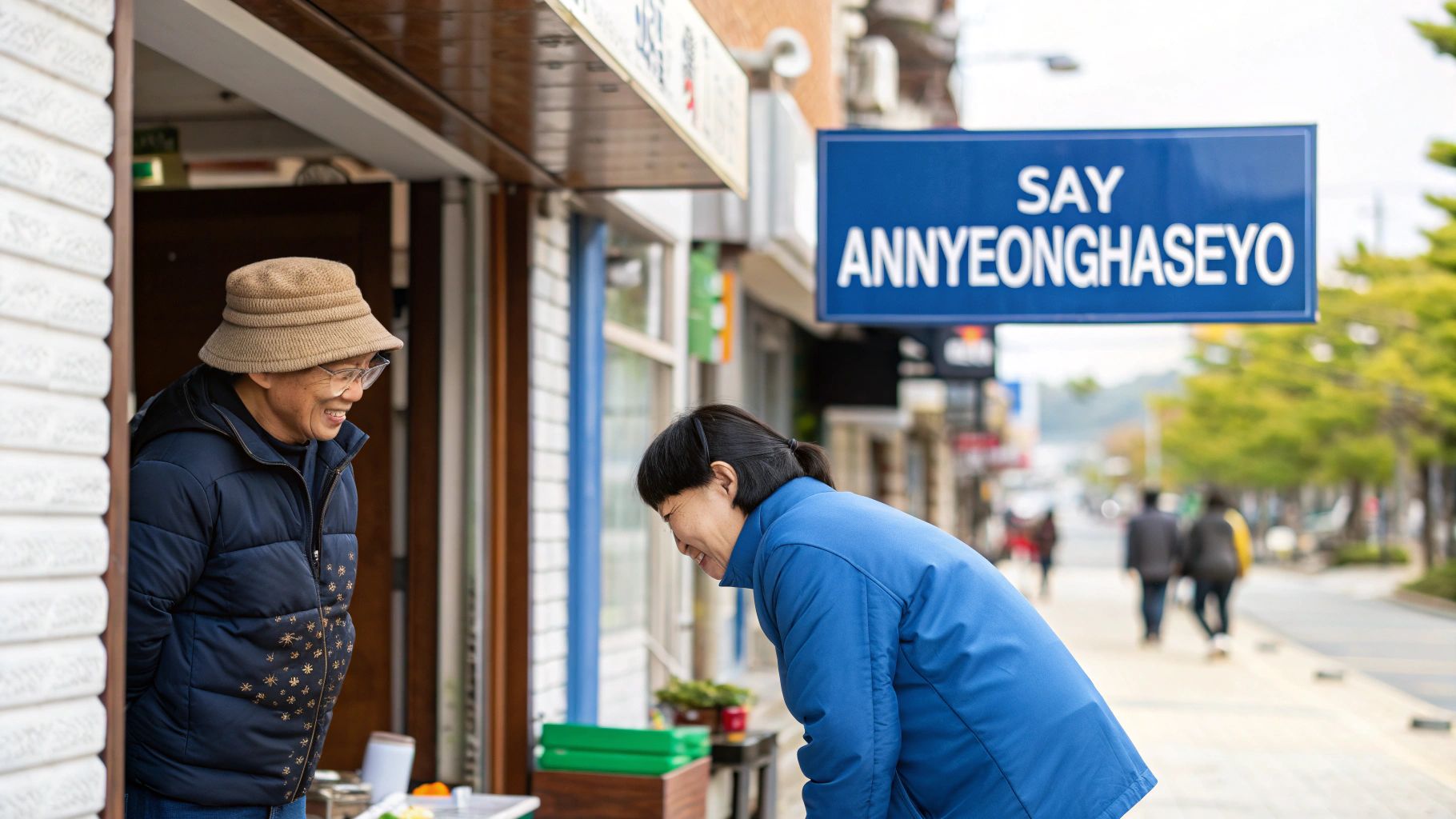
Ready to learn the single most useful phrase in the entire Korean language? Let's dive into 안녕하세요 (annyeonghaseyo).
Think of this as your go-to greeting for nearly every situation. Whether you're walking into a shop, meeting a new teacher, or greeting an elder, this phrase is always the right choice. Its built-in politeness makes it a safe and perfect starting point for any beginner.
What's really beautiful about 안녕하세요 is that it goes beyond a simple "hello." It literally translates to something closer to "Are you at peace?" or "Be well." This reflects a core value in Korean culture: wishing well-being upon others. When you say it, you're not just acknowledging someone; you're sharing a warm, positive sentiment.
Why Mastering This Phrase Matters
Learning to say and spell hello in Korean correctly does more than teach you a new word—it opens a door to cultural understanding. Accompanying your greeting with a slight bow (a simple nod of the head is often enough) shows respect and awareness of local customs. It’s a small gesture that makes a huge difference.
Interest in learning Korean has exploded, driven by the global popularity of K-pop and K-dramas. The Korean language learning market has seen massive growth, projected to reach nearly USD 69 billion by 2034. You can read more about the rising interest in Korean language studies to see how learners like you are part of a huge global community.
Breaking Down the Syllables
One of the best things about Hangul, the Korean alphabet, is how logical it is. Words are formed by combining letters into neat syllable blocks, which makes even longer words much easier to tackle.
Let’s take a closer look at how 안녕하세요 is built.
Breaking Down 안녕하세요 (Annyeonghaseyo)
| Syllable Block (Hangul) | Individual Letters | Romanisation | Pronunciation Tip |
|---|---|---|---|
| 안 | ㅇ + ㅏ + ㄴ | an | Sounds like "ahn," as in the name "Ann." |
| 녕 | ㄴ + ㅕ + ㅇ | nyeong | The 'eo' is like the 'u' in 'sung.' Ends with an 'ng.' |
| 하 | ㅎ + ㅏ | ha | A simple "ha" sound, like you're laughing. |
| 세 | ㅅ + ㅔ | se | Sounds like "say" but without the 'y' sound at the end. |
| 요 | ㅇ + ㅛ | yo | Exactly like saying "yo!" |
Breaking it down into these five simple blocks—안 (an), 녕 (nyeong), 하 (ha), 세 (se), and 요 (yo)—makes memorizing the spelling and pronunciation so much easier. As you begin your journey, getting this phrase down will be your first big win and give you the confidence to start speaking from day one.
Greeting Friends with a Casual Annyeong

Once you've got the polite 안녕하세요 (annyeonghaseyo) down, you can learn its more relaxed and friendly cousin: 안녕 (annyeong). This is the version you’ll hear constantly in K-dramas between close friends, and it’s perfect for creating a warm, informal vibe.
Just like you wouldn't say "How do you do?" to your best friend, using the right level of formality is key in Korean. 안녕 is your go-to greeting for people you know well and are close with, or for anyone younger than you. It shows familiarity and helps you sound much more natural.
Understanding the Spelling and Sound
Here’s the best part: if you know 안녕하세요, you already know how to spell 안녕! It’s literally just the first two syllable blocks from the formal greeting. Easy, right?
- 안 (an): This block is built from ㅇ + ㅏ + ㄴ and sounds like "ahn."
- 녕 (nyeong): This one combines ㄴ + ㅕ + ㅇ, giving it that soft "nyeo" start and a nasal "ng" sound at the end.
Put them together and you get 안녕 (annyeong). Don't worry if you make mistakes at first—even Koreans do sometimes! What matters most is progress.
When to Use Annyeong (and When to Definitely Avoid It)
Learning to switch between jondaemal (존댓말, formal language) and banmal (반말, casual language) is a huge milestone. Using 안녕 in the wrong situation can come off as rude, even if you don't mean it to be.
My Golden Rule: When in doubt, always default to the more formal 안녕하세요. It's always better to be seen as too polite than accidentally disrespectful, especially when meeting someone new or speaking to an elder.
So, who can you greet with a casual 안녕?
- Close friends (your age or younger)
- Classmates you have a good rapport with
- Younger siblings and relatives
And who should you avoid using it with?
- Teachers and professors
- Your boss or anyone senior to you at work
- Store clerks, waiters, or strangers
- People who are clearly older than you
Getting a feel for this distinction will do wonders for building genuine connections and showing respect for Korean culture.
Answering the Phone the Korean Way
When your phone rings in Korea, you’ll need a completely different greeting. It might feel natural to reach for 안녕하세요 (annyeonghaseyo), but that's not what you'll hear. The go-to phrase is 여보세요 (yeoboseyo).
Think of it as the direct equivalent of picking up the phone and saying, "Hello?" in English. It’s a special-use greeting reserved almost entirely for phone calls, and using it is a simple way to show you’re familiar with this little bit of Korean culture.
Breaking Down Yeoboseyo
Let's pull 여보세요 apart. It's just four quick syllables that roll off the tongue.
- 여 (yeo): This one is just ㅇ + ㅕ. The eo vowel sound is similar to the 'u' in "fun" or "sung."
- 보 (bo): A simple combination of ㅂ + ㅗ, which makes a clear "boh" sound.
- 세 (se): Made from ㅅ + ㅔ. It sounds a lot like the English word "say," but cut a little shorter.
- 요 (yo): The same ㅇ + ㅛ we saw in our other greetings. It sounds just like you’re saying "yo!"
Put it all together and you get 여보세요 (yeoboseyo). Try adding a slight upward lilt to your voice at the end, just like you would when asking "Hello?" on the phone.
Pro Tip: While its main job is answering the phone, you might sometimes hear 여보세요 used to get someone's attention if they're far away. It’s like shouting, "Hello? Anybody there?" But 99% of the time, you'll hear it on a call.
Putting It into Practice
So, how does this sound in a real conversation? Let’s imagine your friend, Min-jun, gives you a call.
- (Phone rings)
- You: 여보세요? (Yeoboseyo?)
- Min-jun: 여보세요. 나야, 민준이. (Yeoboseyo. Naya, Minjun-i.) - "Hello. It's me, Min-jun."
See how both people use it to kick off the call? Mastering this single phrase will make your Korean sound much more natural.
Typing and Writing Your Korean Greetings
Once you've got the pronunciation down, the next step is to write these greetings out. Whether you're scribbling in a notebook or tapping out a text message, this is one of the best ways to make new words stick.
Think about a simple, everyday scenario like answering your phone. It’s a perfect real-world example of putting your new skills to use.
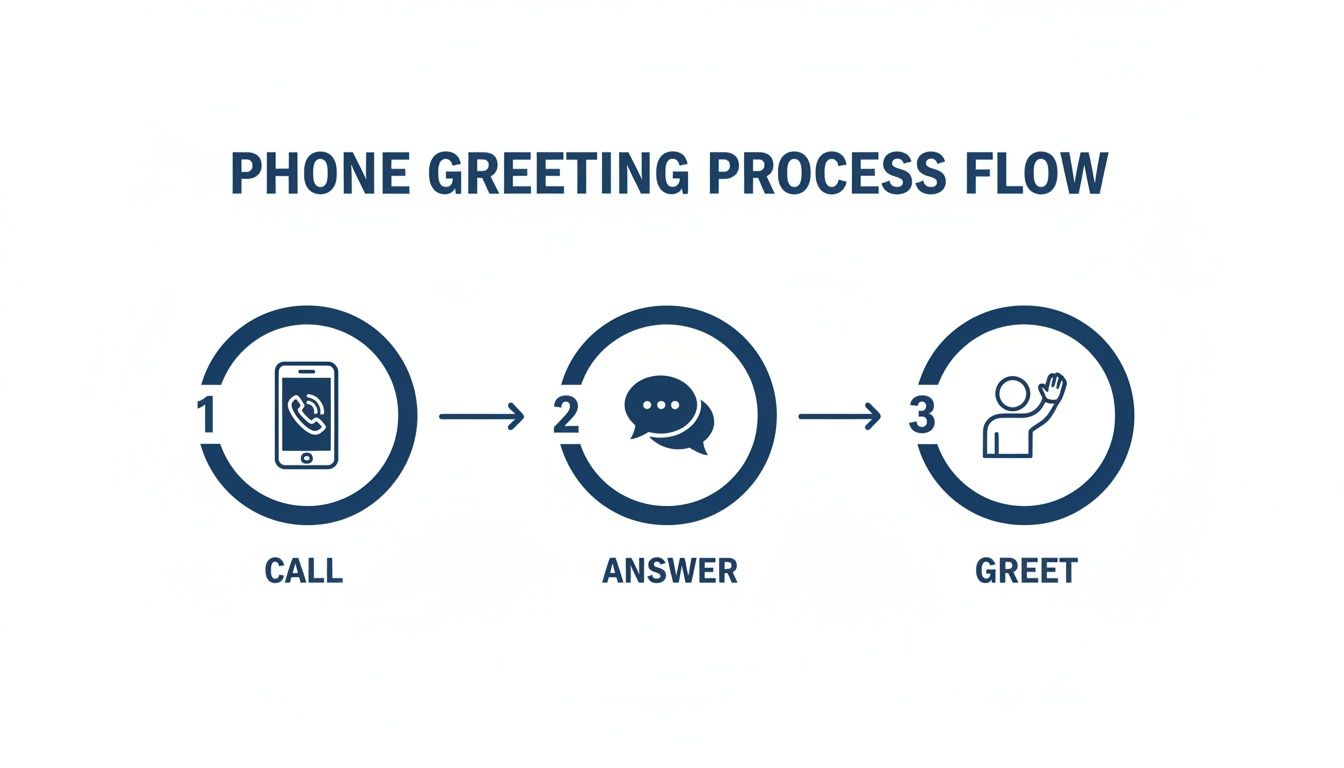
This diagram shows how smoothly a call flows into a greeting. It's that moment where you stop thinking about the mechanics and just do it.
Handwriting and Stroke Order
There’s a real art to writing Hangul, and the secret is in the stroke order. Getting it right from the start not only makes your characters look neat and balanced, but it also helps you write much faster later on.
For a word like 안녕하세요, you tackle it one syllable block at a time, always following two simple rules:
- Top to bottom: Every vertical line is drawn downwards.
- Left to right: Every horizontal line is drawn from left to right.
Stick to this, and your handwriting will look clean and authentic.
Typing on Your Devices
Worried about typing? Don't be. Adding a Korean keyboard to your phone or computer is surprisingly easy, and the layout is incredibly intuitive. Most layouts place consonants on the left side and vowels on the right, which feels natural because it’s how the syllable blocks are built.
Being able to spell hello in Korean, both by hand and on a keyboard, is a practical skill that connects the sounds you've learned to the shapes you're seeing, cementing the language in your mind.
You’re in good company. The global interest in Korean is exploding. Recently, a record-breaking 550,000 people took the Test of Proficiency in Korean (TOPIK)—the highest number since the test began. You can read more about the record-high TOPIK participation and get a sense of the massive community you're now a part of.
Choosing the Right Greeting Every Time
Knowing how to spell hello in Korean is a great first step, but the real magic happens when you know which 'hello' to use. In Korea, your choice of greeting is the first and most important way you show respect, and it speaks volumes before you even get into a conversation.
This is all tied to the Korean system of honorifics—a core part of the language that reflects social hierarchy. Picking between 안녕하세요 (annyeonghaseyo) and 안녕 (annyeong) isn't just a grammar choice; it’s you showing you understand the social context.
Formal vs Informal in Action
Let’s break this down with a quick guide to make sure you're always making the right impression.
Choosing Your Korean 'Hello': Formal vs. Informal
Here’s a simple table to help you decide which greeting fits the moment. Think of it as your cheat sheet for navigating Korean social cues.
| Greeting | Formality Level | When to Use | Example Scenario |
|---|---|---|---|
| 안녕하세요 | Formal/Polite | Meeting elders, teachers, strangers, or in professional settings. | Greeting a barista at a café in Seoul. |
| 안녕 | Informal/Casual | With close friends, classmates you know well, or someone younger than you. | Saying hi to a friend you’re meeting for lunch. |
Choosing correctly shows you’re not just memorizing words—you’re genuinely engaging with the culture. This cultural fluency is becoming more important than ever. South Korea recently surpassed its goal of hosting 300,000 international students two years ahead of schedule, with many there for language training. It just goes to show how vital these skills are, as you can learn more about Korea's international student boom and its implications.
Beginner's Golden Rule: When in doubt, always go with the formal option: 안녕하세요. It's impossible to offend someone by being too polite, and this simple rule will save you from any awkward moments as you find your footing.
Conclusion
Mastering how to spell hello in Korean is your first major step toward fluency. By understanding the difference between the formal 안녕하세요 (annyeonghaseyo) for showing respect and the casual 안녕 (annyeong) for friends, you're not just learning words—you're learning culture. Remember to also use 여보세요 (yeoboseyo) for phone calls to sound like a natural. Practice these greetings, and you'll build the confidence to start real conversations. Every word you learn brings you one step closer to confidence. Keep going—your Korean journey starts now!
🌟 Ready to start your Korean journey? Join Ktalk.live — where global learners connect, speak, and grow together! You can book a free trial class at https://ktalk.live.
Ready to stop reading and start speaking?
Practice what you just learned with a native Korean teacher — free for 100 minutes. No card, no commitment.