Want to practice this with a native Korean teacher?
100-min free trial — no card required.
Have you ever listened to Koreans counting and felt like you were hearing double? You're not mistaken! The Korean language uses two complete number systems side-by-side: one native to Korea and the other, the Sino-Korean numbers, borrowed from Chinese. Learning Korean might seem challenging at first, but with the right approach, it becomes a fun and rewarding journey!
Mastering the Sino-Korean system is a huge step toward fluency because it's used for so many practical, everyday things. From telling the date to reading a price tag, these numbers are everywhere. This guide is designed to walk you through everything you need to know, step-by-step, so you can master sino numbers in korean with total confidence. Every number you learn brings you one step closer to your goal. Let's dive in!
Why Korean Has Two Number Systems
This dual system is a fascinating echo of history. Long before Korea had its own alphabet, Hangul (한글), the educated class used Chinese characters. Naturally, a huge number of Chinese words were borrowed and became part of the Korean language—including their numbers. These became what we now know as Sino-Korean numbers (일, 이, 삼...).
It might sound complicated, but think of each number system having its own specific jobs. Getting a handle on Sino-Korean numbers is a massive step forward because they cover so many practical, everyday situations. You'll use them for:
- Handling Money: Every price tag and bill you see uses Sino-Korean numbers.
- Understanding Dates: Talking about years, months, and days all happens with this system.
- Exchanging Information: Phone numbers, bus routes, and apartment numbers all rely on them.
- Telling Time: Specifically, when you're talking about minutes and seconds.
Don’t worry if this feels like a lot — even Koreans mix them up sometimes! What matters most is progress.
Building Your Foundation with Numbers 0 to 100
Alright, let's get started with the sino numbers in Korean. The best place to begin is with the numbers from zero to ten. These are the absolute essentials—the building blocks you'll use to construct every other number.
Think of it like learning the alphabet. Once you have these first eleven numbers down, the beautiful, logical pattern of the whole system will click into place.
Sino-Korean Numbers 0-10 and Key Multiples
To get started, let’s focus on memorising these core numbers. They form the bedrock of the entire system. Pay close attention to both the Hangul script and the Romanised pronunciation to nail the sounds from the get-go.
| Number | Hangul (한글) | Romanization |
|---|---|---|
| 0 | 영 / 공 | yeong / gong |
| 1 | 일 | il |
| 2 | 이 | i |
| 3 | 삼 | sam |
| 4 | 사 | sa |
| 5 | 오 | o |
| 6 | 육 | yuk |
| 7 | 칠 | chil |
| 8 | 팔 | pal |
| 9 | 구 | gu |
| 10 | 십 | sip |
| 100 | 백 | baek |
| 1,000 | 천 | cheon |
| 10,000 | 만 | man |
Don't worry about the larger numbers (100, 1,000, 10,000) for now; we'll come back to them. The key takeaway here is that once you know 0-10, you’ve done most of the heavy lifting.
A Quick Heads-Up on Zero: You'll see two words for zero: 영 (yeong) and 공 (gong). 영 is what you'll hear for things like temperatures or points in a game. On the other hand, 공 is commonly used when reading out individual digits, like in a phone number. Just know they both exist for now.
Now that you have these basics, let's have some fun putting them together.
Creating Numbers 11 to 99
This is where the logic really shines. Forming numbers from 11 to 99 is surprisingly straightforward, following a simple system of multiplication and addition.
For numbers 11 through 19, you just take 십 (sip), which means 10, and add the next digit. It’s like LEGOs—you have your 'ten' block, and you just snap another number block onto the end.
- 11 is literally "ten-one" → 십 (sip) + 일 (il) = 십일 (sibil)
- 15 becomes "ten-five" → 십 (sip) + 오 (o) = 십오 (sibo)
- 19 is "ten-nine" → 십 (sip) + 구 (gu) = 십구 (sipgu)
See how beautifully consistent that is? No weird exceptions to memorise!
Making the Tens: 20 to 90
To form the tens (20, 30, 40, etc.), the logic is just as simple, but this time we multiply. You place the single-digit number before 십 (sip) to show how many tens you have.
So, "twenty" is literally "two-ten." It’s incredibly intuitive.
- 20 is 2 x 10 → 이 (i) + 십 (sip) = 이십 (isip)
- 30 is 3 x 10 → 삼 (sam) + 십 (sip) = 삼십 (samsip)
- 90 is 9 x 10 → 구 (gu) + 십 (sip) = 구십 (gusip)
Now, just combine those two simple rules, and you can create any number up to 99. Let’s try 57. You’d break it down into (5 x 10) + 7.
- 57 → (5 x 10) + 7 → 오십 (osip) + 칠 (chil) → 오십칠 (osipchil)
- 23 → (2 x 10) + 3 → 이십 (isip) + 삼 (sam) → 이십삼 (isipsam)
- 88 → (8 x 10) + 8 → 팔십 (palsip) + 팔 (pal) → 팔십팔 (palsippal)
By mastering this simple construction, you've just unlocked every number from 1 to 99. This logical structure is one of the best things about the sino numbers in Korean—learn the foundation, and the rest just falls into place.
How to Count Large Sino-Korean Numbers
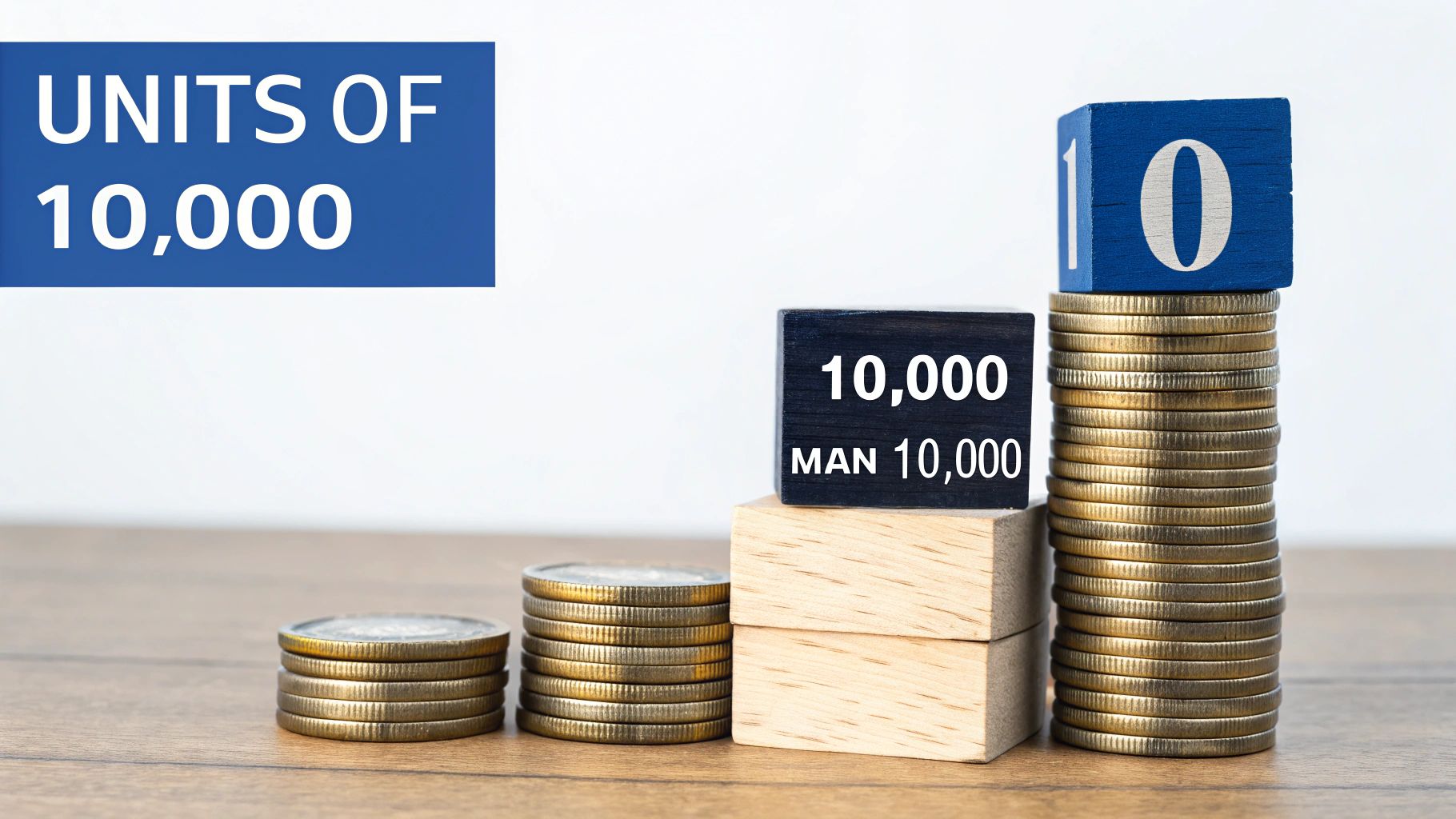
Alright, you've got the numbers up to 99 down. Now it's time to start talking about some really big figures. The good news is that moving into the hundreds and thousands uses the exact same logic you've already learned. It’s all about combining the basic units you know with a few new, larger place markers.
Let’s add the next set of building blocks for sino numbers in Korean:
- 100: 백 (baek)
- 1,000: 천 (cheon)
- 10,000: 만 (man)
Just like you did with 십 (sip), you just stick a number from 1 to 9 in front of these words to create bigger values. For example, 300 is literally "three-hundred," or 삼백 (sambaek). Following that same pattern, 8,000 is "eight-thousand," which is 팔천 (palcheon). It really is that consistent.
The Most Important Number: Man (만)
Now, we've come to the most important—and often trickiest—concept for English speakers to grasp: 만 (man), which means 10,000. While English groups large numbers by thousands (thousand, million, billion), Korean groups everything by ten-thousands.
Think of 만 as your new anchor point for any big number. When you see a large number in Korean, your first instinct should be to mentally group it into sets of four digits, starting from the right.
This shift to thinking in units of ten thousand is a huge milestone in your Korean learning journey. Once you get used to it, reading prices, understanding statistics, and talking about money become second nature.
Let's see how this works in practice. A number like 50,000 isn't "fifty thousand." Instead, you read it as "five ten-thousands."
- 50,000 → 5 x 10,000 → 오만 (oman)
This concept scales up perfectly. For 100,000, just ask yourself, "How many ten-thousands do I have?" The answer is ten. So, 100,000 becomes "ten ten-thousand."
- 100,000 → 10 x 10,000 → 십만 (simman)
- 1,000,000 → 100 x 10,000 → 백만 (baengman)
- 10,000,000 → 1,000 x 10,000 → 천만 (cheonman)
Putting It All Together with Real Examples
Let’s try to build a complex number from scratch to see this logic in action. Imagine a price tag for ₩385,200. You'd construct it piece by piece, from the largest unit down to the smallest.
- Start with the 만 unit: You have 38 sets of 10,000. So that’s 삼십팔만 (samsippalman).
- Move to the thousands: You have 5,000, which is 오천 (ocheon).
- Finish with the hundreds: You have 200, which is 이백 (ibaek).
Combine them, and you get 삼십팔만 오천이백 (samsippalman ocheonibaek). See how 38만 is read as a single chunk? That's the key.
This system is woven into the fabric of daily life and official figures. You can find out more about how these numbers appear in official Korean statistics. With a bit of practice, spotting the 만 unit and reading even massive figures will become automatic.
Putting Sino-Korean Numbers to Work in Real Life
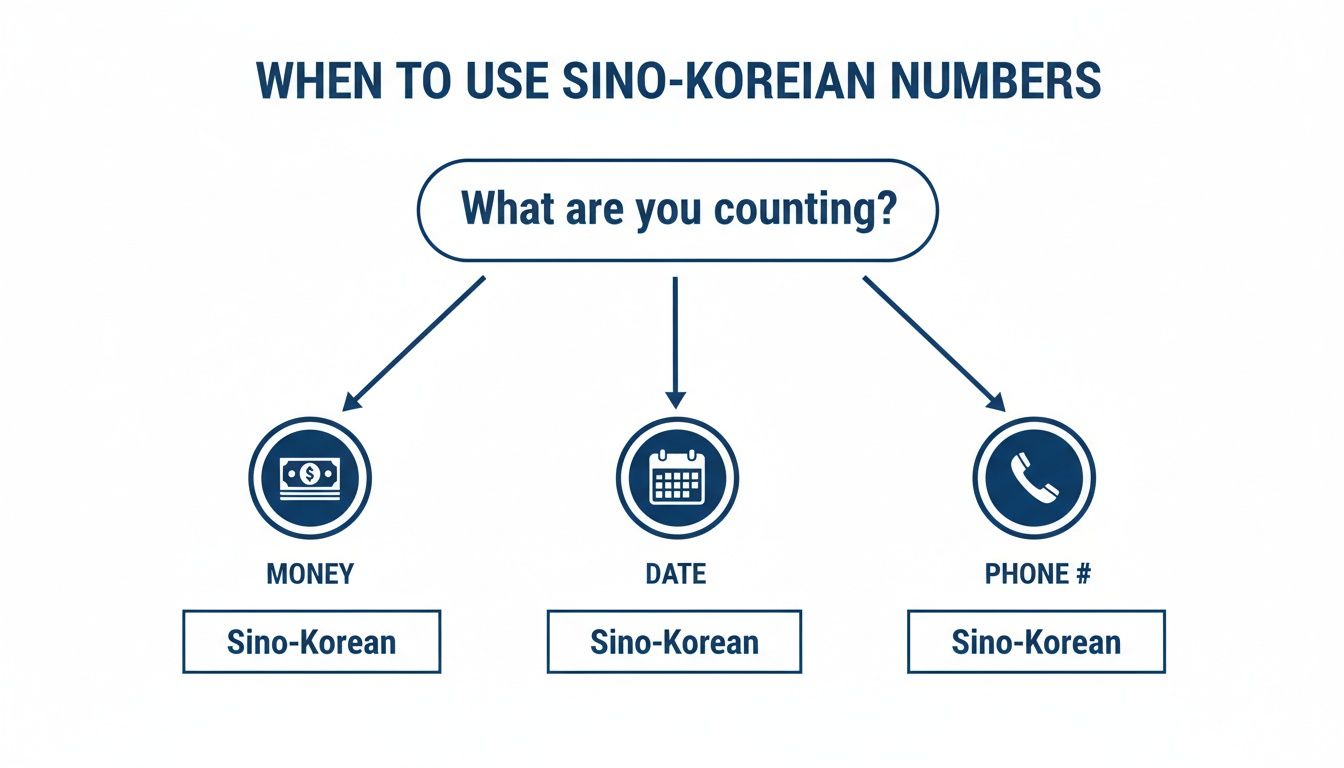
Alright, you’ve wrestled with building the numbers, and that's a huge step. But the real test—the moment you start to feel like you’re actually speaking Korean—is knowing precisely when to use them. This is your field guide for using Sino-Korean numbers just like a native speaker would.
Think of Korea’s two number systems as specialised tools. You wouldn't use a hammer to turn a screw, right? In the same way, you’d never use Native Korean numbers to talk about money. Let’s get into the specific jobs that belong exclusively to the Sino-Korean system.
Money and Prices
This is probably the most common place you'll see Sino-Korean numbers every single day. From a cheap snack at the convenience store to a brand-new laptop, every price tag in Korea is written and spoken using Sino-Korean numbers.
- ₩2,500 (Two thousand five hundred won): 이천오백 원 (icheon-obaek won)
- ₩15,000 (Fifteen thousand won): 만 오천 원 (man-ocheon won)
- ₩120,000 (One hundred twenty thousand won): 십이만 원 (sibiman won)
Dates and Calendars
Whenever you’re scheduling a meeting or talking about your birthday, you'll always reach for Sino-Korean numbers. This goes for the year, the month, and the day.
- Year (년 - nyeon): 2025년 is 이천이십오 년 (icheonisibo nyeon)
- Month (월 - wol): October (the 10th month) is 십월 (siwol)
- Day (일 - il): The 3rd day of the month is 삼일 (samil)
So, to say "October 3rd, 2025," you just string them together: 이천이십오 년 십월 삼일 (icheonisibo nyeon siwol samil). See how logical that is?
Phone Numbers and Addresses
Trying to exchange contact info or find your way around town? Both rely heavily on Sino-Korean numbers. Phone numbers are read out one digit at a time, and addresses often include building and unit numbers that use this system.
- Phone Number: 010-2345-6789 is read as 공일공-이삼사오-육칠팔구 (gongilgong-isamsao-yukchilpalgu).
- Address: Apartment 701, Building 102 would be 백이 동 칠백일 호 (baegi dong chilbaegil ho).
Time: Minutes and Seconds
Here’s where things get interesting. Telling time in Korean requires you to use both number systems. While the hour uses Native Korean numbers, Sino-Korean numbers take over for the minutes and seconds.
- Minute (분 - bun): 30 minutes is 삼십 분 (samsip bun).
- Second (초 - cho): 45 seconds is 사십오 초 (sasibo cho).
This division is clear in national reporting, where big-picture figures are almost always presented in Sino-Korean terms. You can see this in action in official data, like these insights on foreign residents in Korea.
Practical Tip: If it involves dates, money, measurements, or any number over 100, you will almost certainly be using Sino-Korean numbers.
Sino-Korean vs. Native Korean: Making the Right Choice
One of the biggest hurdles for anyone learning Korean is figuring out when to use which number system. It feels tricky at first, but there’s a core logic to it that makes everything click into place.
Think of it this way: Sino-Korean numbers are your go-to for data, measurements, and established concepts. Native Korean numbers, on the other hand, are what you use when you're physically counting things.
The Cheat Sheet for Choosing Your Numbers
Imagine you’re at a café in Seoul. When you order "two coffees," you're counting individual items, so you'll use Native Korean numbers: 커피 두 잔 (keopi du jan).
But when the barista tells you the total price—say, ₩9,000 (구천 원 - gucheon won)—they’re quoting a specific monetary value, so they switch to Sino-Korean.
To make it crystal clear, let's lay it all out side-by-side.
| Situation / Context | Use Sino-Korean Numbers (일, 이, 삼...) | Use Native Korean Numbers (하나, 둘, 셋...) |
|---|---|---|
| Money / Prices | ✅ Yes (e.g., 오천 원 - 5,000 won) | ❌ No |
| Dates (Year, Month, Day) | ✅ Yes (e.g., 시월 - October) | ❌ No |
| Phone Numbers | ✅ Yes (e.g., 공일공 - 010) | ❌ No |
| Time (Minutes / Seconds) | ✅ Yes (e.g., 십오 분 - 15 minutes) | ❌ No |
| Counting People, Items, Objects | ❌ No (Except for numbers over 100) | ✅ Yes (e.g., 사람 세 명 - 3 people) |
| Age | ❌ No (Usually formal documents only) | ✅ Yes (e.g., 스무 살 - 20 years old) |
| Time (Hours) | ❌ No | ✅ Yes (e.g., 두 시 - 2 o'clock) |
This divide isn’t just a grammatical quirk; it’s reflected in official data. For example, government demographic reports use Sino-Korean numbers to state large figures, like the number of foreign residents in Korea. For a deeper look, you can explore immigration statistics on Statista.com.
Practical Tip: If you can physically point to and count a small number of individual items (people, books, apples), use Native Korean. For almost everything else—money, dates, time, phone numbers—Sino-Korean is your go-to system.
Common Mistakes and Pronunciation Tips
Let's be honest—every single person learning Korean has stumbled over numbers. It’s practically a rite of passage! But if you know where the tricky spots are, you can navigate them and sound much more natural.
So, let's break down some of the most common mistakes people make with Sino-Korean numbers and how you can avoid them.
Pronunciation Quirks to Watch Out For
One of the first things that trips people up is how certain number combinations change their sound. Take the number 16, for example. You have 십 (sip) for 10 and 육 (yuk) for 6. Logically, you'd think it's "sipyuk," right? But in reality, the sounds blend together, and it becomes 심륙 (simnyuk).
Then there's the classic confusion with the number zero. Is it 영 (yeong) or 공 (gong)?
- 영 (yeong): Think of this as the "official" zero. You'll use it for things like temperature or scores in a game.
- 공 (gong): This is more like saying "oh" in English for the digit 0. It’s almost exclusively used when you're reading out individual digits, like in a phone number. So, 010 becomes 공일공 (gong-il-gong).
The Biggest Mix-Up: Sino vs. Native Korean
By far, the most frequent mistake learners make is confusing the two number systems.
Wrong: "The price is hana-cheon won." (❌)
Right: "The price is 천 원 (cheon won)." (✅)
Remember this golden rule: money always, always uses Sino-Korean numbers.
Telling time is another classic battleground for the two systems. You have to use both!
- Wrong: "It's dul o'clock and isip minutes." (❌)
- Right: "It's 두 시 이십 분 (du si isip bun)." (✅)
It might feel a little awkward at first, but paying attention to these specific contexts and pronunciation quirks will really polish your Korean. Keep at it, and before you know it, choosing the right number system will feel completely automatic.
Your Path to Korean Number Mastery
Learning the two number systems is a unique and rewarding part of your Korean journey. It may seem complex at first, but with consistent practice, it will become second nature. Remember that every price tag you read and every date you say is an opportunity to strengthen your skills. Don't be afraid to make mistakes—they are a natural part of learning. Every word you learn brings you one step closer to confidence. Keep going—your Korean journey starts now!
🌟 Ready to start your Korean journey? Join Ktalk.live — where global learners connect, speak, and grow together! Book your free trial lesson today at https://ktalk.live.
Ready to stop reading and start speaking?
Practice what you just learned with a native Korean teacher — free for 100 minutes. No card, no commitment.