Want to practice this with a native Korean teacher?
100-min free trial — no card required.
Ever felt like your head was spinning trying to figure out why Korean has two completely different sets of numbers? You're not alone! It's a common stumbling block for almost every new learner, but with the right approach, it becomes a fun and rewarding part of your journey.
The short answer is this: Sino-Korean numbers came from Chinese, and they're used for all the "data" in life—things like dates, money, and phone numbers. The other set, Native Korean numbers, is what you'll use for counting physical objects. Think of them as two different toolkits for very specific jobs. Mastering them is your key to navigating daily life in Korea with confidence.
Understanding the Two Number Systems
If you've ever paused, wondering which number to pull out of your mental filing cabinet, rest assured that feeling is a rite of passage for Korean learners. This dual system exists because of the deep historical connection between Korea and China.
Long before Hangul (the Korean alphabet) was invented, Koreans used Chinese characters for reading and writing. This influence is still seen today, with a huge chunk of Korean vocabulary—including one of its number systems—having Chinese roots. That’s precisely why we call them Sino-Korean numbers.
This guide is all about getting you comfortable with this essential toolkit. And it is essential. Mastering this system is your ticket to navigating everyday life in Korea smoothly and confidently.
Learning the Sino-Korean system is like getting a master key. It doesn't just open one door; it unlocks your ability to handle money, schedule appointments, read dates, and share your phone number—the core functions of daily communication.
Why Focus on Sino-Korean First
Look, both number systems are crucial if you want to become fluent. But honestly, the Sino-Korean set gives you the biggest bang for your buck right from the get-go.
Think about all the things you do every day. You'll be using these numbers for:
- Money: Reading price tags and paying for that coffee.
- Dates: Saying the year, month, and day.
- Time: Talking about minutes and seconds.
- Contact Information: Reading phone numbers and addresses.
- Measurements: Discussing distance, weight, or height.
By focusing on Sino-Korean numbers first, you're laying down a foundation that makes you immediately functional in countless real-world situations. We'll break down exactly how they work and show you why getting this system down is a massive shortcut to sounding more natural. By the time you're done here, you'll have the confidence to handle numbers in just about any practical situation that comes your way.
Learning the Building Blocks From 1 to 100
Ready to get started? The best thing about the Sino-Korean number system is how beautifully logical it is. You don't need to memorise hundreds of different words. Instead, it all starts with just ten core numbers.
Think of them like LEGO bricks. Once you know these first ten, you have everything you need to build any number, all the way into the millions. It’s that simple.
Core Sino Korean Numbers 1-10 and Key Multipliers
First things first, let's get our basic toolkit sorted. This table lists the foundational Sino-Korean numbers from 1 to 10, plus the essential multipliers for 100, 1000, and 10,000. Mastering these is key to forming any larger number.
| Number | Hangul | Romanization |
|---|---|---|
| 1 | 일 | il |
| 2 | 이 | i |
| 3 | 삼 | sam |
| 4 | 사 | sa |
| 5 | 오 | o |
| 6 | 육 | yuk |
| 7 | 칠 | chil |
| 8 | 팔 | pal |
| 9 | 구 | gu |
| 10 | 십 | sip |
| 100 | 백 | baek |
| 1,000 | 천 | cheon |
Take your time getting comfortable with their sounds. These aren't just abstract numbers; they are absolutely essential for daily life in South Korea. They’re used for prices, dates, phone numbers, and addresses.
These numerals, derived from Chinese characters, are used every day by the country's 48.4 million Korean speakers. In fact, words with Chinese origins, known as Sino-Korean vocabulary, make up roughly 57% of the entire Korean language. This makes numbers like il, i, and sip the backbone of formal counting. You can read more about this fascinating linguistic history on Wikipedia's page on Sino-Korean vocabulary.
Combining Numbers 11 to 99
Now for the fun part: snapping those LEGO bricks together. The system works on a simple "multiplication and addition" principle that’s incredibly intuitive once you see it in action.
To make a number like 11, you just combine "ten" (십, sip) and "one" (일, il). You are literally saying "ten-one."
- 11 = 10 + 1 → 십 + 일 → 십일 (sibil)
- 15 = 10 + 5 → 십 + 오 → 십오 (sibo)
- 19 = 10 + 9 → 십 + 구 → 십구 (sipgu)
See the pattern? It's just simple addition.
To create the 'tens' like 20, 30, or 40, you just flip the order. Think of it as multiplication. For "twenty," you say "two-ten."
- 20 = 2 x 10 → 이 + 십 → 이십 (isip)
- 30 = 3 x 10 → 삼 + 십 → 삼십 (samsip)
- 80 = 8 x 10 → 팔 + 십 → 팔십 (palsip)
With just those two simple rules, you can now build any number all the way up to 99.
Key Takeaway: For numbers 11-19, it's 10 + digit (십 + 일 = 십일). For multiples of ten, it's digit x 10 (이 + 십 = 이십).
Let’s try a more complex number, like 57. Just break it down into its parts: fifty ("five-ten") and seven.
- 57 = (5 x 10) + 7 → (오 + 십) + 칠 → 오십칠 (osipchil)
How about 93? That’s ninety ("nine-ten") plus three.
- 93 = (9 x 10) + 3 → (구 + 십) + 삼 → 구십삼 (gusipsam)
This whole section is about recognising the pattern, not about memorising hundreds of unique words. Once you internalise these building blocks and practice a little, counting to 100 with Sino-Korean numbers will feel completely natural.
How to Count Larger Numbers in Korean
Alright, you’ve got the hang of building numbers up to 100. That’s a huge step! Now you're ready to tackle the big stuff—like prices at a bustling Seoul market or talking about population stats. The good news is that counting larger Sino-Korean numbers follows the same logic. There's just one key difference from English that might feel a little weird at first.
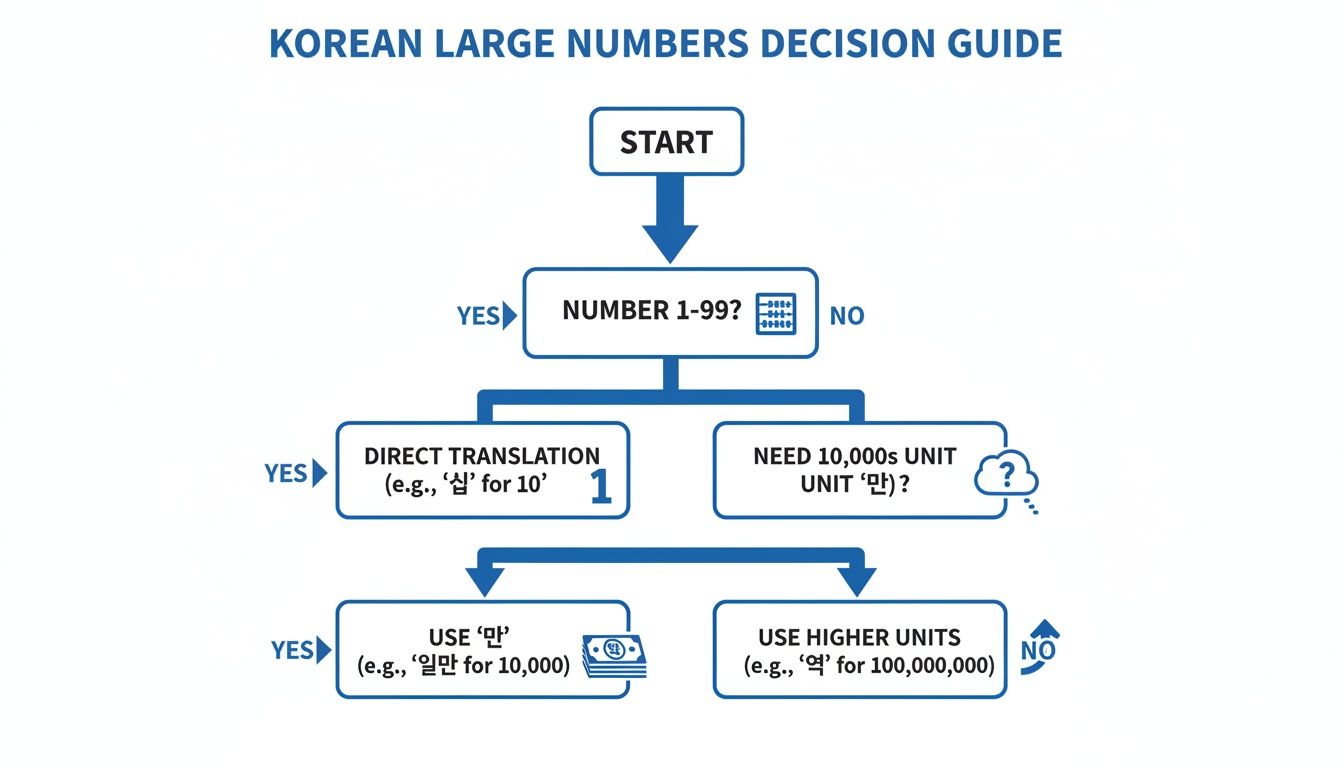
The secret is learning the words for the bigger building blocks: one hundred (백, baek), one thousand (천, cheon), and the most important one of all, ten thousand (만, man). Think of these as the new, bigger LEGO pieces you're adding to your collection.
Here’s the single biggest hurdle for English speakers: the concept of 만 (man, 10,000). While we group large numbers by three zeros (thousand, million, billion), Korean groups them by four zeros (ten thousand, hundred million).
This shift in grouping is why a direct word-for-word translation from English can get you into a tangle. Once you wrap your head around this simple change in perspective, you'll be able to count even massive numbers with total confidence.
Understanding the Man (만) Unit
Let's break this down, because it's that important. In English, we see the number 100,000 and say "one hundred thousand." We're thinking of it as 100 groups of a thousand.
Korean flips that around. When you see 100,000, you should think of it as ten groups of ten thousand. So, 100,000 becomes "ten ten-thousands," or 십만 (simman). It’s just multiplication: 10 (십) times 10,000 (만).
See how this logic plays out as the numbers get bigger?
- 10,000 is 만 (man)
- 50,000 is 오만 (oman) — literally 5 x 10,000
- 100,000 is 십만 (simman) — literally 10 x 10,000
- 1,000,000 is 백만 (baengman) — literally 100 x 10,000
A great way to think about it is with money. If you have a ₩10,000 bill, how many do you need to make ₩50,000? Five of them, right? That’s exactly what 오만 (oman) means: "five ten-thousands." This simple idea scales up no matter how big the number gets.
Building Any Large Number Step-by-Step
So, let's put it all together. The method is refreshingly simple: just start with the biggest unit on the left and say what you see, working your way down.
Let's take the number 365. You just break it down into its components:
- 300 (three-hundred) → 삼백 (sambaek)
- 60 (six-ten) → 육십 (yuksip)
- 5 (five) → 오 (o)
- Combine them: 삼백육십오 (sambaegyuksibo)
Now for a number that looks much scarier, like 99,999. Don't be intimidated! The exact same logic applies.
- 90,000 (nine ten-thousands) → 구만 (guman)
- 9,000 (nine-thousand) → 구천 (gucheon)
- 900 (nine-hundred) → 구백 (gubaek)
- 90 (nine-ten) → 구십 (gusip)
- 9 (nine) → 구 (gu)
- String it all together: 구만 구천구백구십구 (guman gucheongubaekgusipgu)
And just like that, you've unlocked the ability to read price tags, understand financial news, and talk about any large figure in Korean. Mastering Sino-Korean numbers really just comes down to knowing these core units and how to piece them together.
Choosing the Right Number System in Conversation
This is the big question every Korean learner faces: when do I use Sino-Korean numbers, and when do I switch to Native Korean? Honestly, getting this right is a massive step towards sounding natural. The good news is that the rules are much clearer than you might think.
Here's a simple way to think about it: Sino-Korean numbers are for data and abstract measurements. Think of things you'd normally write down as digits. On the other hand, Native Korean numbers are for counting physical, tangible things—stuff you can actually see or touch.
Once you frame it as "data vs. stuff," the puzzle starts to solve itself, and making the right choice becomes so much easier.
Sino-Korean for Data and Concepts
Let's dive into the specifics. You'll always want to reach for your Sino-Korean toolkit when you're dealing with any kind of fixed data point. This system is the default for most official, technical, or mathematical contexts.
Here are the main situations where Sino-Korean numbers are the only way to go:
- Money: Talking about prices in won (원). For instance, 5,000 won is 오천 원 (ocheon won).
- Dates: Stating the year, month, and day. June 1st is 육월 일일 (yuwol iril).
- Phone Numbers: Reading out the digits. 010 is read as 공일공 (gong-il-gong).
- Addresses: Stating building floors or apartment numbers, like the 12th floor (십이 층, sibi cheung).
- Time (Minutes & Seconds): While hours use the other system, minutes and seconds are all Sino-Korean. 30 minutes is 삼십 분 (samsip bun).
- Measurements: Discussing distance, weight, or temperature. For example, 10 kilograms is 십 킬로그램 (sip killogeuraem).
A Handy Rule of Thumb: If it’s a number you'd see on a digital clock, a calendar, a price tag, or your phone screen, it's almost certainly a job for Sino-Korean numbers.
Sino-Korean vs. Native Korean: A Quick Guide
Feeling a bit overwhelmed? Don't worry. This table breaks down the most common scenarios so you can quickly see which system to use. Think of it as your cheat sheet.
| Context / What You Are Counting | Use Sino-Korean Numbers | Use Native Korean Numbers |
|---|---|---|
| Money / Prices | ✅ Yes (오천 원 - 5,000 won) | ❌ No |
| Dates (Year, Month, Day) | ✅ Yes (육월 - June) | ❌ No |
| Phone Numbers | ✅ Yes (공일공 - 010) | ❌ No |
| Counting People / Objects | ❌ No | ✅ Yes (세 명 - three people) |
| Age (Casual) | ❌ No | ✅ Yes (스무 살 - 20 years old) |
| Time (Hours) | ❌ No | ✅ Yes (한 시 - one o'clock) |
| Time (Minutes / Seconds) | ✅ Yes (십 분 - 10 minutes) | ❌ No |
| Any number over 100 | ✅ Yes (백 - 100) | ❌ No (system stops at 99) |
Keep this table handy, and you'll find yourself making the right choice without even thinking about it in no time.
Using Sino Korean Numbers in Real Life
Alright, you've got the rules down. Now it's time to take that knowledge out of the textbook and into the real world. Honestly, knowing the logic is one thing, but actually using Sino-Korean numbers in a conversation is where they finally click and stick for good.
Think of this section as your own personal field trip to Seoul. We're going to walk through some of the most common, everyday situations you'll definitely run into. My goal is to give you the practical phrases you need to get by with confidence.
Ordering at a Café
Picture this: you've just walked into a cool little café in Hongdae and you're craving an iced Americano. This is the perfect, low-stakes scenario to practice using numbers with money.
Dialogue Example
- You: 아이스 아메리카노 한 잔 얼마예요? (Aiseu Amerikano han jan eolmayeyo?)
- "How much is one iced Americano?"
- Barista: 사천오백 원입니다. (Sacheon-obaek won-imnida.)
- "It's 4,500 won."
- You: 네, 여기 오천 원이요. (Ne, yeogi ocheon won-iyo.)
- "Okay, here is 5,000 won."
See how the price, 사천오백 (sacheon-obaek), is just a straightforward combination of 4,000 (사천) and 500 (오백)? You’ll see this pattern everywhere when dealing with Korean currency.
Exchanging Phone Numbers
Let's say you've hit it off with a new friend and want to swap numbers. Phone numbers in Korea are read out digit by digit using Sino-Korean numbers, which makes them fantastic for some quick practice. Just remember that zero is often read as 공 (gong).
Dialogue Example
- Friend: 전화번호가 뭐예요? (Jeonhwabeonhoga mwoyeyo?)
- "What is your phone number?"
- You: 제 번호는 공일공에 일이삼사, 오육칠팔이에요. (Je beonhoneun gong-il-gong-e i-ri-sam-sa, o-yuk-chil-pal-ieyo.)
- "My number is 010-1234-5678."
Notice how each number is spoken clearly and individually? It’s the standard way to do it and helps make sure there’s no mix-up.
Talking About Dates
So, you want to plan a meet-up with that new friend? You'll need to use Sino-Korean numbers to set the date. The year (년, nyeon), month (월, wol), and day (일, il) all rely on this system.
Dialogue Example
- Friend: 우리 언제 만날까요? (Uri eonje mannalkkayo?)
- "When should we meet?"
- You: 시월 이십오일 어때요? (Siwol isib-oil eottaeyo?)
- "How about October 25th?"
In this case, October is 시월 (siwol), which comes from 십 (sip, 10) + 월 (wol) but with a sound change that you get used to. The 25th day is simply 이십오일 (isib-oil), or 20 + 5 + day.
These numbers are woven into the very fabric of daily life in South Korea, far beyond just counting. They are the formal pulse of the country, essential for everything from addresses to academic grades for its 81.5% urban population.
And in a hyper-connected nation with 50.3 million internet users, apps like KakaoTalk embed these numbers for timestamps and mobile payments, making them a core part of modern digital life. You can explore more data on South Korea's digital landscape on this detailed page.
Common Mistakes and Pronunciation Tips
Everyone makes mistakes when learning a new language—it’s how we grow. But when it comes to Sino-Korean numbers, a few specific trip-ups show up again and again. Let's walk through them so you can sidestep these common pitfalls and speak with a lot more confidence.
We'll cover some tricky pronunciation rules and double-check a couple of concepts that often leave learners scratching their heads. A little focus here will make a huge difference in how natural you sound.
Mastering Tricky Pronunciation Rules
One of the biggest hurdles with Sino-Korean numbers isn't just memorising the words, but hearing how their sounds change when they get mashed together. This is a core part of Korean phonetics, and nailing it will instantly make you sound more like a native speaker.
A classic example is the number 16. If you just look at the parts, it seems straightforward:
- 십 (sip, 10) + 육 (yuk, 6)
But in a real conversation, nobody says sip-yuk. The sounds actually blend and morph to flow more smoothly. The final 'p' in sip and the initial 'y' in yuk combine in a way that’s easier for the mouth to say.
Pronunciation Tip: Instead of the clunky sip-yuk, native speakers pronounce it as 심육 (simnyuk). This small change is a dead giveaway of a fluent speaker. Try to listen for it in K-dramas or conversations!
This kind of sound change, called assimilation, pops up with other numbers too. It feels a bit weird at first, but after hearing it enough, your ears will start to expect it, and your pronunciation will naturally follow suit.
Final Checks on Common Sticking Points
Alright, let's quickly go over two areas where learners almost always get tangled up. If you can get these straight, you'll have a rock-solid foundation for using Sino-Korean numbers.
- Don't Forget the 만 (man) Unit: As English speakers, our brains are wired to think in thousands, millions, and billions. The Korean system, with its pivotal 10,000 (만, man) unit, requires a complete mental reboot. Always, always remember to chunk large numbers by their four zeros first. It's the biggest hurdle to overcome.
- Keep the Systems Separate: It’s so easy to accidentally grab a Sino-Korean number when you need a Native Korean one, or vice versa. The best rule of thumb is this: use Sino-Korean for "data"—things like money, dates, phone numbers, and minutes. Use Native Korean for counting actual, physical things you can touch. If you’re ever in doubt, just pop back to the comparison table for a quick refresher.
By focusing on these specific pronunciation quirks and common mistakes, you’re not just memorising numbers. You're fine-tuning your accent and building the instincts of a natural-sounding Korean speaker.
Final Thoughts: Your Journey with Numbers
Learning the Sino-Korean numbers might seem like a small step, but it’s a giant leap toward feeling comfortable and capable in real-world Korean conversations. You’ve learned how to build them, when to use them, and how to avoid common mistakes. Remember, every number you read on a price tag or hear in a K-drama is a chance to practice and build your confidence. Don’t worry if you make mistakes — what matters most is progress. Every word you learn brings you one step closer to fluency. Keep going — your Korean journey starts now!
🌟 Ready to start your Korean journey? Join Ktalk.live — where global learners connect, speak, and grow together! You can learn more and book your free trial class at https://ktalk.live.
Ready to stop reading and start speaking?
Practice what you just learned with a native Korean teacher — free for 100 minutes. No card, no commitment.