
Want to practice this with a native Korean teacher?
100-min free trial — no card required.
Ever wondered how to start a conversation in Korean? Learning how to pronounce hello in Korean is your perfect first step! The most common phrase, 안녕하세요 (Annyeonghaseyo), is your golden ticket to making a great first impression. It’s friendly, polite, and opens the door to connecting with millions of Korean speakers. Learning this single phrase might seem small, but it's a huge leap in your language journey. It shows respect and genuine interest, making every interaction warmer from the start.
Your First Korean Greeting: Annyeonghaseyo (안녕하세요)
Learning to say 'hello' is always the first step, but in Korean, it's packed with a lot more meaning. The phrase 안녕하세요 (Annyeonghaseyo) doesn't just mean 'hello'. Its literal translation is closer to "Are you at peace?" or "Are you well?", which really shows the beautiful, caring nature built right into the language. Think of it as more than a simple greeting; it's a gentle wish for the other person’s well-being.
This phrase is your go-to for making a fantastic first impression. It’s perfect for when you're:
- Meeting someone for the very first time.
- Greeting elders, teachers, or anyone in a position of authority.
- Entering a shop, café, or restaurant.
- Speaking with colleagues or anyone you don't know on a personal level.
Nailing this one phrase shows a genuine interest in Korean culture and opens the door to so many more interactions. You’re also in good company! Interest in Korean is booming across the globe. In fact, the number of people taking the official Test of Proficiency in Korean (TOPIK) is projected to hit a record-breaking 550,000 in 2025—a huge jump from 360,000 in 2022. You can read more about this incredible growth in this insightful article on the Korea Times.
A Simple Breakdown of Annyeonghaseyo (안녕하세요)
Let's get this pronunciation right by breaking it down syllable by syllable. Don't worry about getting it perfect on the first try. The real goal is to understand how each sound flows into the next to create one smooth, melodic word.
Here’s a simple guide to each part of the phrase.
| Hangul Syllable | Romanization | Simple Pronunciation Guide |
|---|---|---|
| 안 (an) | an | Sounds like "ahn" with a soft, nasal finish. |
| 녕 (nyeong) | nyeong | Like "nyawng," with the 'ng' sound from 'song'. |
| 하 (ha) | ha | A simple "ha" sound, like a gentle laugh. |
| 세 (se) | se | Sounds like "seh," similar to the 'se' in 'sell'. |
| 요 (yo) | yo | Just like saying "yo" in English. |
When you put it all together—ahn-nyawng-ha-seh-yo—you have the most essential greeting in the Korean language. Keep practicing saying it out loud!
A Closer Look at the Sounds in Annyeonghaseyo
Romanization is a great first step, but if you want to sound less like a textbook and more like a local, you need to dig a little deeper. Let's fine-tune each syllable of 안녕하세요, focusing on the small adjustments to your mouth and tongue that make all the difference. Think of it as the difference between just reading the notes and actually playing the music.
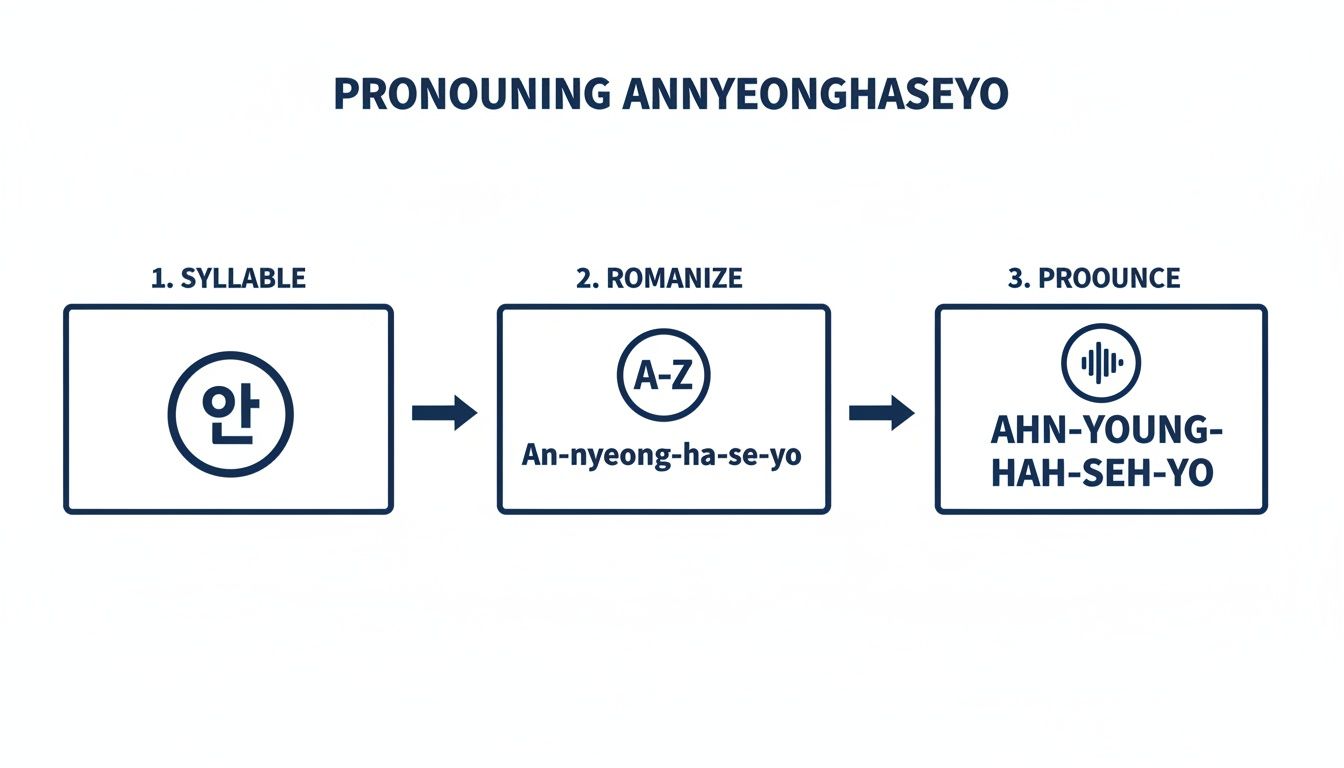
This guide is your roadmap. We're going to move beyond just reading the letters and start making the actual Korean sounds.
Nailing Each Syllable
The real secret to a smooth, natural-sounding greeting is getting the individual sounds right. Let's break it down, piece by piece.
안 (an) & 녕 (nyeong): The key here is mastering the subtle 'ng' sound. For 안 (an), your tongue should be relaxed and down, not touching the roof of your mouth like it does for the English 'n'. The sound should resonate from the back of your throat. For 녕 (nyeong), your tongue starts at the roof of your mouth for the 'ny' and then releases into that same nasal 'ng'.
하 (ha): This is much softer than an English 'ha'. The Korean 'ㅎ' (h) is more of a gentle puff of air. Imagine you're fogging up a mirror—that's the light, breathy quality you're aiming for. It should feel effortless.
세 (se): This is a classic stumbling block for English speakers, who often pronounce it like "say". The vowel 'ㅔ' (e) is actually much closer to the 'e' in "get" or "set". Here’s a little trick: hold a slight smile as you say it. This naturally pulls your lips into the right position. Think "seh", not "say".
요 (yo): The final syllable is the easiest! It sounds just like the English word "yo". Just keep it quick and light—it's the polite punctuation at the end of the phrase.
Don’t worry if you make mistakes—even Koreans do sometimes! What matters most is progress. The goal is to blend these syllables into one continuous, melodic phrase, not five separate chunks of sound. Try listening to native speakers and mimicking their rhythm.
Formal vs. Casual: Getting Your Korean "Hello" Just Right
In Korea, how you say "hello" is about more than just the words. It’s a reflection of your understanding of the social situation and your respect for the person you're speaking to. This is where the crucial difference between formal and informal greetings comes in.
You've got two main players: the formal 안녕하세요 (Annyeonghaseyo) and its short-and-sweet casual version, 안녕 (Annyeong). Picking the right one at the right time is your secret weapon to sounding natural.

It’s just like in English. You probably wouldn't greet your CEO with "Yo, what's up?" and you might sound a bit stiff saying "Good day, how do you do?" to your little brother. Korean has the same unspoken rules.
Your Go-To Greeting: The Formal Annyeonghaseyo
When in doubt, always use 안녕하세요 (Annyeonghaseyo). This is your all-purpose, respectful, and universally safe greeting. It's impossible to go wrong with this one.
Use Annyeonghaseyo when greeting:
- Anyone older than you (a non-negotiable in Korean culture!).
- Your teachers, your boss, or any authority figure.
- People you're meeting for the very first time.
- Staff in shops, cafes, and restaurants.
Basically, if the person isn't a very close friend or someone younger than you, this is your phrase. It’s always better to come across as a little too polite than accidentally being too casual.
The Casual Hello: When to Use Annyeong
안녕 (Annyeong) is the laid-back, friendly "hello." It instantly creates a sense of closeness, but you have to be careful—using it in the wrong situation can come off as disrespectful.
Save Annyeong for these specific cases:
- Close friends who are your age.
- People younger than you, like a younger sibling or a close junior colleague.
- An older person who has specifically told you it's okay to speak informally with them.
To make it even clearer, here’s a quick guide to help you choose the right greeting for any situation.
| Greeting | Politeness Level | When to Use It (Examples) |
|---|---|---|
| 안녕하세요 (Annyeonghaseyo) | Formal / Polite | Meeting your partner's parents, greeting a professor, ordering coffee, talking to a new colleague. |
| 안녕 (Annyeong) | Casual / Informal | Saying hi to a classmate you know well, greeting your younger brother, texting a close friend. |
Think of Annyeonghaseyo as your default setting. As you get to know people, you might switch to Annyeong, but it's a move you make deliberately. Nailing this difference will show people you've taken the time to understand and respect the culture behind the language.
Common Pronunciation Mistakes to Avoid
Every single person learning a new language makes mistakes—it's just part of the game. But knowing what to watch out for when you're learning to pronounce hello in Korean can give you a serious head start. Let's break down the most common stumbles English speakers have with 안녕하세요 (Annyeonghaseyo).
One of the biggest tells of a beginner is pronouncing it as five separate, choppy syllables: "An-nyeong-ha-se-yo." It sounds a bit like a robot because real Korean flows smoothly. Try to think of it not as five distinct blocks of sound, but as one single, connected musical phrase.
Another classic mistake is letting your pitch rise at the very end, making it sound like a question. Unless you're actually asking "Are you well?", the intonation for 안녕하세요 should stay fairly level or drop just a little bit at the end. It's a statement, not a question.
Fine-Tuning Your Sounds
Once you get the rhythm down, a few specific sounds can still be tricky. Nailing these little details will really make your pronunciation click.
The '녕' (nyeong) sound: So many people accidentally say "an-yong." The secret is in that initial 'ny' blend. Your tongue needs to make quick contact with the roof of your mouth, almost like the 'ny' you hear in "canyon," before moving into the 'ng' from "song."
The '세' (se) vowel: English speakers often want to make this sound like "say." The Korean vowel 'ㅔ' is actually much closer to the 'e' in "set" or "sell." A little trick is to hold a slight smile as you say "seh" – this naturally puts your mouth in the right position.
A big difference from English is that Korean has a much more even stress pattern. Instead of putting heavy emphasis on one syllable, try to give each part of 안녕하세요 a similar amount of weight and time. This one change alone will make your greeting sound incredibly more authentic.
Putting Your New Korean Skills into Practice
Alright, you’ve got the theory down. But knowing how to say something and actually saying it are two different worlds. Now comes the fun part: making 안녕하세요 (Annyeonghaseyo) roll off your tongue as naturally as your native language. It’s time to move from reading on a screen to actually speaking.

Confidence comes from repetition. Seriously, just say the full phrase ten times in a row right now. Focus on making the syllables flow together. Find a recording of a native speaker and try to mimic their rhythm and intonation.
Using Hello in a Sentence
Feeling a bit more comfortable with the greeting? Let’s plug it into a full sentence. This is your go-to phrase for a polite and friendly self-introduction:
안녕하세요, 저는 [Your Name]입니다. (Annyeonghaseyo, jeo-neun [Your Name]-imnida.) Hello, I am [Your Name].
Picture this: you walk into a small shop in Myeongdong. A simple, warm "안녕하세요!" to the owner instantly shows respect and opens the door for a much friendlier interaction. Your greeting is also a key to joining a rapidly expanding global community. Saying hello in Korean unlocks entry into the booming Korean language market, projected to grow massively in the coming years.
Reading articles and repeating phrases are great starting points, but nothing—and I mean nothing—beats live feedback. An experienced tutor can catch those tiny pronunciation mistakes you don't even know you're making. This is where practice truly becomes progress.
Fine-Tuning Your Korean Greetings
Once you've got the basics of 안녕하세요 down, you'll start noticing the little nuances of Korean greetings. Let's tackle some of the most common questions that pop up for learners so you can handle any situation like a pro.
What About Saying Hello on the Phone?
Great question! This is a classic rookie mistake. When you're answering a phone call, you don't actually use 안녕하세요. Instead, Koreans have a specific word just for this: 여보세요 (yeoboseyo). Think of it as the direct equivalent of picking up the phone and saying, "Hello?" It's reserved exclusively for phone calls.
How Do I Say “Good Morning” or “Good Evening”?
Here’s a little secret that makes learning Korean greetings much easier: there are no separate phrases for "good morning," "good afternoon," or "good evening." Your trusty 안녕하세요 (Annyeonghaseyo) works for any time of day. It's an all-in-one greeting that keeps things simple. If you do need a specific phrase for "goodnight," the formal expression is 안녕히 주무세요 (annyeonghi jumuseyo).
Is Bowing Necessary When I Say Hello?
Absolutely. Bowing is just as important as the words you say. It’s a non-verbal sign of respect, and the depth of your bow really matters.
- Greeting friends or peers: A simple, slight nod of the head as you say hello is all you need.
- Formal situations: When greeting an elder, your boss, or someone you’re meeting for the first time, a deeper bow from the waist (around 30-45 degrees) is the way to go.
Mastering this simple gesture shows you understand and respect the culture, adding a whole new layer of sincerity to your greeting.
Every word you learn brings you one step closer to confidence. With these tips, you're not just learning to say hello; you're learning to connect with Korean culture on a deeper level. Keep going—your Korean journey starts now! And remember, practice with a native speaker is the fastest way to improve.
🌟 Ready to start your Korean journey? Join K-talk Live — where global learners connect, speak, and grow together! You can book your first free trial class here.
Ready to stop reading and start speaking?
Practice what you just learned with a native Korean teacher — free for 100 minutes. No card, no commitment.