
Want to practice this with a native Korean teacher?
100-min free trial — no card required.
Ever dreamed of ordering confidently at a bustling Seoul market, navigating the subway like a local, or simply striking up a conversation but felt lost for words? Learning Korean might seem challenging at first — but with the right approach, it becomes a fun and rewarding journey! The great news is you don't need to be fluent to start communicating effectively. Your journey begins with mastering a core set of essential phrases in Korean that unlock everyday interactions and build a solid foundation for deeper learning.
This guide is designed to be your trusted companion, not just another vocabulary list. We've organized a comprehensive toolkit covering ten crucial categories, from basic greetings and dining etiquette to navigating emergencies and professional settings. Each section provides the Hangul script, easy-to-follow Romanization, and practical tips you can apply immediately.
Whether you're a K-drama enthusiast eager to understand your favorite shows without subtitles or a traveler ready to immerse yourself in Korean culture, these carefully selected phrases will equip you with the confidence to speak from day one. Let's start building real conversational skills together!
1. Greetings and Basic Courtesy Phrases
Greetings are the first step in any conversation, and in Korea, they are deeply tied to showing respect. Mastering these foundational phrases in Korean is essential for creating a positive first impression. Korean society places a high value on politeness, so using the correct greeting for the situation is crucial. These phrases aren't just words; they're a way to acknowledge the other person and show you care.
Key Phrases and Usage
The most common greeting is 안녕하세요 (annyeonghaseyo), a versatile "hello" appropriate for most situations. For a more casual greeting with close friends, a simple 안녕 (annyeong) is sufficient.
When parting ways, the phrase you use depends on who is leaving:
- If you are leaving, you say 안녕히 계세요 (annyeonghi gyeseyo), which means "stay in peace."
- If the other person is leaving, you say 안녕히 가세요 (annyeonghi gaseyo), meaning "go in peace."
For gratitude, 감사합니다 (gamsahamnida) is the formal and standard way to say "thank you."
Pro Tip: In Korean culture, a slight bow often accompanies formal greetings. Don't worry about getting it perfect—the gesture itself shows respect!
Quick Practice
Imagine you are meeting your friend's older sister for the first time.
- You: 안녕하세요. 처음 뵙겠습니다. (Annyeonghaseyo. Cheoeum boepgesseumnida.) - Hello. It's a pleasure to meet you.
- Friend's Sister: 네, 안녕하세요. (Ne, annyeonghaseyo.) - Yes, hello.
2. Dining and Food-Related Phrases
Food is at the heart of Korean culture, serving as a cornerstone for social gatherings and daily life. Knowing the right phrases in Korean for dining will not only help you order your favorite dishes but also allow you to participate more fully in the fun, communal experience of a Korean meal.
Key Phrases and Usage
To get the attention of the staff in a restaurant, you can say 저기요 (jeogiyo), which functions like "excuse me." When you're ready to order, you can say 주문할게요 (jumunhalgeyo), meaning "I'd like to order." To ask for a specific item, simply point and say 이거 주세요 (igeo juseyo), which translates to "Please give me this."
- Before starting a meal, it's polite to say 잘 먹겠습니다 (jal meokgesseumnida), which means "I will eat well."
- After finishing, you say 잘 먹었습니다 (jal meogeosseumnida), or "I have eaten well," to thank the host or restaurant.
Pro Tip: Korean food can be spicy! If you're not a fan of heat, you can request your dish to be made less spicy by saying 덜 맵게 해주세요 (deol maepge haejuseyo), meaning "Please make it less spicy."
Quick Practice
Imagine you are at a Korean BBQ restaurant.
- You: 저기요, 주문할게요. (Jeogiyo, jumunhalgeyo.) - Excuse me, I'd like to order.
- You: 삼겹살 2인분 하고 상추 좀 더 주세요. (Samgyeopsal i-inbun hago sangchu jom deo juseyo.) - Two servings of pork belly and more lettuce, please.
3. Emergency and Safety Phrases
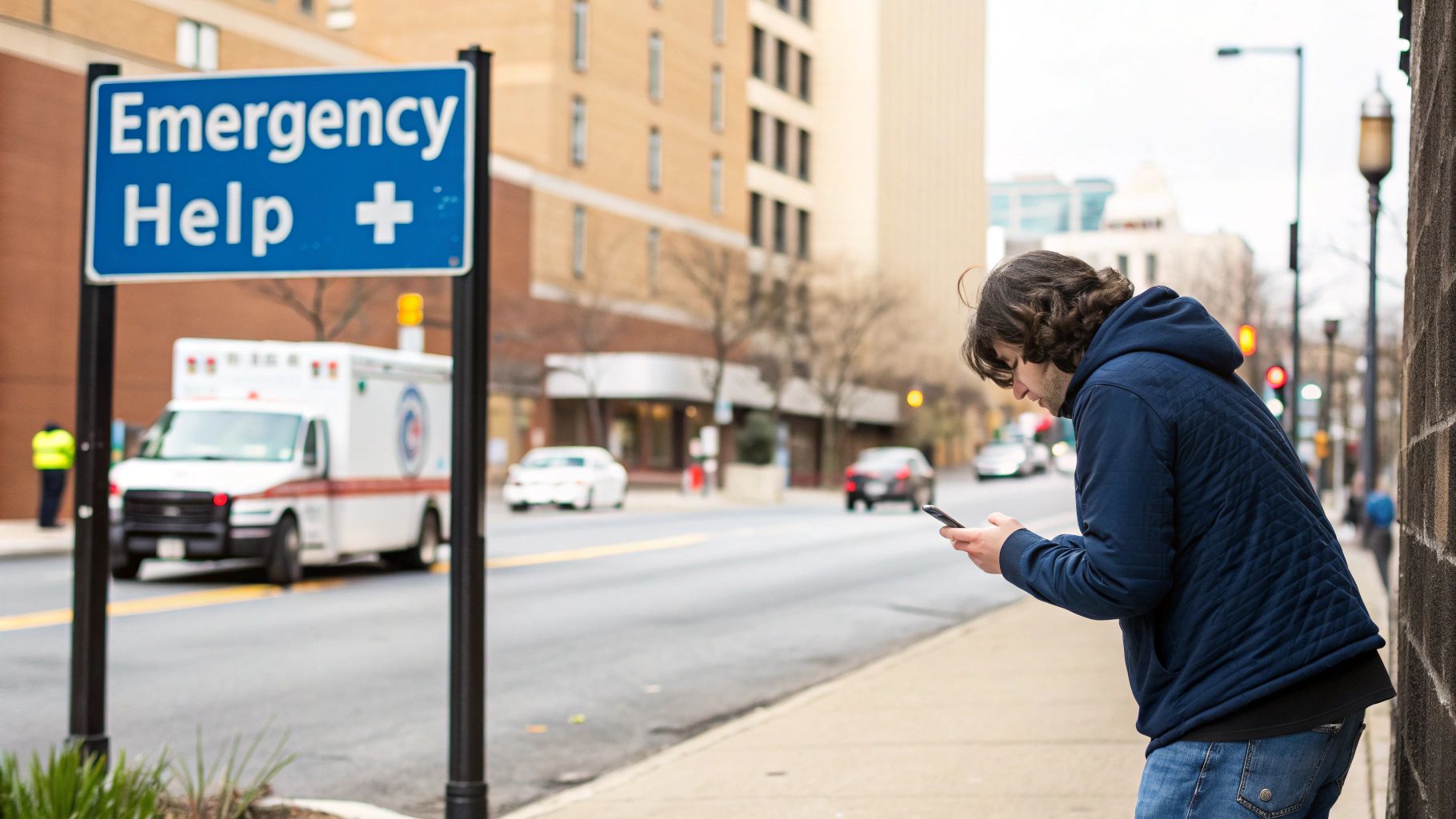
While no one plans for an emergency, knowing how to ask for help is a critical skill when traveling or living in a foreign country. These crucial phrases in Korean can be lifesavers, allowing you to communicate urgent needs clearly and quickly. Having these expressions ready can make a significant difference in a crisis, ensuring you get the assistance you need without delay.

Key Phrases and Usage
The most direct way to ask for help is 도와주세요 (dowajuseyo), meaning "Please help me." It is universally understood in urgent situations.
- If you need a doctor, you can say 의사 불러주세요 (uisa bulleojuseyo), meaning "Please call a doctor."
- To report a crime, use 경찰 불러주세요 (gyeongchal bulleojuseyo), "Please call the police."
- For a medical emergency, 병원에 가주세요 (byeong-won-e gajuseyo) means "Please take me to the hospital."
The emergency number for both ambulance and fire services is 119, while the police can be reached at 112.
Pro Tip: Memorize and practice these phrases until you can say them without thinking. In a real emergency, you may not have time to look them up.
Quick Practice
Imagine you are feeling very unwell and need to get to a hospital.
- You: 저기요. 도와주세요. 너무 아파요. (Jeogiyo. Dowajuseyo. Neomu apayo.) - Excuse me. Please help me. I'm very sick/hurt.
- Stranger: 괜찮으세요? 병원에 가야 돼요? (Gwaenchanheuseyo? Byeong-won-e gaya dwaeyo?) - Are you okay? Do you need to go to the hospital?
- You: 네, 병원에 가주세요. (Ne, byeong-won-e gajuseyo.) - Yes, please take me to the hospital.
4. Shopping and Transaction Phrases
Whether you're exploring the bustling traditional markets of Namdaemun or the trendy boutiques in Gangnam, knowing how to handle transactions is key to a successful shopping trip. These essential phrases in Korean empower you to inquire about products, understand prices, and make purchases with confidence. Using these expressions not only makes shopping easier but also shows respect to vendors.
Key Phrases and Usage
The most fundamental question is asking for the price: 이거 얼마예요? (igeo eolmayeyo?), which means "How much is this?"
- When you've decided to buy something, you can say 이거 주세요 (igeo juseyo), which means "Please give me this."
- To ask if they accept credit cards, use 카드 돼요? (kadeu dwaeyo?).
- In traditional markets where haggling is common, you might say 좀 깎아주세요 (jom kkakkajuseyo) to ask for a small discount.
Pro Tip: In many smaller shops and markets, paying with cash is preferred and may even get you a better deal. It's always a good idea to carry some Korean Won (₩) with you.
Quick Practice
Imagine you are at a market and find a hat you like.
- You: 이거 얼마예요? (Igeo eolmayeyo?) - How much is this?
- Vendor: 만원이에요. (Man-won-ieyo.) - It's 10,000 won.
- You: 좀 깎아주세요. (Jom kkakkajuseyo.) - Please give me a little discount.
- Vendor: 그럼 구천원에 하세요. (Geureom gucheon-won-e haseyo.) - Okay, you can have it for 9,000 won.
5. Travel and Direction Phrases
Navigating a new country is an exciting part of any adventure. From the bustling streets of Seoul to the serene beaches of Busan, knowing how to ask for and understand directions is essential. These practical phrases in Korean are your key to exploring independently, empowering you to interact with locals and discover more of what Korea has to offer.
Key Phrases and Usage
To ask "Where is [place]?", the most useful phrase is [장소] 어디에 있어요? ([jangso] eodie isseoyo?). For example, "화장실 어디에 있어요?" (Hwajangsil eodie isseoyo?) will help you find the restroom.
Understanding the answer requires knowing basic directional words:
- Go straight: 똑바로 가세요 (ttokbaro gaseyo)
- Turn left: 왼쪽으로 가세요 (oenjjogeuro gaseyo)
- Turn right: 오른쪽으로 가세요 (oreunjjogeuro gaseyo)
When using a taxi, you can say 장소로 가주세요 (jangsoro gajuseyo), meaning "Please go to [place]."
Pro Tip: Before your trip, download an offline map app like Naver Maps or Kakao Maps. They are much more accurate than Google Maps in Korea and can help you visualize the directions you receive.
Quick Practice
Imagine you are lost and need to find the nearest subway station.
- You: 실례합니다. 지하철역이 어디에 있어요? (Sillyehamnida. Jihacheollyeogi eodie isseoyo?) - Excuse me. Where is the subway station?
- Local: 아, 저쪽으로 가서 오른쪽으로 가세요. (A, jeojjogeuro gaseo oreunjjogeuro gaseyo.) - Ah, go that way and then turn right.
6. Business and Professional Communication Phrases
In South Korea's dynamic corporate world, using the right language is essential for showing respect and professionalism. Business communication relies heavily on formal speech levels that differ from casual conversation. Mastering these professional phrases in Korean is crucial for anyone working in a Korean company, attending school, or interacting with colleagues in a formal setting.
Key Phrases and Usage
The foundation of Korean business language is the formal speech style. To introduce yourself, you would say 저는 [이름]입니다 (Jeoneun [ireum]imnida), meaning "I am [Name]." When addressing colleagues, it is vital to use their title, such as 부장님 (bujangnim - department head).
Key phrases for daily office life include:
- 수고하셨습니다 (sugohasyeotseumnida): "You have worked hard," said at the end of the day.
- 잘 부탁드립니다 (jal butakdeurimnida): "I look forward to working with you," used in introductions.
- 확인해 보겠습니다 (hwaginhae bogetseumnida): "I will check on it."
Pro Tip: In Korean business culture, indirect communication is often preferred. A phrase like 검토해 보겠습니다 (geomtohae bogetseumnida - "I will review it") can sometimes be a polite way to decline a request without saying "no" directly.
Quick Practice
Imagine you are a new employee meeting your team leader.
- You: 안녕하세요, [직책]님. 새로 입사한 [이름]입니다. 잘 부탁드립니다. (Annyeonghaseyo, [jikchaek]nim. Saero ipsahan [ireum]imnida. Jal butakdeurimnida.) - Hello, [Title]. I am [Name], the new employee. I look forward to working with you.
- Team Leader: 반갑습니다, [이름]씨. 환영합니다. (Bangapseumnida, [ireum]ssi. Hwanyonghamnida.) - Nice to meet you, [Name]. Welcome.
7. Accommodation and Housing Phrases
Whether you're an international student finding a dorm or a traveler booking a hotel, knowing the right housing-related phrases in Korean is essential. The Korean real estate market has unique systems, making clear communication vital. These phrases will help you navigate property viewings, understand rental terms, and discuss your living arrangements.
Key Phrases and Usage
When searching for a place, you can say 월세방을 찾고 있어요 (wolse-bang-eul chatgo isseoyo), meaning "I am looking for a monthly rental room." If you see a property you like, ask 이 집을 볼 수 있을까요? (i jib-eul bol su isseulkkayo?), which means "Can I see this house?"
Understanding the financial terms is crucial:
- 보증금은 얼마예요? (bojeunggeum-eun eolmayeyo?) - How much is the security deposit?
- 월세는 얼마예요? (wolse-neun eolmayeyo?) - How much is the monthly rent?
- 관리비는 포함인가요? (gwallibi-neun pohamingayo?) - Are management fees included?
Pro Tip: The Korean rental system often requires a substantial security deposit called 보증금 (bojeunggeum). Always request a written rental agreement and, if possible, have a native speaker review it before you sign.
Quick Practice
Imagine you are at a real estate agency (부동산, budongsan).
- You: 이 아파트 월세는 얼마예요? (I apateu wolse-neun eolmayeyo?) - How much is the monthly rent for this apartment?
- Agent: 월세는 100만 원이고, 보증금은 1,000만 원입니다. (Wolse-neun baek-man wonigo, bojeunggeum-eun cheon-man wonimnida.) - The monthly rent is 1 million won, and the security deposit is 10 million won.
8. Medical and Healthcare Phrases
Navigating a healthcare system in a foreign country can be daunting, but knowing a few key phrases in Korean can make a huge difference. Whether you're visiting a pharmacy or a hospital, being able to describe your symptoms clearly is essential for receiving proper care. These expressions are critical for your well-being and provide peace of mind.
Key Phrases and Usage
To state where you are feeling pain, use the phrase 여기가 아파요 (yeogiga apayo), meaning "It hurts here," and point to the specific area.
- To say you have a headache, use 머리가 아파요 (meoriga apayo).
- For a stomach ache, it's 배가 아파요 (baega apayo).
- If you have a fever, say 열이 있어요 (yeori isseoyo).
To find medical help, ask 병원 어디에 있어요? (byeongwon eodie isseoyo?) for a hospital, or 약국 어디에 있어요? (yakguk eodie isseoyo?) for a pharmacy.
Pro Tip: Write down your symptoms in simple Korean phrases before your appointment. Many larger hospitals in cities like Seoul have international clinics with English-speaking staff, so don't hesitate to ask for one.
Quick Practice
Imagine you have caught a cold and need to explain your symptoms at a clinic.
- You: 머리가 아프고 열이 있어요. (Meoriga apugo yeori isseoyo.) - I have a headache and a fever.
- Doctor: 언제부터 아팠어요? (Eonjebuteo apasseoyo?) - Since when have you been sick?
- You: 어제부터요. (Eojebuteoyo.) - Since yesterday.
9. Social and Casual Conversation Phrases
Once you've mastered the basics, diving into casual conversation is the key to forming genuine connections. These informal phrases in Korean are the building blocks of friendship and daily interaction, moving you from a polite stranger to a familiar face. Casual language is more relaxed and expressive, essential for making new friends at a language exchange meetup.
Key Phrases and Usage
Casual speech often involves dropping the formal 요 (-yo) ending from verbs. For example, the formal 뭐 해요? (mwo haeyo? - "What are you doing?") becomes 뭐 해? (mwo hae?) among close friends.
Here are some essential phrases for social settings:
- To ask for someone's name in a friendly context: 이름이 뭐예요? (ireumi mwoyeyo?).
- To ask about hobbies: 취미가 뭐예요? (chwimiga mwoyeyo?).
- To connect with someone: 우리 친구해요! (uri chinguhaeyo!), which means "Let's be friends!"
Pro Tip: Don't worry if you make mistakes—even Koreans do sometimes! What matters most is progress. Listening to K-dramas is a great way to pick up natural-sounding expressions.
Quick Practice
Imagine you are at a language exchange cafe.
- You: 저기요, 이름이 뭐예요? (Jeogiyo, ireumi mwoyeyo?) - Excuse me, what's your name?
- New Friend: 저는 민준이에요. 그쪽은요? (Jeoneun Minjun-ieyo. Geujjogeunyo?) - I'm Minjun. And you?
- You: 저는 [Your Name]이에요. 만나서 반가워요! (Jeoneun [Your Name]-ieyo. Mannaseo bangawoyo!) - I'm [Your Name]. It's nice to meet you!
10. Cultural Etiquette and Respect Phrases
Understanding Korea's deep-rooted cultural values is as important as learning its vocabulary. These phrases in Korean go beyond simple communication; they are a direct reflection of respect, social hierarchy, and traditional courtesy. Using them correctly shows that you not only speak the language but also appreciate and understand the culture.
Key Phrases and Usage
Many phrases are tied to specific actions that show respect. For example, when receiving something from an elder, it is polite to accept it with both hands.
- When you are about to eat, especially in a group, you say 잘 먹겠습니다 (jal meokgesseumnida), which means "I will eat well." This shows gratitude to the person who prepared or paid for the meal.
- After finishing your meal, you express thanks by saying 잘 먹었습니다 (jal meogeosseumnida), meaning "I have eaten well."
Pro Tip: In Korea, age and social standing are very important. It is crucial to use formal language (jondaetmal) with those older than you or in a higher position. Using casual language (banmal) without permission can be seen as highly disrespectful.
Quick Practice
Imagine you are having dinner with your Korean boss, who has treated you to a meal.
- You (before eating): 잘 먹겠습니다. (Jal meokgesseumnida.) - I will eat well. Thank you for the meal.
- You (after eating): 정말 잘 먹었습니다. 감사합니다. (Jeongmal jal meogeosseumnida. Gamsahamnida.) - I have eaten really well. Thank you.
From Phrases to Fluency: Your Journey Starts Now
You've just armed yourself with a powerful toolkit of essential phrases in Korean, spanning ten crucial categories from everyday greetings to professional communication. This list is more than a collection of words; it's a foundational map for navigating real-world interactions in Korea with confidence. Think of each phrase as a key that unlocks a new conversation.
The journey from learning your first "안녕하세요" (Annyeonghaseyo) to expressing complex thoughts is built on these very building blocks. Mastering greetings lays the groundwork for social interactions. Understanding dining expressions lets you immerse yourself in Korea's vibrant food culture. Each category represents a significant step towards practical language skills.
Your Actionable Path to Fluency
Knowledge becomes power only when it is applied. Here are your immediate next steps:
- Choose One Category Per Week: Don't try to master everything at once. This week, focus only on ‘Dining Phrases.’ Next week, switch to ‘Shopping Phrases.’
- Create "Micro-Dialogues": Take two or three related phrases and write a short, two-line exchange to practice stringing thoughts together.
- Practice with a Partner: The most critical step is to use these phrases with another person. Speaking them aloud builds the confidence needed for real-world use.
Every word you learn brings you one step closer to confidence. Keep going—your Korean journey starts now!
🌟 Ready to start your Korean journey? Join Ktalk.live — where global learners connect, speak, and grow together! You can book your free 100-minute trial class on K-talk Live today!
Ready to stop reading and start speaking?
Practice what you just learned with a native Korean teacher — free for 100 minutes. No card, no commitment.