
Want to practice this with a native Korean teacher?
100-min free trial — no card required.
Ever found yourself glued to a K-drama, wondering why 'okay' seems to have a dozen different translations? One character says it one way, and in the next scene, someone says it completely differently. It can feel confusing, but here's the secret: saying okay in Korean isn't about one perfect word; it's about choosing the right expression for the right moment. Learning this is a key step toward sounding natural and confident.
This guide is your personal decoder for all things 'okay'. We'll skip dry textbook definitions and dive into how these phrases actually feel in real-life conversations. Instead of getting tangled in complex grammar, we’ll focus on context, helping you navigate different social situations with ease. By the time you're done, you'll know how to say okay in Korean for any situation, making your conversations flow more naturally.
Your Guide to Using Okay in Korean

Think of this guide as your personal decoder for all things 'okay'. We're going to skip the dry, textbook definitions and dive straight into how these phrases actually feel and function in real-life conversations.
Instead of getting tangled up in complex grammar, we’ll focus on the context. You'll see exactly when and where to use each term, which is the key to sounding natural and making genuine connections when you speak Korean. It's all about navigating different social situations with confidence.
By the time we're done, you'll know the difference between:
- The polite, everyday go-to: '괜찮아요' (gwaenchanayo).
- The enthusiastic, 'I love it!' version: '좋아요' (joayo).
- The casual, borrowed-from-English term for friends: '오케이' (okei).
- The simple, respectful nod of agreement: '네' (ne).
Mastering how to say okay in Korean is a bigger step towards fluency than you might think. It shows you’re not just learning words, but you’re also starting to understand the cultural nuances behind them. Every phrase you add to your toolkit gets you closer to speaking with the confidence and ease of a native.
So, let's get started.
The All-Purpose Okay: Gwaenchanayo Explained
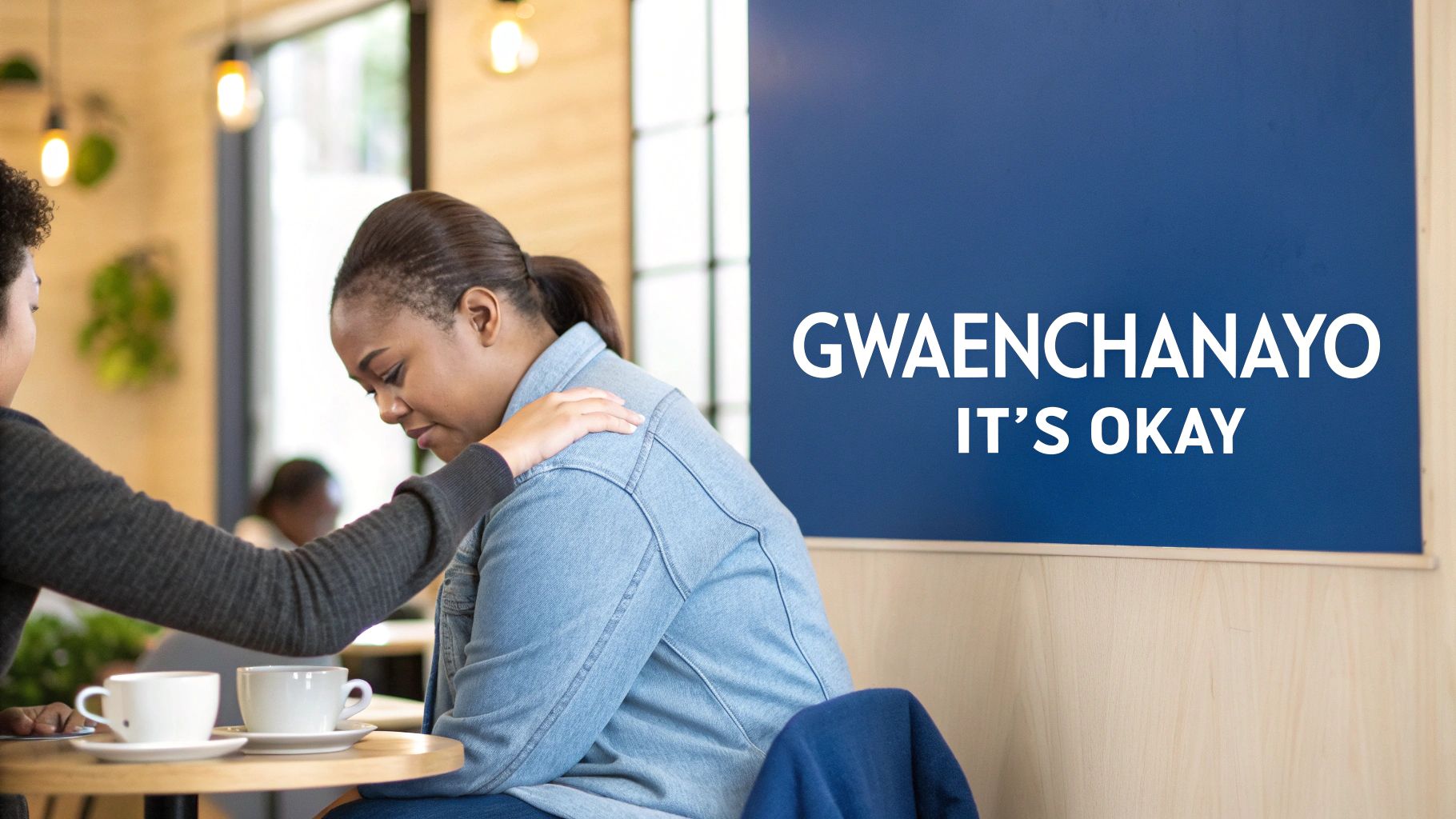
If you only have time to learn one way to say okay in Korean, this is the one you need: 괜찮아요 (gwaenchanayo).
Think of it as your Korean conversation Swiss Army knife. It’s polite, incredibly versatile, and fits into so many everyday situations that you’ll find yourself using it constantly. For a learner, it's the safest and most reliable phrase to have in your back pocket.
With this one expression, you can say "I'm okay," "It's alright," "That's fine," or even a soft "No, thank you." The magic is in its flexibility—at its core, you're letting someone know the situation is acceptable and there are no problems.
Just how common is it? A 2023 survey from the National Institute of Korean Language found that variations of this phrase are among the top 100 most-used expressions in spoken Korean. Its standard polite form, in particular, pops up everywhere, especially in service settings where showing respect is a must.
Using Gwaenchanayo in Real Life
So, how does this work in practice? The beauty of gwaenchanayo is how its meaning shifts slightly based on the flow of the conversation.
Here are a few scenarios you'll definitely run into:
When Someone Apologizes to You
Someone accidentally bumps into you on the subway and says, "죄송합니다" (joesonghamnida - I'm sorry). A quick, warm "괜찮아요" is the perfect way to reassure them that no harm was done and everything is fine.When Someone Asks if You're Hurt or Upset
Imagine you trip and your friend rushes over, asking, "괜찮아요?" (Are you okay?). You can immediately let them know you're not injured by replying, "네, 괜찮아요" (Ne, gwaenchanayo - Yes, I'm okay).When Politely Declining an Offer
A shopkeeper offers you a food sample you don't want to try. Simply smile and say, "괜찮아요." In this context, it acts as a gentle way of saying, "No, thank you, but I appreciate it."
Adjusting Your Politeness Level
Like almost everything in Korean, 괜찮아요 (gwaenchanayo) changes depending on who you’re talking to. Getting these small adjustments right is a huge step towards sounding more natural and respectful.
Quick Tip: That little -요 (-yo) at the end of many Korean words is your key politeness marker. Adding it shows respect, while dropping it makes your speech more casual and friendly.
Let’s look at the different forms you'll encounter.
Gwaenchanayo Politeness Levels at a Glance
This little table is your cheat sheet for picking the right version of "okay" for any situation.
| Korean Form | Romanisation | Politeness Level | When to Use It |
|---|---|---|---|
| 괜찮습니다 | gwaenchanseumnida | Formal | Use in business meetings, with elders you've just met, or in public announcements. |
| 괜찮아요 | gwaenchanayo | Polite / Standard | This is your go-to for most daily interactions—with strangers, colleagues, and older acquaintances. |
| 괜찮아 | gwaenchana | Informal / Casual | Reserved for close friends, family, and people who are clearly younger than you. |
When you're starting out, sticking with 괜찮아요 (gwaenchanayo) is always the safest bet. It hits that sweet spot of being friendly without being overly familiar.
As you get more comfortable and start building real relationships, you'll naturally get a feel for when it’s okay to drop the politeness and switch to the casual 괜찮아 (gwaenchana). This single word truly is a cornerstone for saying okay in Korean.
When ‘Okay’ Really Means ‘Good’ with Joayo

Alright, let's tackle one of the most common mix-ups for anyone learning Korean. You’ve probably got 괜찮아요 (gwaenchanayo) down as "it's okay," but what happens when you want to say something is more than just acceptable? What if you genuinely think it's a great idea?
This is exactly where 좋아요 (joayo) shines. It's your go-to phrase for expressing real enthusiasm.
Here’s an easy way to think about it: gwaenchanayo is like a polite, passive nod. Joayo, on the other hand, is a big, happy thumbs-up. Getting these two confused is a classic rookie mistake that can make you sound lukewarm when you actually mean something is fantastic. Nailing the difference will make your conversations so much clearer and more expressive.
The Real Feeling Behind Joayo
At its heart, 좋아요 (joayo) means "good" or "I like it." You'll want to pull this one out when you’re agreeing to something you're actually excited about, giving a compliment, or just sharing positive vibes. It carries a warmth and energy that gwaenchanayo just doesn't have.
Think about these everyday scenarios where joayo is the perfect choice:
Accepting an Invitation: A friend asks, "우리 커피 마실까요?" (Uri keopi masilkkayo? - Shall we grab coffee?). A simple "좋아요!" tells them you don't just agree—you think it's a brilliant idea.
Praising Food: You taste some amazing kimchi jjigae. Saying "이거 정말 좋아요!" (Igeo jeongmal joayo! - This is really good!) is a direct, sincere compliment.
Reacting to a Suggestion: Someone says, "Let's watch a movie." An enthusiastic "좋아요!" is the perfect way to say "Yes, let's do it!"
In every one of these examples, you're not just saying something is passable. You're actively saying it's good. This tiny shift in wording completely changes the tone from passive acceptance to genuine excitement.
Gwaenchanayo vs. Joayo in Action
Getting the feel for this subtle difference is a game-changer. While using the wrong one won't derail the conversation, using the right one will definitely make it better.
Let's put them side-by-side. Imagine a friend suggests going to the park.
If you reply with 괜찮아요 (gwaenchanayo), it might come across as: "Sure, I guess. The park is fine." There's no real spark. You're just saying it's an acceptable plan.
But if you say 좋아요 (joayo), it sounds more like: "Yes, I'd love to! The park sounds great." Your enthusiasm is totally clear.
Key Takeaway: Use gwaenchanayo when you mean "it's acceptable" or "it's fine." Reach for joayo when you really mean "it's good" or "I like it." Making this distinction is a massive step towards sounding more natural.
Learning to use joayo correctly helps you move from just being understood to truly connecting with people. Whenever you need to give a positive, energetic "okay," make this your go-to phrase.
The Casual and Trendy 'Okei'
If you're into K-pop or K-dramas, you’ve absolutely heard this one before. 오케이 (okei) is that cool, quick confirmation you hear when your favourite idol agrees to something or when friends are texting back and forth. It's the modern, super informal way to say okay in Korean.
This is a classic example of "Konglish," which is just a fun blend of Korean and English. It's woven itself into everyday chats, especially among younger Koreans. Think of it exactly like texting "okay" or even just "k" to your friends. It’s snappy, easy, and just feels current.
This direct loanword from English has really taken off. In fact, the use of 오케이 (okei) is part of a bigger trend. Some reports on the national language estimate that a whopping 40–60% of younger South Koreans sprinkle English loanwords into their daily conversations and social media. It's a fascinating look at how languages evolve, which you can read more about on Wikipedia's comprehensive page on the Korean language.
When Should You Use Okei?
So, when can you whip out an 오케이 (okei) and sound like a local? Easy—only in very casual, informal situations. It’s perfect for friends, siblings, or anyone your age or younger who you're close with. Use it to confirm plans, acknowledge a quick message, or give a simple thumbs-up.
Here are a few prime examples:
Texting a Friend:
- Friend: "영화 보러 갈까?" (Yeonghwa boreo galkka? - Wanna go see a movie?)
- You: "오케이!" (Okei! - Okay!)
Confirming a Meetup Time:
- Friend: "See you at 7?"
- You: "오케이!" (Okei!)
Agreeing to a Small Favour:
- Sibling: "Can you grab me a snack?"
- You: "오케이." (Okei.)
When Should You Absolutely Avoid Okei?
This is the part you really need to get right. Dropping an 오케이 (okei) in the wrong setting can make you sound a bit rude or disrespectful. It implies a casual closeness that just doesn't work in every situation.
Cultural Note: In Korea, showing respect through your choice of words isn't just polite—it's fundamental to social etiquette. Using informal language with an elder or a superior is a major no-no.
Keep 오케이 (okei) out of these conversations:
- With Your Boss or a Manager: Never. Always go with the formal 알겠습니다 (algesseumnida).
- When Speaking to an Elder: Stick to the polite and respectful 괜찮아요 (gwaenchanayo) or simply 네 (ne).
- In Any Formal Setting: This means job interviews, business meetings, presentations—you name it.
It helps to think of 오케이 (okei) as a word reserved for your inner circle. Using it correctly helps you sound natural and connect with friends, while switching to more formal phrases in other contexts shows you have a real handle on Korean culture. Nailing that difference is a huge step toward sounding truly fluent.
Beyond the Basics: More Ways to Say Okay
You've got the essentials down, but let's be real—the Korean language is full of wonderful nuances. If you want to move past textbook Korean and sound more natural, learning the different shades of "okay" is a fantastic next step. It's about more than just agreeing; it's about communicating your true intent.
We'll look at two key phrases that go far beyond a simple 'okay'—one for showing you understand and one for giving a quick, polite nod.
The Acknowledging Okay: 알겠습니다 (Algesseumnida)
Picture this: your manager lays out a new project, or a teacher breaks down a tricky grammar point. Just saying "okay" might feel a little weak, right? It doesn't quite capture that you've truly grasped the information.
This is the perfect moment for 알겠습니다 (algesseumnida).
This phrase is your go-to for saying, "I understand." Think of it as the Korean equivalent of "Got it," "Roger that," or "Understood." It's a formal, respectful expression that confirms you've not only heard but also processed what was said. Using algesseumnida signals both respect and competence, making it a must-know for work or school settings.
Here are a couple of real-world examples:
At the Office: Your team leader says, "Please have this report done by 3 PM." The best response? "알겠습니다." It’s crisp, professional, and confirms you’re on it.
Getting Directions: You ask a local for directions, and they explain, "Go straight and take a left at the bank." A confident "알겠습니다" tells them their instructions were clear and helpful.
This phrase is brilliant because it leaves no room for doubt. It shows you're on the same page, which is incredibly important in any situation where clarity matters.
The Quick Okay: 네 (Ne) and 예 (Ye)
Sometimes, you don't need a full-blown "I understand." You just need a quick, simple way to show you're listening and in agreement. That's where the Korean words for "yes"—네 (ne) and the even more formal 예 (ye)—come in handy.
While their literal meaning is "yes," they are constantly used as a quick "okay." This is super common on phone calls or when someone is explaining something at length. Dropping in a "네, 네" here and there is the verbal equivalent of nodding your head. It shows you're engaged without cutting the other person off.
Pro Tip: Stick with 네 (ne) for most everyday polite situations. Pull out 예 (ye) when you need to kick the formality up a notch, like when you're speaking to a company CEO or a respected elder.
For example, if a friend is confirming plans over the phone ("So, meeting at the station?"), a simple "네" is the perfect "okay."
By adding these contextual phrases to your toolkit, you're not just translating words anymore. You're communicating with finesse. Knowing when to use a thoughtful "okay, I get it" versus a quick "okay, yep" will make your Korean sound impressively authentic.
Common Mistakes to Avoid When Saying Okay
You’re getting the hang of saying okay in Korean, which is a fantastic step! But like any language, there are a few little traps that can catch learners and lead to some slightly awkward moments. Don't worry, though—once you know what they are, they're super easy to sidestep. Let's make sure what you mean is always what you say.
The most common mix-up by far is confusing 괜찮아요 (gwaenchanayo) with 좋아요 (joayo). It seems like a small difference, but it can totally change the vibe of your conversation.
Using Gwaenchanayo When You Mean Joayo
Let’s paint a picture. Your friend asks if you want to go get your absolute favourite food, bibimbap. You’re thrilled! But you reply with, “네, 괜찮아요” (Ne, gwaenchanayo). To your friend, this sounds a lot like, "Yeah... that's fine, I guess." Instead of showing excitement, you've accidentally come across as lukewarm or indifferent.
Remember This Rule: If you genuinely love an idea and want to give it an enthusiastic "yes!", always go with 좋아요 (joayo). Think of 괜찮아요 (gwaenchanayo) as your go-to for when something is simply acceptable, when you're reassuring someone that things are fine, or when politely declining an offer.
Using Okei in Formal Situations
Here’s another classic slip-up: using the super casual 오케이 (okei) with someone older or in a position of authority, like a manager or a teacher. It's the perfect, snappy reply for texting your friends, but in a more formal setting, it can sound a bit too familiar, maybe even a little disrespectful.
In Korea, using the right level of politeness is a huge part of showing respect. It's baked right into the language and culture.
- What to Avoid: Replying with a quick "오케이" when your boss asks you to do something.
- What to Say Instead: Stick to a polite and professional phrase like 알겠습니다 (algesseumnida), which means "I understand," or even just a respectful 네 (ne).
Steering clear of these two common pitfalls will do more than just make your Korean sound correct. It shows you're culturally aware, which goes a long way in building great relationships and helping you communicate with real confidence.
Your Questions About Saying Okay in Korean Answered
Even after getting the hang of the main ways to say okay in Korean, it's totally normal for a few questions to pop up. Let's tackle some of the most common points of confusion so you can start using these phrases like you've been speaking Korean for years.
Can I Just Use Okei All the Time?
It’s tempting, right? It's so simple. But the short answer is a hard no.
While 오케이 (okei) is perfect for texting your friends or chatting with people your age, it's a big no-go with your boss, an elder, or in pretty much any formal situation. Using it then would come across as way too casual, maybe even a bit disrespectful. Politeness is a huge deal in Korean culture, so always think about who you're talking to. Save 오케이 (okei) for your close crew.
What Is the Most Formal Way to Say Okay for a Business Meeting?
In a professional setting, your go-to phrase should be 알겠습니다 (algesseumnida). It's so much more than a simple "okay." It carries the weight of "I understand" or "Message received."
This phrase clearly signals that you've not only heard but also processed the information, which shows respect and professional competence. It's the gold standard in the Korean workplace. If you just need to show simple agreement, the very formal 예 (ye) is also a perfect choice.
How Do I Ask "Is It Okay If I..."?
This is a super useful one! To ask for permission, you'll build a phrase around 괜찮아요 (gwaenchanayo). The pattern you'll use most often is adding -아/어도 괜찮아요? (-a/eodo gwaenchanayo?) to the end of a verb stem.
Let's say you want to ask, "Is it okay if I sit here?" You'd say:
- 여기 앉아도 괜찮아요? (Yeogi anjado gwaenchanayo?)
This structure is a game-changer for politely navigating everyday life in Korea, whether you're asking to snap a photo or see if it's alright to open a window. Getting this pattern down is a massive step toward having conversations that feel natural and smooth.
Learning the different ways to say "okay" is about more than just vocabulary—it's about understanding the culture and connecting with people. Every phrase you master brings you one step closer to fluency. Keep practicing, and don't be afraid to try them out! Your Korean journey starts with these small, important steps.
🌟 Ready to start your Korean journey? Join Ktalk.live — where global learners connect, speak, and grow together
Ready to stop reading and start speaking?
Practice what you just learned with a native Korean teacher — free for 100 minutes. No card, no commitment.