Want to practice this with a native Korean teacher?
100-min free trial — no card required.
Have you ever tried to learn numbers in Korean and felt a little overwhelmed? You're not alone! Unlike English, Korean uses two completely different number systems, and knowing which one to use can seem tricky at first. It’s a common challenge for learners, but with the right approach, it becomes a fun and rewarding journey.
One system is for counting things like people and objects, while the other is for everything else—like dates, money, and phone numbers. This guide will break it all down in a simple, friendly way, so you can start using Korean numbers with confidence. Let's get started!
Your Quick Guide to Korean Numbers

Ever watched a K-drama character order two coffees, or tried to buy a souvenir and felt lost when the shopkeeper told you the price? Don’t worry, getting a handle on numbers in Korean is a huge milestone for every learner.
The real trick isn't just memorization; it's understanding the "why." Korean has two number systems because of its unique history, blending original Korean words with a system adapted from Chinese.
Two Systems for Different Jobs
The best way to think about it is this: in English, we sometimes have special words for quantities. We might say "a couple of friends" instead of "two friends." Korean just takes that idea a bit further.
Here’s the basic split:
- Native Korean Numbers (하나, 둘, 셋…): These are the original Korean words. You’ll use them when you're counting physical things—people, books, apples—as well as your age and the hour on a clock. For the most part, you'll only use these for numbers 1 through 99.
- Sino-Korean Numbers (일, 이, 삼…): These numbers came from Chinese characters. You'll see them used for more abstract concepts like dates, money, phone numbers, addresses, and even minutes and seconds.
Grasping this difference is your most important first step. Once you know which system to use, the rest starts to fall into place. Let's look at the first ten numbers from both systems side-by-side.
Honestly, if you can just memorize the first ten numbers in each system, you’ll be able to navigate over 80% of everyday situations. It’s a small amount of work for a massive payoff!
This quick reference chart should help you see the difference.
Sino-Korean vs Native Korean Numbers at a Glance (1-10)
| Number | Sino-Korean (il, i, sam...) | Native Korean (hana, dul, set...) | Primary Use Case |
|---|---|---|---|
| 1 | 일 (il) | 하나 (hana) | Money, dates, phone numbers |
| 2 | 이 (i) | 둘 (dul) | Counting people, objects, age |
| 3 | 삼 (sam) | 셋 (set) | Sino for minutes, Native for hours |
| 4 | 사 (sa) | 넷 (net) | Counting tangible items |
| 5 | 오 (o) | 다섯 (daseot) | Building floors, bus routes |
| 6 | 육 (yuk) | 여섯 (yeoseot) | Ordering items, e.g., "6 apples" |
| 7 | 칠 (chil) | 일곱 (ilgop) | Sino-Korean is used for numbers over 100 |
| 8 | 팔 (pal) | 여덟 (yeodeol) | Native Korean is essential for conversation |
| 9 | 구 (gu) | 아홉 (ahop) | Counting friends or family |
| 10 | 십 (sip) | 열 (yeol) | Counting anything up to 99 |
Take a moment to get familiar with these. Once you're comfortable, you’ll be surprised at how much you can already understand.
Mastering Sino-Korean Numbers for Everyday Life
The Sino-Korean system is your go-to for almost everything in modern life. Think of it as the practical backbone for all the abstract numbers in Korean you'll come across—from checking a price tag to catching the right bus.
The best part? It's incredibly systematic. Once you nail the numbers from one to ten, you have the keys to build pretty much any number you'll ever need.
The Simple Building Blocks of Sino-Korean Numbers
Let's start with the essentials. You only need to learn these ten core numbers:
- 1: 일 (il)
- 2: 이 (i)
- 3: 삼 (sam)
- 4: 사 (sa)
- 5: 오 (o)
- 6: 육 (yuk)
- 7: 칠 (chil)
- 8: 팔 (pal)
- 9: 구 (gu)
- 10: 십 (sip)
With just these ten words, we can immediately start building bigger numbers. The logic is beautifully simple: to say eleven (11), you just combine "ten" and "one."
Example:
- 11 = 10 (십, sip) + 1 (일, il) = 십일 (sibil)
- 18 = 10 (십, sip) + 8 (팔, pal) = 십팔 (sippal)
It really is that simple! The number for ten (십) comes first, followed by the single digit.
Constructing Numbers from 20 to 99
So, what about a number like 25? The logic stays just as straightforward. You simply say "two-ten-five." You’re essentially speaking the math out loud.
Example:
- 20 = 2 (이, i) + 10 (십, sip) = 이십 (isip)
- 25 = 2 (이, i) + 10 (십, sip) + 5 (오, o) = 이십오 (isibo)
This pattern continues all the way up. To say 99, you'd say "nine-ten-nine" (구십구, gusipgu). Once this clicks, counting to 99 will become second nature.
The structure of Sino-Korean numbers is based on multiplication and addition. For 34 (삼십사), you are literally saying "three times ten" (삼십) plus "four" (사). Grasping this is the secret to forming any number with ease.
Putting Sino-Korean Numbers into Action
So, where will you actually use these numbers? The short answer is: everywhere! This system is your key to navigating daily life in Korea smoothly.
Here are the most common situations:
- Money: When you see a price tag for ₩5,000, you'll read it as 오천 원 (ocheon won).
- Dates: To say "October 26th," you use Sino-Korean for both: 시월 이십육일 (siwol isibyugil).
- Phone Numbers: Digits are read individually, like 공일공 (gong-il-gong) for 010.
- Measurements: Whether it's 2 kilometres (이 킬로미터, i killomiteo) or 10 kilograms (십 킬로그램, sip killogeuraem).
- Floors & Addresses: Heading to the 12th floor? That’s 십이 층 (sibi cheung).
Getting comfortable with prices is one of the most practical skills you can learn. For instance, the average monthly wage in South Korea is around 4,293,856 KRW. Being able to read these large numbers is crucial for understanding the local economic context. You can find more of South Korea's economic statistics on CountryMeters.info.
Mastering the Sino-Korean system is about internalizing a logical pattern. With a bit of practice, you'll be handling prices, dates, and addresses with confidence.
Using Native Korean Numbers for Counting
Alright, let’s get into the Native Korean numbers. Think of this as the original, organic way of counting. It’s what you’ll use for tangible, everyday things—the people you meet, the items you buy, your age, and the hours on a clock.
While this system generally only goes up to 99, it's absolutely crucial for daily conversation. This is the system that truly makes your Korean feel alive and connected to the world around you.
The Core Numbers: 1 Through 10
Most of the time, you'll be using the Native Korean numbers from one to ten. Getting these down cold is your first big step.
Let's get familiar with them:
- 1: 하나 (hana)
- 2: 둘 (dul)
- 3: 셋 (set)
- 4: 넷 (net)
- 5: 다섯 (daseot)
- 6: 여섯 (yeoseot)
- 7: 일곱 (ilgop)
- 8: 여덟 (yeodeol)
- 9: 아홉 (ahop)
- 10: 열 (yeol)
Don't worry if they seem like a mouthful at first. They'll roll off the tongue with a little practice!
The Magic Change for Numbers 1 to 4
Now, here’s a rule that trips up almost every beginner, but it’s a game-changer for sounding natural. When you use the first four Native Korean numbers right before the thing you're counting, they change their shape.
Nailing this is one of the most important steps to using numbers in Korean correctly in real life.
Here’s how they transform:
- 하나 (hana) becomes 한 (han)
- 둘 (dul) becomes 두 (du)
- 셋 (set) becomes 세 (se)
- 넷 (net) becomes 네 (ne)
This little quirk only applies to these four. From five (다섯, daseot) onwards, the numbers stay exactly the same.
Seeing Native Korean Numbers in the Wild
So, how does this look in a real sentence? The basic structure is Noun + Number + Counter. We’ll get into counters in the next section, but for now, just watch how the numbers behave.
Let’s say we’re counting people with the counter 명 (myeong).
- One person: 사람 한 명 (saram han myeong)
- Two people: 사람 두 명 (saram du myeong)
- Three people: 사람 세 명 (saram se myeong)
- Four people: 사람 네 명 (saram ne myeong)
- Five people: 사람 다섯 명 (saram daseot myeong) — See? No change here!
This same rule pops up when you tell someone your age using the counter 살 (sal), which means "years old."
Example Dialogue:
A: 몇 살이에요? (Myeot sarieyo?) — How old are you?
B: 스물세 살이에요. (Seumul-se sarieyo.) — I am 23 years old.
In that conversation, the number 23 (스물셋, seumulset) becomes 스물세 (seumul-se) because it’s followed by the counter 살 (sal). Getting this tiny detail right makes a massive difference. It shows you understand the natural rhythm of the language.
Making Sense of Korean Counters
One concept that can feel strange at first is "counters." In English, we just say "three dogs" or "five books." Simple.
But in Korean, you need a special word—a "counter"—to specify the type of thing you're counting. The basic formula is Noun + Number + Counter. So, "three dogs" becomes "dog three [animal-counter]" (강아지 세 마리, gangaji se mari). It might seem like an unnecessary step, but it’s absolutely essential for sounding natural.
This little flowchart is a great mental shortcut for deciding which number system to use.
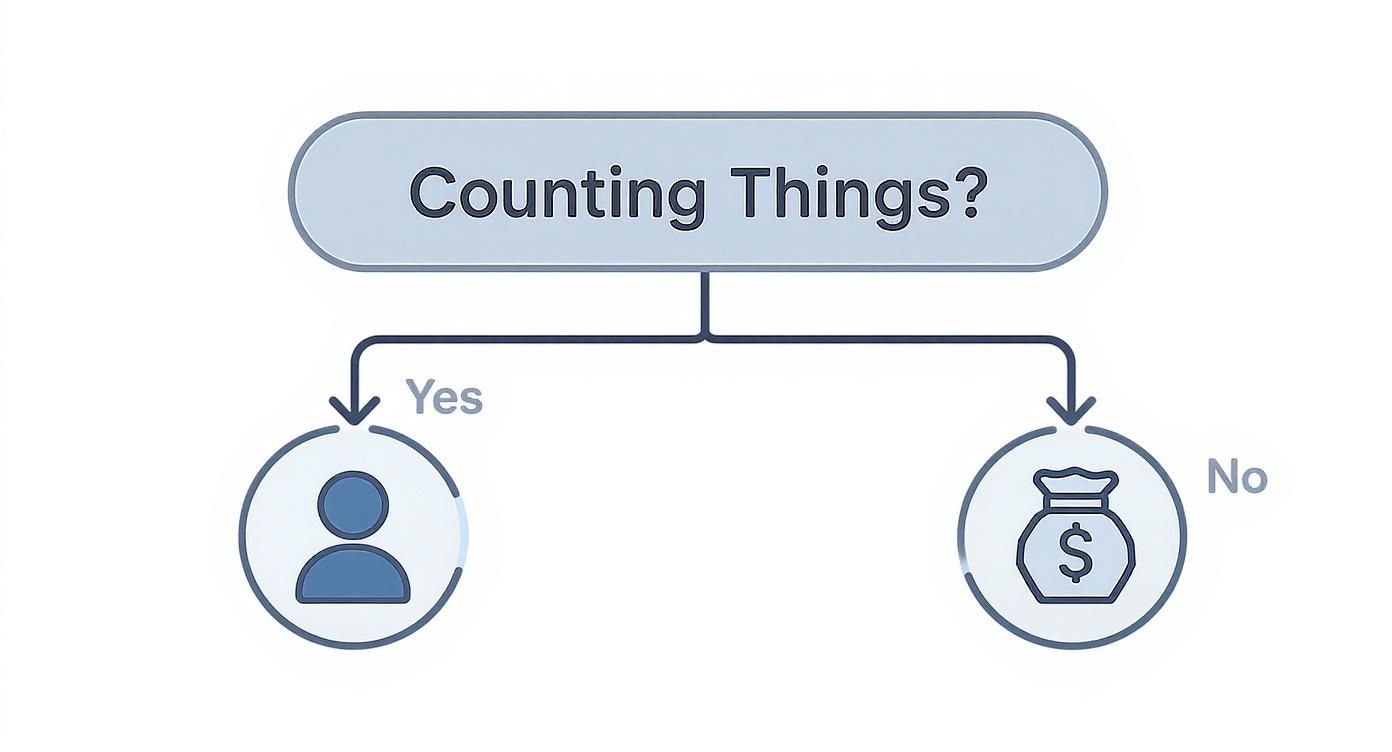
If you're counting actual, physical things, you're on the path to using Native Korean numbers and counters.
Common Counters You'll Actually Use Every Day
The good news? You don't have to memorize a dictionary's worth of counters. A small handful will cover about 90% of your daily conversations.
These are your absolute must-knows:
- -개 (gae) for Items: This is your go-to for most inanimate objects. When in doubt, 개 (gae) is often the safest bet.
- -명 (myeong) for People: Counting your friends or classmates? You'll need 명 (myeong).
- -마리 (mari) for Animals: For your pet cat, the squirrels in the park, or fish in a tank, 마리 (mari) is the counter.
- -권 (gwon) for Books: Anyone headed to a bookstore will need 권 (gwon).
- -병 (byeong) for Bottles: Essential for ordering drinks! Use this for bottles of water or soju.
- -잔 (jan) for Cups/Glasses: For that daily coffee or a cup of tea, you'll use 잔 (jan).
And don't forget the rule: the first four Native numbers (하나, 둘, 셋, 넷) change to 한, 두, 세, 네 right before a counter!
How to Use Counters in Sentences
Let's put this into practice. The pattern is always noun first, then the (shortened) number, and finally the counter.
Example Dialogue:
Imagine you're at a café and want two coffees.
- You’d say: "커피 두 잔 주세요." (Keopi du jan juseyo.)
- This means: "Please give me two cups of coffee."
See how 둘 (dul) became 두 (du) right before the counter 잔 (jan)?
Here's another one. Let's say you're talking about your pet.
- You might say: "고양이 한 마리 있어요." (Goyangi han mari isseoyo.)
- This means: "I have one cat."
Again, 하나 (hana) shortens to 한 (han) before 마리 (mari).
Pro Tip: Don't get overwhelmed. Just focus on mastering 개, 명, and 마리 first. With those three, you can count almost anything you'll run into on a normal day.
Essential Korean Counters for Everyday Use
To help you get started, here’s a quick-reference table with the counters you'll need most. Try making your own sentences with them!
| Counter (Hangul) | Used For | Example Sentence (Korean) | Example Sentence (English) |
|---|---|---|---|
| 개 (gae) | General items, things | 사과 세 개 주세요. (Sagwa se gae juseyo.) | Please give me three apples. |
| 명 (myeong) | People (formal/standard) | 학생 네 명이 있어요. (Haksaeng ne myeongi isseoyo.) | There are four students. |
| 마리 (mari) | Animals | 강아지 두 마리를 키워요. (Gangaji du marireul kiwoyo.) | I am raising two puppies. |
| 권 (gwon) | Books, notebooks | 책 다섯 권을 샀어요. (Chaek daseot gwoneul sasseoyo.) | I bought five books. |
| 병 (byeong) | Bottles | 물 한 병만 주세요. (Mul han byeongman juseyo.) | Just one bottle of water, please. |
| 잔 (jan) | Cups, glasses | 커피 두 잔 주문할게요. (Keopi du jan jumunhalgeyo.) | I'll order two cups of coffee. |
| 장 (jang) | Sheets of paper, tickets | 영화 표 두 장이 필요해요. (Yeonghwa pyo du jangi piryohaeyo.) | I need two movie tickets. |
Getting the hang of counters is a huge step forward in mastering numbers in Korean. Ready to put it into practice? Join a free trial class on K-talk Live and try using these counters with a friendly, native tutor.
Telling Time, Dates, and Age in Korean

Now let's get into the fun part—where the two number systems work together in real life. Talking about time, dates, and age is something you'll do every day, and mastering this is a huge step toward sounding natural.
It might seem complicated, but there are clear, consistent rules. Once you see the pattern, it clicks. Getting this hybrid system down shows you understand the logic behind the numbers in Korean.
How to Tell Time in Korean
Telling the time is the best example of the two systems tag-teaming. The rule here is simple and never changes.
Here’s the basic formula:
- Hours: Use Native Korean numbers + 시 (si)
- Minutes: Use Sino-Korean numbers + 분 (bun)
So for the hour, you’ll grab numbers like 하나 (hana) and 둘 (dul). But for the minutes, you'll flip over to the Sino-Korean system. And don't forget that the first four Native Korean numbers shorten before a counter, and 시 (si) counts as one!
Let's see it in action:
- 3:00 → 세 시 (se si) — See how 셋 (set) becomes 세 (se)?
- 5:10 → 다섯 시 십 분 (daseot si sip bun)
- 8:45 → 여덟 시 사십오 분 (yeodeol si sasibo bun)
Quick Tip: For the 30-minute mark, you can use the word 반 (ban), which means "half." So, 2:30 can be either 두 시 삼십 분 (du si samsip bun) or, more casually, 두 시 반 (du si ban).
Navigating Dates and Months
Compared to telling time, dates are a breeze because they stick to just one system. For years, months, and days, you will always use Sino-Korean numbers.
You just need to know these key counters:
- Year: 년 (nyeon)
- Month: 월 (wol)
- Day: 일 (il)
Let’s say you want to write out "October 25th, 2024." You just assemble the pieces using Sino-Korean numbers.
Example:
- Year 2024: 이천이십사 년 (icheon isipsa nyeon)
- October (Month 10): 십월 (siwol)
- Day 25: 이십오일 (isiboil)
Put it all together: 이천이십사 년 십월 이십오일 (icheon isipsa nyeon siwol isiboil). It's perfectly logical!
Talking About Age in Korean
Age comes up a lot in conversation in Korea. When you're speaking casually, you should always use Native Korean numbers followed by the counter 살 (sal), which means "years old."
Just like telling the hour, the first four Native Korean numbers change their form.
Example Dialogue:
A: 몇 살이에요? (Myeot sarieyo?) — How old are you?
B: 저는 스물네 살이에요. (Jeoneun seumul-ne sarieyo.) — I am 24 years old.
Notice how 24, which is 스물넷 (seumulnet), changes to 스물네 (seumul-ne) right before 살 (sal). It’s a small detail, but it makes a huge difference.
Knowing how to state age correctly is more than just casual chat. For instance, the retirement age in South Korea is 60 years, a policy reflecting the country's demographics. You can see more insights into Korea's demographics on Trading Economics. Using the right numbers in Korean for age is key.
Common Mistakes Learners Make with Korean Numbers
Figuring out the two Korean number systems is a huge step forward, but let's be real—everyone trips up at some point. Think of these common mistakes as rites of passage! Knowing what to watch out for will help you build your confidence much faster.
The most frequent stumble? Mixing up the two systems. A simple rule of thumb: if you can physically count it (like people or apples), use Native Korean. For more abstract things (like money or dates), Sino-Korean is your go-to.
Forgetting the Four Special Numbers
Here’s a classic mistake: forgetting to shorten the first four Native Korean numbers when they’re followed by a counter. A learner might say "커피 하나 잔 주세요" (keopi hana jan juseyo), but a native speaker would say "커피 한 잔 주세요" (keopi han jan juseyo).
To get this down, practice these four changes until they feel like second nature:
- 하나 (hana) becomes 한 (han)
- 둘 (dul) becomes 두 (du)
- 셋 (set) becomes 세 (se)
- 넷 (net) becomes 네 (ne)
This rule applies every single time these numbers come before a counter, whether for age (살, sal), items (개, gae), or people (명, myeong).
Pronunciation Pitfalls
Pronunciation can be tricky. For instance, the Sino-Korean number for two, 이 (i), sounds exactly like the Korean word for "teeth," which is also 이 (i). Don't worry, context is your best friend here!
Along the same lines, the number four, 사 (sa), has the same sound as the word for death. This is why you'll often see the 4th floor in Korean buildings labeled with an "F" instead of the number 4.
Don’t worry if you make mistakes — even Koreans do sometimes! The goal is communication, not perfection. Just being aware of these sound-alikes will help sharpen your listening skills.
One last little tripwire: sometimes learners try to apply the shortening rule to numbers beyond four. The rule only applies to one, two, three, and four. From five (다섯) onwards, the numbers stay exactly as they are, which actually makes things easier. If you keep these points in mind, you'll be navigating numbers in Korean with much more accuracy.
Frequently Asked Questions About Korean Numbers
Even with the rules laid out, a few questions always seem to trip learners up. Let's clear up the most common points of confusion so you can count with confidence.
Why on Earth Does Korean Have Two Number Systems?
This is the big one! The answer is all about history. The Native Korean system (hana, dul, set) is the original way Koreans counted things.
Then, centuries ago, a huge amount of Chinese culture and language was adopted into Korean. Along with it came the Chinese-based number system, which we now call Sino-Korean (il, i, sam). It stuck around for more formal or technical uses, and now we have two systems living side-by-side.
Which System Should I Use for My Age?
Great question! When you're just talking to people, always use Native Korean numbers followed by the counter 살 (sal). So, if you're twenty, you'd say ‘스무 살’ (seumu sal).
You might see Sino-Korean numbers used for age on very formal documents, but that's the exception. For sounding natural in a real conversation, stick with the Native system.
What Happens After 99 in the Native Korean System?
This is where you can breathe a sigh of relief. The Native Korean numbers basically cap out at 99 (아흔아홉, aheunahop).
For any number from 100 and up, everybody switches over to the Sino-Korean system exclusively. So, 100 is 백 (baek), 1,000 is 천 (cheon), and so on. No need to learn a whole new set of words for big numbers!
How Do I Say Zero in Korean?
Ah, zero. It's special enough to have two words, each with its own job.
- 영 (yeong): This is the Sino-Korean version. You'll use it for things that feel more mathematical, like talking about the temperature or keeping score in a game.
- 공 (gong): This one literally means "ball" or "empty space." It’s used when you're reading out digits one by one, especially in phone numbers. That's why the common mobile prefix 010 is always read 공일공 (gong-il-gong).
Learning to use both number systems correctly is a huge achievement in your Korean journey. It opens up so many daily conversations and helps you connect more deeply with the culture. Every number you learn brings you one step closer to confidence.
🌟 Ready to start your Korean journey? Join Ktalk.live — where global learners connect, speak, and grow together! Start with a free trial class at https://ktalk.live.
Ready to stop reading and start speaking?
Practice what you just learned with a native Korean teacher — free for 100 minutes. No card, no commitment.