Want to practice this with a native Korean teacher?
100-min free trial — no card required.
Learning Korean might seem challenging at first, but with the right approach, it becomes a fun and rewarding journey! If you're just starting out, you'll quickly learn that "no" isn't just a single word. Knowing how to say no in Korean is a massive step toward real-world fluency. It's about more than just 아니요 (aniyo); it's about understanding how to politely refuse, disagree, or state that something isn't the case, all while navigating Korean social etiquette. This guide will walk you through the essential ways to say no, from casual chats with friends to formal situations, helping you communicate with confidence and respect.
Your Quick Guide to Saying No in Korean

Before we dive into the deeper cultural etiquette and grammar, it helps to have a quick reference you can turn to. Think of this part as your survival kit. I'm front-loading the most essential phrases so you can start building confidence right away.
This foundation will get you through basic conversations, whether you're ordering food, turning down a sales offer, or just chatting with new friends. Mastering these will make your Korean journey much smoother!
Essential Ways to Say No in Korean
To get you started, here’s a quick-glance table breaking down the most common words for saying no in Korean. It covers everything from polite refusals to the short words used to negate a verb, showing you the Hangul, Romanization, and exactly when to use each one.
| Korean (Hangul) | Romanization | Meaning & Politeness | Common Use Case |
|---|---|---|---|
| 아니요 | aniyo | No (Standard Polite) | The default, safe way to say 'no' to strangers, elders, or in formal settings. |
| 아니 | ani | No (Casual) | Used with close friends, family, or people younger than you. Avoid in polite situations. |
| 안 | an | Don't (Negation) | Placed before a verb to mean you choose not to do something (e.g., 안 가요 - I don't go). |
| 못 | mot | Can't (Negation) | Placed before a verb to mean you are unable to do something (e.g., 못 가요 - I can't go). |
| 괜찮아요 | gwaenchanayo | I'm okay (Polite Refusal) | A soft way to decline an offer, like a second helping of food or a drink. |
Keep this table handy as you start your learning journey—it’s a simple cheat sheet that will serve you well in countless situations.
Mastering the Most Common No: 아니요 (Aniyo)
If you're going to learn just one way to say no in Korean, make it 아니요 (aniyo). This is almost always the first "no" new learners pick up, and for good reason. It’s polite, incredibly versatile, and your safest bet for a massive range of daily situations—from talking to a shopkeeper to answering a simple question from someone you've just met.
Think of 아니요 (aniyo) as your go-to, all-purpose "no." It’s a direct and clear negation used in response to a yes-or-no question. Its standard politeness level makes it perfect for speaking with people you don’t know well, anyone older than you, or in pretty much any public setting you can think of.
But the real magic to sounding natural in Korean is knowing how this one little word shifts depending on who you're talking to. This is where the famous Korean politeness levels enter the picture.
Adjusting Your "No" for Any Situation
Korean isn't just a language; it's a reflection of a social structure, and politeness is woven into its very grammar. Getting a handle on how to adapt your speech is a massive step towards fluency. If you're curious about the deep connection between language and etiquette, you can find out more about how culture shapes Korean on imminent.translated.com.
For a simple "no," you really only need to lock down three main forms.
1. Standard Polite: 아니요 (Aniyo)
- Pronunciation: ah-ni-yo
- When to use: This is your default setting. Stick with it when talking to strangers, colleagues, elders, and in any scenario where you need to show respect.
- Example:
- A: 커피 좋아하세요? (Keopi joahaseyo?) - Do you like coffee?
- B: 아니요, 저는 차를 더 좋아해요. (Aniyo, jeoneun chareul deo joahaeyo.) - No, I prefer tea.
2. Casual / Informal: 아니 (Ani)
- Pronunciation: ah-ni
- When to use: Save this one for your inner circle—close friends, siblings, or people who are clearly younger than you. Using this with an elder or a stranger would come across as quite rude.
- Example:
- A: 오늘 바빠? (Oneul bappa?) - Are you busy today?
- B: 아니, 안 바빠. (Ani, an bappa.) - No, I'm not busy.
3. Formal: 아닙니다 (Animnida)
- Pronunciation: ah-nim-ni-da
- When to use: This is the most formal and respectful version. You'll hear it in business presentations, on the news, during military service, or when you need to show the absolute highest degree of respect, like in a job interview.
- Example:
- A: 학생입니까? (Haksaengimnikka?) - Are you a student?
- B: 아닙니다. 회사원입니다. (Animnida. Hoesawonimnida.) - No. I am an office worker.
Get these three variations down, and you’ll be ready to say a direct no in Korean with confidence, no matter who you find yourself talking to.
Negating Actions with An and Mot
Alright, let's move beyond a simple "no." What happens when you want to say you won't do something, versus you can't do something? This is a huge deal in Korean, and getting it right makes you sound much more fluent. Luckily, it all boils down to two tiny but powerful words: 안 (an) and 못 (mot).
Nailing the difference between these two is a game-changer. They look almost the same, but they unlock a whole new level of nuance, letting you explain why you're not doing something—is it by choice, or because you're unable to?
The Difference Between An and Mot
Here’s the simplest way to think about it. 안 (an) is all about your choice. It's your will. When you use 안 (an), you're making a conscious decision not to do something. On the flip side, 못 (mot) is about inability. It means something outside of your control—a lack of skill, time, or opportunity—is stopping you. You might even want to do it, but you just can't.
- 안 (an) = I don't / I won't (because I'm choosing not to)
- 못 (mot) = I can't (because I'm not able to)
This one distinction is everything. For example, "I don't eat meat" (안 먹어요) is a personal choice. But "I can't eat meat" (못 먹어요) suggests an allergy or a restriction. Using the right word here means people will understand your intention perfectly.
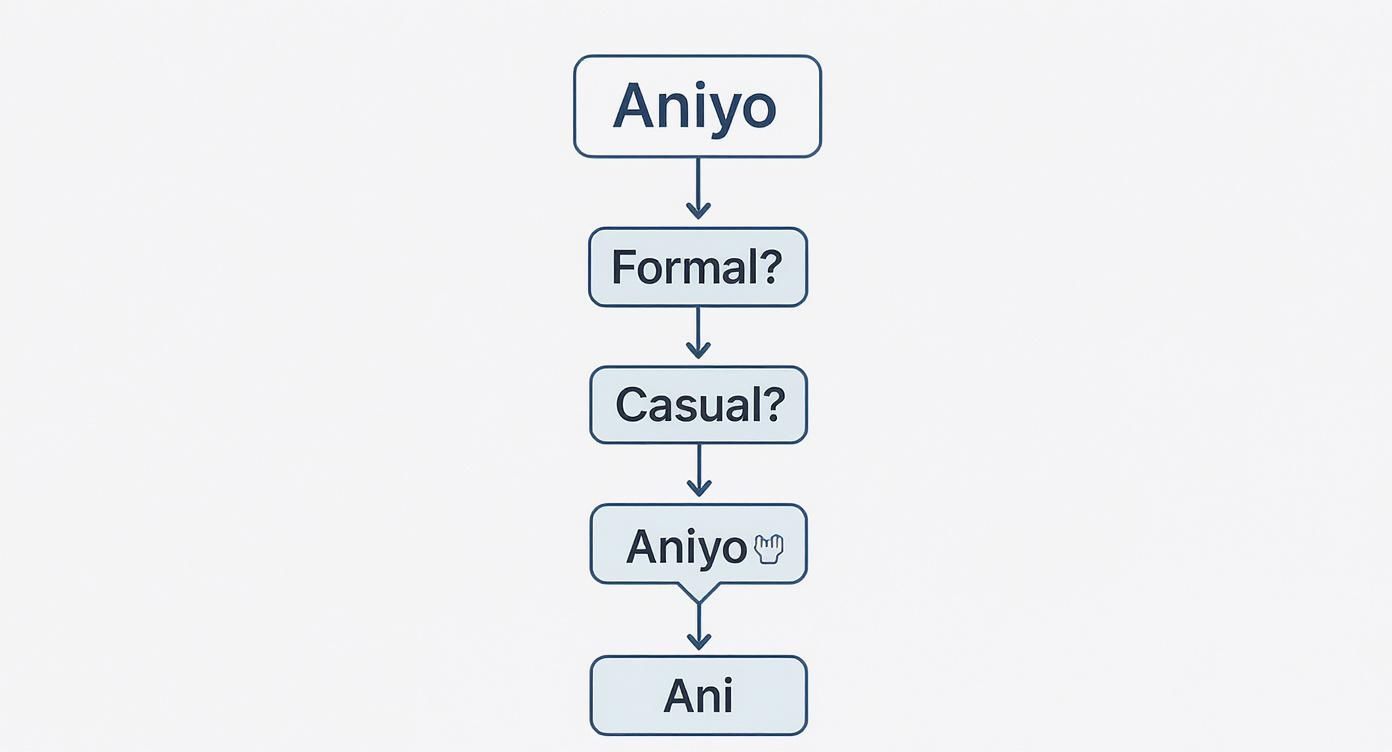
As you can see, the situation—whether you're in a formal meeting or just chatting with friends—guides you to the right form of 'aniyo'.
How to Use Them in Sentences
The grammar here is refreshingly simple. Both 안 (an) and 못 (mot) just pop right in front of the verb. That’s it! No complicated conjugation rules to worry about. Let’s see them in action with a couple of real-world scenarios.
Example 1: Going to a Party
- 안 가요. (an gayo) - I'm not going. (My decision. I'd rather stay home and watch a movie).
- 못 가요. (mot gayo) - I can't go. (Something is stopping me. I have to work late, or I feel sick).
Example 2: Speaking Korean
- 한국어 안 해요. (hangugeo an haeyo) - I don't speak Korean. (A bit of an odd thing to say, as it implies you can but are choosing not to).
- 한국어 못 해요. (hangugeo mot haeyo) - I can't speak Korean. (This means you lack the ability, which is what most learners mean).
Learner Tip: This is a classic beginner mistake! When talking about your Korean skills, you almost always want to use 못 해요 (mot haeyo). If you say 안 해요 (an haeyo), it can come across as a bit blunt, like you're refusing to speak Korean with someone.
Refusing Politely Without Saying No

While 아니요 (aniyo) is technically the correct way to say no in Korean, you’ll quickly discover that native speakers rarely use it to turn down an offer. In Korean culture, a direct "no" can feel a little too blunt, almost ungrateful, especially when someone is making a kind gesture.
Instead, Koreans have mastered the art of the "soft refusal"—using phrases that get the message across gently and thoughtfully. Learning these is a huge step toward sounding more natural and showing you understand the nuances of the culture. It's all about saying "no" without actually saying the word.
Using Gwaenchanayo for a Soft "No"
One of the most versatile phrases in your Korean toolkit will be 괜찮아요 (gwaenchanayo). While it literally means "It's okay" or "I'm okay," it's most often used as a polite "No, thank you." It’s the perfect, go-to phrase for gracefully declining just about anything.
- Friend: 피자 더 먹을래? (pija deo meogeullae?) - Do you want more pizza?
- You: 아니요, 괜찮아요. 배불러요. (Aniyo, gwaenchanayo. baebulleoyo.) - No, I'm okay. I'm full.
In this situation, adding 괜찮아요 (gwaenchanayo) makes the refusal feel much warmer and more appreciative.
Declining with Dwaesseoyo
Another common way to refuse something is with 됐어요 (dwaesseoyo). This phrase translates to something like "It's done" or "That's enough," and it's perfect for stopping an action in its tracks or refusing something as it's being offered. It’s a touch more assertive than 괜찮아요 (gwaenchanayo) but still polite.
- Shopkeeper: 반찬 더 드릴까요? (banchan deo deurilkkayo?) - Shall I give you more side dishes?
- You: 아니요, 됐어요. 충분해요. (Aniyo, dwaesseoyo. chungbunhaeyo.) - No, that's enough. It's plenty.
Cultural Tip: Your tone of voice is everything when you use 됐어요 (dwaesseoyo). Said with a smile, it's a perfectly fine refusal. But if you say it with a sharp, annoyed tone, it can sound quite dismissive. Always deliver it with a friendly expression!
Expressing Difficulty to Decline an Invitation
A direct 아니요 (aniyo) or 못 가요 (mot gayo - I can't go) can come across as quite abrupt when turning down an invitation. A much smoother, more considerate approach is to explain that it would be difficult for you. The magic phrase here is 좀 어려울 것 같아요 (jom eoryeoul geot gatayo), which means "I think it will be a little difficult." It’s a beautifully indirect way to say no in Korean.
- Friend: 이번 주말에 같이 영화 볼까요? (ibeon jumare gachi yeonghwa bolkkayo?) - Shall we watch a movie together this weekend?
- You: 미안해요, 이번 주말은 좀 어려울 것 같아요. (mianhaeyo, ibeon jumareun jom eoryeoul geot gatayo.) - I'm sorry, I think this weekend will be a little difficult.
Putting It All Together in Conversation
Okay, you've learned the individual words and phrases. But the real test is seeing how they actually work when people are talking. This is where you connect the dots. Let’s dive into a few everyday situations to see these different ways of saying no in Korean in action. Keep an eye on the context and the relationship between the speakers—that’s what dictates which "no" is the right one for the job.
Casual Chat Between Friends
Picture two close friends trying to make plans. The vibe is relaxed, so their language is informal and straight to the point.
- Min-jun: 오늘 저녁에 PC방 갈래? (Oneul jeonyeoge PC bang gallae?) - Wanna go to the PC room tonight?
- Sujin: 아니, 나 오늘 약속 있어. (Ani, na oneul yaksok isseo.) - No, I have plans today.
- Min-jun: 아, 진짜? 내일은 어때? (A, jinjja? Naeireun eottae?) - Oh, really? How about tomorrow?
- Sujin: 내일은 일해야 해서 못 가. 미안! (Naeireun ilhaeya haeseo mot ga. Mian!) - I have to work tomorrow, so I can't go. Sorry!
Declining an Offer from a Colleague
Now, let's switch gears to an office environment. A colleague offers you a snack. A blunt "no" would be a bit jarring here, so the refusal needs to be much softer and more polite.
- Mr. Kim: 지수 씨, 과자 좀 드세요. (Jisu ssi, gwaja jom deuseyo.) - Ms. Jisu, would you like some snacks?
- Ms. Jisu: 아니요, 괜찮아요. 저는 방금 먹어서요. (Aniyo, gwaenchanayo. Jeoneun banggeum meogeoseoyo.) - No, I'm okay. I just ate a little while ago.
Here, Ms. Jisu perfectly nails the polite refusal by combining 아니요 (aniyo) with the softer 괜찮아요 (gwaenchanayo).
Politely Refusing a Boss’s Invitation
This is probably the most delicate scenario you'll encounter. Your boss invites you to a team dinner, and you can't make it. A direct no in Korean is absolutely out of the question.
- Manager: 김 대리, 오늘 회식 갈 수 있죠? (Kim daeri, oneul hoesik gal su itjyo?) - Assistant Manager Kim, you can make it to the team dinner tonight, right?
- Mr. Kim: 죄송하지만, 오늘은 좀 어려울 것 같습니다. 집에 일이 있어서요. (Joesonghajiman, oneureun jom eoryeoul geot gatseumnida. Jibe iri isseoseoyo.) - I'm very sorry, but I think it might be a little difficult today. Something came up at home.
Notice how Mr. Kim completely avoids a direct "no," using an apology and an indirect phrase to show respect.
Common Mistakes to Avoid When Saying No
Navigating the nuances of saying "no" in Korean can be tricky. But don't worry. Once you get the hang of a few common pitfalls, your Korean will sound so much more natural and polished. Don’t worry if you make mistakes—even Koreans do sometimes! What matters most is progress.
The Politeness Level Pitfall
This is probably the biggest one. Using the casual 아니 (ani) with your boss, an older person, or even a store clerk you've just met is a major faux pas. Always, always default to the polite 아니요 (aniyo). You can never go wrong with being too polite.
Mixing Up "I Won't" vs. "I Can't"
Another super common trip-up is confusing 안 (an) and 못 (mot). This little mistake can completely flip the meaning of your sentence.
- Don't say: 한국어 안 해요 (hangugeo an haeyo) if you're trying to say you can't speak Korean. This implies you can but are choosing not to.
- Do say: 한국어 못 해요 (hangugeo mot haeyo). This clearly communicates, "I can't speak Korean," which is a statement about your ability.
Being Too Direct When Turning Something Down
New learners often grab onto 싫어요 (sireoyo) because it translates to "I don't like it." But it’s a very strong, direct word that can sound almost childish or overly emotional in everyday situations. Instead of 싫어요! (sireoyo!), use the softer, more graceful 아니요, 괜찮아요 (aniyo, gwaenchanayo) to decline an offer.
Steering clear of these few mistakes will make a world of difference in your conversations.
Answering Your Top Questions About Saying 'No' in Korean
Let's get a few common questions sorted out so you can feel totally confident when you need to politely decline something.
Is It Rude to Say Aniyo Directly in Korea?
Not usually! 아니요 (aniyo) is your standard, polite 'no' and it's perfectly fine for most everyday situations, like ordering coffee or answering a simple question. Where you need to be more careful is when turning down a personal offer or invitation. In those cases, a direct 아니요 can feel a little blunt. A softer approach like 괜찮아요 (gwaenchanayo / I'm okay, no thank you) is often better.
What’s the Difference Between Aniyo and Anieyo?
This one trips up almost everyone! It's a classic mix-up, but the distinction is clear once you see it.
- 아니요 (aniyo) is just the word 'No.' It's what you use to answer a yes/no question.
- 아니에요 (anieyo) means 'It is not...' or 'I am not...' It’s part of a full sentence.
For example, to the question "Are you a student?" (학생이에요?), you could reply, "아니요, 학생이 아니에요" (No, I am not a student).
How Do I Say I Can't in Korean?
The most common, everyday method is to pop the word 못 (mot) right before the verb. It's quick, easy, and gets the point across. For example, 못 가요 (mot gayo) means "I can't go." If you want to sound a little more formal, you can use the grammar pattern -ㄹ/을 수 없다 (-l/eul su eopda). So, 갈 수 없어요 (gal su eopseoyo) also means "I can't go," with a slightly more explanatory feel.
You've now learned the essential ways to say no in Korean, from a direct 아니요 to softer, more culturally nuanced phrases. The key is to pay attention to the situation and your relationship with the person you're speaking to. With a little practice, you'll be able to refuse and disagree with confidence and politeness. Every word you learn brings you one step closer to confidence. Keep going—your Korean journey starts now!
🌟 Ready to start your Korean journey? Join Ktalk.live — where global learners connect, speak, and grow together
Ready to stop reading and start speaking?
Practice what you just learned with a native Korean teacher — free for 100 minutes. No card, no commitment.