Want to practice this with a native Korean teacher?
100-min free trial — no card required.
Have you ever pictured yourself ordering a coffee in a bustling Seoul café or casually telling a new friend your age? Those everyday moments hinge on one crucial skill: using native Korean numbers. Learning Korean might seem challenging at first — but with the right approach, it becomes a fun and rewarding journey!
Korean has two distinct number systems, which can sound daunting. But don't worry, it’s more straightforward than you think. The native system is what you'll use for common, tangible things, like counting objects, people, and talking about your age. This guide will demystify this system so you can start using it with confidence and sound more natural in your conversations.
We'll focus on the practical stuff, showing you exactly:
- How to count everything from books on a shelf to friends in a group.
- The right way to say your age (a common icebreaker!).
- How to tell the time, specifically the hour on the clock.
By the time you're done, these numbers will feel less intimidating and more like a natural part of your Korean toolkit. You'll be ready to jump into real conversations, maybe even in your next lesson on Ktalk.live!

Understanding Native Korean Numbers from 1 to 99
Think of native Korean numbers as your go-to system for counting things you can physically see, touch, or hold. While the Sino-Korean numbers are for abstract concepts like money and dates, this system is for the tangible world around you—people, apples, hours on the clock, and so on. Let's start with the building blocks.
The Foundation: Numbers 1 to 10
Nailing the numbers from one to ten is the most important first step. These are the absolute cornerstones for every other number up to 99. Don't just read them; say them out loud, over and over. Try creating little mental hooks to help them stick. For instance, you might associate the sound of 둘 (dul) with a "duel" between two people.
Here's a quick-reference table to get you started.
| Numeral | Hangul | Romanization |
|---|---|---|
| 1 | 하나 | hana |
| 2 | 둘 | dul |
| 3 | 셋 | set |
| 4 | 넷 | net |
| 5 | 다섯 | daseot |
| 6 | 여섯 | yeoseot |
| 7 | 일곱 | ilgop |
| 8 | 여덟 | yeodeol |
| 9 | 아홉 | ahop |
| 10 | 열 | yeol |
Once you have these down, the numbers from 11 to 19 follow a surprisingly logical pattern. Simply start with 10 (열, yeol) and add the single-digit number onto the end. For example, 11 is 10 (열) + 1 (하나), which becomes 열하나 (yeolhana).
- 11: 열하나 (yeol-hana) = 10 + 1
- 12: 열둘 (yeol-dul) = 10 + 2
- 19: 열아홉 (yeol-ahop) = 10 + 9
Pro Tip: Don’t just read the numbers silently. Saying them aloud is crucial. Hearing yourself pronounce 열하나 (yeolhana) helps train your mouth and ears for the natural rhythm of Korean counting.
Counting by Tens from 20 to 90
Now, things get a little different. Unlike the Sino-Korean system, the native Korean system has unique, standalone words for each group of ten. This means you’ll have to memorize a new set of words, but they are used constantly in everyday conversation, especially when talking about age.
Here are the words you need to know for the tens:
- 20: 스물 (seumul)
- 30: 서른 (seoreun)
- 40: 마흔 (maheun)
- 50: 쉰 (swin)
- 60: 예순 (yesun)
- 70: 일흔 (ilheun)
- 80: 여든 (yeodeun)
- 90: 아흔 (aheun)
Getting a handle on native Korean numbers—like hana (1), dul (2), set (3)—is a game-changer for anyone starting their Korean journey. These numbers are vital for everyday chats, and in South Korea, numbers are everywhere. This is reflected in the soaring interest in the language; as of September 2025, over 550,000 people took the TOPIK proficiency test, the highest since its 1997 launch. You can learn more about the rising interest in Korean language proficiency from The Korea Times.
Combining Tens and Ones
Once you know the words for the tens, you can form any number up to 99 using the same logic as before. Just combine the word for the ten with the word for the one.
Let’s see how it works:
- To say 21, you take 20 (스물) and add 1 (하나) to get 스물하나 (seumul-hana).
- For 35, you combine 30 (서른) and 5 (다섯), giving you 서른다섯 (seoreun-daseot).
- And for 78, it’s 70 (일흔) plus 8 (여덟), which is 일흔여덟 (ilheun-yeodeol).
This consistent pattern makes it much easier to count things in real-time. Remember, this system stops at 99. For any number 100 or higher, you'll switch to the Sino-Korean system.
How to Use Native Korean Numbers in Real Life
You've got the basics for counting from 1 to 99. That’s a huge step! But numbers are only useful when you know how to use them in actual conversations. Native Korean numbers are your go-to for some of the most common daily interactions. Let's walk through the three big situations where you must use this system.
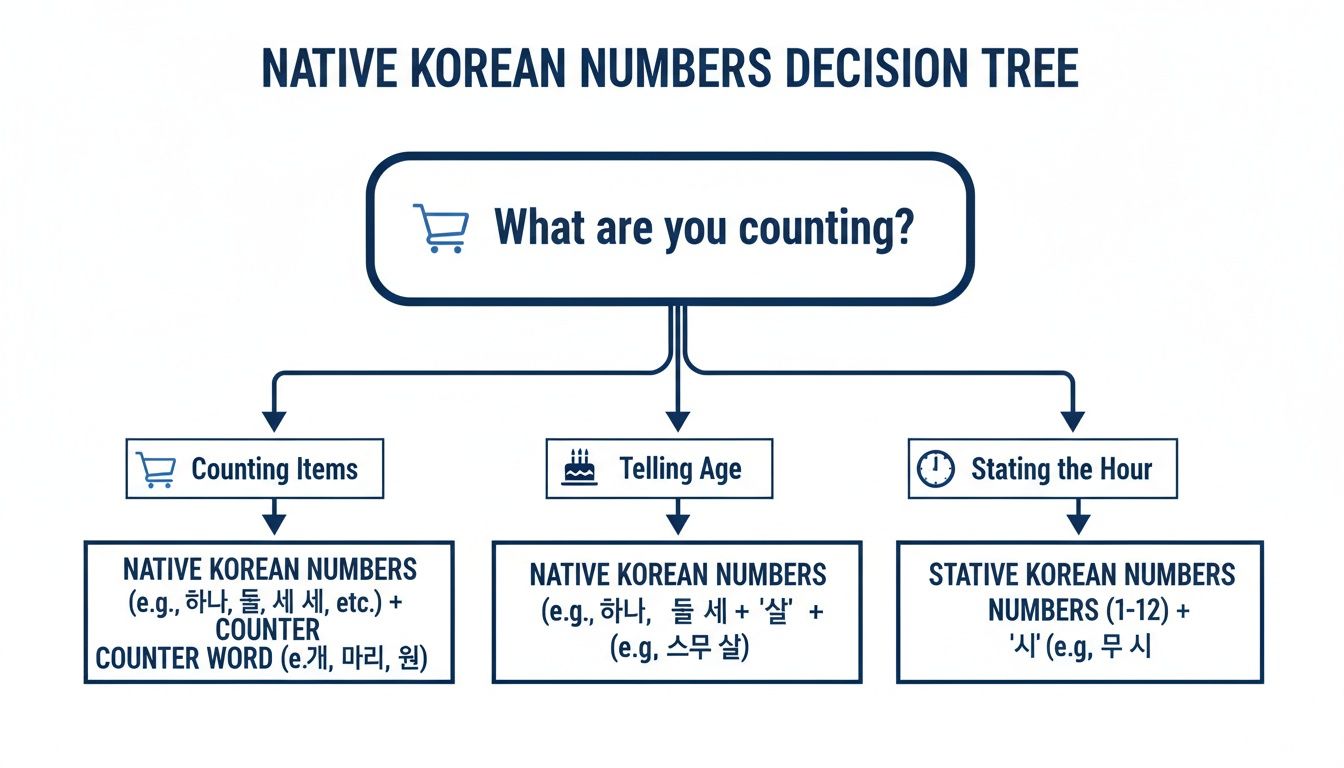
1. Counting Physical Objects and People
This is the most essential use for native Korean numbers. Whenever you're counting actual, physical things—stuff you can point to, hold, or see—this is the system you need.
You'll encounter this constantly, from grabbing a few apples at the market to ordering drinks with friends. It’s all about connecting a number to a tangible item.
- Ordering drinks: 커피 두 잔 주세요. (Keopi du jan juseyo.) - "Please give me two cups of coffee."
- Buying fruit: 사과 다섯 개 주세요. (Sagwa daseot gae juseyo.) - "Please give me five apples."
- Counting friends: 친구 세 명이랑 같이 왔어요. (Chingu se myeong-irang gachi wasseoyo.) - "I came with three friends."
Key Takeaway: If you're answering "How many items/people are there?", your brain should immediately jump to native Korean numbers. It's the default for quantifying the physical world.
2. Stating Your Age
Age comes up a lot in Korean conversation, as it helps determine the social dynamic. When you state your age, you'll almost always use native Korean numbers. The magic formula is the number plus the age counter 살 (sal).
Here’s what it sounds like:
- 저는 스무 살이에요. (Jeoneun seumu sal-ieyo.) - "I am twenty years old."
- 제 동생은 열일곱 살이에요. (Je dongsaeng-eun yeol-ilgop sal-ieyo.) - "My younger sibling is seventeen years old."
- 그분은 마흔다섯 살이세요. (Geubun-eun maheun-daseot sal-iseyo.) - "That person is forty-five years old."
Being able to state your age smoothly is an awesome way to make a great first impression. It shows you've done your homework, and it’s something you can practice right away in your next Ktalk.live class.
3. Telling the Hour on a Clock
Telling time in Korean is the perfect showcase of how the two number systems work together. The rule is simple: Use native Korean numbers for the hour, and Sino-Korean numbers for the minutes.
Let’s just focus on the hour for now. The number you say for the hour always comes from the native system. You’ll pair it with the counter 시 (si), which means 'o'clock' or 'hour'.
- A: 지금 몇 시예요? (Jigeum myeot si-yeyo?) - "What time is it now?"
- B: 세 시예요. (Se si-yeyo.) - "It's three o'clock."
Here are a few more real-world examples:
- 저는 아침 아홉 시에 일어나요. (Jeoneun achim ahop si-e ireonayo.) - "I wake up at nine in the morning."
- 우리는 오후 한 시에 만나요. (Urineun ohu han si-e mannayo.) - "Let's meet at one in the afternoon."
Getting this right is an instant giveaway that you're a learner. Sticking to native numbers for hours will make your Korean sound much more fluent.
Comparing Native and Sino-Korean Numbers
One of the biggest hurdles for learners is knowing which number system to use. But once you get a feel for the specific "jobs" each system has, it becomes second nature.
The simplest way to put it is: Native Korean numbers are for counting tangible, everyday things, while Sino-Korean numbers handle more abstract or systematic information.
When to Use Native vs. Sino-Korean Numbers
So, when does each system shine? This side-by-side comparison should help clear up any confusion.
| Category | Native Korean Numbers | Sino-Korean Numbers |
|---|---|---|
| Telling Time | Hours (한 시 - one o'clock) | Minutes (십 분 - ten minutes), Seconds (삼십 초 - thirty seconds) |
| Counting Things | General items, people, animals (사과 세 개 - three apples) | Used with specific, systematic counters (e.g., 1번 - Number 1) |
| Age | Used for stating age (스물다섯 살 - 25 years old) | Rarely used, except in formal/legal contexts (e.g., 만 25세) |
| Money | Not used | All currency (천 원 - 1,000 won) |
| Dates | Not used | Year, month, day (이천이십사 년 시월 이십육 일) |
| Phone Numbers | Not used | All digits (공일공-일이삼사-...) |
As you can see, there’s a real logic to it. Native numbers handle the hands-on counting, while the Sino-Korean system takes care of more structured, data-driven numbers.
Diving into native Korean numbers unlocks the natural rhythm of everyday conversations. With South Korea's Korean language learning market projected to hit over USD 2.6 billion by 2034, it's clear that more expats and professionals are aiming for this level of skill. If you're curious about this trend, you can explore more about the Korean language learning market from Global Market Insights.
Mastering Counters to Sound Like a Native
You've got the native Korean numbers down. So what’s next? To sound genuinely natural, you need to master counters. We have them in English too—a "cup" of coffee—but they're a non-negotiable part of almost every Korean sentence involving counting.
You don't just say "three friends." You say "three-[people counter]-friends." It follows a simple, consistent formula: Noun + Number + Counter.
- 커피 (keopi) + 두 (du) + 잔 (jan) → 커피 두 잔 (Two cups of coffee)
- 사람 (saram) + 세 (se) + 명 (myeong) → 사람 세 명 (Three people)
- 사과 (sagwa) + 다섯 (daseot) + 개 (gae) → 사과 다섯 개 (Five apples)
The Special Rule for 1, 2, 3, 4, and 20
Here's one golden rule you must know. When the native Korean numbers for 1, 2, 3, 4, and 20 come before a counter, they get a little shorter. Getting this right will instantly make your Korean sound much smoother.
- 하나 (hana) → 한 (han)
- 둘 (dul) → 두 (du)
- 셋 (set) → 세 (se)
- 넷 (net) → 네 (ne)
- 스물 (seumul) → 스무 (seumu)
So, you’d never say "하나 권." The correct way is always "한 권" (han gwon).
Essential Counters for Daily Life
Korean has many counters, but you only need a few for daily use. Focus on these to start:
개 (gae): The all-purpose counter for most inanimate objects. When in doubt, 개 is usually a safe bet.
- Example: 펜 한 개 주세요. (Pen han gae juseyo.) - "Please give me one pen."
명 (myeong): The standard counter for people.
- Example: 학생 네 명이 있어요. (Haksaeng ne myeong-i isseoyo.) - "There are four students."
살 (sal): Exclusively for talking about age.
- Example: 제 아들은 일곱 살이에요. (Je adeul-eun ilgop sal-ieyo.) - "My son is seven years old."
마리 (mari): The dedicated counter for animals.
- Example: 고양이 두 마리를 키워요. (Goyangi du mari-reul kiwoyo.) - "I'm raising two cats."
병 (byeong): Use this for any kind of bottle—water, beer, soju.
- Example: 물 세 병이 필요해요. (Mul se byeong-i piryohaeyo.) - "I need three bottles of water."
잔 (jan): The counter for cups and glasses.
- Example: 주스 한 잔 주세요. (Juseu han jan juseyo.) - "Please give me one glass of juice."
Let's Put This into Practice
Theory is great, but the only way to get a feel for native Korean numbers is to use them. These exercises will help you move from basic counting to applying the rules in context. Let's jump in!
Exercise 1: Fill in the Blanks
Read each sentence and fill in the blank with the correct Korean phrase. The answers are at the end, but give it a real shot first!
- I need to buy three apples.
- 사과 ______________ 주세요. (Sagwa ______________ juseyo.)
- I am twenty-five years old.
- 저는 ______________이에요. (Jeoneun ______________ ieyo.)
- Let's meet at four o'clock.
- ______________에 만나요. (______________e mannayo.)
- There are two cats.
- 고양이 ______________ 있어요. (Goyangi ______________ isseoyo.)
Don't forget the rule for the numbers 1-4 before a counter. It’s one of the most common trip-up points for learners.
Exercise 2: Quick-Fire Translation
Now, let's pull everything together. Translate these simple English phrases into natural-sounding Korean, using the correct native Korean numbers and counters.
- How do you say "one person" in Korean?
- How do you say "five cups of water" in Korean?
- How do you say "twenty years old" in Korean?
These exercises are just a starting point. The more you use these numbers, the more second-nature they'll become. Keep at it!
Answer Key:
- Exercise 1: 1. 세 개 (se gae), 2. 스물다섯 살 (seumuldaseot sal), 3. 네 시 (ne si), 4. 두 마리 (du mari)
- Exercise 2: 1. 한 명 (han myeong), 2. 물 다섯 잔 (mul daseot jan), 3. 스무 살 (seumu sal)
Your Next Steps on Your Korean Journey
You've just tackled one of the most essential parts of the Korean language. Getting a handle on native Korean numbers is a huge step toward having more natural, flowing conversations. You’ve unlocked a key to everyday interactions like counting friends, saying your age, or telling the time. Don’t worry if you make mistakes — even Koreans do sometimes! What matters most is progress.
Now, it's time to put this into practice. Go back and try the exercises again. Look around your room and start counting things. Every word you learn brings you one step closer to confidence. Keep going — your Korean journey starts now!
🌟 Ready to start your Korean journey? Join Ktalk.live — where global learners connect, speak, and grow together
Ready to stop reading and start speaking?
Practice what you just learned with a native Korean teacher — free for 100 minutes. No card, no commitment.