
Want to practice this with a native Korean teacher?
100-min free trial — no card required.
Ever wondered how to say the month in Korean? If you're picturing long, complicated words, I have great news for you. Learning the months is one of the most satisfyingly simple parts of the Korean language. It all comes down to a logical pattern that’s incredibly easy to master.
This guide will walk you through the simple formula for naming all twelve months, show you how to use them in everyday conversation, and even point out a couple of common mistakes to avoid. Don’t worry if you’re a complete beginner—this is a fun and rewarding first step on your language journey! Let's get started.
Your Quick Guide to the 12 Months in Korean
If you've ever felt overwhelmed trying to learn new vocabulary, you're in for a pleasant surprise. Learning the Korean months is incredibly straightforward because it's less about memorisation and more about a simple, logical pattern. Forget learning twelve totally different words like you do in English; the Korean system is more like a plug-and-play formula.
All you need are two key components: the Sino-Korean number for each month (we'll get to those in a moment) and the word for "month" itself, which is wol (월). You just combine the two.
Think of it like this:
- 1 (il) + month (wol) = Il-wol (January)
- 2 (i) + month (wol) = I-wol (February)
- 12 (sip-i) + month (wol) = Sip-i-wol (December)
It’s a beautifully consistent system. Once you know the numbers from one to twelve, you basically know all the months.
This timeline gives you a great visual for how the year lays out, showing how each month is just its corresponding number followed by 'wol'.
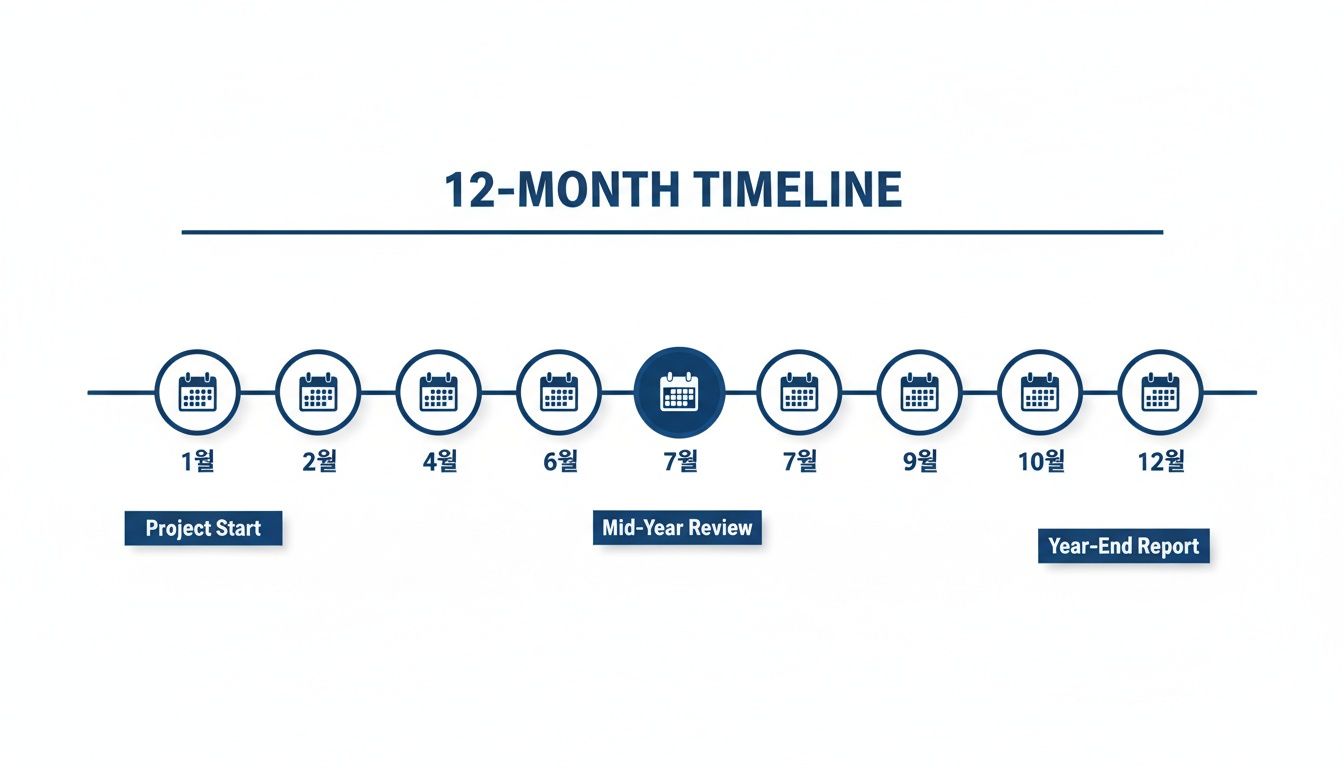
As you can see, once you've learned the pattern for one month, you've pretty much learned them all.
The 12 Months in Korean at a Glance
To kick things off, here’s a complete reference chart with everything you need. This table gives you the Hangul, the romanised spelling, and a handy pronunciation guide to help you get the sounds just right from day one.
| Month | Hangul (Korean Script) | Romanization | Pronunciation Guide |
|---|---|---|---|
| January | 1월 (일월) | Il-wol | EEL-wol |
| February | 2월 (이월) | I-wol | EE-wol |
| March | 3월 (삼월) | Sam-wol | SAM-wol |
| April | 4월 (사월) | Sa-wol | SAH-wol |
| May | 5월 (오월) | O-wol | OH-wol |
| June | 6월 (유월) | Yu-wol | YOO-wol (note the sound change!) |
| July | 7월 (칠월) | Chil-wol | CHIL-wol |
| August | 8월 (팔월) | Pal-wol | PAL-wol |
| September | 9월 (구월) | Gu-wol | GOO-wol |
| October | 10월 (시월) | Si-wol | SHEE-wol (note the sound change!) |
| November | 11월 (십일월) | Sip-il-wol | SHIP-EEL-wol |
| December | 12월 (십이월) | Sip-i-wol | SHIP-EE-wol |
Bookmark this table! It's your foundation for everything from talking about birthdays and holidays to scheduling meetings. Now that you have the basics down, we'll dive into why this system works the way it does and how to start using it in real conversations.
The Simple Logic Behind Korean Months (You'll Love This)
If you're tired of memorising long lists of vocabulary, you're in for a treat. Naming the month in Korean isn't about learning twelve new words. Instead, it's based on a beautifully simple and logical system that will save you a ton of mental energy.
Think of it like building with LEGOs. You only need two types of bricks to construct every single month of the year. Once you get the hang of this pattern, you won't be memorising at all—you'll just be applying a simple rule. It’s one of those "aha!" moments that makes learning Korean so rewarding.

This kind of logical structure is a big reason why Korean is attracting learners from all over the world. In fact, the Korean language learning market in South Korea is set to skyrocket from USD 7.54 billion in 2025 to a massive USD 46.69 billion by 2035. This boom is driven by students, professionals, and K-culture fans who are jumping into the language, often through accessible apps and online courses. You can dig deeper into the factors behind this growth in the full Korean language learning market report.
Building Block 1: The Sino-Korean Numbers
First things first, we need the numbers. The Korean language has two number systems, but for dates, money, and phone numbers, we use the Sino-Korean system, which originally came from Chinese characters.
For the months, you only need to know how to count from one to twelve. Let's run through them:
- 1 – 일 (il)
- 2 – 이 (i)
- 3 – 삼 (sam)
- 4 – 사 (sa)
- 5 – 오 (o)
- 6 – 육 (yuk)
- 7 – 칠 (chil)
- 8 – 팔 (pal)
- 9 – 구 (gu)
- 10 – 십 (sip)
- 11 – 십일 (sip-il)
- 12 – 십이 (sip-i)
Getting these twelve numbers down is the most crucial step. They’re the foundation not just for months but for tons of other practical, everyday situations in Korean.
Building Block 2: The Word for "Month"
The second and final piece of our puzzle is the Korean word for "month" itself: 월 (wol).
This one little syllable is the key. It gets attached to the end of a number to signify "month." It’s a constant—it never changes.
The Magic Formula: Number + 월 (wol) = Month
That's it. You just take the Sino-Korean number and stick 월 (wol) right after it. To say "January," which is the first month, you take the number for one, 일 (il), and add 월 (wol). Boom: 일월 (il-wol).
Let's try another one. "May" is the fifth month. The number five is 오 (o). Add 월 (wol), and you get 오월 (o-wol). This predictable pattern works for almost every month, making this one of the easiest and most satisfying vocabulary sets you'll encounter on your Korean journey.
How to Use Korean Months in Everyday Sentences
Alright, you’ve got the list of all 12 months in Korean memorised. That’s a great first step! But let's be honest, the real goal is to actually use them in conversation, right? This is where we shift from just knowing the words to making plans, asking about birthdays, and understanding schedules.
It's actually much more straightforward than you might think. Let's look at the simple grammar and vocabulary you need to start talking about dates like you've been doing it for years.

Adding the Particle 에 (e) for "In" a Month
If you want to say something is happening "in" a certain month, you just need one tiny particle: 에 (e). Simply attach it to the end of the month's name. It's a small piece of grammar that does a ton of heavy lifting in your sentences.
Think of 에 (e) as a little time-stamp that tells your listener when something is happening.
- 1월 (Il-wol) becomes 1월에 (Il-wol-e) — In January
- 8월 (Pal-wol) becomes 8월에 (Pal-wol-e) — In August
- 12월 (Sip-i-wol) becomes 12월에 (Sip-i-wol-e) — In December
Let's see how this works in a couple of real sentences:
Example 1: 제 생일은 5월에 있어요. (Je saeng-il-eun o-wol-e iss-eo-yo.) My birthday is in May.
Example 2: 우리는 9월에 한국에 갈 거예요. (Urineun gu-wol-e han-guk-e gal geo-ye-yo.) We are going to go to Korea in September.
See? Just by adding that one particle, you can specify timeframes for just about any situation.
Talking About Time Relative to Now
While naming specific months is super useful, a lot of everyday chat is more general. We often say things like "this month," "next month," or "last month." These are conversational essentials, and luckily, they're quite easy in Korean.
These phrases are standalone and don't use the Sino-Korean -월 (wol) system.
- This month — 이번 달 (ibeon dal)
- Next month — 다음 달 (da-eum dal)
- Last month — 지난달 (jinan dal)
You might notice they use 달 (dal), which is the native Korean word for "month," instead of the Sino-Korean 월 (wol). This is a key distinction. Let's see them in a natural back-and-forth.
Putting It All Together in Mini-Dialogues
Reading isolated sentences helps, but seeing these phrases pop up in a real conversation is where it all clicks. Here are a couple of quick scenarios to show you how it works.
Scenario 1: Making Plans
- Person A: 다음 달에 뭐 할 거예요? (Da-eum dal-e mwo hal geo-ye-yo?) What are you doing next month?
- Person B: 다음 달에 제주도에 갈 거예요. (Da-eum dal-e jeju-do-e gal geo-ye-yo.) I'm going to Jeju Island next month.
Scenario 2: Talking About a Past Event
- Person A: 그 콘서트는 언제였어요? (Geu kon-seo-teu-neun eon-je-yeoss-eo-yo?) When was that concert?
- Person B: 지난달이었어요. 10월에 했어요. (Jinan dal-i-eoss-eo-yo. Si-wol-e haess-eo-yo.) It was last month. They held it in October.
By getting comfortable with these fundamental phrases and the particle 에 (e), you've just unlocked a huge part of everyday Korean. You can now discuss deadlines, schedules, and exciting events, moving you from just listing vocabulary to having real, meaningful conversations.
Common Mistakes to Avoid with Korean Months
Let's be honest, every Korean learner trips up now and then. When it comes to something as specific as the months, a few common mistakes pop up all the time. Getting these details right is one of those small things that makes a huge difference in sounding natural and avoiding mix-ups.
Don't worry if you've made these mistakes—we all have! What matters most is progress. The key is to spot them, understand why they happen, and build the right habits from the get-go.
The Two Usual Suspects: June and October
If you've been looking closely at the list of months, you might have felt a little confused when you got to June and October. Your brain, following the pattern, probably told you that June (month 6) should be 육월 (yuk-wol) and October (month 10) should be 십월 (sip-wol). That makes perfect sense, but it's actually wrong.
This is probably the most common slip-up for beginners. To make the words flow better, Koreans drop the final consonant sound for these two months:
- June (6월): The correct way to say it is 유월 (yu-wol), not yuk-wol. The final ㄱ (k) sound from 육 (yuk) gets dropped.
- October (10월): Similarly, this is pronounced 시월 (si-wol), not sip-wol. The final ㅂ (p) sound from 십 (sip) disappears.
So, why does this happen? It all comes down to making things easier to say. Korean has some neat phonological rules that smooth out pronunciation. Think of it as a natural shortcut the language has created over centuries to avoid clunky-sounding word combinations.
Drilling these two exceptions until they're second nature is a quick win that will immediately make you sound less like a textbook and more like a fluent speaker.
Mixing Up Your Number Systems
This is the big one. As we covered earlier, Korean has two completely different sets of numbers: the Native Korean system (하나, 둘, 셋...) and the Sino-Korean system (일, 이, 삼...). This can be a real headache for new learners.
Here's the golden rule: for talking about the month in Korean, you always, always, always use the Sino-Korean numbers. No exceptions.
Using a Native Korean number will immediately flag you as a learner and can sound pretty jarring to a native speaker.
Let's take March, the third month, as an example:
- ✅ Correct: 삼월 (sam-wol) — using the Sino-Korean number 삼 (sam).
- ❌ Incorrect: 셋월 (set-wol) — using the Native Korean number 셋 (set).
This rule is non-negotiable, so do whatever it takes to burn it into your memory. Firmly link "Sino-Korean numbers" with "months and dates" in your mind. If you can nail the exceptions for June and October and stick to the right number system, you’ll be well on your way to talking about the calendar like a pro.
Connecting Korean Culture to Each Month
Knowing the word for a month in Korean is one thing, but connecting it to the culture is what really makes the language click. Each month in Korea has its own distinct personality, shaped by national holidays, seasonal foods, and local festivals. Understanding this annual rhythm turns a simple vocabulary list into a living, breathing story.
Think about it: when you tie words to real-life experiences, they just stick better. It's one thing to memorise that 1월 (Il-wol) is January. It’s entirely different to connect it with the buzz and excitement of Seollal (설날), the Lunar New Year—a massive family holiday that usually lands in January or February. This context gives the word weight and makes it part of a bigger picture of life in Korea.
A Year of Korean Festivities
Let’s take a quick trip through the Korean calendar. Seeing how the months and cultural events line up will add a whole new layer of meaning to the vocabulary you’re learning.
Spring (3월-5월 / Sam-wol to O-wol): As things start to thaw, cherry blossom festivals (벚꽃 축제 / beot-kkot chuk-je) spring up all over the country in late March and April. May is lovingly called "Family Month," celebrating Children's Day on May 5th and Parents' Day on May 8th.
Summer (6월-8월 / Yu-wol to Pal-wol): The sticky heat of July and August (7월 / Chil-wol and 8월 / Pal-wol) is peak season for hitting the beaches, like the famous Haeundae in Busan. It's also the perfect time for ice-cold noodles (냉면 / naengmyeon) and giant bowls of shaved ice dessert (빙수 / bingsu).
Autumn (9월-11월 / Gu-wol to Sip-il-wol): September or October brings Chuseok (추석), the beautiful harvest moon festival, which you can think of as a kind of Korean Thanksgiving. It’s a major holiday where families get together to share food and pay respects to their ancestors.
Winter (12월-2월 / Sip-i-wol to I-wol): December is aglow with festive lights for Christmas, and the crisp, cold air makes it the ideal season for hearty, bubbling stews like kimchi-jjigae (김치찌개).
Language Learning as a Cultural Gateway
Tapping into these cultural moments is a huge motivator when you’re learning a language. This is especially true for the massive number of international students who now call South Korea home.
In August 2025, South Korea saw an incredible surge, reaching 305,329 international students—smashing its 2027 goal two years early. A significant portion of these students, about 79,500, were on D-4-1 visas specifically for Korean language training, showing that language is often the first step into deeper cultural and academic pursuits. Discover more about this impressive growth in South Korea’s student population.
This kind of cultural context does more than just help you memorise words. It gives you something genuinely interesting to talk about. Instead of just asking, "When is your birthday?" you can now ask, "Do you enjoy the cherry blossoms in 4월 (Sa-wol)?" It makes the whole process of learning the language feel so much more meaningful.
Practice Exercises to Master Korean Months
Alright, we’ve covered the theory. Now it’s time to roll up our sleeves and actually use what you've learned. This is where the knowledge really starts to stick—moving from your head to your tongue.
I’ve put together a few simple exercises to help you cement the Korean months in your memory. Think of these as a quick workout for your brain. They're designed to reinforce those number patterns and build your confidence. Let's dive in.
Exercise 1: Match the Month
First up, a straightforward matching game. Your goal is to connect the English month with its Korean counterpart. This is a great way to check how quickly you can recognise the Hangul.
- February
- October
- July
- December
- A. 12월 (Sip-i-wol)
- B. 2월 (I-wol)
- C. 7월 (Chil-wol)
- D. 10월 (Si-wol)
(Answers: 1-B, 2-D, 3-C, 4-A)
Exercise 2: Fill in the Blanks
Ready to put the months into context? Fill in the blanks with the correct month in Korean. If you get stuck, think back to the seasons and holidays we discussed earlier for a clue.
- 한국에서는 보통 **______**에 벚꽃이 펴요. (In Korea, cherry blossoms usually bloom in ______.)
- 크리스마스는 **______**에 있어요. (Christmas is in ______.)
(Answers: 1. 4월 (Sa-wol / April), 2. 12월 (Sip-i-wol / December))
Exercise 3: Quick Translation
For the final challenge, let’s test your recall. How would you write these months in Hangul? No multiple choice this time!
- September
- June
- January
(Answers: 1. 9월 (Gu-wol), 2. 6월 (Yu-wol), 3. 1월 (Il-wol))
This kind of dedicated practice is exactly what sets learners up for success. It mirrors the high standards that have made South Korea an educational powerhouse. By 2023, an incredible 70% of 25-34-year-olds in the country had completed post-secondary education—the highest rate among all OECD nations.
With foreign enrolment also climbing, including over 79,500 students on language training visas, it’s clear that mastering these fundamentals is a critical first step. You're on a well-trodden path! You can read more about South Korea's educational achievements and see just how valued learning is in the culture.
Your Top Questions Answered
Alright, you've got the basics down, you’ve seen how the grammar works, and you've even peeked into the cultural side of things. But I know there are always a few tricky questions that pop up when you start using this stuff in the real world.
Let's tackle those lingering queries head-on. Think of this as a final check-in to make sure you’re feeling 100% confident with the months in Korean.
How Do I Ask "What Month Is It?"
This is one of the first practical questions every learner needs. If you want to ask "What month is it?" in Korean, there's a simple, go-to phrase.
You would ask: 몇 월이에요? (Myeot worieyo?)
Let’s quickly pull that apart:
- 몇 (myeot) means "how many" or, in this context, "which."
- 월 (wol) is our key word for "month."
- 이에요 (ieyo) is the polite verb ending that means "is it?"
To answer, someone would just state the month, like 3월이에요 (Sam-worieyo) for "It's March." Easy!
Do Koreans Ever Abbreviate the Months?
Great question, especially since we do it all the time in English with "Jan" or "Dec." The short answer is no, Koreans don't really abbreviate the months.
The names are already so efficient—just a number followed by 월 (wol)—that there’s simply no need to shorten them further. You’ll always see and hear the full version, like 1월 (Il-wol) or 11월 (Sip-il-wol), whether it’s written down or in conversation.
Can You Go Over the Pronunciation for June and October Again?
Of course. This is probably the number one thing that trips people up. Even though the system for naming the month in Korean is beautifully logical, June and October are the two famous exceptions.
It all comes down to making the words sound smoother and more natural.
- For June (6월): The number six is 육 (yuk). Saying yuk-wol is a bit clunky. To fix this, the final ㄱ (k) consonant is dropped, giving us the much more fluid 유월 (yu-wol).
- For October (10월): It's the same story. The number ten is 십 (sip). The combination sip-wol sounds a little harsh, so the final ㅂ (p) is dropped, resulting in the softer-sounding 시월 (si-wol).
Nailing these two exceptions is a huge step in making your spoken Korean sound much more natural.
Learning how to say the month in Korean is a fantastic milestone. It’s practical, logical, and gives you a real sense of accomplishment. You’ve learned the simple formula, practiced the key phrases, and even navigated the tricky exceptions. Every word you learn brings you one step closer to confidence. Keep going—your Korean journey starts now!
🌟 Ready to start your Korean journey? Join Ktalk.live — where global learners connect, speak, and grow together! https://ktalk.live
Ready to stop reading and start speaking?
Practice what you just learned with a native Korean teacher — free for 100 minutes. No card, no commitment.