
Want to practice this with a native Korean teacher?
100-min free trial — no card required.
Learning Korean might seem challenging at first, but with the right approach, it becomes a fun and rewarding journey! Have you ever wanted to watch a K-drama without subtitles or sing along to your favorite K-pop song knowing exactly what it means? You're not alone. The global interest in Korean culture has made the desire to learn Korean more popular than ever.
This guide is your personal roadmap. We'll break down the process into simple, manageable steps that focus on what truly matters: building a solid foundation and gaining the confidence to speak. Forget trying to memorize everything at once; we're going to build a smart, effective study habit together.
Your Realistic Roadmap to Speaking Korean
Taking the plunge to learn Korean is an exciting step, often sparked by a captivating K-drama, infectious K-pop, or a deep desire to connect with the culture. But that initial buzz can quickly fade when you're faced with the question: "Where do I even start?"
The secret isn't trying to absorb everything at once. It's about following a structured path that builds momentum and keeps you motivated.
This guide is that path. We'll start by setting goals that mean something to you, like ordering coffee in Seoul or chatting with a Korean friend. From there, we’ll map out a timeline with clear milestones, helping you craft a study routine that fits into your life, not the other way around.
Charting Your Course
A good language learning journey always starts with a plan. Instead of just bouncing between random videos and apps, it’s much more effective to think of your learning in clear, manageable phases. This approach stops you from getting burnt out and makes sure every new thing you learn is built on a solid foundation.
It boils down to a simple, effective flow: first, figure out your personal "why," then get the core knowledge, and finally, put that knowledge to work by speaking.
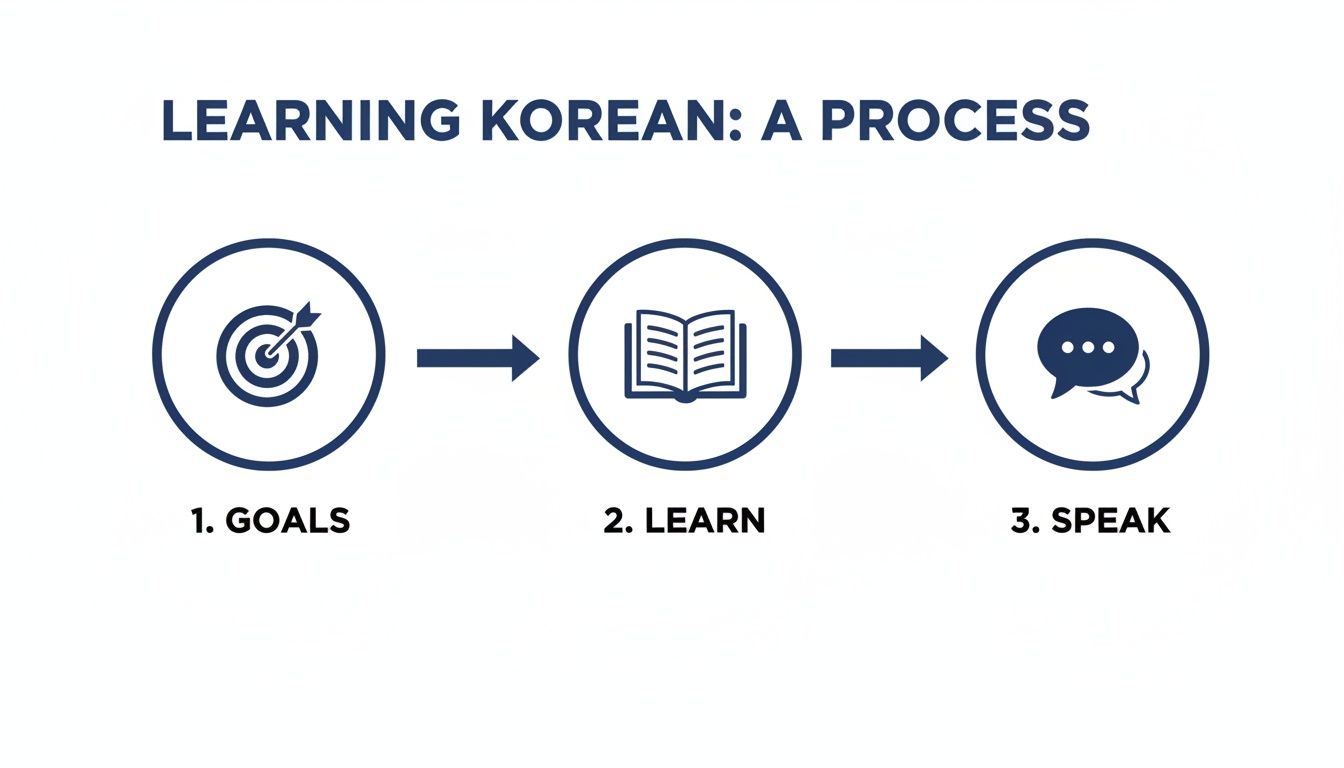
When you see it broken down like this, it becomes clear that every step—from learning the alphabet to joining your first conversation—is connected. Each one leads you closer to your goal.
What to Expect in This Guide
Think of this guide as your personal mentor. We'll walk you through a practical, step-by-step plan that covers the skills you actually need. You’ll discover how to:
- Set smart goals: Pinpoint what success looks like for you and create achievable milestones.
- Master the fundamentals: We'll tackle Hangul (the Korean alphabet) and build a core vocabulary you can use right away.
- Understand grammar basics: Grasp essential sentence structures and particles without getting bogged down in theory.
- Practice speaking with confidence: Learn how to use what you know in real conversations, even as a total beginner.
The best way to learn a language is to use it. Don't fall into the trap of waiting until you feel 'ready'—start speaking from the very first week. Your confidence will build with every single word you try.
This hands-on approach ensures you're not just memorizing lists of words, but actually building the skill to communicate. Let's get you started with a clear path and the confidence to take that first step.
Master Hangul — The First Step
Before you can string sentences together, you need the basic building blocks. For anyone starting to learn Korean, this means tackling two things right away: the alphabet, Hangul (한글), and a solid base of essential words.
Many beginners get spooked by a new writing system, but don’t worry! Hangul is famously logical. Forget everything you think you know about complex characters. Most people can get the hang of it in just a couple of hours. Let's walk through how to unlock it, and then we'll show you how to build a vocabulary you can actually use in real life.
Unlocking Korean with Hangul
There's a reason Hangul is called one of the most scientific alphabets in the world. It was designed so that each character mimics the shape your mouth makes when you say the sound. This makes it incredibly intuitive.
For example, the consonant 'ㄱ' (g/k) looks like the shape of your tongue touching the roof of your mouth. The character 'ㅁ' (m) looks like a closed mouth. This direct link between shape and sound is a game-changer for memorization.
The trick is not to overwhelm yourself. Group the letters into small, logical sets.
Basic Consonants:
- ㄱ (g/k) - as in go
- ㄴ (n) - as in nose
- ㄷ (d/t) - as in dog
- ㄹ (r/l) - a fluid sound between r and l
- ㅁ (m) - as in mom
- ㅂ (b/p) - as in boy
- ㅅ (s) - as in sun
- ㅇ (ng/silent) - Silent at the start of a syllable, 'ng' at the end.
- ㅈ (j) - as in jam
Basic Vowels:
- ㅏ (a) - sounds like the a in father
- ㅓ (eo) - like the o in son
- ㅗ (o) - like the o in go
- ㅜ (u) - like the oo in moon
- ㅣ (i) - sounds like the ee in see
Once you have these, you can build syllable blocks. Take ㄴ (n) + ㅏ (a), and you get 나 (na), meaning "I" or "me" in casual Korean. It's that simple!
The real power of learning Hangul first is that you can start reading and sounding out words immediately. This builds immense confidence and opens the door to all other aspects of the language without relying on romanization, which can often be misleading.
Build Vocabulary the Smart Way
With Hangul under your belt, it's time to gather some words. But please, don't just grab a dictionary and start on page one. To learn Korean effectively, you need a strategy. The goal is to absorb high-frequency words that will pop up in everyday conversations.
Start by aiming for a core list of about 100 words. We recommend focusing on themes that are immediately useful.
- Greetings: 안녕하세요 (Annyeonghaseyo - Hello), 감사합니다 (Gamsahamnida - Thank you).
- People: 사람 (saram - person), 친구 (chingu - friend), 저 (jeo - I, formal).
- Places: 집 (jip - house), 학교 (hakgyo - school), 한국 (Hanguk - Korea).
- Food & Drink: 물 (mul - water), 밥 (bap - rice/meal), 커피 (keopi - coffee).
- Numbers: 하나 (hana - one), 둘 (dul - two), 셋 (set - three).
This themed approach makes learning feel more organized and helps you recall words much faster. As you learn a new noun, like "school" (학교), try pairing it with a related verb, like "to go" (가다 - gada). Suddenly, you can form a mini-phrase: 학교에 가다 (hakgyo-e gada - to go to school). Giving words context like this is what makes them stick.
Making Words Stick with Spaced Repetition
One of the most powerful techniques for memorizing words is the Spaced Repetition System (SRS). The idea is simple: you review new information at increasing intervals. You'll see a new word again soon after you first learn it, then after a slightly longer gap, and so on.
This process is scientifically proven to move information from your short-term to your long-term memory. You can use flashcard apps or even make your own physical flashcards.
The key is consistency. A short, daily review session is infinitely more effective than a long cramming session once a week. By mastering Hangul and building a core vocabulary with these smart methods, you're laying the strongest possible foundation for your journey.
Making Sense of Korean Grammar and Sentences

Let's be honest: the word "grammar" can make even the most dedicated learner nervous. When you first dive into Korean, the sentences might look like they've been put together completely backward compared to English. But here's the good news—Korean grammar is incredibly logical once you get a handle on a few foundational concepts.
Forget trying to memorize a massive book of rules right now. As a beginner, your goal is to understand the core patterns that let you start building actual sentences. We'll start with the biggest mental shift for English speakers and then unravel the mystery of those little "particles" you see everywhere.
The Subject-Object-Verb Sentence Structure
The first and most important grammar rule to internalize is the sentence order. In English, we follow a Subject-Verb-Object (SVO) pattern. For example: "I drink coffee."
Korean completely flips this to Subject-Object-Verb (SOV). The verb always comes at the very end. This is a non-negotiable rule and the key to unlocking how Korean sentences are built.
Let's take our simple sentence and rearrange it:
- Subject: I (저는 - jeo-neun)
- Object: Coffee (커피를 - keopi-reul)
- Verb: Drink (마셔요 - masyeoyo)
Put it together in the correct SOV order, and you get: 저는 커피를 마셔요 (Jeo-neun keopi-reul masyeoyo). It’ll feel strange at first, but after seeing it a few times, it starts to click. Think of the verb as the grand finale of the sentence.
Grasping the SOV structure is your first real breakthrough. Once this clicks, you'll be able to figure out the basic meaning of most sentences, even if you don't know every single word.
Understanding Particles: The Unsung Heroes
So, what are those little syllables like -는 (-neun) and -를 (-reul) stuck to the end of words? These are called particles, and they're one of the most powerful tools in the Korean language. They work like tiny signposts, telling you the exact role each word plays in the sentence.
Here are the first two you absolutely must know:
- Topic Marking Particles (은/는 - eun/neun): These attach to the subject, highlighting it as the main topic. Use 은 (eun) after a consonant and 는 (neun) after a vowel.
- Object Marking Particles (을/를 - eul/reul): These attach to the object—the noun that's being acted on by the verb. Use 을 (eul) after a consonant and 를 (reul) after a vowel.
Let's see them in action with a new example: "My friend reads a book."
- Friend (친구 - chingu) ends in a vowel, so we add 는 (neun) → 친구는
- Book (책 - chaek) ends in a consonant, so we add 을 (eul) → 책을
- Reads (읽어요 - ilgeoyo) is the verb, which goes last.
The final sentence is: 친구는 책을 읽어요 (Chingu-neun chaeg-eul ilgeoyo). These particles do all the heavy lifting, making the relationship between the words crystal clear.
Basic Verb Endings and Politeness
The final piece of this beginner's puzzle is getting verbs right. In Korean, verbs change based on tense and, most importantly, the level of politeness you want to show.
The most versatile politeness level for beginners is the standard polite form, which ends in -아요/어요 (-ayo/eoyo). It's polite enough for almost any daily situation, from ordering at a cafe to chatting with new people.
Here’s a quick look at the verb 가다 (gada - to go):
| Tense | Conjugation | Example Sentence (I go to school) |
|---|---|---|
| Present | 가요 (gayo) | 저는 학교에 가요. (Jeo-neun hakgyo-e gayo.) |
| Past | 갔어요 (gasseoyo) | 저는 학교에 갔어요. (Jeo-neun hakgyo-e gasseoyo.) |
| Future | 갈 거예요 (gal geoyeyo) | 저는 학교에 갈 거예요. (Jeo-neun hakgyo-e gal geoyeyo.) |
By focusing on just these three things—the SOV structure, particles, and polite verb endings—you have the toolkit to move beyond single words and start building simple, correct sentences.
Practice Speaking Naturally
You've memorized vocabulary and you're getting a handle on the grammar. That’s a fantastic start, but the real goal is to actually talk to people, right? This is where the magic happens, but it’s also where most learners get stuck. It’s time to bridge that intimidating gap between knowing Korean on paper and speaking it in real life.
This section is all about taking your passive knowledge and making it an active, confident skill. We'll look at smart ways to practice on your own, but more importantly, we’ll dive into why nothing beats interacting with real people to speed up your journey.
From Silent Study to Actually Speaking
The biggest hurdle is almost always in your head. So many learners think, "I'll start speaking once I know enough." The truth? You'll never feel like you know "enough." The quickest way to get better is to start using the Korean you have right now, no matter how little you think it is.
A powerful technique you can do completely on your own is shadowing. You listen to a native speaker and repeat what they say out loud, trying to perfectly match their pronunciation, speed, and intonation.
- Find short audio clips: Beginner dialogues from a textbook or simple lines from a K-drama work perfectly.
- Listen first: Play the clip a couple of times to get a feel for the rhythm.
- Speak along: Now, play it again and try to speak at the exact same time. The goal is to match the sounds and rhythm.
This simple exercise is a workout for your mouth. It builds the muscle memory needed for a more natural Korean accent, all without the pressure of a live conversation.
Why a Safe Speaking Space is a Game-Changer
While solo practice builds your foundation, real growth happens when you interact. Speaking with others forces your brain to pull out words and grammar on the fly, locking in what you’ve learned far better than flashcards. This is where finding a supportive, structured environment can completely change the game.
Feeling judged is a huge fear for beginners, but the right setting makes that anxiety disappear. A small-group class offers the perfect middle ground. You get to speak, listen to others at your level, and get instant, gentle feedback from a tutor.
The fear of making a mistake holds back more language learners than any grammar rule ever will. The moment you start seeing mistakes as learning opportunities is the moment you start getting truly conversational.
Demand for real-world speaking skills is exploding. Driven by the Korean wave, the number of people taking the TOPIK (Test of Proficiency in Korean) soared to over 550,000 as of September 2025—a record high. With online learning holding a 58.2% market share, it's clear people want accessible ways to learn. This surge highlights the need for platforms that focus on small-group sessions to meet this global interest. You can get more details from this koreatimes.co.kr article on Korean language proficiency.
How to Get the Most Out of Your Speaking Practice
Joining a live class is a brilliant move, but how you show up makes all the difference. To maximize every session, try these tips:
- Do a little prep. Briefly look over the topic for your next lesson.
- Speak up, even if it's simple. Every attempt is a win.
- Listen with intent. You can learn just as much from your classmates' questions.
- Jot down corrections. These notes become your personalized roadmap for what to work on.
Platforms like K-talk Live are designed to create this kind of safe and effective space. With classes capped at just six learners, you’re guaranteed the speaking time and personal attention you need.
Immerse Yourself in Korean Culture

Memorizing grammar rules can only take you so far. Language is a living thing, and the real magic happens when you see it in action. Immersing yourself in Korean media is one of the most fun and effective ways to learn Korean. It connects the dots between your notebook and how people actually talk in the real world.
When you start using the media you already enjoy as a study tool, learning stops feeling like a chore and turns into an adventure.
K-Dramas and Films Are Your New Classroom
K-dramas are a goldmine for beginners because they’re packed with clear, everyday conversations. The trick is to watch with intention. Start with slice-of-life or romantic comedies, as the dialogue is more straightforward.
- Listen for what you know: Can you pick out greetings or basic words? Hearing them used naturally helps lock them in.
- Pause and mimic: When you hear a short phrase, pause and say it out loud. Try to copy the actor's intonation.
- Set a tiny goal: Aim to pick up just one new, useful phrase per episode, like 배고파요 (baegopayo - I'm hungry).
Unlock Modern Vocabulary with K-Pop
K-pop lyrics offer a fantastic window into modern, casual Korean—including slang you’d never find in a textbook. Plus, the repetition in choruses is a natural memory aid. Pull up the lyrics for your favorite songs and notice how emotions are expressed. You’ll hear phrases like 보고 싶어 (bogo sipeo - I miss you) over and over again. Singing along is an incredible way to improve your pronunciation.
Language learning through media isn't about studying; it's about engaging. When you connect a new word to a song you love or a scene that made you cry, it sticks with you on a much deeper level.
Visual Learning with Webtoons and Books
Reading practice doesn’t have to mean dense blocks of text. Webtoons (웹툰) are a perfect entry point. The illustrations give you context, allowing you to guess the meaning of new words. In the same way, Korean children's books use simple grammar and vocabulary, making them a brilliant way to build your reading confidence.
Don't Forget Essential Cultural Etiquette
As you learn Korean, you'll see that language and culture are completely intertwined. Understanding some basic etiquette shows respect and helps you build genuine connections.
- Bowing (인사 - insa): A simple nod of the head works in casual settings, while a deeper bow is for showing respect to elders.
- Dining Customs: It’s customary to wait for the oldest person at the table to take their first bite.
This immersive style of learning is catching on everywhere. The Korean language learning market in South Korea is expected to grow beyond USD 2.6 billion by 2034, largely thanks to a record number of international students. This demand highlights the value of mimicking this immersive experience, which you can do effectively through great online platforms. You can dive deeper into this trend with this GM Insights industry analysis of the Korean language learning market.
Staying Motivated and Tracking Your Progress
Learning Korean is a marathon, not a sprint. Real, lasting progress comes from building habits that stick, especially when you hit those inevitable learning plateaus. Remember, consistency beats intensity every time. A focused 30-minute practice session every single day will do more for you than a five-hour cram session on a Sunday.
It's easy to feel like you're not getting anywhere. That’s why tracking your journey is so powerful—it gives you tangible proof of your growth.
- Keep a simple Korean journal. At the end of each day, write just one sentence in Korean. In your first week, it might be, "저는 커피를 마셨어요." (I drank coffee.) Months later, you'll be stunned by your progress.
- Record yourself speaking. Once a month, record yourself talking for just one minute. When you compare those recordings over time, you’ll hear undeniable improvements.
- Create a "wins" list. Did you understand a line in a K-drama without subtitles? Write it down! This list becomes your secret weapon for motivation.
Every single person learning a language hits a plateau. It’s a completely normal part of the process, and the trick is to change your approach, not to give up.
A plateau isn't a wall; it's a sign that it's time to try a new path. It’s your brain telling you it’s ready for a different kind of challenge.
If you feel stalled, shake things up. Try a new study resource, find a language exchange partner, or join a structured class to get expert guidance. With over 200,000 multicultural students in the country, South Korea's own education policies are being updated to better support Korean language learners, showing how important structured learning is for real progress. You can read more about South Korea's new education policies at straitstimes.com.
Frequently Asked Questions
It's totally normal to have a mix of excitement and questions when you first decide to learn Korean. Let's tackle some of the big ones that pop up for almost every beginner.
Just How Hard Is Korean for English Speakers?
The short answer? It's a challenge, but probably not for the reasons you think. The grammar is a complete flip-flop from English (think Subject-Object-Verb), and the honorifics system takes getting used to. But here's the good news: Hangul. The Korean alphabet is a work of genius you can learn in an afternoon. Once you can read, the whole process feels less intimidating.
How Long Until I'm Actually Conversational?
There’s no one-size-fits-all answer here. It boils down to how much time you put in and how often you actually speak. Here's a rough idea:
- 3-6 Months: You'll likely be able to handle essentials like ordering coffee and simple chats.
- 1-2 Years: With steady effort, you can hit a comfortable conversational stride.
- 3+ Years: This is the timeline for reaching an advanced, nuanced level of fluency.
The secret isn't cramming. It's consistency. A little bit every day—even just 20-30 minutes—builds real fluency much faster than sporadic study sessions.
What Are the Best Resources to Use?
While language apps are great for drilling vocabulary, they rarely give you the full picture. The most effective approach is a balanced one. Mix your self-study tools with something more structured and interactive. Live classes make a huge difference, providing the immediate feedback and real-time speaking practice that apps just can't offer.
Every word you learn brings you one step closer to confidence. Keep going—your Korean journey starts now!
🌟 Ready to start your Korean journey? Join Ktalk.live — where global learners connect, speak, and grow together! Book your free trial class today.
Ready to stop reading and start speaking?
Practice what you just learned with a native Korean teacher — free for 100 minutes. No card, no commitment.