Want to practice this with a native Korean teacher?
100-min free trial — no card required.
Ever dreamed of reading the lyrics to your favorite K-pop song or ordering from a menu in Seoul? Learning Korean might seem like a huge challenge, but the journey begins with one surprisingly simple step: mastering the Korean vowels and consonants. Known as Hangul, the Korean alphabet is celebrated for its logical design and is your first key to unlocking this beautiful language. It's not about memorizing thousands of characters; it's about understanding a system so brilliant you can learn its basics in just a few hours.
Think of Hangul as the foundation of your Korean language house. Once it's solid, building everything else—vocabulary, grammar, and conversation—becomes so much easier and more fun. This guide is here to walk you through it, step by friendly step. Let's get started!
Why Hangul Is Your First Step into Korean
So, you're ready to learn Korean? Excellent! The very first place to start is always Hangul (한글), the official Korean alphabet. Forget what you know about languages that demand you memorize thousands of complex characters. Hangul is celebrated worldwide for its logical, scientific design.
Mastering it is the most crucial first step because once you do, you can sound out practically any Korean word you come across. This system wasn't an accident; it was a brilliant 15th-century invention with a powerful purpose: to make literacy accessible to everyone.
A Brilliant Invention for the People
Before Hangul existed, Koreans relied on Classical Chinese characters to write. This created a huge hurdle for most people, as only the highly educated elite could ever hope to master such a complex system. King Sejong the Great saw this as a real problem and wanted a way to boost literacy for all his subjects.
The Korean alphabet was born in 1443 under his guidance during the Joseon Dynasty. King Sejong’s mission was clear: create a writing system that was phonetic, logical, and so straightforward that anyone could learn it quickly. You can dive deeper into the fascinating Korean language history on Optilingo.com.
This user-friendly design is what makes Hangul so remarkable. It's often said that a determined learner can grasp the basics in just one morning.
"A wise man can acquaint himself with them before the morning is over; a stupid man can learn them in the space of ten days." - Jeong Inji, 15th Century Scholar on Hangul.
Why You Will Succeed with Hangul
Diving into Korean vowels and consonants first is the best way to set yourself up for long-term success. It's an incredibly effective approach for beginners for a few key reasons:
- It’s Logical and Intuitive: The shapes of many letters actually mimic the shape your mouth makes when you produce the sound. This clever connection makes memorizing them feel much more natural.
- It Builds Confidence Fast: There's nothing more motivating than being able to read and write basic syllables within a few hours. This early victory gives you the boost you need to move on to grammar and vocabulary.
- It Unlocks Pronunciation: When you understand the individual sound of each letter, you gain the power to pronounce new and unfamiliar words correctly, right from the start.
Don’t worry if learning a new alphabet seems scary—Hangul isn’t a barrier; it's a key. By learning its 24 basic letters, you open the door to a rich language and an incredible culture. This first step is simple, fun, and by far the most rewarding way to start your journey to speaking Korean.
Understanding the Basic Korean Vowels

Let's dive right into the heart of Hangul. The entire system is built on 10 basic vowels, and getting these down is your first huge win. Don’t think of this as just memorizing random shapes; instead, try to see the simple, beautiful philosophy behind it all.
What makes Hangul so genius is that all its vowels come from just three simple components, each with its own symbolic meaning. This building-block approach is exactly what makes learning Korean vowels and consonants feel so much more intuitive than you might expect.
- A vertical line (ㅣ): This represents a person standing tall.
- A horizontal line (ㅡ): This symbolizes the flat, expansive Earth.
- A short stroke (originally a dot, •): This represents Heaven or the sun in the sky.
That's it. Every single one of the basic vowels is just a combination of these three elements. Once this clicks, the letters stop looking like abstract symbols and start making perfect, logical sense. It’s a system truly designed for people to understand, not just memorize.
The Vertical Vowels
First up, let's meet the 'standing' vowels. These are all built around that vertical 'person' line (ㅣ). The key is the short stroke—which way it points tells you everything you need to know about the sound.
- ㅏ (a): Like the "ah" in "father." A classic "say ahhh" sound.
- ㅑ (ya): The extra stroke adds a 'y' sound. Sounds like "yah," as in "yacht."
- ㅓ (eo): Like the "o" in "son" or the 'u' in "fun." This one can take a little practice.
- ㅕ (yeo): Following the pattern, this is "yeo," like the start of "yonder."
- ㅣ (i): The simplest of all. It makes a clean "ee" sound, like in "meet" or "see."
The Horizontal Vowels
Next are the 'flat' vowels, based on the horizontal 'Earth' line (ㅡ). Here, the short stroke’s position—either above or below the line—is what changes the sound.
- ㅗ (o): Sounds like the "o" in "go" or "home." Keep your lips rounded!
- ㅛ (yo): Again, two strokes means we add that 'y' sound. This one is "yo," like a "yo-yo."
- ㅜ (u): This is the "oo" you hear in words like "moon" or "choose."
- ㅠ (yu): You’ve probably got the hang of this now—it sounds just like the English word "you."
- ㅡ (eu): Often the trickiest one. Try saying "ooh," then pull your lips back into a flat line, almost like you’re smiling without showing your teeth.
Pro Tip: Have you ever seen a vowel written by itself, like '아' or '오'? It's always paired with the silent consonant 'ㅇ'. That's because vowels can't stand alone in a Korean syllable block, so 'ㅇ' acts as a silent placeholder to fill the space and complete the character.
The 10 Basic Korean Vowels Chart
Here’s a quick-reference table to help you practice the basic vowels. Pay close attention to the English sound equivalents—they're your best guide to getting the pronunciation right from the start.
| Hangul Vowel | Romanization | Sound (Similar to English) |
|---|---|---|
| ㅏ | a | Like the "ah" in father |
| ㅑ | ya | Like the "ya" in yacht |
| ㅓ | eo | Like the "o" in son |
| ㅕ | yeo | Like the beginning of yonder |
| ㅗ | o | Like the "o" in go |
| ㅛ | yo | Like the "yo" in yo-yo |
| ㅜ | u | Like the "oo" in moon |
| ㅠ | yu | Sounds exactly like the word you |
| ㅡ | eu | Like "ooh" but with unrounded lips |
| ㅣ | i | Like the "ee" in meet |
By mastering these ten fundamental sounds, you’ve built the entire foundation you need to read and pronounce almost any Korean word. Every other vowel in the language is just a combination of these basic shapes. Practice saying them out loud a few times a day, and you'll be reading your first words before you know it.
Mastering the 14 Basic Korean Consonants
Alright, you’ve got the basic vowels down. Now, let’s meet their partners in crime: the 14 basic Korean consonants. This is where the real genius of Hangul starts to click into place. These aren't just random squiggles; many of the consonant shapes are designed to mimic the shape of your mouth or tongue as you pronounce them.
It’s this clever link between shape and sound that makes learning Korean vowels and consonants feel so intuitive. You practically have a built-in cheat sheet for pronunciation from the get-go.
An Alphabet That Mirrors Your Mouth
Think about what your mouth does when you make a 'g' or 'k' sound. The back of your tongue rises to touch the roof of your mouth, right? Now, take a look at the Hangul character for this sound: ㄱ (giyeok). It's literally a side-profile drawing of your tongue in that exact position. That’s not a coincidence; it's genius design.
Here are a few more:
- ㄴ (nieun): Looks like the tip of your tongue touching the ridge behind your top teeth to make an 'n' sound.
- ㅁ (mieum): This little box represents the closed shape of your lips when you say 'm'.
- ㅅ (siot): This one looks a bit like your teeth coming together to hiss out an 's' sound.
- ㅇ (ieung): See the circle? It represents the round shape of your throat, where sounds like 'ng' come from.
This isn't just a fun fact; it's a powerful learning shortcut. Instead of brute-force memorization, you're making logical connections, which helps the consonants stick in your brain much, much faster.
The Basic Consonant Chart
Let’s lay them all out. Here are the 14 basic consonants you need to know. Just keep in mind that some consonants sound a little different depending on where they are in a word.
| Hangul | Name | Romanization | Sound (Similar to English) |
|---|---|---|---|
| ㄱ | 기역 (giyeok) | g / k | Sounds like 'g' at the start of a word (like go) but more like 'k' at the end. |
| ㄴ | 니은 (nieun) | n | A clear 'n' sound, just like in nose. |
| ㄷ | 디귿 (digeut) | d / t | Starts like 'd' (think dog) and ends like 't'. |
| ㄹ | 리을 (rieul) | r / l | This one's tricky! It's a soft 'r' (or even a flap 'd') between vowels, but a clear 'l' at the end of a syllable. |
| ㅁ | 미음 (mieum) | m | A simple 'm' sound, as in mom. |
| ㅂ | 비읍 (bieup) | b / p | Sounds like 'b' at the beginning (like boy) and 'p' at the end. |
| ㅅ | 시옷 (siot) | s / t | Sounds like 's' before most vowels (e.g., sun), but hardens to a 't' sound at the end of a syllable. |
| ㅇ | 이응 (ieung) | - / ng | The silent placeholder. It has no sound at the start of a syllable but makes the 'ng' sound (like in sing) at the end. |
| ㅈ | 지읒 (jieut) | j | A 'j' sound, just like in jump. |
| ㅊ | 치읓 (chieut) | ch | A stronger, puff-of-air 'ch' sound, as in chair. |
| ㅋ | 키읔 (kieuk) | k | A strong, aspirated 'k' sound, like in kite. |
| ㅌ | 티읕 (tieut) | t | A strong, aspirated 't' sound, as in top. |
| ㅍ | 피읖 (pieup) | p | A strong, aspirated 'p' sound, as in pie. |
| ㅎ | 히읗 (hieut) | h | A soft, breathy 'h' sound, like in hello. |
The modern Seoul dialect of Korean has 19 consonant phonemes. They are sorted into plain, tense, and aspirated groups. What makes them distinct isn’t just the puff of air (aspiration) but also how they change the pitch of the vowel that follows. This level of phonetic detail is part of what makes Hangul one of the most scientific alphabets in the world. You can dive deeper into this structured system by exploring more about Hangul on Wikipedia.org.
Putting It All Together From Day One
Here’s where the fun really begins. You can start building syllables right now. With the vowels you already know and the consonants you’ve just met, you have all the tools to start forming Korean syllable blocks.
Let’s try combining a few:
- ㄱ (g/k) + ㅏ (a) = 가 (ga)
- ㄴ (n) + ㅗ (o) = 노 (no)
- ㄷ (d/t) + ㅜ (u) = 두 (du)
- ㅅ (s) + ㅣ (i) = 시 (si)
By simply mixing and matching these basic Korean vowels and consonants, you can already read and write dozens of simple syllables like 나 (na), 더 (deo), 비 (bi), and 고 (go). This is the fundamental skill that unlocks everything else, from K-drama subtitles to restaurant menus.
How to Form More Complex Sounds
You've got the foundational Korean vowels and consonants down. Nice one! Now it’s time for the really cool part: seeing how Hangul cleverly combines these simple building blocks to create every other sound in the language.
If the basic letters are like individual Lego bricks, this next step is learning how to click them together to build something amazing. The true genius of Hangul is its modular design. Once you know the core pieces, you can construct everything else without a fuss.
Creating New Vowels by Fusing Old Ones
At first glance, the 11 compound vowels (also called diphthongs) might seem like a lot of new characters to memorize. But here’s a little secret: they aren't new at all. Every single one is just a mash-up of two basic vowels you already know.
Think of it like mixing paint. You know your primary colors, right? Well, combining them gives you a whole new palette. The same thing happens here. For example, what happens when you take ㅏ (a) and blend it with ㅣ (i)? You get ㅐ (ae), which sounds like the 'a' in "apple."
Here are a few more common combinations to get a feel for it:
- ㅗ (o) + ㅏ (a) = ㅘ (wa): This one gives you the "wah" sound you hear in the word "water."
- ㅜ (u) + ㅓ (eo) = ㅝ (wo): This creates the "wuh" sound from the English word "wonder."
- ㅡ (eu) + ㅣ (i) = ㅢ (ui): This is a trickier one. It’s a sliding sound that moves from "eu" to "ee."
You’ll start to see patterns pretty quickly. Once you spot these little rules, you can often guess how a compound vowel will sound just by looking at its ingredients.
Introducing the Tense Double Consonants
Alright, let's add a bit of punch to your consonants. So far, you've met the plain and aspirated (the "puffy-air") consonants. Now, say hello to the third and final category: tense consonants. These are the five double consonants: ㄲ (kk), ㄸ (tt), ㅃ (pp), ㅆ (ss), and ㅉ (jj).
Getting these sounds right is vital for telling words apart. For instance, 달 (dal) means "moon," but 딸 (ttal) means "daughter."
So, what exactly is a "tense" sound? It’s a sound you make by tensing the muscles in your throat, which produces a sharper, more forceful sound without any puff of air. It’s the difference between a gentle tap and a sharp jab.
A fantastic trick for English speakers is to compare the 'p' in "pin" versus the 'p' in "spin." Say them both out loud right now. The 'p' in "pin" comes with a little explosion of air. But the 'p' in "spin" is tight, sharp, and has no air. That punchy 'p' in "spin" is almost exactly the sound of the Korean tense consonant ㅃ.
This idea applies to all five double consonants. You tighten your vocal cords and release the sound with more pressure, creating a clipped, strong sound.
Plain vs Aspirated vs Tense Consonants
Getting a handle on the subtle but crucial differences between plain, aspirated, and tense consonants will seriously level up your pronunciation. It’s often what separates a beginner from someone who sounds more natural.
| Consonant Type | Hangul Examples | Pronunciation Tip | English Analogy |
|---|---|---|---|
| Plain | ㄱ (g/k), ㄷ (d/t), ㅂ (b/p), ㅅ (s), ㅈ (j) | A relaxed sound, sometimes with a tiny, almost unnoticeable puff of air. The sound can shift a bit when placed between vowels. | The soft 'g' in go or the 'b' in boy. |
| Aspirated | ㅋ (k), ㅌ (t), ㅍ (p), ㅊ (ch) | A strong, breathy sound with a very obvious puff of air. Hold your hand in front of your mouth; you should literally feel the air hit it. | The strong, airy 'p' in pie or the 'k' in kite. |
| Tense | ㄲ (kk), ㄸ (tt), ㅃ (pp), ㅆ (ss), ㅉ (jj) | A sharp, tight sound with absolutely no puff of air. It feels more forceful and is often slightly higher in pitch. | The sharp, punchy 'p' in spin or the 'k' in sky. |
By mastering these compound vowels and tense consonants, you’re basically completing your Hangul toolkit. You now have all the sounds you need to read and speak Korean.
How to Build Syllable Blocks and Use Batchim
Alright, you've met the individual Korean vowels and consonants. That's a huge step. Now for the fun part: seeing how they actually combine to make words.
Unlike English, where we write letters one after another in a long line, Korean characters, or Hangul, are grouped into neat syllable blocks. Think of it less like spelling and more like building with LEGOs. Each block is one syllable, and the rule is simple: you need at least one consonant and one vowel. This structure is what gives Korean writing its clean, organized look.
Let's take the word Hangul. You wouldn't just write ㅎ-ㅏ-ㄴ-ㄱ-ㅡ-ㄹ. Instead, you build the syllables:
- 한 (han): This block is built from ㅎ (h) + ㅏ (a) + ㄴ (n).
- 글 (geul): This one comes from ㄱ (g) + ㅡ (eu) + ㄹ (l).
Put them together, and you get 한글 (Hangeul).
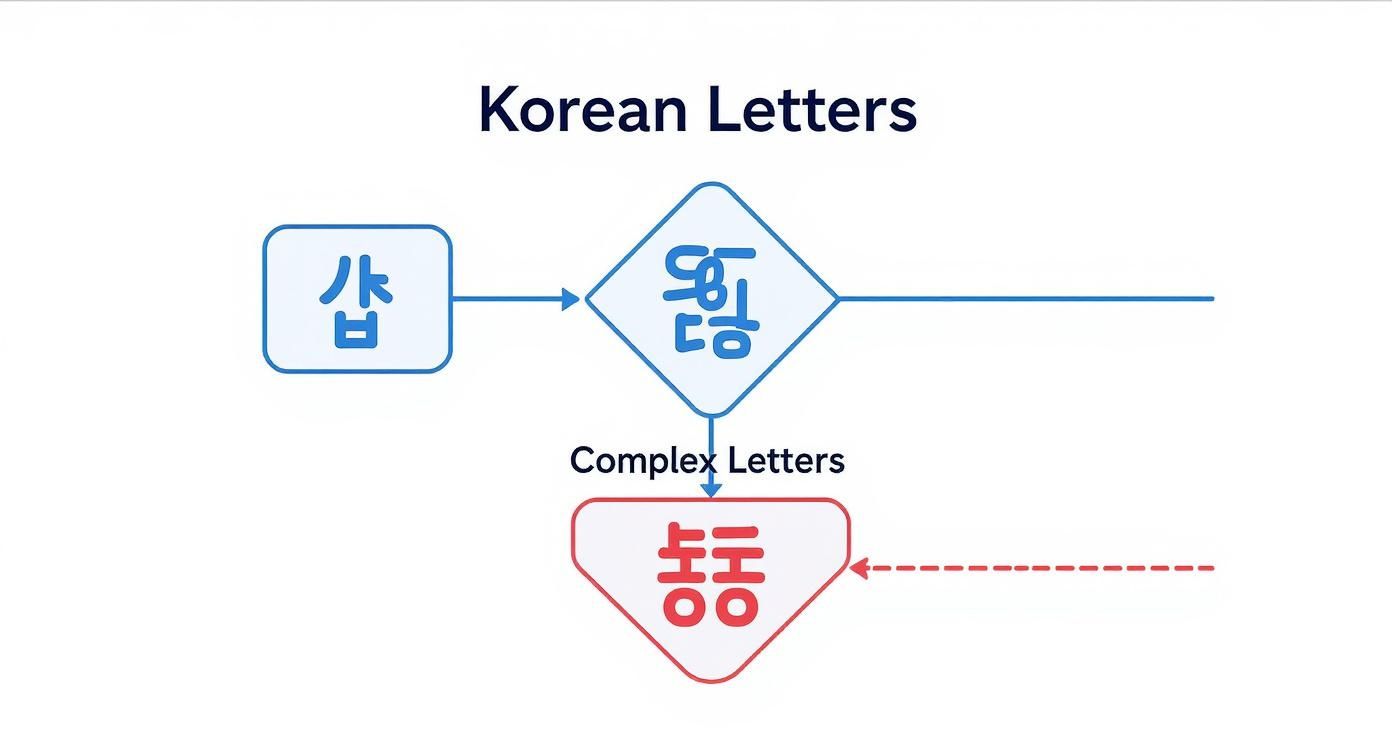
This chart shows how those simple letters we learned earlier snap together to create more complex sounds, forming the very foundation of these syllable blocks.
The Magic of the Final Consonant: Batchim
Now, let's zoom in on a critical piece of these syllable blocks: the Batchim (받침). The word itself means "support," which is a fantastic way to think about it. The Batchim is simply the final consonant tucked in at the bottom of a syllable block.
This is where pronunciation gets really interesting. A consonant's sound can change completely depending on whether it's at the beginning of a syllable or sitting in that final Batchim spot. This is one of the most important rules you’ll learn for sounding natural.
Take the consonant ㄱ:
- At the start of a syllable, like in 가 (ga), it has a soft 'g' sound.
- In the Batchim position, like in 한국 (Hanguk), the ㄱ in 국 sounds like a sharp, unreleased 'k'.
"Unreleased" just means you stop the airflow abruptly instead of letting out a puff of air. It’s a subtle shift, but it’s the kind of detail that will make your Korean sound authentic.
The 7 Sounds of Batchim
Here’s some good news. While many different consonants can be a Batchim, they can only be pronounced in one of seven ways. That’s it! This rule simplifies things massively.
Let's break down the only seven sounds your mouth needs to make for any final consonant:
| Final Sound | Batchim Consonants that Make this Sound | Example | Pronunciation |
|---|---|---|---|
| k (unreleased) | ㄱ, ㅋ, ㄲ | 부엌 (bu-eok) - kitchen | [bu-eok] |
| n | ㄴ | 산 (san) - mountain | [san] |
| t (unreleased) | ㄷ, ㅅ, ㅆ, ㅈ, ㅊ, ㅌ, ㅎ | 옷 (ot) - clothes | [ot] |
| l | ㄹ | 물 (mul) - water | [mul] |
| m | ㅁ | 밤 (bam) - night | [bam] |
| p (unreleased) | ㅂ, ㅍ | 집 (jip) - house | [jip] |
| ng | ㅇ | 강 (gang) - river | [gang] |
Look at the 't' sound row. A whopping seven different consonants—ㄷ, ㅅ, ㅆ, ㅈ, ㅊ, ㅌ, and ㅎ—all get pronounced as an unreleased 't' sound when they’re at the bottom. So when you see the word 꽃 (kkot), which means flower, that final 'ㅊ' isn't a 'ch' sound at all. It's just a 't'.
This adaptability is a big reason why Hangul has been so successful. Its ease of learning has been vital in preserving Korean culture, especially during periods like the Japanese colonial era (1910–1945), when Hangul became a powerful symbol of identity. You can find more on Hangul's cultural impact on AmazingTalker.com.
Learning these Batchim rules might feel like a hurdle at first, but it is an absolute game-changer. It's what takes you from just sounding out letters to truly reading Korean.
You’ve Learned Hangul — What’s Next?
Give yourself a pat on the back. You've just worked your way through the entire system of Korean vowels and consonants. Think about that for a second—you now understand the brilliant logic behind Hangul and the basic rules that make the language sing.
This is so much more than just memorizing a few new shapes. You now hold the key to actually reading, writing, and speaking Korean. Seriously, you've just taken the biggest and most important step in your language journey. From here on out, it’s all about practice.
Time to Start Reading and Speaking
Okay, enough with the theory. The real fun starts now. The absolute best way to make all this new knowledge stick is to actually put it to work. Try reading simple words you spot in K-dramas or on your favorite Korean snack packaging.
- Read simple signs: Look for common words like 카페 (ka-pe - cafe) or 메뉴 (me-nyu - menu).
- Practice with names: A fun exercise is to try writing your own name, or your friends' names, in Hangul.
- Speak with confidence: Don't stress about getting it perfect right away. The main thing is to just start making the sounds.
Remember this: every single Korean person learned to read using the exact same building blocks you just did. What you've accomplished is a huge deal, and the only thing standing between you and fluency now is consistent practice. You’re officially ready to go. Take what you've learned and start using it. The path is clear, and your Korean journey is well and truly underway.
Every word you learn brings you one step closer to confidence. Keep going—your Korean journey starts now!
🌟 Ready to start your Korean journey? Join Ktalk.live — where global learners connect, speak, and grow together! Find out more at https://ktalk.live.
Ready to stop reading and start speaking?
Practice what you just learned with a native Korean teacher — free for 100 minutes. No card, no commitment.