Want to practice this with a native Korean teacher?
100-min free trial — no card required.
Ever felt like you know plenty of Korean words but can't quite follow a K-drama? You're not alone. It's a common hurdle, but the solution might be hiding right on the page. Good Korean reading practice is your secret weapon, a bridge connecting vocabulary to real-world conversations.
This isn't just about sounding out Hangul. It’s about understanding the natural flow of sentences, grasping cultural nuances, and building the confidence to speak. In this guide, we'll explore practical, fun ways to make reading a core part of your learning journey, turning a passive skill into your biggest asset for fluency. Let's dive in!
Building a Rock-Solid Reading Foundation
You can't build a house without a solid foundation, and the same goes for your Korean reading skills. Before you can dive into webtoons or news articles, you need to get completely comfortable with Hangul (한글) and a core set of essential words.
Don't worry if this sounds basic—mastering it is what separates struggling learners from successful ones. Rushing this stage often leads to frustration later. Taking the time to make these basics second nature will make your entire Korean journey smoother and far more enjoyable.
From Characters to Core Words
Your first big goal is to make Hangul second nature. You want to see a character and instantly know its sound without thinking. Flashcard apps like Anki or Quizlet are great, but don't just stop there. Practice reading simple, everyday words you see around you.
- 커피 (keo-pi) - Coffee
- 지하철 (ji-ha-cheol) - Subway
- 우유 (u-yu) - Milk
- 감사합니다 (gam-sa-ham-ni-da) - Thank you
Next, start building your core vocabulary. Knowing just the first 500–1000 most common words unlocks a huge portion of everyday written Korean. Focus on the essentials: basic verbs, common nouns, and crucial particles. This is the smart way to build momentum.
This visual timeline shows just how important that solid foundation is on your path to fluency.
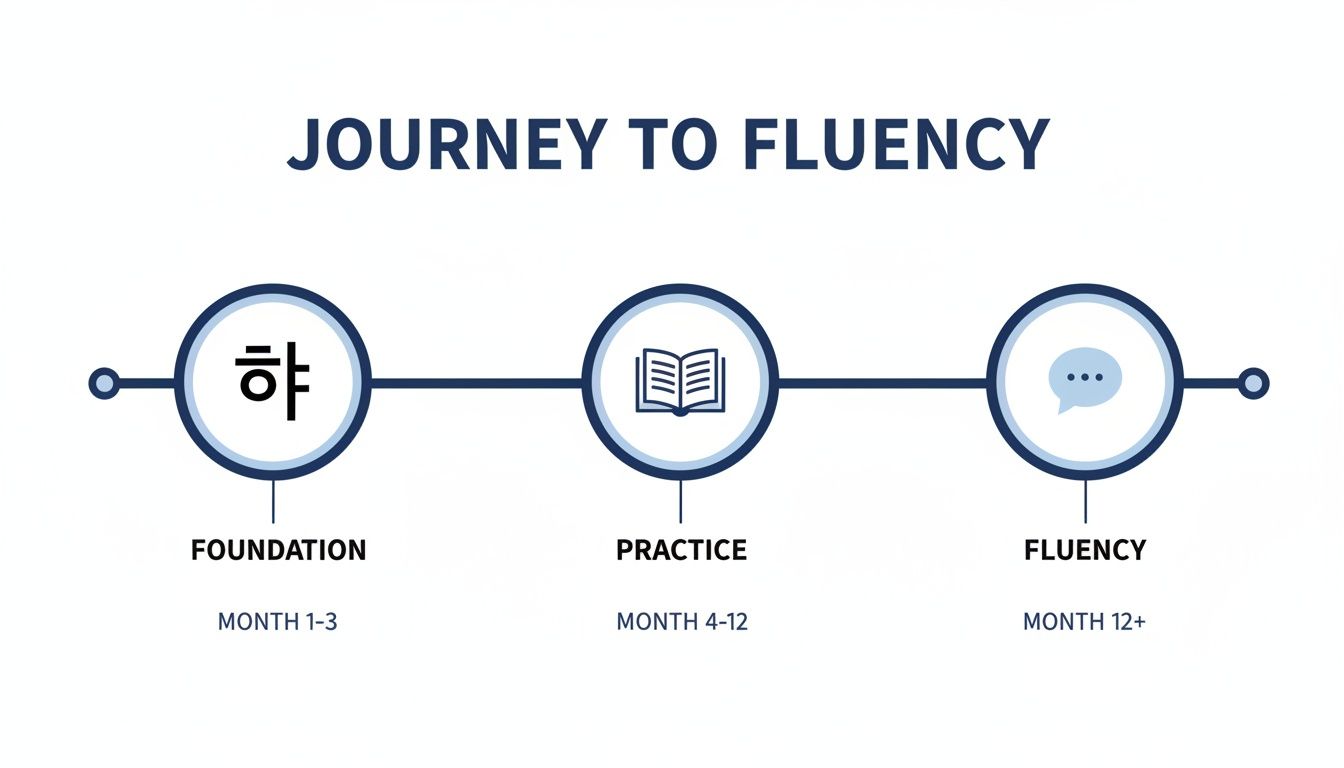
As the graphic shows, consistent practice is what turns that foundational knowledge into real-world fluency.
A Structured Plan for Success
To avoid getting overwhelmed, a structured plan is your best friend. Instead of trying to learn everything at once, set clear, achievable goals. A weekly plan helps organize your Korean reading practice from day one and builds a routine that sticks.
Here’s a sample plan for your first month:
| Week | Hangul Focus | Vocabulary Goal (New Words) | Daily Practice Example |
|---|---|---|---|
| Week 1 | Master all 14 basic consonants and 10 basic vowels. | 25 words (greetings, simple nouns like 'water', 'person'). | Write each character 10 times and read basic words like '아이' (a-i, child) aloud. |
| Week 2 | Learn the 5 double consonants and 11 complex vowels. | 35 words (family terms, common verbs like 'to go', 'to eat'). | Practice reading two-syllable words and simple phrases found in textbooks. |
| Week 3 | Understand how syllable blocks (consonant + vowel) are formed. | 50 words (numbers, days of the week, food items). | Find a Korean children's book and try to read one page per day, sounding out each block. |
| Week 4 | Introduce basic sound-change rules (e.g., how 'ㅂ' can sound like 'm'). | 60 words (adjectives, essential particles like '은/는'). | Read short webtoon dialogues and listen to the audio to connect written words with pronunciation. |
Following a plan like this builds momentum and gives you a real sense of accomplishment as you tick off each week's goals. It's all about building small, consistent habits.
Finding Reading Material You Actually Enjoy
Let's be honest—if learning feels like a chore, you won't stick with it. The secret to consistent Korean reading practice is finding material you genuinely want to read. When you’re hooked on a story, you absorb the language without even realizing it.
New words make sense in context, and you get a natural feel for sentence structure. Your personal interests are your most powerful learning tool.
Start with Fun, Simple Texts to Build Momentum
When you’re just starting out, the goal is to build confidence with quick wins. Trying to tackle a dense novel right away is a recipe for burnout. Instead, ease in with material that's designed to be clear and enjoyable.
- Children's Books (동화책): Don't underestimate these! They use simple grammar and repeat key vocabulary, which is perfect for reinforcing the basics.
- Webtoons (웹툰): These are a goldmine for learners. The visuals provide instant context, helping you guess new words without breaking your flow. Plus, they're filled with casual, everyday dialogue.
- Graded Readers: These books are written specifically for language learners and are sorted by level. They carefully control the vocabulary and grammar so you can read a whole story without constantly reaching for a dictionary.
A practical tip: Choose material where you already know about 80% of the words. This keeps you engaged while gently introducing new vocabulary—the key to avoiding frustration.
Tap into What Koreans Are Reading Now
As you get more comfortable, you can start exploring more authentic materials. This doesn't mean you have to jump straight to heavy classic literature. Thanks to celebrated authors and a trend called 'Text Hip,' reading has become a popular activity among young Koreans.
The numbers don't lie. Online bookseller Yes24 saw book sales to teens and young adults climb by 18 percent in one year. The number of book reviews by readers in their teens and 20s also shot up by a massive 34.9 percent. You can dig deeper into South Korea's vibrant book market insights to see how much the reading culture is thriving.
When you read the same modern books that young Koreans are buzzing about, you’re doing more than just practicing a language—you're plugging directly into a living culture.
How to Level Up Your Reading List
Once you've mastered the basics, it's time to find content that matches your passions.
- For Intermediate Learners: Start reading short news articles on a portal like Naver News, find blog posts about your hobbies (cooking, gaming, fashion), or look up the lyrics to your favorite K-pop songs.
- For Advanced Learners: Now you can dive deep. Try full-length novels by contemporary authors, read opinion essays, or even find professional articles related to your field of study. This is how you'll acquire the sophisticated vocabulary needed for true fluency.
No matter your level, the rule is the same: read what you love. That passion is the fuel that will sustain your Korean reading practice for the long haul.
How to Read for Real Understanding
Staring at a page of Korean text is one thing, but truly understanding it is another. To make real progress, you need to be an active reader. This means using smart strategies to deepen your comprehension and make new words stick.
The secret is to balance two different approaches: extensive and intensive reading.
Think of extensive reading as a leisurely stroll. You read for pleasure and the overall gist, not stopping for every unknown word. Intensive reading is more like being a detective. You analyze a short text, examining every word and grammar point until you've cracked its meaning.
From Passive Scanning to Active Learning
A common trap is becoming too reliant on digital dictionaries. While convenient, looking up every word prevents you from developing the crucial skill of guessing a word's meaning from context.
Instead, try this: read an entire paragraph or page first. Jot down words you don't know, but resist looking them up immediately. After you finish the section, go back and look up only the words that are critical to understanding the main idea. This keeps your reading flow intact and trains your brain to work a little harder.
Here's a practical challenge: After reading a short section, try to summarize it in one or two simple Korean sentences. They don't have to be perfect! The goal is to process what you’ve read and put it into your own words—a fantastic way to make it stick.
Making Your Mark with Simple Annotation
One of the best ways to read actively is to physically mark up the text. You don’t need a complicated system; just keep it simple.
- Circle words you don't know.
- Underline grammar patterns you're trying to master.
- Put a question mark next to sentences that are confusing.
- Scribble a quick summary note (in English or basic Korean) in the margin.
This simple act keeps you focused and turns the page into a personalized study sheet. This might be why many people still prefer physical books. A survey by the Korean Publishing and Reading Research Institute found that 80.4 percent of South Korean adults read at least one print book. You can check out the full research on South Korea's reading habits for more on this.
By using these active reading techniques, you’ll turn every session into a powerful learning opportunity.
Making Your Reading Habit Stick
Life gets busy, but when it comes to learning a language, consistency is the secret sauce. A little bit every day is far more effective than cramming for hours once a week. Let's build a practical plan to weave Korean reading practice into your daily life so it feels natural, not like another chore.
The trick is to attach your new reading habit to a routine you already have. Instead of trying to find a new hour in your day, just link a short reading task to something you already do automatically.
Carving Out Your Reading Time
Think about the small gaps in your day. You’re not looking for an hour to read a novel; you're looking for a few focused minutes, every single day. That consistency is far more powerful than occasional, intense study sessions.
Here are a few ideas:
- The Commuter: Got a 15-minute bus or train ride? Perfect. That's just enough time to scroll through a webtoon on your phone.
- The Coffee Break: While your coffee is brewing, read a short Korean blog post or a quick news article.
- The Weekend Deep-Dive: Set aside a bigger chunk of time on Saturday or Sunday—maybe 30-40 minutes—to get into a short story or an interesting essay.
- The Bedtime Story: Wind down at night by reading a few pages from a Korean children's book.
A great tip is to set a goal you can hit even on your worst day. Aim for something so small it feels almost silly, like reading just one paragraph. You’ll be surprised how often you end up reading more.
Winning the War Against Distractions
Let's be real: our biggest enemy is the constant ping of digital distractions. This isn’t just a problem for language learners; it's a global trend. A Social Survey by South Korea's National Data Agency highlighted a stark decline in reading among young people.
The average number of books read by teens dropped from 22.2 in 2011 to just 11.7 a decade later—a drop of nearly 50%. Researchers noted this lined up perfectly with the rise of media consumption on smartphones. You can read more about these societal shifts in South Korea.
The answer isn't to get rid of your phone but to be smarter about how you use it.
When it's time to read, create a distraction-free space. Put your phone in 'Focus Mode' for 15 minutes. Close extra browser tabs. Find a quiet spot. By making a conscious effort to protect this time, you're signaling to your brain that your Korean reading practice is important, making the habit much more likely to stick.
Connecting Your Reading to Confident Speaking
Reading is fantastic for building your vocabulary, but how do you get that knowledge out of your head and into a conversation? This is where the real progress happens. You have to bridge the gap between passively understanding a word and actively using it to express yourself.
The best way to do this is to take what you’re reading and immediately apply it in a live conversation. The act of pulling a new word from your memory and using it in the moment forges a permanent connection in your brain.
From Text to Talk
This is where a platform like Ktalk.live becomes invaluable. It creates a direct pipeline from your Korean reading practice to your speaking practice, making the transition seamless and effective.
Imagine you just finished reading an exciting webtoon chapter. You could immediately:
- Chat about the plot: Join a small-group class and talk about what happened. Try summarizing the story or describing your favorite character using the vocabulary you just learned.
- Ask about confusing phrases: Did you find an idiom that a dictionary couldn’t quite explain? Ask a native tutor to break down the cultural nuance for you.
- Use your new words: Make it your mission to use the vocabulary you just learned. If you read an article about the weather, try to work words like 습하다 (seup-ha-da - to be humid) into the conversation.
This creates a powerful learning cycle: you read, you speak, you get feedback, and you improve.
Making It Real with Ktalk.live
Live, structured classes provide the perfect, low-pressure space to put your reading into action. It’s a safe environment to try out the language you've been absorbing without fear of making mistakes.
The magic happens when you stop treating reading and speaking as separate activities. They are two sides of the same coin. Your reading provides the fuel for speaking, and speaking gives your reading a clear purpose.
Here’s a practical goal: each week, pick one article or webtoon to read. Find five new words or phrases. Then, make it your mission to use them in your next Ktalk.live small-group class. This simple habit transforms your Korean reading practice into a powerful engine for building real speaking confidence.
Your Korean Reading Journey Starts Now
Building a solid reading habit is one of the most effective ways to accelerate your Korean fluency. It expands your vocabulary, deepens your cultural understanding, and provides the raw material you need to become a confident speaker. Remember, every page you read is a step forward.
Start small, stay consistent, and choose materials that you truly enjoy. Don’t worry about being perfect; focus on making progress. Your dedication will pay off, opening up a whole new world of Korean books, media, and conversations. Every word you learn brings you one step closer to confidence. Keep going—your Korean journey starts now!
🌟 Ready to start your Korean journey? Join Ktalk.live — where global learners connect, speak, and grow together! Find the perfect class for your level at https://ktalk.live.
Ready to stop reading and start speaking?
Practice what you just learned with a native Korean teacher — free for 100 minutes. No card, no commitment.