
Want to practice this with a native Korean teacher?
100-min free trial — no card required.
Trying to book a train ticket, order a coffee, or sign up for a cool new app in Korea, only to be stopped by a request for a local Korean phone number? If this sounds familiar, you're not alone! In one of the most connected countries on earth, a local number is more than just a way to call friends—it's the key that unlocks everyday digital life. Learning how a Korean phone number works is a small step that makes a huge difference in your journey.
This guide is for anyone—travelers, students, or K-culture fans—who wants to dive into modern Korean life without a hitch. We’ll break down everything you need to know, from understanding the number formats to getting your own SIM or eSIM. Let's make sure your time in Korea is as smooth and connected as possible!
Why a Korean Phone Number Is Your Digital Key
In South Korea, your phone number is woven into the very fabric of the country's digital infrastructure. It acts as a primary method for identity verification, giving you access to countless services that are essential for anyone living in or just visiting the country.
Think of it as your digital passport. Without it, you’ll quickly find yourself on the outside looking in, unable to access the simple conveniences that locals use every single day. Here's a glimpse of what a local number opens up for you:
- Essential Services: You'll need it to sign up for must-have apps like KakaoTalk, food delivery services, and public transport apps.
- Convenient Reservations: Easily book restaurant tables, concert tickets, train seats, and even doctor's appointments online.
- Online Verification: Many Korean websites and apps require a local number for bon-in injeung (본인인증), which is a form of real-name identity verification.
- Seamless Connectivity: Keep in touch with new friends, family back home, and even your Ktalk.live tutors without having to hunt for unreliable public Wi-Fi.
Breaking Down the Korean Numbering System
Seeing a long string of Korean numbers for the first time can feel a bit confusing. But don’t worry, there's a surprisingly simple logic behind it all. Once you get the hang of it, you’ll be able to tell what kind of number you're looking at instantly—a skill you'll use constantly.
Think of a Korean phone number as having three distinct parts: Prefix - Middle Part - Final Part. It's this simple structure that makes them easy to read and remember. Let's break down what each section tells you.
Mobile Numbers: The Universal 010
If there's one number you need to know in modern South Korea, it's 010. This is the prefix for virtually every personal mobile phone in the country. Seeing a number start with 010 is an immediate giveaway that you're dealing with a mobile line.
The standard format is 010-XXXX-YYYY.
- 010 (공일공 - gong-il-gong): The mobile identifier. It’s the universal sign of a mobile phone.
- XXXX: A four-digit middle section.
- YYYY: The final unique four digits.
So, a complete mobile number like 010-1234-5678 will always have 11 digits. Koreans almost always write it with hyphens to make it easier to read. This isn't just a trend; it's a reflection of how deeply mobile-centric the country is.
And it’s not slowing down. In 2023, South Korea had a staggering 162.11 mobile subscriptions per 100 people, and that number is projected to climb to 175.96 by 2028. If you're curious about the data, you can find more insights into these mobile trends at CEICdata.com.
Landline Numbers: It’s All About the Area Code
While mobile phones dominate, landlines are still very much in use for businesses, offices, and homes. The main difference? Instead of the 010 prefix, landlines use area codes that correspond to a specific city or province.
Here are a few of the most common ones you'll run into:
- 02: Seoul (서울 - Seoul)
- 031: Gyeonggi Province (경기도 - Gyeonggi-do)
- 051: Busan (부산 - Busan)
- 064: Jeju Island (제주도 - Jeju-do)
Landline numbers follow a format like Area Code - XXX(X) - YYYY. For instance, a coffee shop in Seoul might have a number like 02-123-4567. Notice how the total digits can be 9 or 10, which is shorter than a mobile number. That area code at the beginning is your dead giveaway that you're calling a fixed line.
Here’s a quick summary to help you tell them apart at a glance.
Korean Phone Number Formats at a Glance
| Number Type | Typical Format | Example | Key Identifier |
|---|---|---|---|
| Mobile | 010-XXXX-YYYY | 010-1234-5678 | Starts with the 010 prefix. Always 11 digits. |
| Landline | Area Code-XXX(X)-YYYY | 02-123-4567 | Starts with a 2 or 3-digit area code (e.g., 02, 031). |
This simple distinction between the 010 prefix for mobiles and area codes for landlines is the first step to mastering Korean phone numbers.
How to Call Korea from Anywhere in the World
Want to get in touch with friends, colleagues, or your Ktalk.live language tutor in South Korea? It's actually pretty simple once you know the formula. The whole process boils down to three key parts, with the most important being South Korea’s country code: +82.
Think of +82 as the master key that unlocks the Korean phone network from anywhere on the globe. It’s the very first thing you’ll need after telling your phone you’re calling internationally.
The Three Simple Steps to Calling Korea
No matter where you're calling from, the basic pattern for an international call is always the same. You just have to put the numbers in the right order.
Start with Your Exit Code: First, you need to tell your local phone network you're making a call outside the country. In the US and Canada, this code is 011. If you're in the UK or most of Europe, it's 00. The easiest shortcut on any mobile phone? Just press and hold the '0' key until the plus sign (+) appears. This automatically handles the exit code for you.
Add South Korea's Country Code: Right after your exit code, punch in 82. This is what routes your call straight to South Korea.
Dial the Korean Number (But Drop the Zero!): Here’s the step where most people trip up. You need to remove the first '0' from the local Korean number you're trying to call. So, if a mobile number is
010-1234-5678, you only dial10-1234-5678after the country code.
The Golden Rule: When calling Korea from another country, always drop the leading zero from the local number. Forgetting this tiny detail is the number one reason international calls fail to connect.
Putting It All Together: Real-World Examples
Let's walk through a few examples. Imagine you're trying to call a mobile number in Korea, 010-9876-5432.
- From the United States or Canada: You'd dial
011-82-10-9876-5432. - From the United Kingdom: It would be
00-82-10-9876-5432. - From Australia: The sequence is
0011-82-10-9876-5432. - From any mobile phone, anywhere: The simplest way is to dial
+82-10-9876-5432.
This works exactly the same way for landlines. Let's say you need to call a number in Seoul, like 02-123-4567. You would just dial +82-2-123-4567. Follow this simple process, and you’ll get through every time.
Choosing the Right SIM or eSIM Plan for You
Alright, so you're ready to get your own Korean phone number. This is where things get practical. You've got a few solid options, and the best one really boils down to your situation—how long you're staying, what kind of phone you have, and your personal preference. Let's walk through the main ways you can get connected in South Korea.
Each route has its own perks. Some are all about convenience, others offer better long-term value, and some are completely digital. Figuring out these differences now will save you a lot of hassle later.
Before we dive into getting a number, it helps to know how people will call you from abroad. It's a simple, three-step dance.
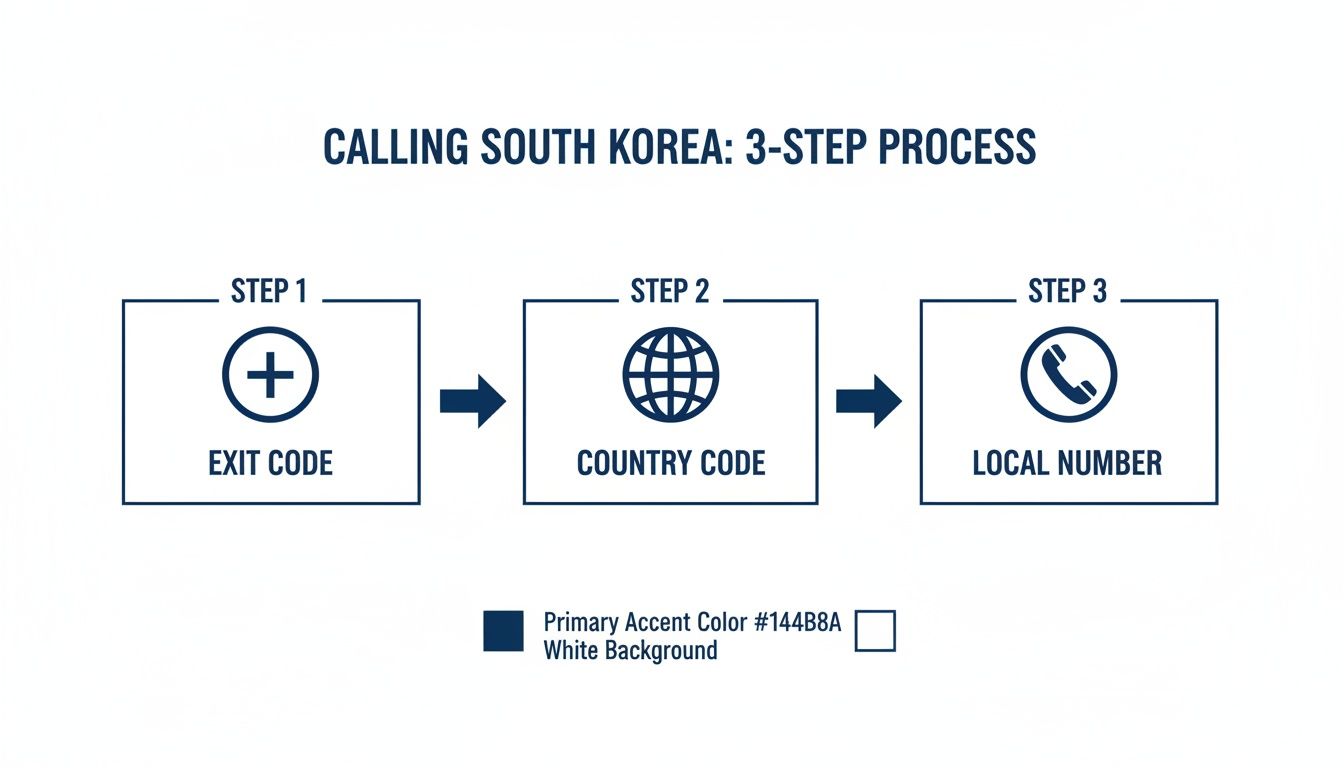
This little graphic breaks down the international dialing sequence perfectly: exit code, country code, then the local number. That's all there is to it.
Physical SIM Cards vs. eSIMs
- Physical SIM Cards: The good old physical SIM card is still a classic for a reason. You can pre-order one online to grab at an airport counter—like at Incheon (ICN)—the moment you land, or just pop into a local convenience store to buy one. They are simple to install and great for short-term tourists. The only downside is you have to physically swap your home SIM (don't lose it!).
- eSIMs (Embedded SIMs): If you've got a newer smartphone, an eSIM is a total game-changer. It's a digital SIM card that lives inside your phone. You can buy a plan, scan a QR code, and activate it all online, often before you even leave home. It’s perfect for tech-savvy travelers who want to be connected the second they land. Just be sure to check if your device is eSIM-compatible first.
Prepaid vs. Postpaid Plans
The length of your stay is the biggest factor here. Are you on a short holiday or settling in for a while?
Prepaid Plans: These are perfect for tourists and short-term students. You pay upfront for a bundle of data, calls, and texts. Registration is a breeze—all you typically need is your passport. No strings attached.
Postpaid Plans: If you're a long-term resident, an international student staying for a year, or working in Korea, this is the way to go. These are monthly contracts that offer much better value but come with more requirements, like an Alien Registration Card (ARC) and usually a local bank account.
It's hard to overstate how connected Korea is. In 2023, the country had around 83.89 million mobile subscriptions for a population of just over 51 million. That's a staggering 162.11 subscribers for every 100 people! Having a reliable plan isn't just a convenience; it's how life happens here. You can dig into more of this data over at TheGlobalEconomy.com.
Major Korean Carriers
When you start shopping for a plan, you'll see three names pop up again and again. These are the big players in the Korean telecom world, and they all have competitive options for foreigners.
- SK Telecom (SKT): The largest carrier in the country, known for its massive and reliable network coverage.
- KT (Korea Telecom): Another giant, famous for its solid service and a huge variety of plans designed for foreigners.
- LG U+: A strong third competitor that often runs great promotions and offers generous data packages to attract customers.
All three have English-language customer support and websites, so you won't be left struggling. It’s always a good idea to check their current offers online before making a final decision.
Navigating Registration and ID Requirements
Getting your own Korean phone number is a bit of a rite of passage, but it definitely comes with some paperwork. Knowing what you need beforehand can save you a ton of hassle. South Korea's system is pretty strict about tying phone numbers to a person's identity, which is actually the key to unlocking most online services here.
For Short-Term Visitors and Prepaid SIMs
If you're just in Korea for a short holiday, a prepaid SIM is your best friend. The whole process is designed to be fast and painless so you can get online right after you land.
Honestly, all you'll probably need is your passport. When you grab a SIM at the airport or a convenience store, you'll show your passport, they'll scan it, and register the number to you. That's usually all it takes to get data and make calls.
The Bottom Line: For tourists, a valid passport is pretty much the only ID you'll need for a prepaid SIM. The system is built for speed to get you connected fast.
For Long-Term Residents and Postpaid Plans
Now, if you're planning on staying in Korea for a while—maybe as a student or for work—you'll need more than a passport to get a proper monthly phone plan. This is where your Alien Registration Card (ARC) comes into play. It's absolutely essential.
The ARC (외국인등록증 - oegugin deungnokjeung) is your official ID card as a foreign resident in South Korea. Phone companies won't even talk to you about a contract without it because they need to verify your identity and legal residency status. On top of your ARC, you'll almost certainly need a Korean bank account to set up automatic monthly payments.
Understanding Bon-in Injeung (본인인증)
This leads us to one of the most important concepts for digital life in Korea: bon-in injeung (본인인증), or "real-name verification." Countless Korean websites, apps, and online services demand that you verify who you are using a phone number registered under your name and ARC.
A simple tourist SIM linked only to your passport just won't cut it for these kinds of identity checks. This is exactly why getting a number properly tied to an ARC is so powerful. It's the key that unlocks full access to Korea's digital ecosystem, from banking and online shopping to booking concert tickets and using government services.
It’s More Than Just a Number
Mastering the ins and outs of a Korean phone number is a small but powerful step that makes life in Korea so much easier. It's your key to the country’s amazing digital world, allowing you to order food, navigate the subway, and connect with new friends effortlessly. More than that, every practical skill you learn, like this one, brings you closer to the culture and boosts your confidence.
Every word you learn brings you one step closer to fluency. Keep going—your Korean journey starts now!
🌟 Ready to start your Korean journey? Join Ktalk.live — where global learners connect, speak, and grow together!
Frequently Asked Questions
Getting the hang of Korean phone numbers can feel a bit tricky at first, especially if you're new to the country. Let's tackle some of the most common questions that pop up for visitors and new residents.
Can I Get a Korean Phone Number Before I Arrive?
Yes, you absolutely can, and it's a great way to make your arrival smoother. The easiest method is to buy an eSIM online from a global provider before you even pack your bags. You just install it on your phone back home, and the moment you land at Incheon, your data plan is ready to go.
If you prefer a physical SIM card, that's also an option. Many companies let you pre-order a SIM online and simply pick it up from a counter at the airport once you arrive. It’s super convenient.
What's the Difference Between a Prepaid and Postpaid Plan?
The real difference boils down to how you pay and what kind of ID you need. It’s pretty straightforward once you break it down.
Prepaid Plan (Pay-as-you-go): Think of this as topping up your credit. You pay for your data and calls upfront, and when it runs out, you just add more. This is the go-to choice for tourists and short-term visitors because you usually only need your passport to sign up. No long-term contracts, no fuss.
Postpaid Plan (Monthly Contract): This is the standard long-term plan you'd get from a major carrier like SKT or KT, with a bill at the end of each month. While it often offers better value over time, it's designed for residents. You'll need an Alien Registration Card (ARC) and a Korean bank account to even apply.
Why Won't My Tourist SIM Work for Online Verification?
Ah, the classic headache for many foreigners in Korea. This happens because of a robust security system called bon-in injeung (본인인증), which translates to "real-name verification."
Most Korean websites—especially for banking, online shopping, or booking event tickets—require you to verify your identity using a phone number that's officially tied to an Alien Registration Card (ARC) in their national database. Your tourist SIM is registered with your passport, which isn't connected to this system. So, for those high-security sites, a standard tourist SIM just won't cut it.
🌟 Ready to start your Korean journey? Join Ktalk.live — where global learners connect, speak, and grow together! https://ktalk.live
Ready to stop reading and start speaking?
Practice what you just learned with a native Korean teacher — free for 100 minutes. No card, no commitment.