Want to practice this with a native Korean teacher?
100-min free trial — no card required.
Learning Korean might seem challenging at first, but with the right approach, it becomes a fun and rewarding journey! Your entire adventure starts right here, with the Korean language vowels. These simple sounds are the key to unlocking the whole Hangul writing system, making reading and pronunciation way easier than you probably imagine. Don't worry if it looks unfamiliar; these foundational characters are your first, most important step toward speaking Korean with confidence. By the end of this guide, those strange symbols will start to feel like old friends.
Why Vowels Are Your First Step to Reading Korean

At first glance, learning Korean can feel like a huge challenge. But it has a secret weapon: Hangul, one of the most logical alphabets ever created. Forget memorizing thousands of complex characters like in other East Asian languages. The magic of Hangul is its simplicity, and that begins with the Korean language vowels.
Modern Korean is built around just 10 basic vowels. That’s it! These form the absolute foundation of the language. This brilliant system was designed in 1443 by King Sejong the Great, who wanted a simple, phonetic alphabet so that everyone could become literate, not just the elite. If you're curious, you can learn more about Hangul's fascinating origins and structure.
By getting a handle on these core sounds, you’re setting yourself up for success. You'll be able to:
- Read Korean words accurately from your very first lesson.
- Pronounce syllables correctly with a more natural flow.
- Move on to grammar and vocabulary much faster because reading won't hold you back.
Think of the vowels as your essential building blocks. Once you know them, everything else in Korean just starts to click. Those strange-looking symbols will quickly transform into meaningful words you can actually read and say out loud.
Meeting the 10 Foundational Korean Vowels
Alright, let's dive in! It's time to meet the 10 foundational Korean vowels that form the heart of the language. Don't feel pressured to memorize them all in one go. The real magic of Hangul lies in its logical design, which makes remembering these shapes far more intuitive than you might think.
We can split these ten vowels into two simple families: vertical vowels (the ones standing tall) and horizontal vowels (the ones lying flat). This isn't just a visual trick; understanding this distinction is crucial for when we start building syllable blocks later. For now, let's just focus on connecting each character to a sound you probably already know.
The Five Vertical Vowels
The vertical vowels are all built around a central standing line, ㅣ (i). Think of this as the main trunk of a tree, with smaller branches added to create different sounds. When writing, you'll always find these vowels placed to the right of a consonant.
Let's meet them one by one:
- ㅏ (a): A bright, open sound, like the "a" in "father" or that "ah-ha!" moment.
- ㅑ (ya): See that extra little stroke? That's your cue to add a "y" sound. It sounds just like the "ya" in "yacht".
- ㅓ (eo): This can be tricky. It's close to the "o" in "son" or "cut". Keep your mouth relaxed and slightly open—don't round your lips!
- ㅕ (yeo): Following the pattern, that second stroke adds the "y" again. This is the sound in "young".
- ㅣ (i): The simplest of the bunch! This makes a sharp "ee" sound, like in "see" or "free".
Quick Tip: Did you spot the pattern? A single short stroke (ㅏ, ㅓ) gives a pure vowel sound. A double short stroke (ㅑ, ㅕ) simply slides a 'y' in front of it. Grasping this simple rule instantly cuts your memorization work in half!
The Five Horizontal Vowels
Next up are the horizontal vowels. These are all based on the horizontal line ㅡ (eu). When you start building words, these vowels will always be tucked underneath their consonant partner.
Here’s the horizontal family:
- ㅗ (o): The classic "o" sound you hear in "boat" or "o-ver". Round your lips into a small, tight circle.
- ㅛ (yo): And there's our extra stroke again! ㅗ (o) becomes ㅛ (yo), the exact sound in "yo-yo".
- ㅜ (u): This makes a deep "oo" sound, like in "moon" or "zoo". Your lips should be rounded and pushed forward.
- ㅠ (yu): You know this one, right? The extra stroke adds the "y". So, ㅜ (u) becomes ㅠ (yu), which sounds like the English word "you".
- ㅡ (eu): This is often the toughest sound for beginners. Pull your lips back flat as if saying "cheese," but keep them relaxed and make a sound from the back of your throat. It's a short, flat "eugh" sound.
To really get a feel for these, say them out loud. Your mouth shape is everything! Exaggerate the movements at first to build the right muscle memory.
The 10 Basic Korean Vowels and Their Sounds
This little chart is perfect for drilling the fundamental vowels. It shows the Hangul character, its romanization, and a familiar English word to anchor the sound.
| Hangul Vowel | Romanization | Sounds Like (English Word) |
|---|---|---|
| ㅏ | a | father |
| ㅑ | ya | yacht |
| ㅓ | eo | son |
| ㅕ | yeo | young |
| ㅣ | i | see |
| ㅗ | o | go |
| ㅛ | yo | yo-yo |
| ㅜ | u | moon |
| ㅠ | yu | you |
| ㅡ | eu | (no direct equivalent) |
Take your time with these 10 foundational Korean vowels. Say them, write them down, and listen for them in Korean songs or dramas. They are the essential building blocks you’ll use for every single Korean word you ever learn.
How Simple Vowels Combine to Create New Sounds
Once you've got a handle on the 10 foundational Korean vowels, you're ready for the fun part. Think of those basic vowels like primary colors. They're essential on their own, but when you mix them, you unlock a whole new palette of sounds.
In Korean, this "mixing" creates what we call diphthongs, or compound vowels. These are single sounds made by combining two simple vowels. There are 11 of them, and while that might sound like a lot, the logic behind them is refreshingly simple. You’re not learning 11 brand new characters; you’re just learning 11 simple formulas.
The Magic of Vowel Formulas
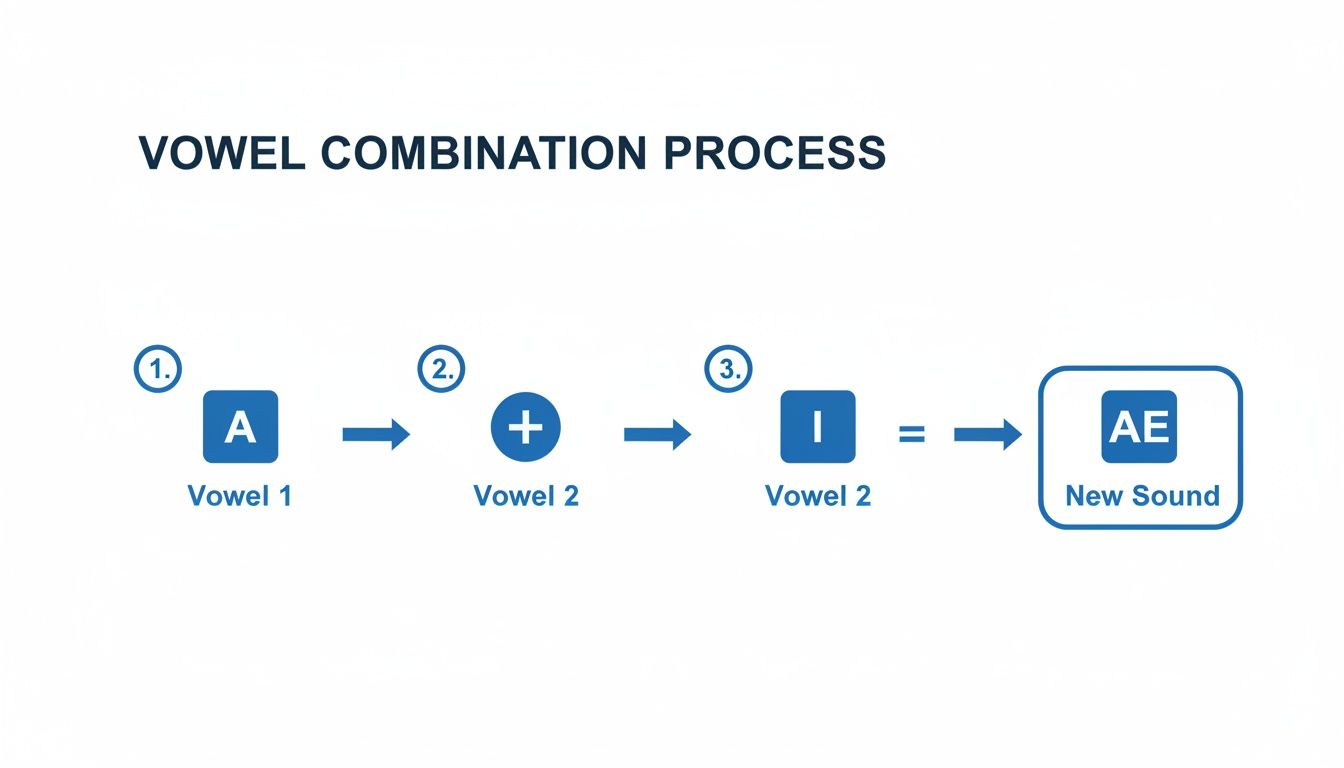
The best way to get your head around these compound vowels is to see them as simple addition problems. Once the pattern clicks, memorizing them becomes almost effortless.
Let’s start with the first two, which are very common but often trip up new learners.
ㅐ (ae) = ㅏ (a) + ㅣ (i)
This vowel sounds like the "a" in "apple" or "ant". It’s a bright, open sound.- Example: 개 (gae) - dog
ㅔ (e) = ㅓ (eo) + ㅣ (i)
This one sounds more like the "e" in "egg" or "bed". It’s a slightly more relaxed sound.- Example: 네 (ne) - yes
Honestly, in modern Korean, the difference between ㅐ (ae) and ㅔ (e) has become so subtle that many speakers pronounce them almost identically. Don't stress yourself out trying to perfect them right away. Focus on telling them apart when you read, and your ear will slowly pick up the slight difference.
A Whole New World of "W" Sounds
Next up are the compound vowels that start with a "w" sound. You make these by combining a horizontal vowel (ㅗ or ㅜ) with a vertical vowel, creating a smooth, gliding sound.
Here are the four most common "w" sounds:
ㅘ (wa) = ㅗ (o) + ㅏ (a)
Sounds exactly like the "wa" in "waffle".- Example: 사과 (sagwa) - apple
ㅝ (wo) = ㅜ (u) + ㅓ (eo)
Sounds like the "wo" in "won".- Example: 원 (won) - Korean currency
ㅙ (wae) = ㅗ (o) + ㅐ (ae)
Sounds like the "wai" in "wait".- Example: 왜 (wae) - why
ㅞ (we) = ㅜ (u) + ㅔ (e)
Sounds just like the "we" in "wedding".- Example: 웨딩 (weding) - wedding
A Quick Pronunciation Tip: When making these "w" sounds, start with your lips rounded for the first vowel (ㅗ or ㅜ). Then, quickly open them to the shape of the second vowel (ㅏ, ㅓ, ㅐ, or ㅔ). The movement should feel quick and fluid.
Other Important Combinations
There are just a few more compound vowels. They all follow the same logic—blending two sounds into one seamless new one.
- ㅚ (oe) = ㅗ (o) + ㅣ (i): This makes a "we" sound, very similar to ㅞ. Example: 회사 (hoesa) - company.
- ㅟ (wi) = ㅜ (u) + ㅣ (i): This sounds exactly like the English word "we". Example: 위 (wi) - up/above.
- ㅢ (ui) = ㅡ (eu) + ㅣ (i): The trickiest of the bunch. Its pronunciation can change, but it often sounds like a quick slide from "eu" to "ee". Example: 의사 (uisa) - doctor.
Getting these combinations down is a huge leap toward sounding natural. Clear vowel pronunciation is vital, and poor pronunciation is a common sign of declining proficiency in heritage speakers, which proves how important it is to get these right from the start. You can discover more insights about Korean language preservation and usage among heritage speakers. By breaking these 11 compound vowels into formulas, you can skip rote memorization and understand how they're built.
Building Your First Korean Syllable Blocks
You’ve met the basic Korean language vowels and seen how they combine. Now for the fun part: putting it all together. Korean isn't written in a long string of letters like English. Instead, Hangul letters are assembled into neat syllable blocks, giving the language its organized, geometric look.
Getting the hang of this structure is a huge leap forward. It’s the moment when individual letters stop being just a list to memorize and start becoming a logical system for building any Korean word you can think of.
The Golden Rule of Syllable Blocks
Every Korean syllable block must contain at least one consonant and one vowel. But what about words that start with a vowel sound, like 아이 (ai), meaning "child"? Korean uses a special placeholder consonant: 'ㅇ' (ieung). When you see 'ㅇ' at the beginning of a syllable, it’s completely silent. It’s just there to hold the consonant spot so the block is structurally sound. Think of 'ㅇ' as a silent partner that lets the vowel shine.
How to Assemble Syllable Blocks
Assembling a syllable block feels a bit like playing Tetris. The shapes of the vowels—whether they are tall or flat—tell you exactly how the pieces fit together.
Side-by-Side: For vertical vowels like ㅏ (a), ㅓ (eo), and ㅣ (i), the consonant always sits to the left.
- Example: Consonant ㄱ (g) + vowel ㅏ (a) = 가 (ga).
Top-and-Bottom: For horizontal vowels like ㅗ (o), ㅜ (u), and ㅡ (eu), the consonant sits on top.
- Example: Consonant ㄴ (n) + vowel ㅜ (u) = 누 (nu).
This is exactly why we grouped the vowels into "vertical" and "horizontal" sets earlier! Their orientation dictates how the entire syllable is built.
Putting It All into Practice: Simple Drills
Theory is one thing, but getting these sounds to roll off your tongue is another. These drills will help turn what you've learned about Korean language vowels into a real skill. Remember to say everything out loud to build muscle memory in your mouth.
Start with Vowel-Heavy Words
Let's jump in with some simple words that are basically just a collection of vowels. Pay close attention to the shape of your mouth and the sound that comes out.
- 아이 (ai) - child (a great combo of ㅏ and ㅣ)
- 오이 (oi) - cucumber (listen for that clear transition from ㅗ to ㅣ)
- 우유 (uyu) - milk (this one really works your ㅜ and ㅠ sounds)
- 여우 (yeou) - fox (a nice flow from ㅕ to ㅜ)
Try saying each word three times. The first time, go super slow and exaggerate the vowel shapes. Then, speed it up to a more natural pace.
Make Your Practice Fun
The best practice is the kind that doesn't feel like a chore. Connect it to things you already love, and it will stick better.
- K-Pop Idol Names: Are you a fan? Try writing your favorite idols' names in Hangul and saying them aloud. For example, 뷔 (V) from BTS uses that tricky ㅟ sound, and 아이유 (IU) is a perfect drill for 아, 이, and 유.
- K-Drama Titles: Next time you’re scrolling, take a closer look at the titles. Can you sound them out? Many are short and use simple words.
- Food Names: Think about your favorite Korean foods! Say 김치 (gimchi) or 비빔밥 (bibimbap) aloud, focusing on making each vowel sound clear and distinct.
Reading to yourself is a good start, but speaking is where the magic happens. Getting feedback is the only way to know if you're on the right track. This is why live interaction is so powerful. If you're ready to take that step, you might want to try a free trial class on Ktalk.live. It's a great way to practice with a professional and kickstart your speaking journey.
Your Korean Journey Starts Now
You've just taken your first major step into the world of Hangul! By understanding the logic behind the Korean language vowels, you've built a solid foundation that will make everything else—from reading signs in Seoul to singing along to your favorite K-Pop song—so much easier. Don't worry if you make mistakes; even native speakers do sometimes! What matters most is progress and staying curious.
Remember, mastering these vowels isn't about memorizing a list; it's about understanding a system. Every word you learn from this point on will use these very same building blocks. Keep practicing, stay patient with yourself, and celebrate every small victory. Every word you learn brings you one step closer to confidence. Keep going—your Korean journey starts now!
🌟 Ready to start your Korean journey? Join Ktalk.live — where global learners connect, speak, and grow together! Book your free 100-minute trial class and take your learning to the next level.
Ready to stop reading and start speaking?
Practice what you just learned with a native Korean teacher — free for 100 minutes. No card, no commitment.