
Want to practice this with a native Korean teacher?
100-min free trial — no card required.
Have you ever dreamed of watching a K-drama without subtitles or understanding your favorite K-pop lyrics? Learning Korean might seem challenging at first, but with the right approach, it becomes a fun and rewarding journey! Many beginners are surprised to discover that the Korean alphabet, Hangul, is so logical you can start reading it in a single afternoon. This guide is your personal roadmap, designed to take the guesswork out of learning the Korean language for beginners. We'll break down everything from the alphabet to building your first sentences, setting you on a clear path to understanding a vibrant new culture and language. Your adventure starts now!
Your Korean Learning Adventure Starts Here
Think of this guide as your personal roadmap. We're going to walk you through everything, step-by-step, from decoding the alphabet to confidently building your very first sentences. This isn't just about memorising words; it's about setting you on a real path to fluency and opening up a vibrant new culture.
Here's what we'll accomplish together:
- We'll make it simple. Complex grammar and pronunciation rules will be broken down into easy, bite-sized pieces.
- You'll build real skills. The goal is to move past flashcards and start forming your own correct sentences.
- You'll connect with the culture. Imagine watching K-Dramas without glancing at the subtitles or having a real conversation with a native speaker. That's where this journey leads.
Meet Hangul — The World's Most Logical Alphabet
If you're starting to learn the Korean language for beginners, your first step isn't about memorising thousands of complex characters. It's about getting to know Hangul (한글), the brilliant Korean alphabet.
Hangul was created back in the 15th century by King Sejong the Great, and it's praised by language experts worldwide for its incredibly scientific and logical design. He didn't just want a new writing system; he wanted one that was easy, intuitive, and accessible to absolutely everyone.
Unlike alphabets that took millennia to evolve, Hangul was engineered with a clear purpose. The shapes of the consonants are designed to mimic the shape your mouth and tongue make when you form the sound. This genius little trick makes learning to read and pronounce Korean feel incredibly natural. In fact, most beginners can pick up the basics in just a few hours.
This infographic gives you a great overview of how the key pieces of learning Korean—the alphabet, sentence structure, and culture—all fit together.
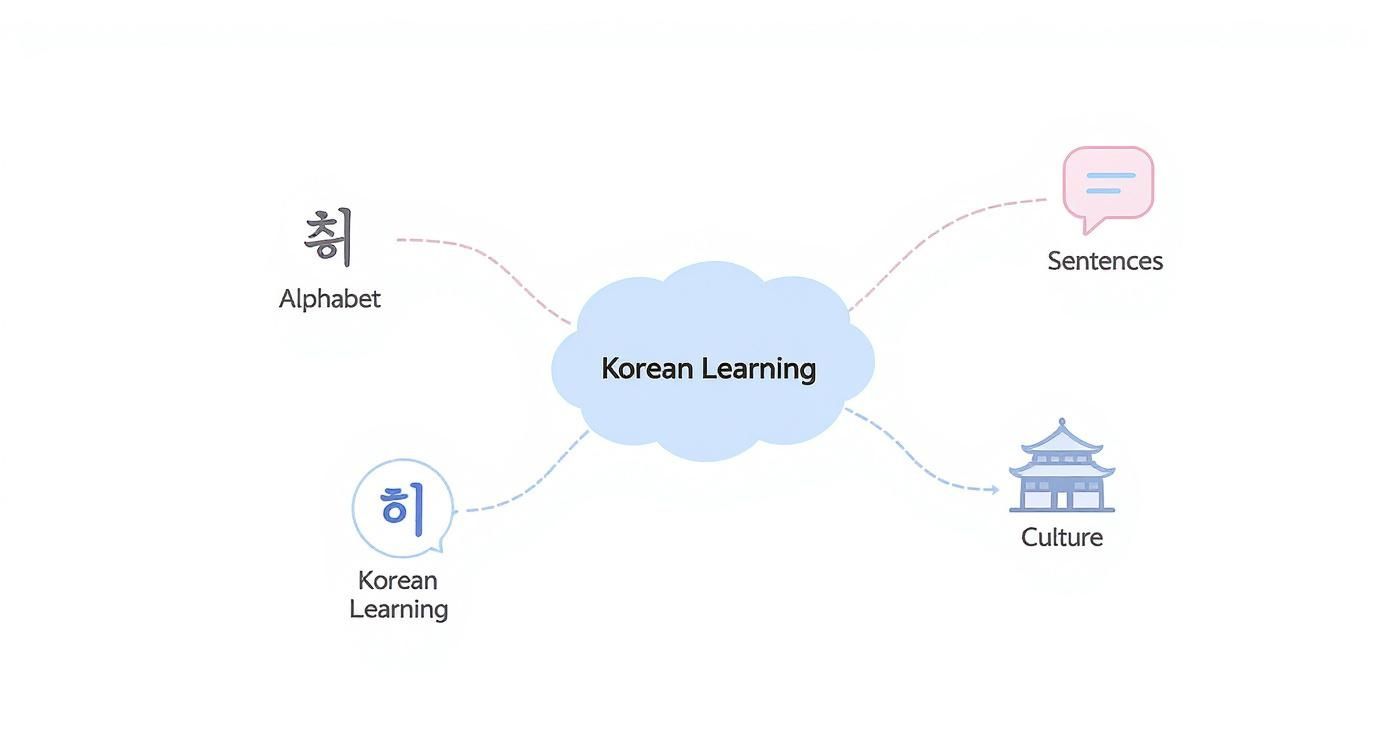
As you can see, Hangul is the foundation. Once you have that down, everything else, from building sentences to understanding cultural nuances, starts to click into place.
The Genius Design Of Hangul Consonants
Let's break down how this works in practice. The design isn't just a happy accident; it's a built-in pronunciation guide for your mouth.
Take the basic consonant ㄱ. When you say this sound (it's like a soft 'g' in "go"), the back of your tongue rises to touch your soft palate. And what does the character ㄱ look like? It's a simple, visual representation of that very action.
Here's another one: the consonant ㄴ, which sounds like the 'n' in "nose." To make that sound, the tip of your tongue touches the ridge right behind your upper teeth. The shape of ㄴ is a picture of that tongue position. Simple, right?
King Sejong’s goal was to empower everyone with literacy. He famously said, "A wise man can acquaint himself with them before the morning is over; a stupid man can learn them in the space of ten days." This principle still holds true today.
This direct link between sound and shape is what makes Hangul so special. You're not just memorising abstract letters; you're learning the mechanics of Korean sounds, which gives you a massive head start.
Assembling Syllable Blocks Like Puzzles
Now for the really cool part. In English, we just write letters one after another in a straight line. Korean does something different. It groups Hangul letters into syllable blocks, a bit like fitting pieces into a puzzle.
Each block represents a single syllable and always has at least one consonant and one vowel. You read the letters in the block from left to right, then top to bottom. It helps to think of each syllable as a small square box you need to fill.
Let's use the word 'Hangul' as our example. You combine the letters into two neat blocks:
- 한 (han): ㅎ (h) + ㅏ (a) + ㄴ (n)
- 글 (geul): ㄱ (g) + ㅡ (eu) + ㄹ (l)
The letters fit together perfectly, giving written Korean its clean, organised look. Once you get the hang of it, reading becomes a really satisfying, rhythmic process.
Your First Hangul Chart: Vowels And Consonants
To get you started, here’s a chart with the basic vowels and consonants you’ll need. These are the fundamental building blocks for pretty much everything you'll read and write in Korean. Don't feel pressured to memorise them all at once. Just focus on getting familiar with the shapes and their sounds.
Basic Hangul Vowels And Consonants
| Hangul Character | Romanization | Approximate Sound | Example Word |
|---|---|---|---|
| ㅏ | a | 'a' in "father" | 아 (ah) |
| ㅣ | i | 'ee' in "see" | 이 (ee) - means "tooth" |
| ㅗ | o | 'o' in "go" | 오 (oh) - means "five" |
| ㅜ | u | 'oo' in "moon" | 우유 (uyu) - means "milk" |
| ㄱ | g/k | 'g' in "go" or 'k' in "kite" | 가구 (gagu) - means "furniture" |
| ㄴ | n | 'n' in "nose" | 나 (na) - means "I/me" |
| ㅁ | m | 'm' in "mom" | 엄마 (eomma) - means "mom" |
| ㅇ | ng/- | Silent at start, 'ng' in "sing" at end | 이 (ee) / 공 (gong) |
This is just a small sample to get you started on the right foot. Once you start recognising these characters, you've already taken the single biggest step on your journey.
Practice writing them out and saying them aloud. Before you know it, you'll be decoding signs, K-pop lyrics, and your favourite K-drama titles with confidence. Your adventure in learning the Korean language for beginners has officially begun.
How to Sound Natural When Speaking Korean
You've got the Hangul alphabet down, which is a massive win. Now comes the fun part: making your Korean sound less like you're reading from a textbook and more like you actually speak the language. Don't worry if you make mistakes — even Koreans do sometimes! What matters most is progress.
This isn't about chasing a "perfect" accent. It's about getting a feel for a few core pronunciation rules that make Korean flow so beautifully. They might seem a bit odd at first, but once they click, they'll completely change how you speak and hear Korean.
The Magic of Batchim (Final Consonants)
First up, let's talk about Batchim (받침). It sounds technical, but it’s a simple idea: Batchim is just the final consonant that sits at the bottom of a syllable block. In the word 한 (han), for instance, the ㄴ (n) is the Batchim.
Simple enough, right? But here's where the magic comes in. A Batchim's sound can completely change depending on what comes after it. It’s like a chameleon, shifting its sound to blend in with the next syllable.
Let's take the word for "kitchen," which is 부엌 (bueok). That final ㅋ (k) is a sharp 'k' sound. But what happens when you want to say "in the kitchen"? You add the particle -에 (e).
Now you have 부엌에 (bueoke).
Did you see what happened? The ㅋ (k) sound doesn't stay put. It hops over to the next syllable, so you pronounce the whole thing as [부어케 / bu-eo-ke]. The hard stop at the end of "bueok" is gone. This linking rule is exactly what makes spoken Korean sound so smooth and connected.
For English speakers, this can feel a little weird. We tend to pronounce our words as separate, distinct units. But in Korean, syllables often flow into each other like water. Understanding Batchim is your key to navigating that stream.
Making Sense of Sound Changes
Another fascinating part of Korean pronunciation is something called sound assimilation. This is just a fancy way of saying that sounds influence each other. When two different sounds meet, one might change to become more like its neighbour, making it easier to say. It happens in English all the time—think about how "handbag" naturally slides into sounding like "hambag."
Korean has a handful of these assimilation rules that are incredibly common. One of the first you'll encounter involves the consonants ㄱ (g/k) and ㄴ (n).
When a syllable ending in a ㄱ (g/k) sound is followed by one starting with ㄴ (n) or ㅁ (m), that ㄱ (g/k) sound often morphs into an ㅇ (ng) sound.
- Take the word for "last year": 작년 (jak-nyeon).
- Broken down, you have 'jak' and 'nyeon'.
- But when you say them together naturally, the ㄱ changes to sound like ㅇ. The actual pronunciation is [장년 / jang-nyeon].
This little tweak makes the transition between the two sounds much smoother for your mouth. Don't worry about memorising a giant list of rules right now. Just start listening for these changes. You'll hear them constantly in K-dramas, songs, and conversations.
The Three "Levels" of Consonant Sounds
This is often one of the trickiest hurdles for beginners: telling the difference between Korean consonants that sound almost identical to our ears. Korean has sets of related consonants that exist on three "levels" of intensity: a normal sound, a breathy sound, and a tense sound.
Let's look at the 'g/k' family to see how this works:
- ㄱ (g/k) - The Normal Sound: This is your baseline. It's a relaxed sound, kind of like the 'g' in "go" but softer, without any real force behind it.
- ㅋ (k) - The Aspirated (Breathy) Sound: This one is all about the air. Hold a piece of paper in front of your mouth—it should flutter when you say ㅋ. It's a strong, airy 'k' sound, like the 'k' in "kite."
- ㄲ (kk) - The Tense Sound: For this one, you create tension in the back of your throat. There's no puff of air at all. It’s a sharp, clipped sound, almost like the 'sk' sound in "sky."
Getting these subtle differences down takes time and a lot of listening. But it’s what will make your Korean clear and easy for native speakers to understand. Start by just trying to hear the difference, then mimic what you hear. Your ear will eventually tune in, and your mouth will follow.
Building Your First Korean Sentences
Alright, you've tackled Hangul. What’s next? Now for the fun part: actually building your first sentences. The word "grammar" can make anyone's palms sweat, but I promise the logic behind Korean sentences is surprisingly simple once you get the hang of a few core ideas.
Think of it like learning the rules to a new card game. Once you know the basic moves, you can start piecing together your own strategies. The single most important rule to get under your belt is Korean sentence order.
The Subject-Object-Verb Rule
For most English speakers, this is the biggest mental flip. We use a Subject-Verb-Object (SVO) structure, but Korean uses Subject-Object-Verb (SOV).
Let's look at a super simple example to see the difference:
- English (SVO): I (Subject) eat (Verb) kimchi (Object).
- Korean (SOV): I (Subject) kimchi (Object) eat (Verb).
In Korean, the verb almost always lands at the very end of the sentence. It feels strange at first, I know. But try to think of the verb as the final punchline that ties the whole thought together. With a bit of practice, it starts to feel completely normal.
Here’s what that looks like in actual Korean:
저는 (I) + 김치를 (kimchi) + 먹어요 (eat).
Jeoneun gimchireul meogeoyo.
All you're really doing is rearranging the same blocks of meaning into a new pattern.
Understanding Korean Particles
You might be wondering, "If the verb is at the end, how does anyone know what's what?" The answer is one of the most clever features of the language: particles (조사). These are little markers that attach directly to the end of nouns, and they are your best friends in Korean.
Particles act like little labels that tell you the exact role of each word. They clarify who is doing what to whom.
For starters, you only need to focus on these two fundamental sets:
- Subject Particles (-이/가, -i/ga): These flag the subject—the person or thing doing the action. You use -이 (i) after a word ending in a consonant and -가 (ga) after a vowel.
- Object Particles (-을/를, -eul/reul): These flag the object—the thing receiving the action. You use -을 (eul) after a consonant and -를 (reul) after a vowel.
Let's build a sentence from scratch to see this in action:
- Start with the subject: 학생 (haksaeng) - "student"
- Attach the subject particle: 학생이 (haksaeng-i) - "The student..." (haksaeng ends in a consonant, so we add -이)
- Now the object: 책 (chaek) - "book"
- Attach the object particle: 책을 (chaek-eul) - "...the book..." (chaek ends in a consonant, so we add -을)
- Finish it off with the verb: 읽어요 (ilgeoyo) - "reads"
Put it all together and you get: 학생이 책을 읽어요 (haksaeng-i chaek-eul ilgeoyo), which means, "The student reads a book." The particles make everything crystal clear.
This wonderfully logical structure is a huge reason so many people are diving into Korean. In fact, the global interest is undeniable when you look at the Test of Proficiency in Korean (TOPIK). Since the test began, the number of people taking it has shot up by a factor of 140. That’s a massive jump, showing just how many learners are getting serious about mastering the language. You can read more about the growth of Korean language learners and see how you can join them.
Basic Verb Conjugation: The Polite Form
The final piece of the puzzle is the verb itself. In Korean, verbs change their endings depending on formality, not on who is doing the action (like "I go" vs. "he goes").
The most practical and common form you'll need is the polite, informal style, which ends in -아요/어요 (-ayo/eoyo). This is what you'll hear in K-dramas, in cafes, and in most everyday conversations where you want to be respectful.
Getting the hang of it is pretty straightforward. You just take the dictionary form of a verb (which always ends in -다) and apply a simple rule:
- Look at the verb stem (everything before the -다).
- If the last vowel of that stem is ㅏ (a) or ㅗ (o), you add -아요 (-ayo).
- For any other vowel, you add -어요 (-eoyo).
- There's one special one: 하다 (hada), which means "to do," always becomes 해요 (haeyo).
Let's look at a few examples:
| Dictionary Form | Stem | Last Vowel | Polite Form | English Meaning |
|---|---|---|---|---|
| 가다 (gada) | 가 (ga) | ㅏ (a) | 가요 (gayo) | To go |
| 먹다 (meokda) | 먹 (meok) | ㅓ (eo) | 먹어요 (meogeoyo) | To eat |
| 보다 (boda) | 보 (bo) | ㅗ (o) | 봐요 (bwayo) | To see/watch |
| 공부하다 (gongbuhada) | 공부하 (gongbuha) | - | 공부해요 (gongbuhaeyo) | To study |
And just like that, you have the three tools you need: SOV structure, particles, and polite verb endings. You're no longer just learning words; you're ready to start communicating.
Essential Vocabulary for Everyday Conversations
Okay, you've got a handle on how to build a basic Korean sentence. Now for the fun part: filling it with actual words. Building your vocabulary is probably the most rewarding part of learning the Korean language for beginners because every new word immediately opens up what you can say and understand.
Instead of just trying to memorise a dictionary, let's be strategic. We'll focus on high-impact words and phrases you’ll genuinely use from the get-go. This is your starter pack for navigating real-world situations in Korea.
To kick things off, here's a table of the top 20 most useful phrases you'll hear and use constantly. Getting these down will give you a massive confidence boost right away.
Top 20 Essential Korean Phrases For Beginners
This list is packed with immediately useful phrases for daily conversation. It covers everything from greetings and questions to common courtesies, helping you start speaking from day one.
| Korean Phrase (Hangul) | Romanization | English Meaning | Context/When to Use |
|---|---|---|---|
| 안녕하세요 | annyeonghaseyo | Hello | A polite, all-purpose greeting for any time of day. |
| 감사합니다 | gamsahamnida | Thank you | The standard, formal way to show gratitude. |
| 죄송합니다 | joesonghamnida | I'm sorry | The standard, formal apology for mistakes. |
| 네 | ne | Yes | The most common way to agree or say "yes." |
| 아니요 | aniyo | No | The standard way to disagree or say "no." |
| 이름이 뭐예요? | ireumi mwoyeyo? | What is your name? | A polite way to ask someone's name. |
| 제 이름은 [Name]입니다 | je ireumeun [Name]imnida | My name is [Name] | The formal way to introduce yourself. |
| 만나서 반갑습니다 | mannaseo bangapseumnida | Nice to meet you | Used when meeting someone for the first time. |
| 어디에서 왔어요? | eodieseo wasseoyo? | Where are you from? | A common question to ask foreigners. |
| 이거 뭐예요? | igeo mwoyeyo? | What is this? | Incredibly useful when shopping or pointing at things. |
| 얼마예요? | eolmayeyo? | How much is it? | Essential for shopping. |
| 화장실이 어디예요? | hwajangsiri eodiyeyo? | Where is the bathroom? | A true lifesaver when you're out and about. |
| 물 좀 주세요 | mul jom juseyo | Please give me some water | A polite way to ask for water in a restaurant. |
| 맛있어요! | masisseoyo! | It's delicious! | A great compliment to give when eating. |
| 잘 먹겠습니다 | jal meokgesseumnida | I will eat well | Said before a meal to show gratitude. |
| 잘 먹었습니다 | jal meogeosseumnida | I ate well | Said after a meal to thank the host or chef. |
| 안녕히 가세요 | annyeonghi gaseyo | Goodbye (to someone leaving) | Literally "Go in peace." |
| 안녕히 계세요 | annyeonghi gyeseyo | Goodbye (when you are leaving) | Literally "Stay in peace." |
| 괜찮아요 | gwaenchanayo | It's okay / I'm okay | A versatile phrase for reassurance. |
| 영어 할 수 있어요? | yeongeo hal su isseoyo? | Can you speak English? | A useful backup question to have. |
Mastering these phrases will do more than just help you communicate; it shows respect for the culture and will make your interactions much smoother.
Smart Ways to Make Vocabulary Stick
Just reading a list of words is a good start, but it won't get them into your long-term memory. The real trick is to actively engage with the words, not just passively review them.
Here are a few proven techniques that actually work:
Use Flashcard Apps: Seriously, get an app like Anki or Quizlet. They use something called a spaced repetition system (SRS), which is a fancy way of saying the app shows you a word right before you’re about to forget it. It feels like magic, but it's one of the most efficient ways to learn.
Create Weird Associations: Your brain loves strange connections. Don't just memorise that 물 (mul) means water. Picture a mule drinking a huge bucket of water. The sillier the mental image, the more likely you are to remember it.
Label Your World: This one is simple but so effective. Grab a pack of sticky notes and label things around your house in Hangul. Seeing 문 (mun) on your door or 의자 (uija) on your chair every single day makes learning effortless and embeds the words in a real-world context.
Practice in Context: This is the most important step. You have to actually use the words. Try forming simple sentences with a tutor on a platform like Ktalk.live. Saying "저는 물을 마셔요" (I drink water) in a real conversation will lock that phrase in your brain far better than just reading it a dozen times.
Smart Study Strategies and Trusted Resources
Alright, you've got the fundamentals down. So, what's next? This is where the real journey begins. Learning a language is all about building smart, sustainable habits that fit into your life. The goal isn't to cram for a test; it's to create a routine that feels less like a chore and more like a rewarding part of your day.
The best way to make steady progress is to work on all four core skills: listening, speaking, reading, and writing. If you only focus on one, you'll find the others lag behind. By touching on a little bit of everything each week, you create a powerful cycle where each skill reinforces the others, helping new concepts stick in your brain for good.
Creating Your Balanced Study Plan
Think about your study plan like a well-balanced diet—you need a bit of everything to thrive. A solid weekly routine could look something like this:
- Listening (2-3 hours): This is the easy part! Throw on a K-Pop playlist while you're working, or watch an episode of a K-Drama with Korean subtitles. You don't even have to be paying 100% attention; just having the sounds of the language around you helps your brain tune into its natural rhythm.
- Speaking (1-2 hours): This is where you'll see the fastest gains in confidence. Find a language exchange partner or, even better, book a session with a native tutor on a platform like Ktalk.live. Nothing beats real-time conversation for making the language truly yours.
- Reading (1-2 hours): Dive into simple webtoons or even children's books. The goal here is to see the grammar and vocabulary you've learned used in actual context. It's a great "aha!" moment when you recognise something you just studied.
- Writing & Vocabulary (1-2 hours): Flip through your flashcards and try writing a simple diary entry. Seriously, even just one sentence a day—like "Today was fun" (오늘 재미있었어요)—builds an incredibly powerful habit over time.
Easy Immersion Techniques from Home
You don’t have to book a flight to Seoul to immerse yourself in Korean. The trick is to weave the language into your daily life, creating a mini-Korea right where you are.
One of the simplest and most effective things you can do is change your phone's language to Korean. It's a bit intimidating for the first day or two, I'll admit, but you'll be shocked at how quickly you learn essential words like 설정 (seoljeong - settings) and 메시지 (mesiji - message). Another great move is to follow Korean creators or news outlets on social media. It's a fantastic way to pick up on casual, modern slang in bite-sized pieces.
Pro Tip: Next time you're watching a K-Drama, fight the urge to turn on the English subtitles. Switch to the Korean ones (자막 - jamak) instead. This forces your brain to connect the sounds you're hearing with the Hangul letters you're seeing, giving your reading and listening skills a massive boost at the same time.
Trusted Resources to Guide Your Journey
The internet is overflowing with Korean learning resources, but not all are created equal. Language exchange apps are great for casual speaking practice, but for structured learning with real feedback, you need something more. Platforms like Ktalk.live are perfect for beginners, offering small group classes with experienced tutors who can correct your pronunciation and guide your conversations in a friendly, low-pressure setting.
You're joining a massive global community. The interest in Korean has exploded, and the South Korean government has noticed. In 2020 alone, they dedicated about 23.6 billion Korean won (roughly $20.7 million USD) to support Korean language programs in over 1,800 schools across 43 countries. You can discover more insights about Korean language trends and see just how many people are on this journey with you. By picking the right tools and building a solid routine, you’re setting yourself up for an exciting and successful adventure.
Ready to Start Your Korean Journey?
We’ve covered the roadmap for learning the Korean language for beginners: mastering the Hangul alphabet, understanding core grammar, building essential vocabulary, and creating a smart study plan. Think of this guide as your first toolkit—the most important step is simply picking it up and starting to build. Every word you learn brings you one step closer to confidence. You’re not alone on this path; you are joining a massive global community of passionate learners. Keep going—your Korean journey starts now!
🌟 Ready to turn knowledge into conversation? Check out Ktalk.live. It’s a fantastic place where learners from all over the world meet up to practice, chat, and improve together.
Got Questions? We've Got Answers
So, is Korean Actually Hard for English Speakers to Learn?
This is probably the number one question we get. The truth is, it's a mixed bag, but in a good way. The grammar will definitely feel different from English—that's the biggest hurdle. But the Korean alphabet, Hangul, is an absolute game-changer. It's widely considered one of the most logical and straightforward writing systems ever created.
Seriously, most people can get the hang of reading it in just a few hours. Once you get past that initial grammar learning curve, you'll find the rest of the journey feels much smoother.
Realistically, How Long Until I Can Have a Conversation?
It really depends on the person and how much time you can put in. But if you can consistently dedicate around 3-5 hours a week to focused study, you could find yourself handling basic, everyday conversations within 3 to 6 months.
The secret ingredient? Consistent practice, especially when it comes to speaking. Getting that real-time feedback on your pronunciation and sentence structure is what makes all the difference. Using a platform like Ktalk.live can give you that crucial speaking practice and seriously fast-track your progress.
What's the Best Way to Start Learning Korean Right Now?
Don't dive into grammar just yet. The absolute best first step is to learn Hangul. Think of it as getting the keys to the car before you learn to drive.
Mastering the alphabet opens up everything else. You'll be able to read signs, menus, and webtoons, which makes learning vocabulary and grammar so much more engaging. After you’ve got Hangul down, shift your focus to understanding basic sentence structure and start picking up essential, high-frequency words and phrases.
🌟 Ready to start your Korean journey? Join Ktalk.live — where global learners connect, speak, and grow together! Visit us at https://ktalk.live to book your free trial class.
Ready to stop reading and start speaking?
Practice what you just learned with a native Korean teacher — free for 100 minutes. No card, no commitment.