Want to practice this with a native Korean teacher?
100-min free trial — no card required.
Struggling with Korean particles, verb endings, or those tricky honorifics? You’re not alone! Learning Korean is a fun and rewarding journey, but it’s easy to get stuck wondering if your sentences sound natural. A Korean grammar checker can be your secret weapon, acting as an instant proofreader to catch common slip-ups in your writing.
Think of it as a helpful friend who spots errors you might have missed, giving you the confidence to write more freely. Whether you're sending your first messages in Hangul or polishing an essay, the right tool can turn every mistake into a valuable learning opportunity. This guide will show you the best options and how to use them to master Korean grammar.
Your Personal Tutor for Flawless Korean Writing

If you've ever stared at your screen wondering whether to use 은/는 (eun/neun) or 이/가 (i/ga), you know how tricky Korean grammar can be. This is where a good Korean grammar checker feels like a lifesaver.
These tools are much more than a simple spell check. They are built to help you:
- Pinpoint and fix complex grammatical errors.
- Gain real confidence in your writing skills.
- Start writing more naturally and fluently over time.
Think of it as your personal writing coach, always on standby to help you polish every sentence. With a reliable grammar checker, you can focus on expressing yourself without worrying about small mistakes.
How a Korean Grammar Checker Actually Works
Ever wonder what’s happening behind the scenes of a Korean grammar checker? It’s not magic—it's technology! Think of it as a super-fast writing assistant that has memorized every Korean grammar rule.
These tools analyze your writing by breaking sentences down into their core parts—nouns, verbs, adjectives, and those notoriously tricky particles. Then, they compare your sentence structure against a huge database of correct patterns to see if everything lines up.
Understanding the Core Functions
At its heart, a Korean grammar checker is designed to catch the common mistakes that trip up learners. It doesn't just point out what’s wrong; it guides you toward what sounds natural and appropriate.
It’s programmed to look for specific pain points and provide instant corrections, helping you build better writing habits over time.
- Particle Correction: It flags incorrect particle usage, like mixing up the topic markers 은/는 (eun/neun) and the subject markers 이/가 (i/ga)—a classic beginner’s hurdle.
- Verb Conjugation: The software checks that your verb endings are correct for the tense (past, present, future) and the politeness level you're aiming for.
- Honorific Suggestions: It helps you navigate the complexities of formal language (존댓말, jondaetmal) and casual language (반말, banmal).
For instance, if you write "친구가 영화를 봤어요" (Chinguga yeonghwareul bwasseoyo), the tool sees that the subject particle '가' is correctly used. But if you type "친구는 영화를 봤어요" (Chinguneun yeonghwareul bwasseoyo), it recognizes that you're making 'the friend' the topic. It’s these subtle distinctions that make all the difference.
The Technology Behind the Suggestions
So how does it know all this? The magic is a blend of hard-coded grammar rules and smart statistical analysis. The rule-based part is straightforward: the software knows a noun ending in a consonant gets 이 (i), while one ending in a vowel gets 가 (ga).
A good Korean grammar checker does more than correct you; it teaches you. By showing you the why behind a correction, it turns a simple mistake into a lasting grammar lesson.
This technology is getting more powerful every day, driven by the global interest in learning Korean. This demand fuels tools that can now catch up to 95% of common Hangul errors. For anyone learning the language, this can seriously cut down on editing time and transform writing into a fun learning experience. You can find more insights about this growing market here.
With every suggestion, you’re not just fixing a typo—you’re reinforcing a core grammar concept, one sentence at a time.
Understanding What Grammar AI Can't Do
A Korean grammar checker can be a fantastic learning partner, but it's important to know its limits. Think of it less as a fluent native speaker and more as a smart assistant who has memorized a textbook. It knows the rules, but it often misses the feeling and cultural context that native speakers understand instinctively.
The AI can spot a typo from a mile away, but it can get stumped by the subtle social cues and unwritten rules that are a huge part of everyday communication.
The Problem with Particles and Nuance
Particles like 은/는 (eun/neun) and 이/가 (i/ga) do more than mark the subject of a sentence—they add subtle layers of emphasis and contrast that can shift the entire meaning.
Take these two perfectly correct sentences:
- 제가 학생입니다. (Jega haksaeng-imnida.) - I am a student. (This often answers the question, "Who is the student?")
- 저는 학생입니다. (Jeoneun haksaeng-imnida.) - As for me, I am a student. (This is more for introducing yourself as the topic).
A grammar checker will give both a green checkmark because, technically, they're flawless. But it has no idea what conversation you're in. Choosing the right particle is all about context, and that’s a skill that machines haven't mastered yet.
The Honorifics Dilemma
Nowhere is the AI’s lack of context more obvious than with honorifics. A grammar checker can confirm you’ve used a formal verb ending correctly, but it has no idea who you’re talking to.
Let's say you're writing an email. The tool might suggest the very formal -습니다 (-seumnida) ending. That's great for a CEO, but what about a friendly colleague who's a bit older? Maybe the polite but less stiff -아요/어요 (-ayo/eoyo) is a better fit. The AI simply can't make that call for you.
A Korean grammar checker can perfect your syntax, but it can't perfect your relationships. Knowing which honorific to use is about human intuition, not just algorithms.
Blind Spots for Slang and Real-World Korean
Language is always changing. New slang and casual expressions pop up every day from K-dramas, webtoons, and text messages. A standard Korean grammar checker often flags these as mistakes because they don't follow the formal rules it was trained on.
Words like 대박 (daebak - awesome) or 꿀잼 (kkuljaem - super fun) will likely get underlined in red, even though they're used all the time. The AI is built on a foundation of standard Korean, so it’s often a step behind the dynamic language people actually use.
At the end of the day, you're in charge. Use these tools to catch obvious mistakes, but always trust your own growing understanding of culture and context to have the final say.
The Best Korean Grammar Checkers Available Today
Now that we’ve covered what a Korean grammar checker can and can’t do, let’s look at the best tools out there. Finding the right one depends on your needs, but a few options consistently come out on top.
Two of the most trusted are the Naver Grammar Checker and the Pusan National University (PNU) Korean Spelling/Grammar Checker. For anyone serious about improving their writing, these are both excellent places to start.
Top Tools for Korean Learners
What makes these two so good? They’re powerful platforms developed by Korean institutions that have a deep, native understanding of the language.
Naver Grammar Checker (네이버 맞춤법 검사기): Backed by Korea's top search engine, this tool is incredibly easy to use. Just paste your text, and it quickly highlights mistakes with suggested corrections. Its clean, simple interface makes it a favorite for beginners.
Pusan National University Grammar Checker (부산대학교 맞춤법/문법 검사기): This checker comes from a top university’s research lab. It often gives more detailed feedback, explaining the logic behind its suggestions. This makes it a fantastic resource for intermediate and advanced learners who want to understand the why behind their mistakes.
The demand for these tools is growing fast. In South Korea alone, the market for grammar check software has hit a sales revenue of $30.9023 million. This shows how vital tools from Naver and PNU have become. You can learn more about the Asia Pacific grammar check software market and its growth.
They typically flag obvious errors in red and subtle issues in green, helping you prioritize what to fix. For a learner, running your text through one of these can help you catch 20-30% more errors than a standard spellcheck.
Comparing Your Options
Choosing between these tools often comes down to your personal learning style. While Naver is brilliant for its speed, PNU is celebrated for its depth.
The best Korean grammar checker is the one you actually use. Try pasting the same text into both Naver and PNU to see which feedback style clicks with you.
To help you decide, here’s a quick comparison of the top Korean grammar checkers.
Comparing Top Korean Grammar Checkers
| Feature | Naver Grammar Checker | PNU Grammar Checker | LanguageTool (Korean) |
|---|---|---|---|
| Best For | Beginners & quick checks | Intermediate/Advanced learners | General use & browser integration |
| Feedback Style | Simple, direct suggestions | Detailed, academic explanations | Clear, multi-language support |
| Ease of Use | Very high | High | High |
| Unique Strength | Speed and accessibility | In-depth grammatical analysis | Works across many websites |
While Naver and PNU are Korean-specific powerhouses, LanguageTool is a strong contender if you need something that integrates into your browser. Think about what you need most: quick fixes, deep learning, or convenience.
Building a Smarter Practice Routine
So, you've found a Korean grammar checker you like. Now what? The real magic isn't just catching mistakes—it's turning that tool into a genuine learning partner. Instead of blindly clicking "accept," build a practice routine that transforms corrections into solid knowledge.
A fantastic way to do this is with a simple, four-step workflow: Write, Check, Analyze, and Revise. This forces you to slow down and think critically about the feedback.
This flowchart can help you decide which tool—Naver, PNU, or LanguageTool—is the right starting point for you.
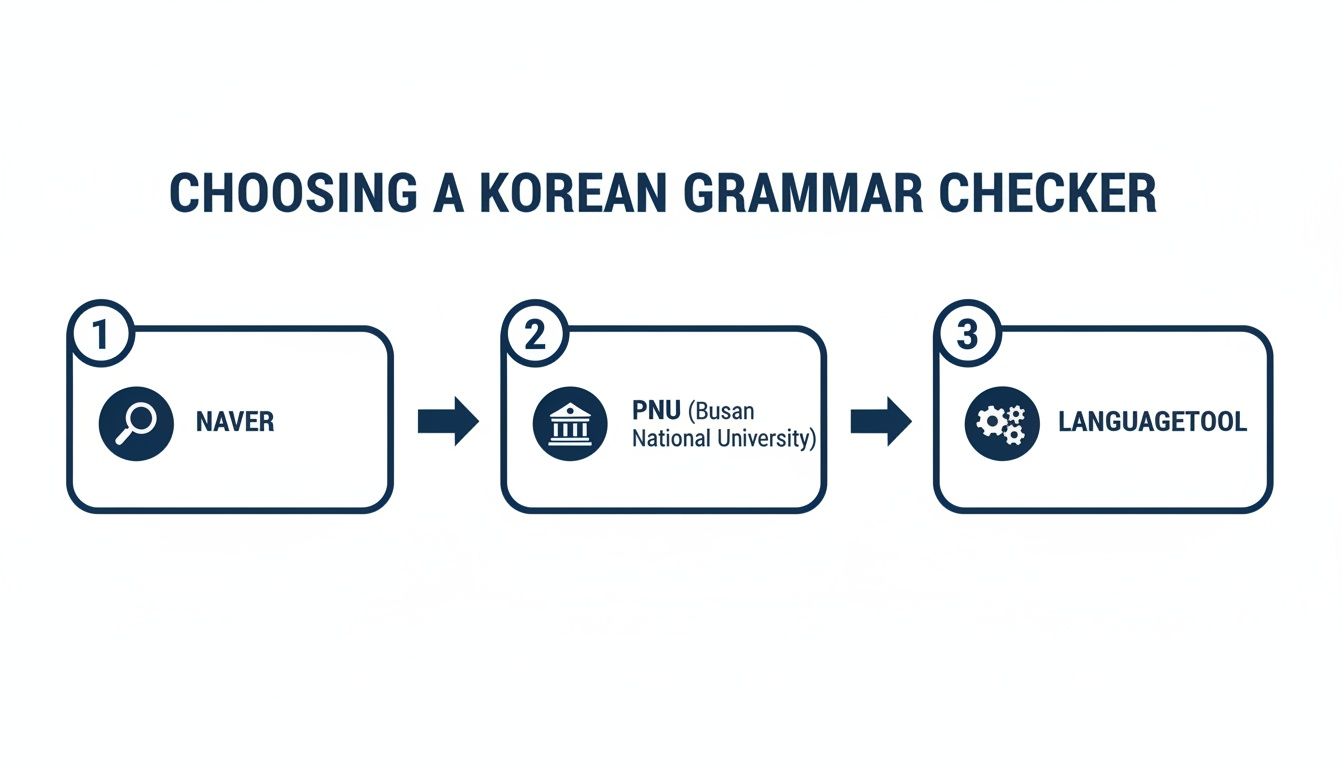
Your choice depends on your goal. Quick checks? Go with Naver. Deep analysis? PNU is your friend. This decision is the first step in building an effective routine.
The Write, Check, Analyze, Revise Method
This process turns a passive tool into an interactive study session, encouraging you to engage with your errors instead of just erasing them.
Write: First, just write. Draft a diary entry, a comment on a YouTube video, or a few practice sentences. Don't stress about making it perfect.
Check: Now, copy and paste your text into your chosen grammar checker. Run the tool, but don't immediately accept the suggestions.
Analyze: This is where the real learning happens. For each error, ask yourself: Why is my version wrong? Did I mess up a particle? Use the wrong verb ending? Dig into the grammar rule behind the correction.
Revise: Manually type the correction into your original text. Don’t just copy-paste. Then, to really make it stick, rewrite the corrected sentence one or two more times. This helps lock the right pattern in your brain.
Let's walk through an example. Say you wrote this:
- Original: 오늘 공원에서 친구는 만났어요. (Oneul gongwoneseo chinguneun mannasseoyo.)
Your grammar checker will flag 친구는 (chinguneun) and suggest 친구를 (chingureul). Instead of just accepting it, you stop and analyze. You remember that the verb 만나다 (mannada - to meet) takes an object, so it needs the object particle 를 (reul). You then go back and revise it yourself.
When you treat every correction as a mini-lesson, you shift from simply fixing a document to actively sharpening your core grammar skills.
Practical Tips for a Killer Routine
To really get the most out of this, a few extra habits can make a world of difference.
Check in Small Chunks: Don't throw a whole essay into the checker at once. By pasting your writing paragraph by paragraph, the feedback is much more manageable.
Keep a Mistake Journal: Dedicate a notebook or a digital document to your common errors. If you see the checker constantly fixing your
이/가 (i/ga)particles, you've just identified a weak spot.Experiment with Suggestions: Sometimes a checker gives you a few different options. Play with them! Plug each one into your sentence to see how it changes the nuance. This builds your intuition for what sounds most natural.
By adopting this mindful approach, your Korean grammar checker becomes more than a proofreader—it becomes a dynamic tool that accelerates your journey to writing Korean with clarity.
Knowing When to Ask a Human for Help
A Korean grammar checker is a fantastic tool, but it has one big blind spot: it can't actually understand you. An algorithm is great at fixing your particles, but it has no idea about your tone, intent, or the subtle cultural context behind your words. This is where automated tools hit a wall and human guidance becomes essential.
An algorithm can't tell you if your message sounds too blunt to an elder or weirdly formal for a friend. These are things only a person can truly feel.
The Irreplaceable Value of Human Feedback
While a grammar checker cleans up your writing, a human tutor or language partner helps you connect on a deeper level.
- Real-World Context: A person can ask, "Who is this for?" and help you find the right words and honorifics that fit the situation.
- Cultural Nuance: A native speaker can explain why a certain phrase, even if grammatically perfect, feels awkward or impolite in Korean culture.
- Confidence and Encouragement: A tool just points out your flaws. A great tutor builds you up, celebrates your progress, and gives you the confidence to start speaking.
An algorithm can perfect your sentences. A human teacher helps you perfect your communication. Understanding that difference is the key to becoming a truly fluent speaker.
This is where a balanced learning strategy comes in. Use your grammar checker for daily practice and quick proofreads. But for the skills that truly matter, like navigating real conversations and understanding cultural subtext, nothing beats live interaction. That’s why platforms like K-talk Live exist. They offer small-group classes where experienced tutors give you the personalized feedback that AI simply can't.
Got Questions About Korean Grammar Checkers? We’ve Got Answers.
You've probably still got a few questions. That’s perfectly normal. Let's tackle some of the most common ones learners ask when using these tools.
Can I Trust These Checkers for Formal Writing?
For the most part, yes. A top tool like the Naver checker or the PNU tool is solid for standard formal writing. It’s great at spotting typical mistakes in verb endings and sentence structure.
But if you're writing something truly important, like a business proposal, think of the checker as your first pass, not the final word. You absolutely need a native speaker to review it afterwards to catch the subtle nuances in tone that algorithms miss.
Will a Grammar Checker Help Me Learn Korean Slang?
Definitely not. In fact, it will do the opposite! Grammar checkers are built on standard, formal Korean.
They'll almost always flag slang and casual expressions as errors because they break the formal rules. To learn modern slang, you need to immerse yourself in how people actually talk. That means watching K-dramas, reading webtoons, and talking with native speakers.
How Is a Grammar Checker Different from Google Translate?
This is a great question! They solve two different problems. Google Translate converts text from one language to another. Its job is translation, not grammatical perfection.
A Korean grammar checker, on the other hand, works with text you've already written in Korean. Its whole purpose is to find grammatical errors or awkward phrasing within the language. If your goal is to sharpen your own writing skills, a checker is the right tool for the job.
Every mistake is a chance to grow, and with the right tools, you’ll be writing confident, natural Korean in no time. Keep practicing, stay curious, and remember that every word you learn brings you one step closer to fluency. Your Korean journey starts now!
🌟 Ready to start your Korean journey? Join Ktalk.live — where global learners connect, speak, and grow together! Start your journey today!
Ready to stop reading and start speaking?
Practice what you just learned with a native Korean teacher — free for 100 minutes. No card, no commitment.