
Want to practice this with a native Korean teacher?
100-min free trial — no card required.
Diving into Korean might seem challenging at first, but with the right approach, it becomes a fun and rewarding journey! From K-pop to Oscar-winning films, Korean culture is everywhere, and it's no wonder so many people are drawn to the language. If you're wondering where to even begin, you're in the right place. This guide is your friendly starting block, designed to show you that learning Korean for beginners is not just possible, but an exciting adventure. We’ll break down the essentials, from the beautiful logic of the Hangul alphabet to your very first phrases, giving you a clear and simple path forward. Let's start your journey!
Mastering Hangul: The World's Most Logical Alphabet
If you've ever been intimidated by learning a new alphabet, let Hangul put your mind at ease. The Korean alphabet, known as Hangul (한글), is famous for being one of the most logical and straightforward writing systems ever created. Forget memorizing hundreds of complex characters; Hangul is more like playing with building blocks.
It was designed with a beautiful simplicity: each character visually represents the shape your mouth and tongue make when you form the sound. It's an incredibly intuitive system that just clicks for most beginners. This is the first and most crucial step, and many people find they can get the hang of it in just a couple of hours.
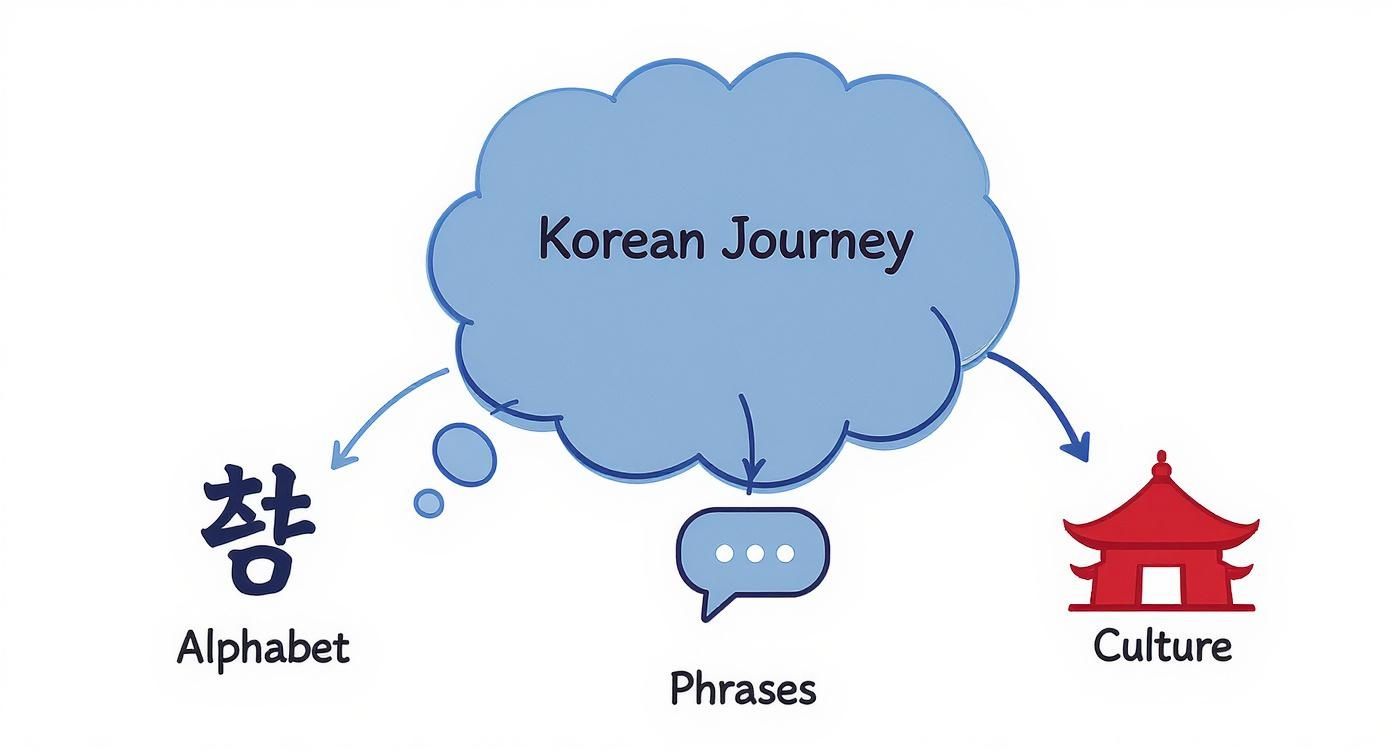
This diagram helps show how everything in your Korean learning journey—from the alphabet to key phrases and cultural understanding—is all connected.
To get you started, here's a quick cheat sheet with some basic vowels and consonants. Don't worry about memorizing it perfectly yet—just look at the shapes and see how they correspond to the sounds.
Your First Hangul Cheat Sheet
| Hangul Character (자모) | Romanization | Closest English Sound |
|---|---|---|
| ㄱ | g/k | goat / book |
| ㄴ | n | nose |
| ㄷ | d/t | door / cat |
| ㄹ | r/l | road / lamp |
| ㅁ | m | mouth |
| ㅂ | b/p | bat / top |
| ㅅ | s | sun |
| ㅇ | ng/- | sing / (silent) |
| ㅈ | j | jam |
| ㅏ | a | father |
| ㅓ | eo | son |
| ㅗ | o | go |
| ㅜ | u | boot |
| ㅡ | eu | put |
| ㅣ | i | tree |
This is just a small sample, but it’s the foundation you'll build everything else on. With this simple system, you're already on your way to reading and writing in Korean.
Your First Essential Korean Phrases
Alright, are you ready to actually start speaking? Learning your first few phrases is one of the most exciting parts of starting Korean for beginners. It’s that first real taste of the language that gives you a massive confidence boost right out of the gate.
Here are five practical phrases you can start using today. For each one, you’ll get the Hangul, an easy-to-follow pronunciation guide, and the cultural context. This way, you’ll know not just what to say, but when and how to say it properly.
- 안녕하세요 (annyeonghaseyo) - Hello
- This is your all-purpose formal greeting. Use it anytime, anywhere, with anyone you don't know well.
- 감사합니다 (gamsahamnida) - Thank you
- The most common and polite way to express thanks. Perfect for showing gratitude in any situation.
- 네 (ne) - Yes
- Simple, but essential. It can also mean "I understand" or "pardon?" depending on the context.
- 아니요 (aniyo) - No
- The polite and standard way to say no.
- 죄송합니다 (joesonghamnida) - I'm sorry
- Use this formal apology when you've made a mistake or need to get someone's attention respectfully.
Think of this as laying the practical foundation for your very first conversations. Let's get you talking.
Build Vocabulary the Smart Way
Let's be honest: memorizing endless lists of random words is a one-way ticket to burnout. A much better approach is to be strategic. Start with "Konglish," which are Korean words borrowed from English, to get an instant vocabulary boost. You'll quickly recognize words like 커피 (keopi) for coffee or 초콜릿 (chokollit) for chocolate.
Another great trick is to group new words by theme. Instead of learning words alphabetically, try learning all the words related to food, then transportation, then family. This helps your brain build a network of connections. Spaced repetition apps like Anki are also fantastic for moving vocabulary from your short-term recall into your long-term memory.
This kind of intelligent learning is part of what’s fueling a massive global interest in the language. Thanks to the Hallyu wave, the Korean language learning market has now shot past $7.2 billion. Discover more insights about this growing trend.
Understand Basic Korean Sentence Structure

Let's tackle one of the biggest hurdles for English speakers learning Korean for beginners: the sentence structure. It's going to feel a bit like you're speaking backwards at first, but trust me, there’s a simple logic to it. The biggest difference is that Korean follows a Subject-Object-Verb (SOV) pattern, while English uses Subject-Verb-Object (SVO).
This means the verb always comes at the very end of a Korean sentence. Always. It’s a foundational rule that makes constructing sentences much easier once you get the hang of it.
English vs. Korean Sentence Structure
Let's break down a simple sentence side-by-side to see it in action.
| Sentence Part | English Example (SVO) | Korean Example (SOV) |
|---|---|---|
| Subject | I | 저는 (Jeo-neun) |
| Object | an apple | 사과를 (sagwa-reul) |
| Verb | eat | 먹어요 (meogeoyo) |
So, instead of saying, "I eat an apple," the Korean structure literally translates to "I an apple eat." Once you train your brain to save the verb for last, you've conquered a massive part of Korean grammar.
Practical Ways to Start Speaking Today
All the knowledge in the world won't help you speak Korean until you actually start practicing. The real goal is to get you talking from day one. A fantastic technique is shadowing: find a K-drama or podcast with clear speakers and mimic what they say. Try to match their pronunciation, rhythm, and intonation.
Of course, nothing beats practicing with a real person. Platforms like Ktalk.live are perfect for this, offering a friendly space to try out what you've learned without any pressure. You are far from alone on this path! The number of people learning Korean has exploded, and the number of people taking the official TOPIK test is now 140 times higher than when it first started. Learn more about the global rise in Korean language learning.
Common Questions About Learning Korean
Whenever you start something new, questions are bound to pop up. Here are straightforward answers to what we get asked most often.
How long does it take to speak Korean conversationally?
This varies, but most English speakers need about 6 to 12 months of consistent effort to hold a decent conversation. What really makes the difference is how much you practice speaking from the very beginning. The more you immerse yourself, the faster you'll get there.
Is Korean harder than Japanese or Chinese?
Many learners find Korean the most beginner-friendly of the three. The biggest reason is its alphabet, Hangul, which is so logical you can learn the basics in an afternoon. Plus, Korean doesn't have the complex tones you find in Mandarin, which is a huge relief for beginners.
What are the best resources to get started?
The trick is to mix it up. Flashcard apps like Anki are fantastic for vocabulary, and watching K-dramas is a brilliant (and fun) way to tune your ear to the language. But the single most important thing is talking to people. Real conversations are the key to making everything you've learned stick.
Your Korean Journey Starts Now
You've just taken your first step into a vibrant and rewarding language. From the simplicity of Hangul to your first essential phrases, you now have the building blocks to start your Korean adventure. Remember, every word you learn brings you one step closer to confidence. Don’t worry if you make mistakes—what matters most is progress. Keep practicing, stay curious, and embrace the joy of connecting with a new culture. Your Korean journey starts now!
🌟 Ready to start your Korean journey? Join Ktalk.live — where global learners connect, speak, and grow together! Book your free trial class today!
Ready to stop reading and start speaking?
Practice what you just learned with a native Korean teacher — free for 100 minutes. No card, no commitment.