Want to practice this with a native Korean teacher?
100-min free trial — no card required.
Learning Korean might seem challenging at first — but with the right approach, it becomes a fun and rewarding journey! Have you ever found yourself humming along to a K-pop song or binge-watching a K-drama and wishing you could understand the conversation without subtitles? You're not alone. This wave of interest in Korean culture has inspired millions to start learning the language, and if you’re one of them, you're in the right place.
Starting with structured korean beginner lessons is the smartest way to build a solid foundation. This guide is your personal roadmap. We'll explore everything from mastering the Korean alphabet, Hangul, to building your first sentences and finding a learning style that fits you perfectly. Think of us as your mentor, here to guide you from your very first ‘안녕하세요’ (Annyeonghaseyo - Hello) all the way to feeling confident in a real conversation. Let's get started on this exciting adventure together!
Why Korean Beginner Lessons Are Your First Step
Let’s be honest, you’ve probably been hooked by a K-drama or found yourself singing along to a K-pop hit. That's how it starts for so many people! This massive wave of interest in Korean culture has inspired millions to dive into the language, and if you’re one of them, you’ve come to the right place. Jumping straight into a dedicated korean beginner lesson is, without a doubt, the best way to build a solid foundation for future fluency.
Think of this guide as your personal roadmap for the exciting journey ahead. We'll break down everything you need to know, from choosing a learning path that actually fits your goals to understanding what a good beginner curriculum looks like. We'll even cover how to find an instructor who clicks with your learning style.
Consider this your mentor, here to guide you from your very first ‘안녕하세요’ (Annyeonghaseyo - Hello) all the way to feeling confident in a conversation. And you're not alone in this adventure. The demand for quality Korean lessons is skyrocketing. In fact, the global market for Korean language learning is expected to grow at a staggering 25.1% compound annual growth rate between 2025 and 2034. If you're curious, you can read the full research on this explosive growth to see just how many people are joining you.
Our goal here is to demystify the whole process and get you feeling excited and ready for the rewarding challenge ahead. Let's get started.
Choosing Your Learning Path: Group vs. Private Lessons
So, you’re ready to dive into learning Korean. One of the first big decisions you’ll make is how you want to learn. Will you join a group class or opt for private, one-on-one lessons? This choice really shapes your experience with Korean beginner lessons, and there’s no single right answer—it all comes down to what works for you.
Think of group lessons as joining a friendly club. You’re all in it together, learning from each other’s questions and making new friends along the way. It’s a lively, social way to learn and often much easier on the wallet.
Private lessons are more like hiring a personal coach. The entire experience is built around you. Your instructor gives you their undivided attention, designs a plan just for your goals, and moves at a pace that feels right. This is the fast track for anyone with a specific target in mind, like acing an exam or getting ready for a trip.
The Social Buzz of Group Lessons
If you’re someone who gets energised by being around other people, group classes are a fantastic option. There’s a special kind of motivation that comes from learning in a community. You hear a classmate ask a question you were thinking about, you cheer each other on through tricky grammar points, and you build a real sense of shared progress.
This setup is also brilliant for building real-world conversation skills. You’ll be doing role-plays and group activities, getting you used to speaking Korean with different people, not just your teacher.
The trade-off? Group lessons follow a set curriculum and move at a fixed pace. If you pick things up really quickly, you might feel held back. If you need more time, you might feel rushed. Plus, the teacher's attention is naturally split, meaning you get less personal speaking time than in a private session.
- Pros: More affordable, great for making friends, you get to practise with different partners, and you learn from everyone’s questions.
- Cons: Less one-on-one attention, a fixed pace that might not be perfect for you, and less individual speaking time.
The Focused Power of Private Lessons
Private lessons offer a level of customisation that group classes just can’t touch. Got a specific goal? Maybe you’re prepping for a trip to Seoul in three months or need to learn business Korean for your job. A private tutor can build every single lesson around exactly what you need to know.
With this one-on-one format, you get your instructor's full focus. They can catch your mistakes instantly, explain concepts in a way that clicks for you, and adjust the lesson on the fly. All the speaking time is yours, which can seriously speed up your progress and boost your confidence.
Of course, this personalised attention comes at a price. Private lessons are the more expensive route, and without the social dynamic of a group, the experience can feel more intense. For some people, being the only student in the "room" can feel a little daunting at first.
The best learning environment is one that matches your personality and goals. Whether you prefer the camaraderie of a group or the dedicated focus of private tutoring, choosing the right path will make your Korean lessons more effective and enjoyable.
This simple decision tree can help you visualise which path might be better for you, starting with your interest in Korean culture and leading to your learning launch.
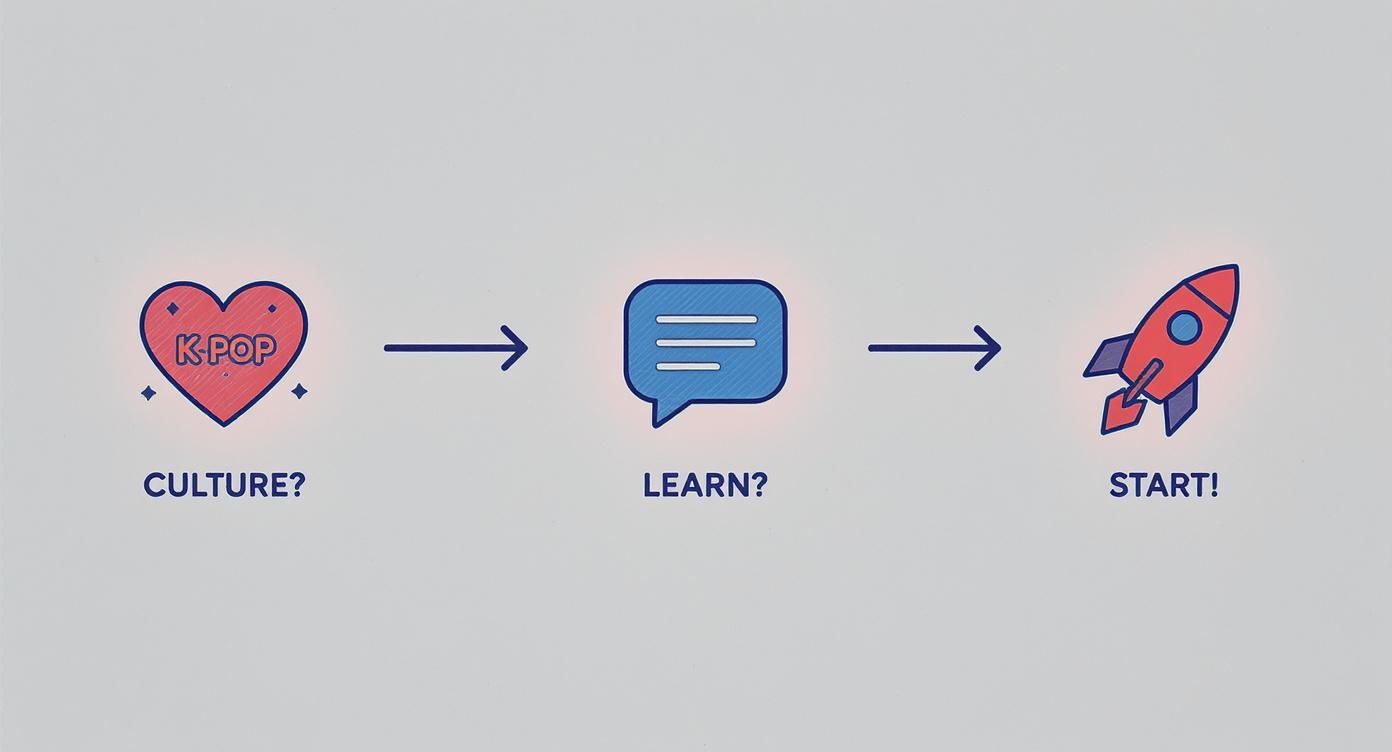
The key takeaway is that your motivation—whether it's for culture or communication—should guide your first steps toward starting your lessons.
Group vs Private Korean Lessons: A Quick Comparison
To help you decide, here’s a straightforward breakdown of how the two formats stack up against each other.
| Feature | Group Lessons | Private Lessons |
|---|---|---|
| Pace & Curriculum | Fixed pace, follows a set curriculum. | Flexible pace, curriculum is tailored to your goals. |
| Attention | Teacher's attention is shared among all students. | You receive 100% of the teacher's attention. |
| Social Aspect | Highly social, with peer interaction and friendship. | Focused on student-teacher interaction only. |
| Cost | More budget-friendly and affordable. | A premium investment for personalised learning. |
| Best For... | Social learners, beginners, and those on a budget. | Learners with specific goals or a tight deadline. |
Ultimately, the choice between group and private lessons boils down to your personal priorities. Are you looking for social interaction and affordability, or do you need speed and a perfectly customised plan? Weigh these factors against your personality and budget, and you’ll find the right fit. And remember, platforms like Ktalk.live offer both options, so you can find the perfect learning style for your journey.
What to Expect in Your First Korean Lessons
Diving into a new language can feel like stepping into the unknown. It’s natural to wonder, "What will I actually be doing in my first few Korean beginner lessons?" The good news is that a well-designed course isn't about throwing you in the deep end. It’s all about building your confidence from the ground up, starting with the most essential pieces of the language.
Forget about getting bogged down in complicated grammar right away. Your first classes will focus on giving you skills you can use immediately. You'll start by getting a handle on the Korean alphabet and then quickly move on to simple greetings and basic sentences. Think of it like learning a few basic chords on a guitar; you can start playing simple tunes long before you master a complex solo.
The whole point is to demystify Korean and show you that becoming conversational is a completely achievable goal. Let’s look at what you'll actually cover.

Your First Mission: Mastering Hangul
Your journey starts with Hangul (한글), the Korean alphabet. At first glance, it might seem a bit alien if you're only used to the Roman alphabet, but here’s a secret: Hangul is widely considered one of the most logical and brilliantly designed writing systems ever created. It was made specifically to be easy for everyone to learn.
You’ll be shocked at how quickly you can pick it up—most people get the basics down in just a few hours. Unlike languages that rely on complex characters, Hangul is made up of 24 basic letters (14 consonants and 10 vowels) that are neatly combined into syllable blocks.
It's simpler than it looks. For instance:
- The consonant ㄱ makes a 'g' sound.
- The vowel ㅏ makes an 'a' sound, like the 'a' in "father."
- Put them together, and you have 가 (ga). Easy, right?
Your first lessons will walk you through how to pronounce each letter and how to put these blocks together. This one skill is the key that unlocks everything else. Suddenly, you can start reading signs, restaurant menus, and even K-pop lyrics. It’s an incredibly empowering first step.
Building Your Foundation with Basic Grammar
Once you can read and write Hangul, the next step is learning how to piece words together into simple sentences. Korean grammar is definitely different from English, but it has a very predictable and consistent logic. One of the first major differences you'll tackle is the sentence structure.
Korean uses a Subject-Object-Verb (SOV) sentence order. In English, we say, "I eat kimchi." A Korean speaker flips it to say, "I kimchi eat" (저는 김치를 먹어요 - Jeoneun gimchireul meogeoyo).
It feels a bit backwards at first, but with a little practice, it starts to feel completely natural. You'll also be introduced to particles, which are tiny markers attached to nouns to show what role they play in the sentence (like who's doing the action or what's being acted on). Think of them as the glue holding the sentence together. Getting these fundamentals down is crucial for everything that comes next.
Essential Vocabulary for Everyday Life
Grammar rules don't mean much without the words to go with them. Your Korean beginner lessons will arm you with a core set of vocabulary that you can actually use in real-life situations. The focus is always on high-frequency words and phrases that give you the biggest bang for your buck as a new learner.
You won’t be stuck memorising lists of obscure words. Instead, you'll learn the practical stuff that helps you get by.
Here’s a little taste of what you can expect:
- Greetings and Introductions: You'll nail phrases like 안녕하세요 (Annyeonghaseyo - Hello) and 제 이름은...입니다 (Je ireumeun...imnida - My name is...) so you can introduce yourself with confidence.
- Asking Simple Questions: Learning how to ask "What is this?" (이거 뭐예요? - Igeo mwoyeyo?) or "Where is the restroom?" (화장실이 어디예요? - Hwajansiri eodiyeyo?) is a game-changer.
- Numbers, Days, and Time: These are essentials for shopping, making plans, and just navigating daily life. You’ll even learn both the Sino-Korean and Native Korean number systems.
- Food and Ordering: Soon enough, you'll be able to walk into a Korean restaurant and order with phrases like 이거 주세요 (Igeo juseyo - Please give me this).
After just a few weeks, you’ll have a toolkit of words and phrases that make you feel genuinely capable. This early curriculum is designed to give you those "aha!" moments and quick wins, building the momentum you need to stick with it. Every lesson on a platform like Ktalk.live is structured to make sure you’re making clear, steady progress right from day one.
Finding the Right Teacher for Your Journey
We’ve talked about lesson formats and what you’ll learn, but let’s get to the one thing that can make or break your entire experience: your teacher. A great teacher is so much more than a grammar expert. They’re your guide, your cheerleader, and your personal bridge to Korean culture. They’re the ones who turn the hard work of learning a language into an adventure you actually look forward to.
Think of it like finding a personal trainer. The right one knows your limits, sees your potential, and figures out exactly how to motivate you. They make you want to show up. That’s especially critical when you’re just starting out with Korean. A positive, encouraging first impression can set you up for success for years to come.

Qualities of an Amazing Korean Teacher
When you’re scrolling through potential tutors on a platform like Ktalk.live, it’s easy to feel overwhelmed by the choices. But the best teachers almost always share a few key traits that make all the difference for a beginner.
First and foremost, a great teacher has endless patience. You’re going to make mistakes. A lot of them. A good instructor knows this and creates a safe, judgment-free zone where you can try, mess up, and try again without feeling embarrassed. They won't make you feel silly for asking what seems like a basic question.
They also offer deep cultural insight. Honestly, learning Korean without understanding the culture is like trying to eat a meal with no flavour. A fantastic teacher will connect the dots for you, explaining the why behind certain phrases, sharing little stories about life in Korea, and giving you a heads-up on social etiquette. It makes the language come alive.
Finally, they have a gift for making complex ideas simple. Korean grammar can feel like a puzzle at first, but a skilled teacher knows how to break it down using clear examples and relatable analogies. They are masters at turning those moments of confusion into "aha!" moments of clarity.
Preparing for a Trial Lesson
Most online platforms, including Ktalk.live, will let you book a trial lesson. This is your chance to see if you and the teacher actually click. Don’t just show up and wing it. Treat it like a casual interview—a two-way street to see if it’s a good fit.
This is a bigger deal than you might think. Global interest in Korean is skyrocketing, with the number of people taking the official Korean language proficiency test (TOPIK) projected to hit around 550,000 by September 2025. With so many people wanting to learn, finding a truly great teacher is a massive advantage. You can discover more about the rising interest in Korean language proficiency and see for yourself why quality instruction matters.
To really nail your trial lesson, come prepared with a few questions. Your goal is to get a feel for their teaching style and how they work with total beginners.
Questions to Ask a Potential Teacher
Here are a few things you can ask to figure out if an instructor is the right person to guide you through your Korean beginner lessons:
- How do you help absolute beginners start speaking from day one? This tells you if they focus on practical, real-world communication.
- What kind of materials do you usually use? You're hoping to hear about more than just a textbook—things like interactive tools, videos, or real-life articles.
- How do you correct mistakes when a student is speaking? This helps you understand if their style is gentle and encouraging or more direct.
- Could you give me an example of how you’d explain a tricky grammar point? This is a great way to test their ability to make things simple.
- How do you bring Korean culture into your lessons? This is key if you want a rich, well-rounded learning experience.
Finding the right mentor is an investment in your success. A teacher who inspires you will keep you motivated long after the initial excitement fades, turning challenges into achievements and making every lesson something to look forward to.
Don't rush this decision. Taking the time to find a teacher who not only teaches but also inspires you is one of the best things you can do to make sure your journey with the Korean language is both successful and genuinely fun.
Squeezing Every Drop of Value from Your First Korean Lessons
So, you’ve picked your lesson format and found a teacher you click with. Fantastic! Now comes the fun part: making sure every single class moves you forward. Stepping into your first Korean beginner lessons is a huge buzz, but turning that initial excitement into a real, lasting skill takes more than just showing up. It’s all about building the right habits from day one.
Think of this as the inside scoop on how to learn smart. We'll walk through a few simple, practical things you can do to lay a rock-solid foundation and see progress faster than you thought possible. These are the little secrets that separate the learners who really take off from those who just tread water.
Set Tiny, Winnable Goals
Staring up at the giant mountain called "fluency" can be paralysing. Forget the finish line for now. Instead, break the journey down into tiny, achievable steps. Your first goal shouldn't be some vague "master Korean" idea; it should be something you can actually tick off a list, like, "This week, I will learn to read and write Hangul."
This approach gives you a series of small wins that build confidence and keep you motivated. Once you've got Hangul down, your next goal might be learning how to introduce yourself without fumbling for words.
Here’s what these small goals can look like in practice:
- Week 1: Nail all 24 basic Hangul letters. Be able to sound out simple words like "우유" (uyu - milk).
- Week 2: Memorise 10 essential words and actually use them in a basic sentence.
- Week 3: Get comfortable counting from 1 to 10 using both the native Korean and Sino-Korean number systems.
- Week 4: Be able to ask "What is this?" (이거 뭐예요? - Igeo mwoyeyo?) and understand a simple answer.
Celebrating these little victories makes learning feel less like a chore and more like a game you're winning. It's proof you're getting somewhere, and that's incredibly powerful for keeping your spirits high.
Learn to Love Your Mistakes
Let's just get this out of the way: you are going to make a ton of mistakes. You’ll butcher pronunciation, tangle up grammar, and forget words you just learned. This isn’t a sign you're failing. It’s a sign you’re in the ring, trying, and that’s the only way to learn anything. Don’t worry if you make mistakes — even Koreans do sometimes! What matters most is progress.
Every mistake is just a lesson in disguise. Don't run from them—run towards them. The more mistakes you make and correct, the faster you get it right.
Think of every error as a guidepost. When your teacher gently corrects your pronunciation of "의" (ui), don't shrink in your seat. That’s a gift! You just learned something crucial that you won't forget. A good learning environment, like the supportive small-group classes at Ktalk.live, is built for this. It’s a safe space to be imperfect, experiment, and grow without any judgment. The goal here is progress, never perfection.
Open Your Mouth and Speak. Every. Single. Day.
If there’s one secret to getting good at Korean fast, this is it. You can't just be a sponge, passively soaking up information from your teacher. You have to actively use the language, which means speaking—even when it feels clunky and you’re sure you sound ridiculous.
Make a promise to yourself to speak Korean for at least a few minutes every day. It doesn't need to be a deep conversation. Just read your notes out loud. Narrate what you're doing as you make coffee: "I am drinking water" (나는 물을 마셔요 - Naneun mureul masyeoyo).
This daily habit builds muscle memory in your mouth, lips, and tongue, making the sounds feel more natural over time. The more you speak, the more your brain accepts it as normal, and your confidence will follow.
Use Fun Stuff to Review
Review is just as important as learning new things, but nobody said it has to feel like homework. The best way to make grammar and vocabulary stick is to connect it to the Korean culture you're already passionate about.
- Listen to K-Pop: Pick a song you love and hunt for the words you know. Pull up the lyrics and see how much you can decipher.
- Read Webtoons: Find a simple webtoon aimed at kids or beginners. The combination of basic language and pictures is a fantastic, low-pressure way to review.
- Watch K-Dramas with Korean Subtitles: This might sound intimidating, but just try to catch the simple stuff. Hearing an actor say "안녕하세요" (Annyeonghaseyo) or "감사합니다" (Gamsahamnida) and seeing the Hangul on screen reinforces what you’ve learned in a real-world context.
This drive to connect with the culture is fuelling a massive trend in education. As of April 2025, the number of international students in South Korean universities shot past 250,000 for the first time, and many start right where you are—in beginner language classes. The government's “Study Korea 300K” initiative is even pushing to hit 300,000 students by 2027, which just shows how many people are eager to learn. You can read about the surge in international students in Korea to see the bigger picture. By adopting these active learning habits, you’re on the exact same path as thousands of other successful learners.
Conclusion: Your Korean Journey Starts Now
You've got the roadmap, a clear sense of what to look for, and a solid plan to start your Korean learning journey. From mastering the simple genius of Hangul to building your first sentences and finding the right teacher, you now know the key steps to take. Remember, the goal isn't perfection; it's progress. Every new word you learn brings you one step closer to confidence.
The most important step is the one you take right now. Dive in, have fun, and embrace the process of learning. Your adventure into the beautiful Korean language and culture begins with a single "hello." Keep going — your Korean journey starts now!
🌟 Ready to start your Korean journey? Join Ktalk.live — where global learners connect, speak, and grow together!
🌟 Ready to stop wondering and start learning? Join K-talk Live—where global learners connect, speak, and grow together in fun, small-group classes. Book your free trial lesson today!
Ready to stop reading and start speaking?
Practice what you just learned with a native Korean teacher — free for 100 minutes. No card, no commitment.