
Want to practice this with a native Korean teacher?
100-min free trial — no card required.
Learning Korean might seem challenging at first, but what if I told you it could be a fun and rewarding journey? Many people see a new alphabet and think it’s impossible to learn. But the Korean basic language has a secret weapon: Hangul, one of the most logical alphabets ever created.
This guide is your first step. Whether you're hooked on K-dramas, planning a trip to Seoul, or just love learning new things, you're in the right place. We'll break down the essentials in a simple, encouraging way, so you can start speaking and reading Korean with confidence from day one. Let’s get started on this adventure together!
Starting Your Korean Language Journey
We've laid out a clear path to take you from a curious beginner to a confident speaker. Don’t worry if you feel like you're starting from zero — everyone does!
We're going to break down the absolute core of the Korean basic language, focusing on:
- The surprisingly simple logic behind the Hangul alphabet.
- The basic Subject-Object-Verb sentence structure (it's different, but you'll get the hang of it fast!).
- A handful of essential phrases you can start using from day one.
This isn't about memorizing a textbook. It's about stripping away the complexity so you can start speaking and reading Korean right away.
Meet Hangul: The World's Most Logical Alphabet
Ever thought you could learn a new alphabet and start reading it in a single afternoon? With Korean, that’s not a dream—it’s a reality, all thanks to Hangul (한글). It’s the absolute best place to start your journey into the Korean basic language.
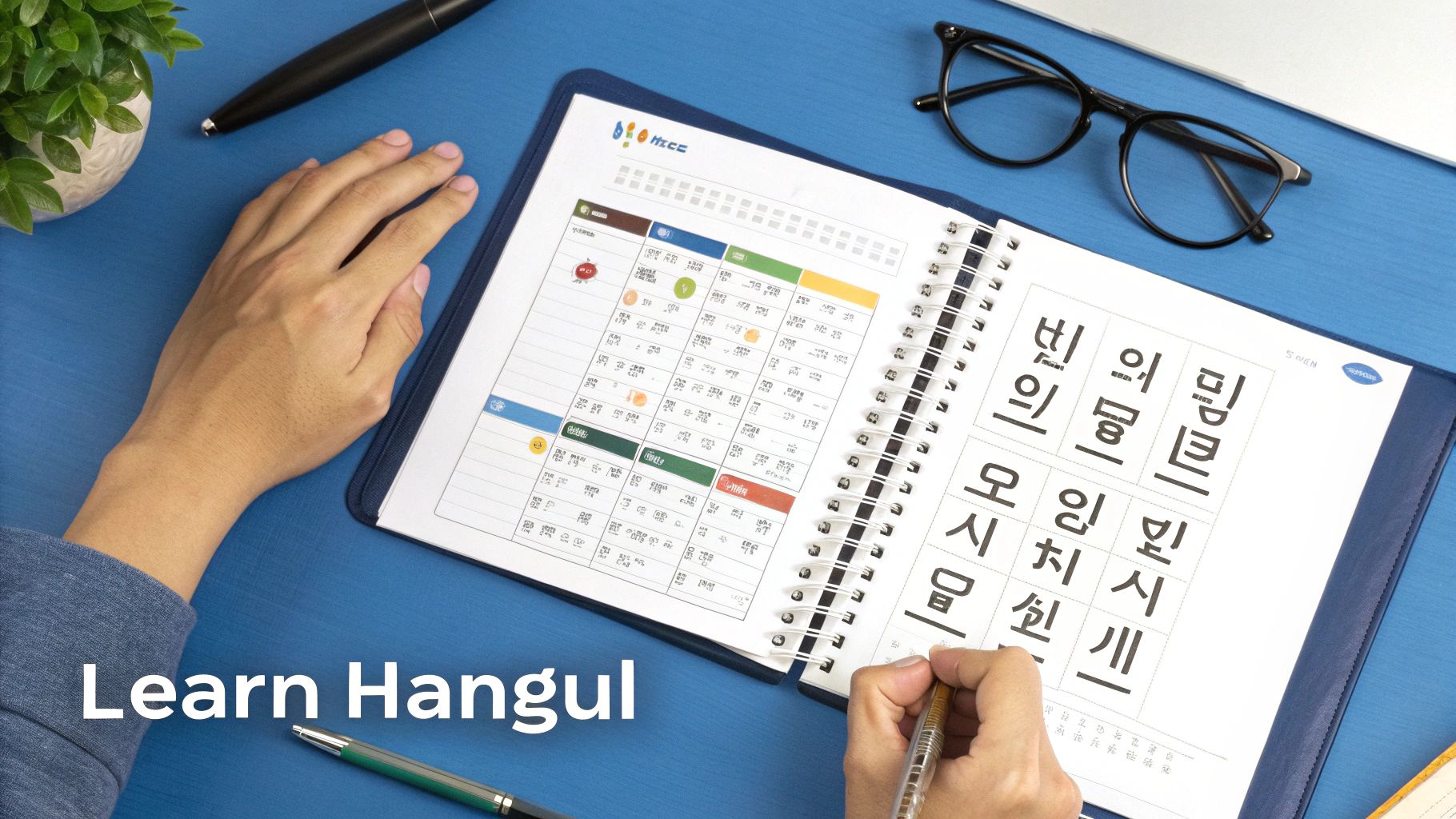
Unlike writing systems that evolved over centuries, Hangul was intentionally created in the 15th century by King Sejong the Great. His goal was simple: to make a writing system so easy that anyone, from a scholar to a farmer, could learn to read and write. The result was pure genius.
The secret to Hangul is that its letter shapes are based on the shape your mouth makes when you say them. This direct link between sound and symbol makes learning feel incredibly intuitive.
The Science Behind the Shapes
Let's break down this clever design. The entire consonant system is based on just five core shapes, each with a visual cue to help you remember the sound.
- ㄱ (g/k): Looks like the side of your tongue raising to touch the roof of your mouth.
- ㄴ (n): Mimics the tip of your tongue touching just behind your top teeth.
- ㅁ (m): This square represents a closed mouth. Go ahead, say "m." See?
- ㅅ (s): This shape looks like a tooth, a great reminder of the hissing "s" sound.
This isn't just rote memorization; it's learning a system with built-in logic. The vowels are equally brilliant, based on three simple shapes: a dot for the sky (•), a horizontal line for the flat earth (ㅡ), and a vertical line for a person standing tall (ㅣ).
The deliberate, scientific design of Hangul is why UNESCO awards the King Sejong Literacy Prize each year. It is celebrated globally as an efficient and accessible writing system.
Building Syllable Blocks
Once you’ve got the letters down, you assemble them like building blocks. Korean isn’t written in a long, continuous line. Instead, characters are grouped into neat syllable blocks.
For example, to write the word Hangul, you take the letters h (ㅎ), a (ㅏ), and n (ㄴ). You don't line them up; you combine them into a single block: 한 (han).
This structure makes reading much easier. You’re not deciphering a long string of characters; you’re seeing distinct, organized chunks of sound. It’s why new learners can often sound out their first words, like 사랑 (sa-rang, love), within their first hour of study. It’s an incredible confidence boost right at the start.
Getting to Grips with Korean Grammar (It's Easier Than You Think!)
Does the word "grammar" make you shudder? Let's fix that. Korean grammar is actually one of the most logical and consistent systems out there. Once a few key concepts fall into place, you'll start to see how sentences are built with a beautiful, predictable rhythm.

The single biggest mental shift for English speakers is the word order. In Korean, you save the most important part—the action—for the very end.
The SOV Puzzle: Subject-Object-Verb
In English, we follow a Subject-Verb-Object (SVO) pattern. Think about a simple sentence like, "I drink coffee." The action ("drink") is in the middle.
Korean flips this on its head, using a Subject-Object-Verb (SOV) structure. The verb always comes last. It’s like telling a story where the punchline is the final word.
- English (SVO): I (Subject) + drink (Verb) + coffee (Object).
- Korean (SOV): 저는 (jeo-neun, I) + 커피를 (keopi-reul, coffee) + 마셔요 (masyeoyo, drink).
If you translate that word-for-word, it’s "I coffee drink." This SOV structure is the absolute foundation of the Korean basic language. Internalize this one rule, and you’ll instantly have a better feel for how sentences flow.
Particles: The Helpful Sticky Notes of Korean
"Okay," you might be thinking, "if the verb is at the end, how do I know what's the subject and what's the object?" That's where particles come in. They are little grammatical markers that attach to the end of nouns to give them a clear job in the sentence.
Here are the first two you absolutely need to know:
- Topic Particles (-은/는, -eun/neun): These flag the main topic of the sentence—what you're talking about.
- Subject Particles (-이/가, -i/ga): These mark the subject—the "doer" of the action.
Let’s see them in action:
- 저는 학생입니다. (Jeoneun haksaeng-imnida) – I am a student. (Here, 'I' is the topic.)
- 고양이가 귀여워요. (Goyangiga gwiyeowoyo) – The cat is cute. ('The cat' is the one being cute.)
Don’t worry if you make mistakes — even Koreans do sometimes! Just recognize these particles as helpful signposts.
Politeness Levels: Speaking with Respect
Finally, one of the most fascinating parts of Korean is how respect is baked right into the grammar. The way you end your sentences changes depending on who you're talking to.
You don't need to memorize all seven levels right away. As a beginner, just focus on the standard polite form that ends in (-요, -yo). This one form is your golden key—it’s friendly, respectful, and works in nearly every daily situation. For example, the verb "to go" (가다, gada) becomes 가요 (gayo) in this form.
Your First Korean Phrases for Real Conversations
Alright, you've got a feel for Hangul and how sentences are put together. Now for the fun part: actually using the language. Learning a handful of key phrases is the quickest way to build confidence and start having real, simple interactions.
Your First 10 Essential Korean Phrases
We've pulled together the phrases you'll hear and use most often. Memorize these, and you'll have a solid foundation for navigating everyday situations.
| Korean (Hangul) | Romanization | English Meaning |
|---|---|---|
| 안녕하세요 | Annyeonghaseyo | Hello / Good day |
| 감사합니다 | Kamsahamnida | Thank you (Formal) |
| 죄송합니다 | Joesonghamnida | I'm sorry (Formal) |
| 안녕히 가세요 | Annyeonghi gaseyo | Goodbye (to someone leaving) |
| 안녕히 계세요 | Annyeonghi gyeseyo | Goodbye (when you are leaving) |
| 네 | Ne | Yes |
| 아니요 | Aniyo | No |
| 이거 얼마예요? | Igeo eolmayeyo? | How much is this? |
| ...주세요 | ...juseyo | Please give me... |
| 화장실 어디예요? | Hwajangsil eodiyeyo? | Where is the restroom? |
These 10 phrases are your starting blocks. Commit them to memory, and you'll be surprised at how much you can communicate right away.
Greetings and Goodbyes
These are the absolute first words you'll use, and they set the tone for any conversation.
안녕하세요 (Annyeonghaseyo) - Hello / Good day
This is your go-to, all-purpose greeting. It works beautifully any time of day.안녕히 가세요 (Annyeonghi gaseyo) - Goodbye (to someone leaving)
Use this when you're staying and the other person is walking away.안녕히 계세요 (Annyeonghi gyeseyo) - Goodbye (when you are leaving)
This is what you say when you're the one heading out the door.
Essential Courtesies and Requests
Politeness is a huge part of Korean culture. Using these phrases will go a long way. The magic word you need to know is 주세요 (juseyo), which means "please give me." You can tack this onto the end of almost any noun to make a simple, polite request.
Cultural Insight: The phrase 'juseyo' is incredibly powerful. You can just point at a coffee on a menu and say "커피 주세요" (keopi juseyo), and voilà! You’ve just successfully ordered your first drink in Korean.
A Practical 4-Week Korean Study Plan
Motivation is fantastic, but a solid plan turns that energy into real progress. Here’s a practical four-week roadmap designed to build a strong foundation in Korean basic language. Think of this as a way to make steady, noticeable gains each week.
Week 1: Laying the Foundation
Your first week is all about mastering Hangul. The goal is to see a Korean word and just read it, without needing to translate from Romanization first.
- Goal: Read and write all basic Hangul letters with confidence.
- Activity: Use a flashcard app like Anki or Quizlet. Spend 15 minutes a day drilling characters and another 15 minutes writing them out.
- Phrase Focus: Learn your first five essential greetings, like 안녕하세요 (annyeonghaseyo) and 감사합니다 (kamsahamnida).
Week 2: Building Your First Sentences
Now it's time to understand how Korean sentences click together. This week, focus on the fundamental Subject-Object-Verb (SOV) structure.
- Goal: Grasp the SOV word order and learn the basic topic/subject particles, -은/는 (eun/neun) and -이/가 (i/ga).
- Activity: Try writing five simple sentences about yourself, like "I am a student" (저는 학생입니다 / Jeoneun haksaeng-imnida).
- Phrase Focus: Practice your self-introduction: "My name is [Your Name]" (제 이름은 [Your Name]입니다 / Je ireum-eun [Your Name]-imnida).
Week 3: Expanding Your World
With the basic sentence structure under your belt, you can start adding some color to your language by building a core vocabulary.
- Goal: Memorize 20-30 new words. Focus on high-frequency topics like food, numbers (1-10), and common places.
- Activity: Watch a short K-drama clip and listen for words you know. The goal isn't to understand everything, but to train your ear.
- Grammar Focus: Get comfortable with the standard polite verb ending, -요 (-yo).
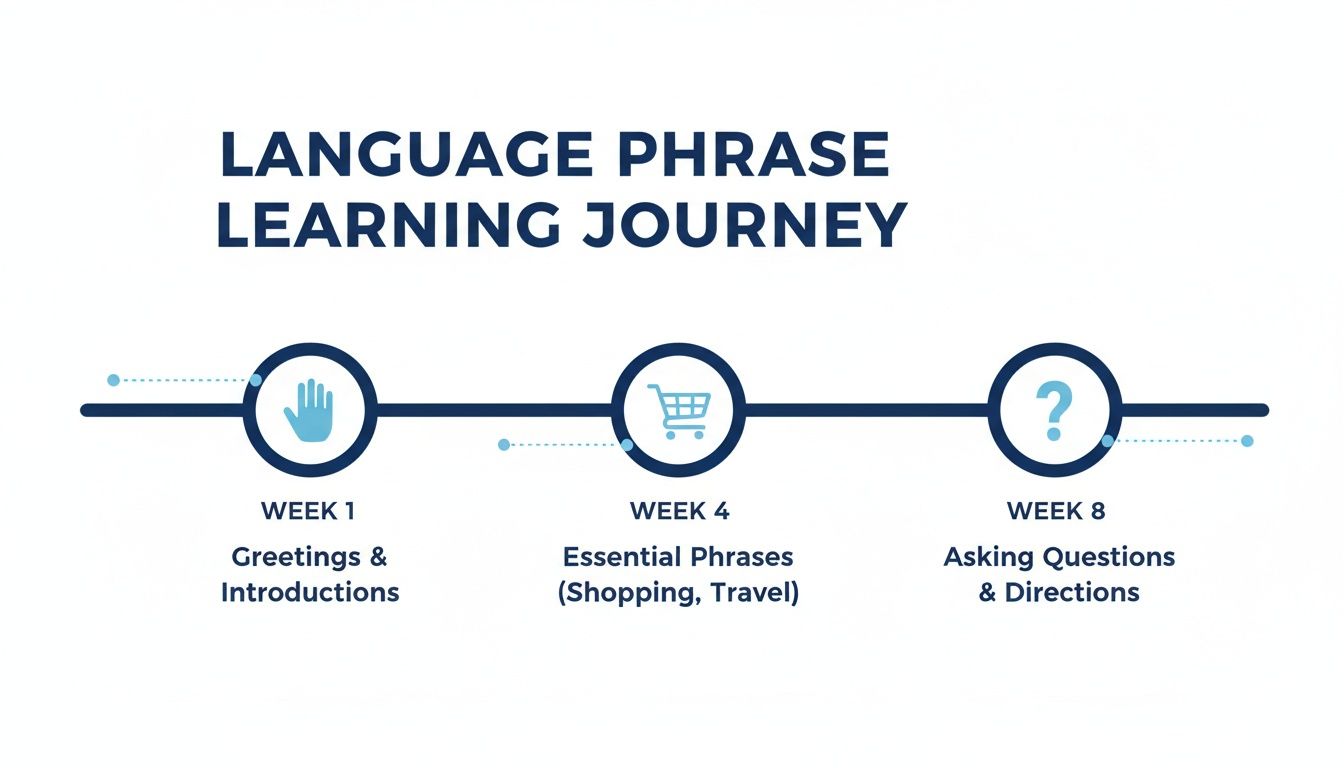
Week 4: Putting It All Together
In your final week, it's time to activate everything you've been learning. The goal is to start forming simple questions and answers.
- Goal: Learn how to form basic questions using words like "what" (뭐 / mwo) and "where" (어디 / eodi).
- Activity: Practice asking and answering simple questions, like "What is this?" (이거 뭐예요? / Igeo mwoyeyo?).
This steady approach works. Interest in Korean has exploded, with a record number of people taking the proficiency test. You can read more about the rising interest in Korean at The Korea Times. This plan puts you on the same path to success.
Common Mistakes Beginners Make (And How to Avoid Them)
Everyone makes mistakes when learning a new language. But knowing the common pitfalls can save you time and help you build a stronger foundation in the Korean basic language.
One of the biggest traps for beginners is leaning too hard on Romanization. It feels like a helpful shortcut, but it quickly becomes a crutch that holds back your pronunciation. The truth is, Romanized spellings can't capture the subtle sounds of real Korean.
Here's the best way to think about it: treat Romanization like training wheels on a bike. Use them for a day or two, but then make a real commitment to thinking in Hangul. This one habit will speed up your learning like nothing else.
Another hurdle is translating sentences word-for-word from English. This doesn't work because Korean sentence structure is completely different. Instead of "I go to the store," you need to think "I the store to go." Try to get comfortable with the core pattern: Subject + Object + Verb.
Finally, the biggest hurdle of all is the fear of speaking. But progress only starts when you try. Every mistake is a lesson. The key is to find a safe and supportive place to practice, which is why structured classes like those at Ktalk.live can make such a huge difference.
Conclusion
We've covered the genius of Hangul, the basics of grammar, and essential phrases to get you started. This guide has given you the map. Now it’s time to take the first step. The real magic happens when you move from knowing about Korean to actually using it in real conversations.
Fluency is forged in practice. The global market for Korean language learning is set to soar past USD 2.6 billion, showing just how rewarding this skill is. You can read more about this boom at gminsights.com. Joining a platform like Ktalk.live can bridge the gap between theory and confident speaking.
Every word you learn brings you one step closer to confidence. Keep going—your Korean journey starts now!
🌟 Ready to start your Korean journey? Join Ktalk.live — where global learners connect, speak, and grow together! Book your free trial class today!
Ready to stop reading and start speaking?
Practice what you just learned with a native Korean teacher — free for 100 minutes. No card, no commitment.