
Want to practice this with a native Korean teacher?
100-min free trial — no card required.
Learning Korean might seem challenging at first — but with the right approach, it becomes a fun and rewarding journey! Dreaming of ordering coffee in Seoul or understanding your favorite K-drama without subtitles? Your adventure starts with a solid foundation. Mastering a few essential Korea basic words is the most effective first step, empowering you to navigate initial conversations and show respect. Think of these words as your keys to unlocking a new way to connect with a vibrant culture. Every word you learn brings you one step closer to confidence. Let’s begin this journey together!
This guide is designed to give you the most crucial words you'll need from day one. We’ll go beyond simple definitions to explore the context: when to use a formal phrase versus an informal one, and how pronunciation shapes meaning. Forget about perfection for now. The goal is progress! This list is your practical, actionable starting line for learning some essential Korea basic words. Let’s dive in!
1. 안녕하세요 (Annyeonghaseyo) — Hello
This is arguably the most essential of all Korea basic words and your key to unlocking polite conversation. 안녕하세요 (Annyeonghaseyo) is the formal, all-purpose greeting for "Hello." It's a respectful and safe choice for nearly every situation, from greeting a shopkeeper to meeting a new acquaintance. The phrase literally combines ‘안녕’ (annyeong), meaning "peace," with a formal verb ending, effectively asking, "Are you at peace?"
Its versatility makes it the first phrase every learner should master. Whether you are entering a restaurant or meeting someone for the first time, this single phrase signals respect and a willingness to engage politely.

Practical Tips You Can Apply
- When to Use: Use 안녕하세요 (Annyeonghaseyo) whenever you need to be polite, which is most of the time as a beginner. It's perfect for addressing elders, strangers, colleagues, and service staff.
- Pronunciation: Break it down into five syllables: ahn-nyong-hah-say-yo. Try to say each part clearly.
- Pro Tip: For maximum respect, pair your greeting with a slight bow. A small nod of the head is standard for everyday interactions.
2. 감사합니다 (Gamsahamnida) — Thank You
After greetings, expressing gratitude is one of the most important social interactions. 감사합니다 (Gamsahamnida) is the primary way to say a formal "Thank you." This is a crucial phrase to learn, as Korean culture places a high value on politeness. The phrase is derived from ‘감사’ (gamsa), meaning "gratitude," combined with a formal verb ending.
Using this phrase demonstrates cultural awareness and respect. Whether a shop assistant helps you find an item or a stranger gives you directions, a sincere 감사합니다 (Gamsahamnida) is the perfect response.
Practical Tips You Can Apply
- When to Use: Use 감사합니다 (Gamsahamnida) whenever you want to express formal thanks. It is appropriate for elders, strangers, and in professional settings.
- Pronunciation: Break it down: gahm-sah-hahm-nee-dah. The 'b' sound in '-합니다' often sounds more like a soft 'm' in natural speech.
- Pro Tip: Just like with greetings, accompany your thanks with a slight bow or a nod of the head to show genuine appreciation.
3. 네 (Ne) / 아니요 (Aniyo) — Yes / No
Knowing how to agree or disagree is fundamental. In Korean, 네 (Ne) is your go-to word for "Yes," and 아니요 (Aniyo) is the polite way to say "No." These are among the most frequently used Korea basic words, essential for everything from simple confirmations to daily conversations.
Mastering these simple responses is crucial because it shows you are listening and actively participating. Whether you're confirming you heard someone correctly or declining an offer, 네 (Ne) and 아니요 (Aniyo) are the polite and expected replies.

Practical Tips You Can Apply
- When to Use: Use 네 (Ne) and 아니요 (Aniyo) in almost any situation. This includes responding to questions from shopkeepers, teachers, or colleagues.
- Pronunciation: 네 (Ne) is a single, crisp syllable pronounced like "neh." 아니요 (Aniyo) is three syllables: ah-nee-yo.
- Pro Tip: Pair 네 (Ne) with a nod of your head to reinforce your agreement. In conversation, it can also mean "I see" or "I understand."
4. 미안합니다 (Mianhamnida) — I'm Sorry
Knowing how to apologize sincerely is crucial in any culture. 미안합니다 (Mianhamnida) is the formal and respectful way to say "I'm sorry." It conveys genuine regret and is appropriate for situations from minor inconveniences, like bumping into someone, to more significant mistakes.
Mastering this phrase shows cultural awareness and respect for social harmony. Using 미안합니다 (Mianhamnida) correctly demonstrates your understanding of these social norms and your willingness to maintain a positive and respectful rapport with others.
Practical Tips You Can Apply
- When to Use: Use 미안합니다 (Mianhamnida) when you need to offer a formal apology. It's the standard choice for apologizing to elders, strangers, or in any professional context.
- Pronunciation: Break it down into five syllables: mee-ahn-hahm-nee-da. The 'b' sound in '합니다' often sounds more like 'm'.
- Pro Tip: Your body language is just as important as your words. Accompany your apology with a slight bow to show genuine remorse.
5. 주세요 (Juseyo) — Please Give Me
This is a magic word for anyone traveling or living in Korea. 주세요 (Juseyo) means "Please give me..." and can be attached to the end of a noun to politely ask for something. It's incredibly versatile and one of the most useful phrases you will learn.
From ordering food to shopping for clothes, this phrase empowers you to communicate your needs clearly and politely. It’s a simple way to form a complete, respectful request.
Practical Tips You Can Apply
- When to Use: Use it anytime you need to ask for an item. It's perfect for restaurants, cafes, shops, and markets.
- Pronunciation: Pronounce it as three distinct syllables: joo-say-yo.
- Pro Tip: Simply say the noun you want, followed by 주세요 (Juseyo). For example, "물 주세요" (Mul juseyo) means "Please give me water."
6. 화장실 (Hwajangsil) — Restroom
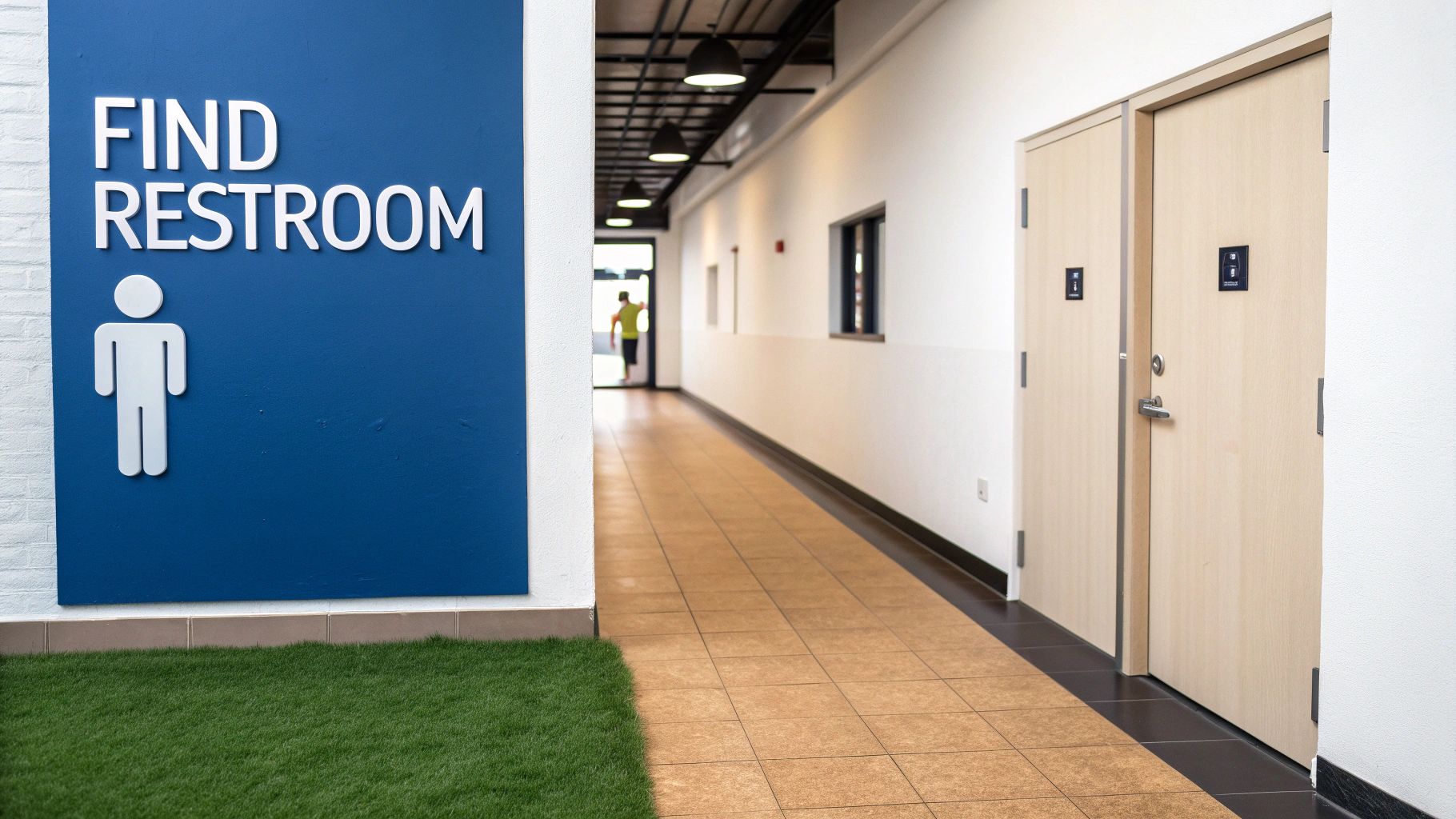
Of all the practical words you'll learn, this one is a true lifesaver. 화장실 (Hwajangsil) is the standard and polite word for "restroom" or "bathroom." Knowing how to ask for its location is absolutely essential for navigating any public space in Korea.
Memorizing "Hwajangsil" ensures you can handle a basic need with ease and politeness. It's a word that cuts through language barriers instantly because the need is universal.
Practical Tips You Can Apply
- When to Use: Use 화장실 (Hwajangsil) anytime you need to find the facilities. It's appropriate for all public and private settings.
- Pronunciation: Break it down into three syllables: hwa-jang-shil. The 'shil' sound is similar to the 'sheel' in 'sheep' but shorter.
- Pro Tip: The most critical phrase is "화장실이 어디예요?" (Hwajangsil-i eodi-yeyo?), which means "Where is the restroom?" Commit this full sentence to memory!
7. 얼마예요? (Eolmayeyo?) — How much is it?
This phrase is essential for anyone navigating daily life in Korea. 얼마예요? (Eolmayeyo?) directly translates to "How much is it?" and is your key phrase for shopping, dining, and any transaction involving money.
Mastering this phrase is crucial for managing your budget and interacting confidently in commercial settings. Asking 얼마예요? (Eolmayeyo?) shows you are an engaged customer and leads to smoother interactions.
Practical Tips You Can Apply
- When to Use: Use 얼마예요? (Eolmayeyo?) anytime you need to ask for the price of an item or service.
- Pronunciation: Break it down clearly into four syllables: eol-mah-yay-yo.
- Pro Tip: To be more specific, point to the item you are interested in and then ask. For example, pointing at a shirt, you can say, "이거 얼마예요?" (Igeo eolmayeyo?), meaning "How much is this?"
8. 반갑습니다 (Bangapseumnida) — Nice to meet you
While 안녕하세요 (Annyeonghaseyo) is your go-to "Hello," 반갑습니다 (Bangapseumnida) is the essential follow-up for first-time meetings. This formal phrase means "Nice to meet you" and adds a layer of warmth and sincerity.
Using this phrase demonstrates that you understand the cultural importance of a proper introduction, setting a respectful and friendly tone from the very beginning. It's perfect for making a great first impression.
Practical Tips You Can Apply
- When to Use: Use 반갑습니다 (Bangapseumnida) immediately after greeting someone for the first time, especially in formal or business settings.
- Pronunciation: Break it down into four syllables: ban-gap-seum-ni-da. Practice saying it smoothly to convey confidence.
- Pro Tip: In business contexts, it's common to say this while performing a handshake and a slight bow.
Your Journey Starts Now
Congratulations! You've just learned some of the most important Korea basic words to kickstart your language journey. These phrases are more than just vocabulary; they are the keys to unlocking meaningful interactions and showing respect for Korean culture. From a polite 안녕하세요 (Annyeonghaseyo) to a grateful 감사합니다 (Gamsahamnida), you're now equipped to handle your first conversations. Every word you learn brings you one step closer to confidence. Keep going—your Korean journey starts now!
🌟 Ready to start your Korean journey? Join Ktalk.live — where global learners connect, speak, and grow together! You can even book your free 100-minute trial class today.
Ready to stop reading and start speaking?
Practice what you just learned with a native Korean teacher — free for 100 minutes. No card, no commitment.