
Want to practice this with a native Korean teacher?
100-min free trial — no card required.
So, you're asking the big question: is it difficult to learn Korean? The short answer is, it's a mix of surprising wins and genuine challenges. For native English speakers, learning Korean isn't an impossible climb; it’s more like a fascinating hike. You’ll find some wonderfully easy paths and some steep sections that require a bit more effort.
Learning Korean might seem challenging at first — but with the right approach, it becomes a fun and rewarding journey! If you've ever been hooked by a K-drama or found yourself humming a K-pop tune, you've probably wondered what it would take to understand the language. This guide will walk you through what to expect, from the easy first steps to the trickier parts, giving you a clear and realistic picture of your path ahead.
What Makes Korean Easy vs. Hard?
The journey into Korean is unique, full of pleasant surprises and a few tricky new concepts. The difficulty isn't a straight line. Some parts, like the alphabet, are refreshingly logical and can give you a fantastic confidence boost right at the start. Then you'll hit other areas, like grammar and certain sounds, that require you to rewire your brain a bit.
This infographic gives you a quick snapshot of the highs and lows you can expect.
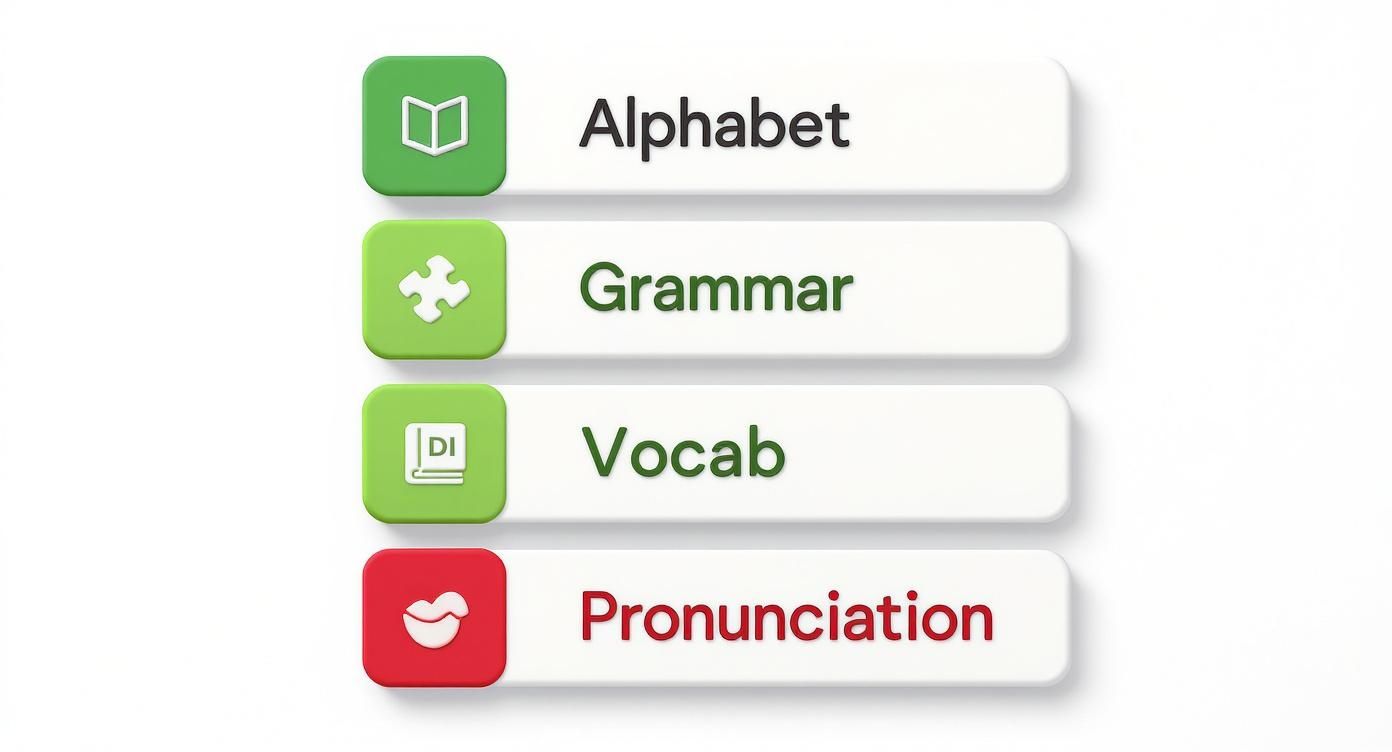
As you can see, the path starts with an easy win before introducing some new hurdles. It’s all about perspective. Don’t worry if you make mistakes — even Koreans do sometimes! What matters most is progress.
In this guide, we'll walk you through each of these parts, giving you a clear picture of what to expect and how tools like the small-group classes at K-talk Live can turn a challenge into an exciting adventure.
Korean Learning Difficulty at a Glance
For a quick reference, here’s a breakdown of what makes Korean both straightforward and challenging for English speakers.
| Aspect | Difficulty Level | Reason |
|---|---|---|
| Alphabet (Hangul) | Easy | Incredibly logical and phonetic. You can learn the basics in an afternoon. |
| Grammar | Hard | The SOV (Subject-Object-Verb) sentence structure is a big shift from English. |
| Vocabulary | Hard | Very few cognates (words that sound similar) to English. Most words need to be learned from scratch. |
| Pronunciation | Medium | Some sounds have no English equivalent, but the rules are mostly consistent. |
| Honorifics | Medium to Hard | Requires understanding social context to use polite language correctly. |
This table should help you anticipate where you'll fly and where you might need to slow down and put in a bit more work.
Learn Hangul — The First Step and Your Biggest Win
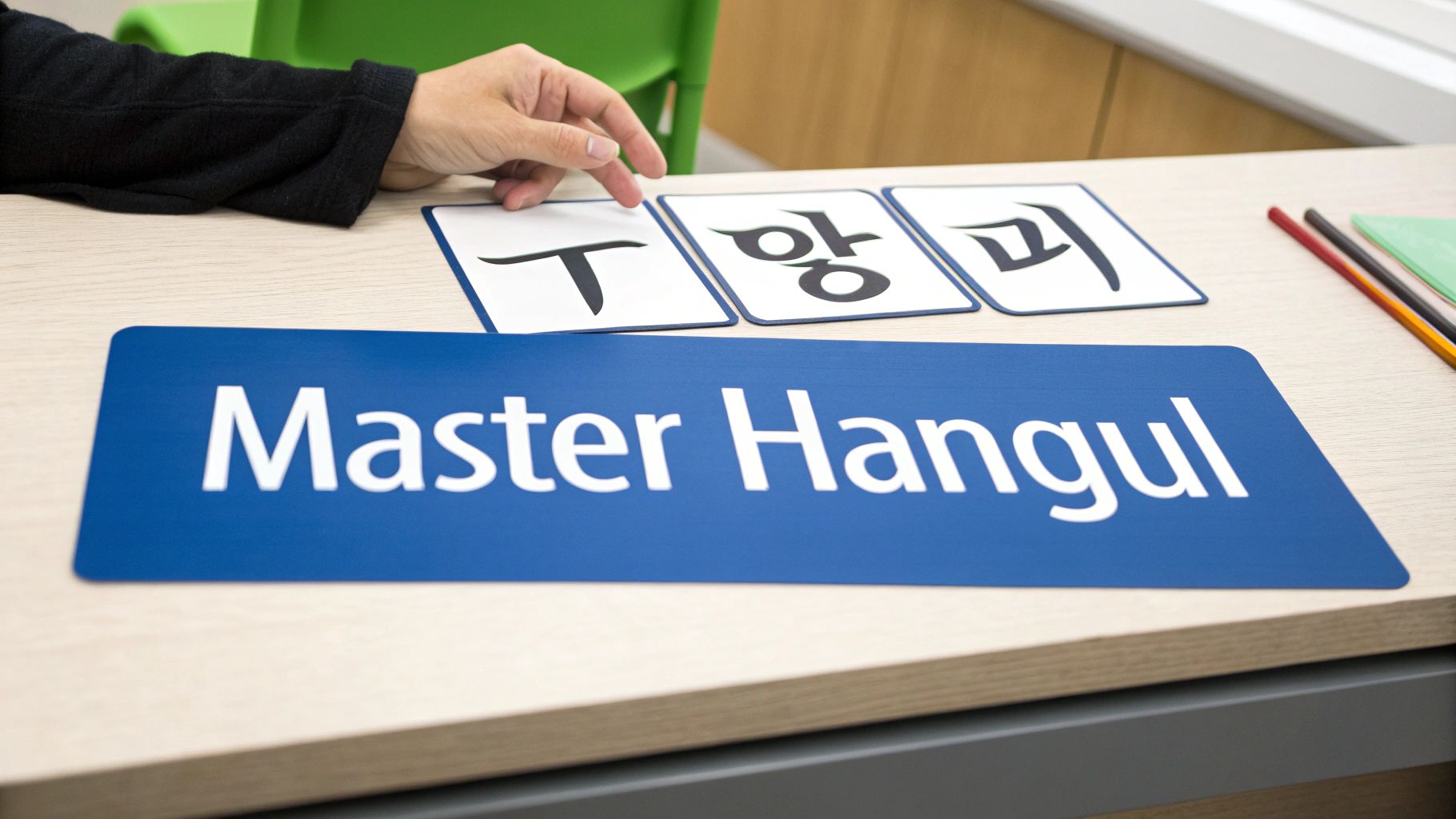
If you're wondering how hard it is to learn Korean, let's start with the best news first: the alphabet, Hangul (한글). Honestly, this is your biggest confidence booster right out of the gate. Think of it as the language's welcome gift to new learners.
Hangul is widely praised as one of the most logical writing systems ever created. It was invented in the 15th century by King Sejong the Great, who had a brilliant goal: to create an alphabet so simple that anyone could learn to read and write. Forget thousands of complex characters; with Korean, you only need to learn 24 basic letters.
An Alphabet That Just Makes Sense
The real magic of Hangul is how intuitive it is. The letter shapes are designed to reflect the sounds they represent.
- Consonants: Many consonant shapes mimic the position of your mouth and tongue when you say them. For example, ㄱ (giyeok) looks like the shape your tongue makes when producing a 'g' or 'k' sound.
- Vowels: The vowels are even simpler, built from just three components: a horizontal line for the Earth (ㅡ), a vertical line for a person (ㅣ), and a dot for the Sun (•).
You just stack these simple letters into syllable blocks to build words. It’s like playing with LEGOs. For example, you combine ㅎ (h), ㅏ (a), ㄴ (n), ㄱ (g), ㅡ (eu), and ㄹ (l) to form the word 한글 (Hangeul).
Most people are stunned when they realise they can start reading basic signs and menus after just a few hours. This initial success isn't just a small victory; it's proof that you can do this and gives you the momentum you'll need for the trickier parts.
Getting to Grips with Korean Grammar
Here's where the real fun—and the biggest hurdle for most English speakers—begins. What makes Korean tricky often comes down to this: Korean grammar plays by a completely different set of rules. It can feel like learning to solve a new kind of puzzle.
The biggest change is the sentence structure. English uses a Subject-Verb-Object (SVO) sequence, like "I read the book." Korean, however, uses a Subject-Object-Verb (SOV) pattern. The verb always goes at the very end.
Cracking the Subject-Object-Verb Code
Let's look at this with a basic sentence. In English, we say, "I eat pizza."
In Korean, you'd say:
- 저는 피자를 먹어요. (jeo-neun pija-reul meogeoyo)
Translated word-for-word, this means "I pizza eat." It feels backward at first, but once you train your brain to wait for the action at the end, it starts to feel natural.
Why You'll Learn to Love Particles
You might be thinking, "If the words move around, how does anyone know what’s going on?" The secret lies in particles. These are little grammatical markers that latch onto nouns to clarify their job in the sentence.
For instance:
- -은/는 (eun/neun) marks the sentence's topic.
- -을/를 (eul/reul) signals the object.
In our example, jeo-neun tells us "I" is the topic, and pija-reul tells us "pizza" is the object. Getting comfortable with particles is a non-negotiable step; they are the glue that holds Korean sentences together. Getting live practice in a supportive group like a Ktalk.live class can help these concepts click so much faster.
Build Vocabulary and Pronunciation the Smart Way

Once you get a handle on grammar, you’ll shift focus to building your vocabulary and nailing your pronunciation. For most English speakers, diving into Korean vocabulary feels like building from scratch, since there's very little crossover.
But don't worry, you have a secret weapon: Konglish (콩글리시). These are English loanwords that have been adopted into daily Korean life, giving you a handful of familiar words right from the start.
You probably already know words like:
- 커피 (keopi) — coffee
- 아이스크림 (aiseukeurim) — ice cream
- 컴퓨터 (keompyuteo) — computer
- 택시 (taeksi) — taxi
Mastering New Sounds
When people ask if it is difficult to learn Korean, pronunciation is often a key concern. The challenge isn't the whole language, but a few key sounds that don't have an English equivalent. A classic example is the set of consonants that sound almost identical to an untrained ear, like the three versions of the 'g/k' sound: ㄱ (g/k), ㅋ (k), and ㄲ (kk).
Getting these sounds right isn't something you can learn from a textbook; you have to hear them and say them. This is where listening and imitation become your most powerful tools. Immerse yourself by watching K-dramas or getting direct feedback from a native speaker in a Ktalk.live session. It helps train your ear and teaches your mouth the new muscle memory required to make these sounds correctly.
Immerse Yourself in Korean Culture: Hallyu Helps
So, you're asking, "is it difficult to learn Korean?" The short answer is: it's gotten a whole lot easier, thanks to 'Hallyu', or the Korean Wave. This global explosion of Korean culture means the world is more plugged into Korea than ever before. Your favourite K-pop tracks become fun vocabulary exercises, and those addictive K-dramas are invaluable listening practice. It's a worldwide learning ecosystem!
A World of Resources at Your Fingertips
This cultural boom has triggered a massive increase in learning tools. Today, you've got an endless supply of apps, YouTube channels, and online platforms like K-talk Live all built to help you master the language.
This isn't just a grassroots movement. In 2020, an estimated 160,000 students enrolled in Korean courses worldwide. Seeing this, the South Korean government has invested heavily, supporting language education in over 1,800 schools across 43 countries. You can learn more about these global language trends to see how big this has become. The worldwide love for Korean culture has cleared a path for you, making the learning journey more straightforward and supportive than ever.
Your Korean Learning Action Plan
Alright, let's turn that excitement into a clear, actionable path that will actually get you speaking Korean.
- Tackle Hangul First: This should be your Day 1 mission. It’s a logical alphabet, and mastering it gives you an immediate rush of accomplishment that unlocks everything else.
- Learn Grammar Intuitively: Instead of just memorizing rules, learn basic sentence structures first, then start swapping out vocabulary words. This makes grammar feel practical, not intimidating.
- Immerse Yourself Daily: Sneak Korean into your life. Are you obsessed with a K-drama? Perfect. Those are now your study materials. This kind of immersion makes learning stick because it's enjoyable.
- Start Speaking Now: Even if it’s just to yourself. To really build confidence, you need to talk to actual people. A platform like K-talk Live is perfect for getting real-time feedback from a tutor in live conversations.
One of the biggest hurdles that makes learning Korean difficult is simply not having the right support. Research highlights that structured learning plays a huge role in a student's success. You can read up on the study's findings to see just how much of a difference good resources make. Remember, this is a marathon, not a sprint. Celebrate every little win!
Common Questions About Learning Korean

When you're just starting out, a few big questions always seem to pop up. Let’s tackle some of the most common ones so you can set your expectations right.
How long does it take to become conversational?
For an English speaker studying consistently, hitting a basic conversational level often takes about 6–12 months. To put it in perspective, the U.S. Foreign Service Institute estimates it takes 2,200 hours of dedicated study to reach professional fluency. Be patient with yourself!
Is Korean harder than Japanese or Chinese?
Each language has its own mountain to climb. The good news? Korean’s alphabet, Hangul, is far easier to master than the thousands of characters needed for Chinese or Japanese. However, Korean grammar is often seen as just as tricky as Japanese. Ultimately, the "easiest" language is the one you're most excited to learn.
Do I need to learn Hanja?
For day-to-day chats, you absolutely do not need to learn Hanja (Chinese characters). Modern Korean is written almost exclusively in Hangul. That said, knowing some basic Hanja can be a secret weapon for boosting your vocabulary later on. Think of it as an optional upgrade, not a requirement.
What is the hardest part of learning Korean?
For most English speakers, the two biggest hurdles are grammar and pronunciation. Korean's Subject-Object-Verb sentence structure and its use of particles force you to build sentences in a whole new way. But stick with it, and one day, it will just click.
Your Korean Journey Starts Now
So, is it difficult to learn Korean? Yes, it has its challenges, but it's far from impossible. With a logical alphabet to start, a wealth of resources at your fingertips, and a vibrant global community, there has never been a better time to begin. The key is to stay consistent, celebrate your progress, and embrace the process. Every word you learn brings you one step closer to confidence. Keep going — your Korean journey starts now!
🌟 Ready to start your Korean journey? Join Ktalk.live — where global learners connect, speak, and grow together
Ready to stop reading and start speaking?
Practice what you just learned with a native Korean teacher — free for 100 minutes. No card, no commitment.