
Want to practice this with a native Korean teacher?
100-min free trial — no card required.
Ever felt that pang in your chest when a K-drama character whispers, “I miss you”? Learning to say i miss you in hangul is a rite of passage for any Korean learner, and it’s about so much more than just translating words. It’s about tapping into the heart of how Koreans communicate their feelings and connecting on a much deeper level.
Think of this guide as your friendly mentor, here to help you get beyond a simple, flat translation. We’ll explore the different politeness levels, nail the pronunciation, and even peek at the simple grammar behind the most common phrase, 보고 싶어요 (bogo sip-eoyo). By the time we're done, you'll be able to express this heartfelt feeling with the nuance and confidence of a native speaker. Let's get started!
Mastering the Three Main Ways to Say 'I Miss You'
In Korean, how you speak to someone is deeply tied to your relationship with them. This is especially true when sharing your feelings, and saying 'i miss you' in Hangul is a perfect example. The phrase changes depending on the level of politeness your relationship calls for, which is a key way of showing respect.
Getting these right is like knowing when to say "Hello," "Hey," or "Good morning, sir" in English. Choosing the right one helps you sound natural and shows you understand an important part of Korean culture.
This flowchart gives a great visual breakdown of how the different politeness levels work when you want to express that you're missing someone.
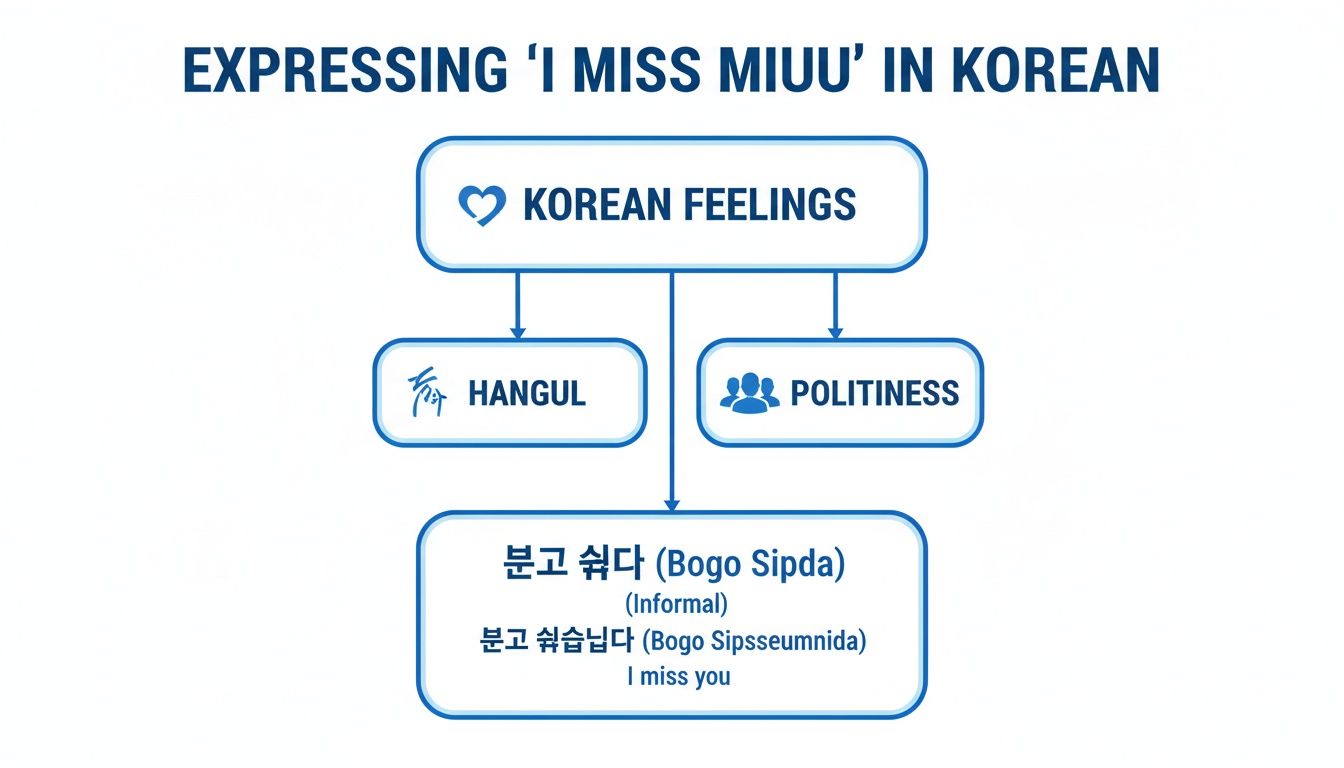
The big idea here is that expressing yourself well isn't just about vocabulary; it's about social awareness. Let's dive into each level so you can feel confident you're picking the perfect phrase every single time.
The Standard Polite Form: Bogo Sipeoyo
- Hangul: 보고 싶어요
- Romanization: Bogo sip-eo-yo
- Pronunciation: [bo-go ship-aw-yo]
This is your go-to, the most versatile version you'll learn. 보고 싶어요 (Bogo sip-eo-yo) is the standard polite form that fits comfortably in most everyday situations. It’s the perfect choice for talking to older friends, colleagues, teachers, or anyone you need to show respect to without sounding stuffy.
What makes it polite? That little ending: -요 (-yo). Think of this as your reliable default. When in doubt, you can never go wrong with bogo sip-eo-yo.
The Casual, Informal Form: Bogo Sipeo
- Hangul: 보고 싶어
- Romanization: Bogo sip-eo
- Pronunciation: [bo-go ship-aw]
Notice the polite -요 (-yo) ending is gone? That simple change turns the phrase into 보고 싶어 (Bogo sipeo), the casual, informal version you save for the people closest to you.
This is the one you'll use with your best friends, siblings, and romantic partners—especially if they are the same age or younger. Using this form signals intimacy and shows you have a relaxed, comfortable relationship.
Pro Tip: Be mindful with this one. Dropping the -요 (-yo) with an elder or someone you've just met can come across as rude. It's always best to start with the polite form first.
The Highly Formal Form: Bogo Sipseumnida
- Hangul: 보고 싶습니다
- Romanization: Bogo sip-seum-ni-da
- Pronunciation: [bo-go ship-seum-ni-da]
And here we have the most formal way to say 'I miss you' in Hangul. 보고 싶습니다 (Bogo sip-seum-ni-da) is not something you'll hear in casual chats. Instead, it's reserved for very formal settings.
You might encounter this phrase in a public speech, a business presentation, or a formal letter to someone of high social standing. The key here is the -습니다 (-seumnida) ending, which carries the highest level of respect.
Quick Reference: The Three Levels of Formality
| Hangul | Romanization | Formality Level | When to Use It |
|---|---|---|---|
| 보고 싶어요 | Bogo sip-eo-yo | Standard Polite | The most common form. Use with friends, colleagues, and older acquaintances. |
| 보고 싶어 | Bogo sip-eo | Casual / Informal | Use with close friends, romantic partners, siblings, and people you are very familiar with. |
| 보고 싶습니다 | Bogo sip-seum-ni-da | Formal | Reserved for formal situations like speeches or addressing someone of high status. |
Keep this table handy as you practise. With a little experience, choosing the right level of formality will become second nature.
Breaking Down the Grammar: What 'Bogo Sipeoyo' Really Means
To truly understand a phrase, you have to look under the hood. Let's pull apart 보고 싶어요 (bogo sip-eoyo) to see the simple grammar behind it.
First, you have the verb stem from 보다 (boda), which means "to see." In Korean, you constantly work with verb stems, adding different endings to express all sorts of meanings.
The second piece is the grammatical pattern -고 싶어요 (-go sip-eoyo). This is an ending you can attach to almost any verb stem to say "I want to..."
Literal Meaning: So, when you put 보다 (boda) and -고 싶어요 (-go sip-eoyo) together, you're literally saying, “I want to see (you).” This is how Koreans express the feeling of missing someone.
This phrasing gives you a beautiful peek into a cultural perspective. Instead of focusing on someone's absence, the focus is on the positive desire to see them again.
A Gateway to More Korean Phrases
Here's the best part. Once you've got the -고 싶어요 (-go sip-eoyo) pattern down, you've unlocked the ability to talk about all kinds of things you want to do.
Just look at how versatile it is:
- 먹다 (meok-da) — to eat → 먹고 싶어요 (meok-go sip-eoyo) — I want to eat.
- 가다 (ga-da) — to go → 가고 싶어요 (ga-go sip-eoyo) — I want to go.
- 자다 (ja-da) — to sleep → 자고 싶어요 (ja-go sip-eoyo) — I want to sleep.
By digging into the simple grammar of how to say I miss you in Hangul, you've done more than just learn one phrase—you've picked up a key tool for expressing yourself. When you feel ready to put this into practice, trying a small group class on Ktalk.live is the perfect way to start.
A Practical Guide to Perfect Pronunciation
Alright, you've got the Hangul down. Now for the part that really brings it to life: the pronunciation. Getting the sounds right is what makes the difference between simply knowing the words and truly connecting with someone.
Let's break down 보고 싶어요 (bogo sip-eoyo) syllable by syllable so you can say it with real heart.
Breaking Down Each Syllable
- 보 (bo): This is easy. It’s pretty much identical to the "bo" in "boat." Keep it short and punchy.
- 고 (go): Just like the first syllable, this sounds exactly like the English word "go."
- 싶 (sip): Another straightforward sound. Think of taking a "sip" of your favorite drink.
- 어요 (eo-yo): This is the tricky part. The star here is the '어' (eo) vowel. It doesn’t have a perfect match in English, but it’s close to the "uh" sound in "uh-oh." The key is to keep your jaw relaxed. Once you have that "eo" sound, just tack on a "yo" at the end.
Putting it all together, you get bo-go-sip-eo-yo. Try to say it smoothly, letting the sounds flow into each other.
Finding the Natural Rhythm
Korean has a very different cadence compared to English. Instead of putting strong stress on one part of the phrase, aim for an even, melodic flow across all the syllables. A great way to practise is by listening to native speakers in K-dramas or language apps.
Key Takeaway: The goal isn't to sound like a robot perfectly reciting syllables. It’s about conveying genuine emotion. When you say 'i miss you' in hangul with a natural rhythm, the person you're speaking to won't just hear the words—they'll feel them.
Using "I Miss You" in Real Conversations
You’ve got the phrase down, but using it naturally is where the real connection happens. Let's look at how 보고 싶어요 (bogo sip-eoyo) plays out in real, everyday chats.

Scenario 1: Phone Call with a Loved One
Picture this: you're on a call with a family member who lives far away. As the conversation wraps up, you want to leave them with a warm feeling.
- You: 잘 지내요? 목소리 들으니까 너무 좋다.
- Jal jinaeyo? Moksori deureunikka neomu jota.
- Are you doing well? It’s so good to hear your voice.
- Them: 응, 나도.
- Eung, nado.
- Yes, me too.
- You: 보고 싶어요.
- Bogo sip-eoyo.
- I miss you.
Scenario 2: Texting a Close Friend
You and your best friend haven't been able to hang out lately. In a quick text, the informal 보고 싶어 (bogo sipeo) is the perfect fit.
- You: 요즘 너무 바빠서 얼굴도 못 보네 ㅠㅠ
- Yojeum neomu bappaseo eolguldo mot bone ㅠㅠ
- We’ve been so busy lately we haven’t even been able to see each other ㅠㅠ
- Friend: 진짜! 언제 한번 보자.
- Jinjja! Eonje hanbeon boja.
- I know! Let's meet up sometime soon.
- You: 응, 보고 싶어!
- Eung, bogo sipeo!
- Yeah, I miss you!
Common Responses You Might Hear
So, you've put it out there. What will they say back? The simplest and most common response you'll get is:
나도 보고 싶어요 (Nado bogo sip-eoyo) – "I miss you too."
The key here is 나도 (nado), which means "me too." It's a fantastic, versatile phrase to have in your back pocket for all sorts of situations.
Beyond "Bogo Sipeoyo": Other Ways to Express Longing
While 보고 싶어요 (bogo sip-eoyo) is your go-to, Korean has other beautiful ways to talk about that feeling of longing. Digging into these alternatives is how you start to sound less like a textbook and more like a native speaker.
One of the most important phrases is 그리워요 (geuriwoyo). This one carries a sense of nostalgia, a wistful yearning for something you can't just go back to. Think of missing a time in your life, a place you used to live, or someone who is no longer with you.
What's the Real Difference? Bogo Sipeoyo vs. Geuriwoyo
So, how do you know which one to use?
- 보고 싶어요 (Bogo sip-eoyo) is direct. It literally means "I want to see you." It’s an active feeling, a straightforward desire to be with a person right now.
- 그리워요 (Geuriwoyo) is more like "I long for..." or "I'm nostalgic for..." It’s a softer, more reflective feeling. You'd say
고향이 그리워요(gohyangi geuriwoyo) for "I miss my hometown," because it’s a place filled with memories you're yearning for.
Nailing these kinds of emotional nuances is a huge step forward for any Korean learner, especially as South Korea's international community continues to grow. Find out more about South Korea's international student boom here.
Your Korean Journey Starts Now
You’ve just learned one of the most powerful phrases in the Korean language. Mastering how to say '보고 싶어요'—and when to use each version—is a huge milestone. This isn't just a vocabulary word; it's a key to expressing genuine emotion and connecting with people on a deeper level.
Every word you learn brings you one step closer to confidence. So get out there and use it! Each time you practice, you build the muscle memory you need for real, flowing conversations. Keep that momentum going—your Korean journey starts now!
Frequently Asked Questions
Still got a few questions? Don't worry, that's completely normal. Let's clear up some common points people run into when learning to say I miss you in Hangul.
Can I Use Bogo Sipeoyo for Missing a Place or a Thing?
This is a fantastic question. 보고 싶어요 (bogo sip-eoyo) is almost exclusively used for people, as it literally means "I want to see you." When you're feeling nostalgic for a place, a thing, or a past moment, the word you're looking for is 그리워요 (geuriwoyo). For example, to say, "I miss my hometown," you’d say 고향이 그리워요 (gohyangi geuriwoyo).
Is It Okay to Say Bogo Sipeo to a Friend of the Opposite Gender?
Absolutely! In Korea, it's completely normal for friends to say 보고 싶어 (bogo sipeo) to each other, regardless of gender. Think of it as a warm and casual way of saying, "Hey, I miss hanging out!" It doesn’t automatically carry any romantic weight among close friends.
What Is the Difference Between Bogosipeo and Bogosipda?
Great question! Let's break it down simply.
- 보고 싶어 (bogo sipeo) is what you say to someone in a casual conversation.
- 보고 싶다 (bogo sipda) is the dictionary or "plain" form. You use this when you're talking about the feeling of missing someone, like a thought you're expressing out loud. You'll see it in diary entries, song lyrics, or when someone is muttering to themselves.
So, if you're talking directly to your friend, you'll almost always want to use 보고 싶어.
🌟 Ready to start your Korean journey? Join Ktalk.live — where global learners connect, speak, and grow together! Book your free trial class today.
Ready to stop reading and start speaking?
Practice what you just learned with a native Korean teacher — free for 100 minutes. No card, no commitment.