
Want to practice this with a native Korean teacher?
100-min free trial — no card required.
Learning how to study Korean might seem challenging at first, but with the right approach, it becomes a fun and rewarding journey! The secret is breaking down the massive goal of fluency into small, satisfying wins. It all comes down to a simple process: first, master the alphabet (Hangul). Next, build a solid foundation of the most common words. Finally, learn how to put those words together into basic sentences.
This step-by-step roadmap is designed to get you speaking and understanding right from the start. We'll show you how to build a strong foundation and create a study routine that actually works, turning what feels like a huge mountain into a series of small, climbable hills.
Your Practical Korean Study Roadmap
Staring down the challenge of learning a new language can feel overwhelming. The secret is having a clear, actionable map to guide you, especially through those crucial first steps. Let's forget about fluency for a moment and focus on building a strong foundation that will support everything else you learn down the road. This is your quick-start guide to gaining real momentum in your Korean studies.
The path forward is simple and logical. We'll begin where every Korean learner must: mastering Hangul. It’s a surprisingly elegant alphabet. From there, I'll show you how to start building a vocabulary of words you'll actually use in real conversations. Finally, you’ll get the hang of the basic Subject-Object-Verb (SOV) sentence structure, which is the backbone of the entire language.
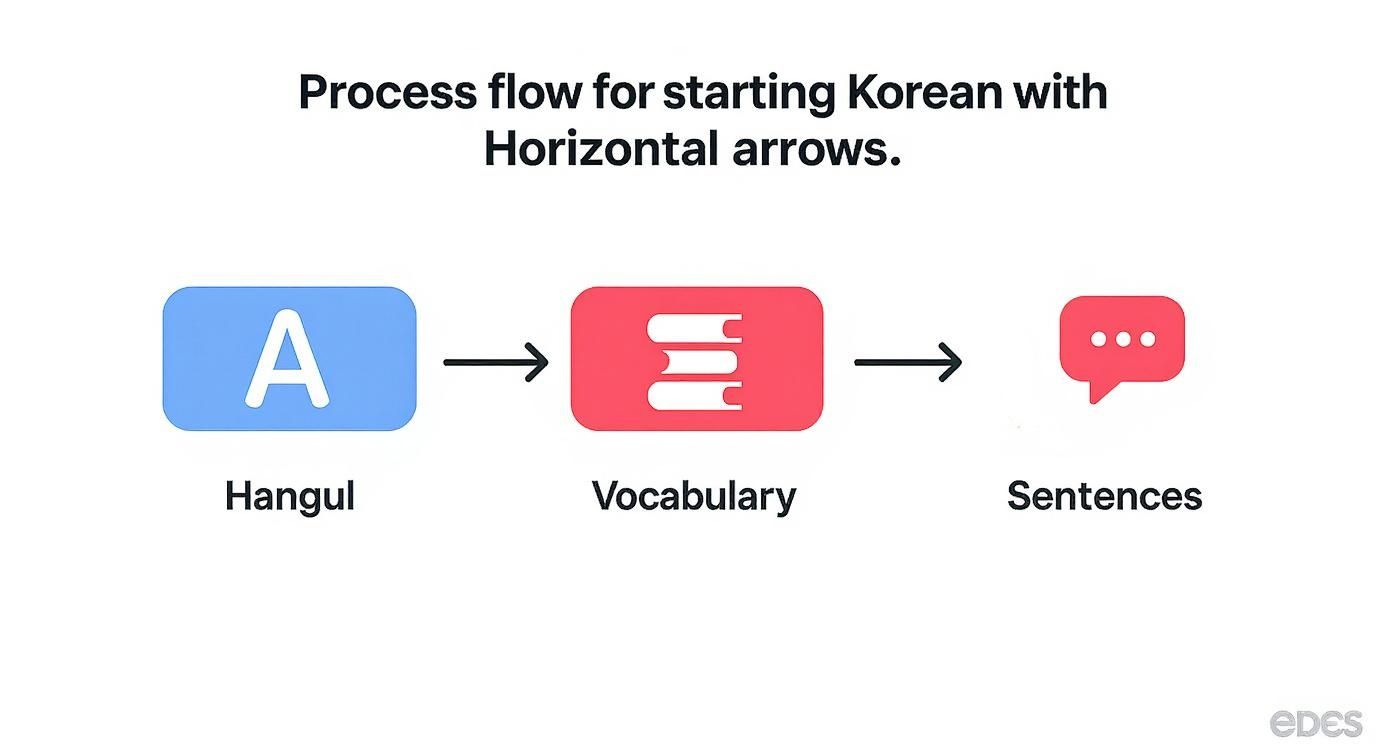
As you can see, each skill builds on the one before it. This creates a clear, manageable path from knowing nothing to having your first simple conversations.
Set Realistic First Goals
Before you jump in, it’s important to set realistic expectations. Your first month isn't about memorizing complex grammar rules. It's about getting comfortable with the sounds, letters, and unique rhythm of the Korean language.
Here's a breakdown of what you should aim for at the very beginning:
- Master Hangul: Your mission for the first week is to read and write all the Korean consonants and vowels. Don't worry, this isn't as hard as it sounds!
- Learn Core Vocabulary: Concentrate on the 100 most common words. This list will be full of greetings, simple nouns like 물 (mul, water), and essential verbs like 가다 (gada, to go).
- Understand Sentence Structure: Get a feel for the basic Subject-Object-Verb (SOV) order. Instead of saying "I drink water" (SVO), you’ll say "I water drink" (저는 물을 마셔요, Jeoneun mureul masyeoyo).
This initial roadmap is designed to give you a solid foundation and the confidence to start learning effectively today.
Learn Hangul — The First Step
Before you can dream of binge-watching K-dramas without subtitles, you have to learn to read. For anyone starting their Korean journey, that means getting to grips with Hangul (한글), the Korean alphabet. The good news? Hangul is one of the most logical writing systems ever created.
Unlike the thousands of characters in Chinese or Japanese, Hangul has just 24 basic letters—14 consonants and 10 vowels. The consonant shapes were even designed to mimic the shape your mouth makes when you say them. Genius, right?
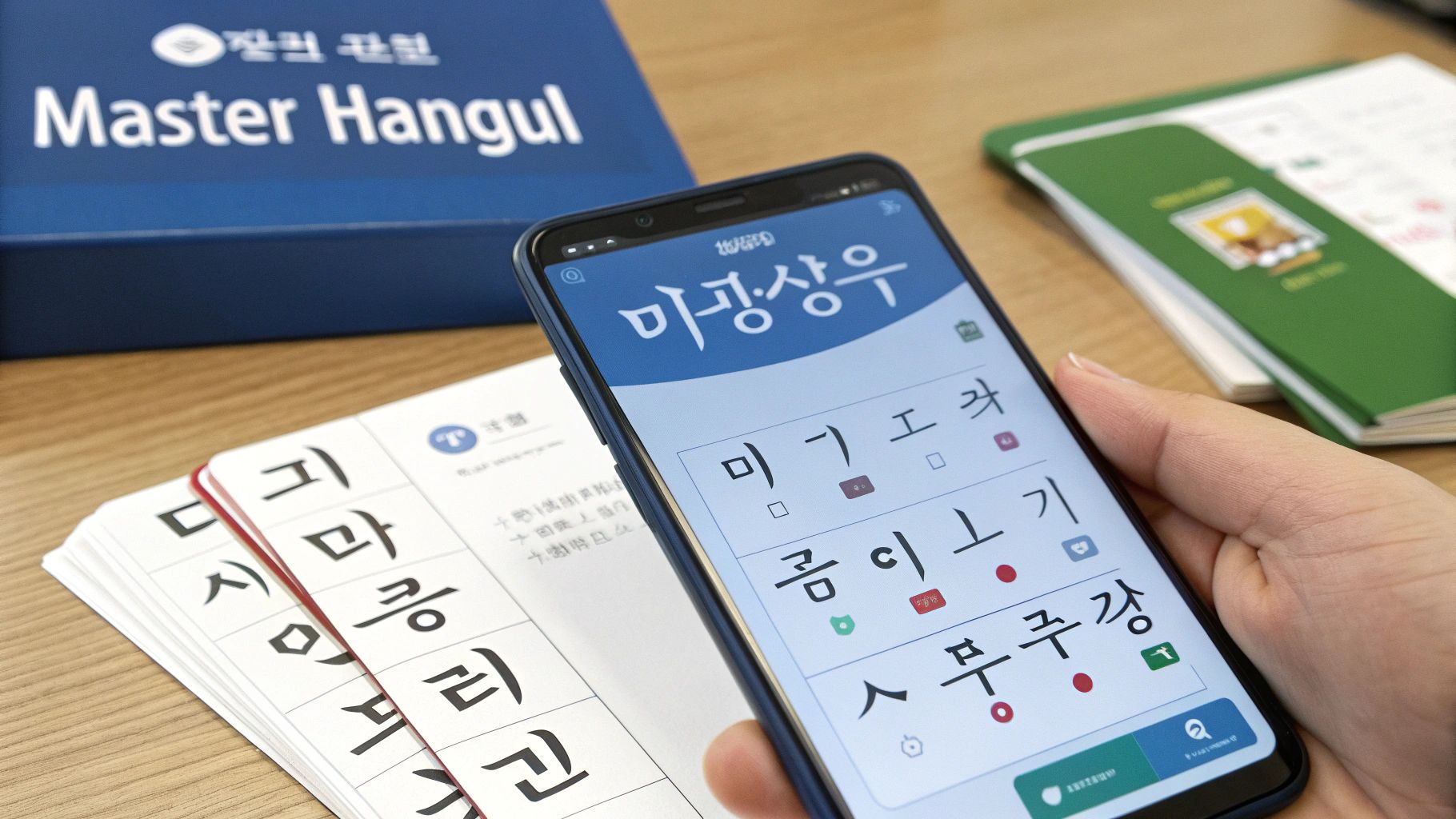
Because of this brilliant design, most people can learn the entire alphabet in a single afternoon. Seriously. It’s tempting to lean on Romanization as a crutch, but resist the urge. Spending just a few hours mastering Hangul from day one is a game-changer.
Build Vocabulary the Smart Way
Once you can read Hangul, your next mission is building a solid vocabulary base. But don't just memorize random word lists. A much smarter approach is to focus on high-frequency words and use proven memory techniques.
- Focus on High-Frequency Words: Your first goal should be learning the top 200–300 most common Korean words. These make up a surprisingly large percentage of everyday speech.
- Use Spaced Repetition Systems (SRS): Get on a flashcard app like Anki or Memrise. The SRS algorithm shows you a word right before you’re about to forget it, boosting long-term retention.
- Learn Words in Context: Instead of just memorizing 학교 (hakgyo - school), learn the phrase 학교에 가요 (hakgyo-e gayo - I go to school). This helps you internalize grammar naturally.
Your vocabulary goal isn’t to know every word; it’s to know the right words first.
Your First Korean Words
To get you started, here are a few essential words. Notice how you can already combine them to form simple ideas.
| Category | Korean Word | Pronunciation | English Meaning |
|---|---|---|---|
| Greetings | 안녕하세요 | annyeonghaseyo | Hello |
| People | 친구 | chingu | Friend |
| Places | 집 | jip | Home / House |
| Verbs | 먹다 | meokda | To eat |
| Adjectives | 좋다 | jota | To be good |
Just by knowing these, you can start forming phrases like 친구하고 밥을 먹어요 (Chinguhago babeul meogeoyo - I eat a meal with a friend). See? You're already building sentences.
The Konglish Shortcut
Here’s a fun hack to quickly expand your vocabulary: tap into Konglish (콩글리쉬). These are English words adopted into Korean, usually with a Korean-style pronunciation.
- 커피 (keopi) - Coffee
- 아이스크림 (aiseukeulim) - Ice cream
- 컴퓨터 (keompyuteo) - Computer
- 택시 (taeksi) - Taxi
- 버스 (beoseu) - Bus
Of course, Konglish is no substitute for authentic Korean vocabulary, but it’s a fantastic way to get an instant confidence boost.
Crafting a Study Routine That Sticks
Knowing what to study is one thing, but the real secret to progress is consistency. A short, focused session every day will always beat a frantic, multi-hour cram session once a week. It’s all about designing a realistic routine that fits into your life.
Even 30 minutes a day can build incredible momentum. The goal isn't perfection; it’s about creating a habit that feels natural and, most importantly, sticks. Don’t worry if you make mistakes—even Koreans do sometimes! What matters most is progress.
Set Goals That Motivate You
A vague goal like "I want to be fluent" isn't very helpful. You need clear, actionable targets that show you're making real progress. This is where SMART goals come in handy.
A SMART goal is:
- Specific: Instead of "learn vocabulary," try "learn 10 new words related to food."
- Measurable: "Complete two lessons in my textbook" is something you can check off a list.
- Achievable: Aiming to master 100 grammar points in a week leads to burnout. Be honest about your schedule.
- Relevant: If your dream is to watch K-dramas, then focusing on listening skills is highly relevant.
- Time-bound: Give yourself a deadline, like "I will master the basic past tense this week."
This framework turns a huge mountain into a series of small, climbable hills, building your confidence with every win.
Building a Balanced Weekly Schedule
A common trap for learners is focusing too much on one skill while neglecting others. An effective routine develops all four core skills: listening, speaking, reading, and writing. The country’s high literacy rate of approximately 97.9% is built on this foundation of balanced, consistent learning. You can dig into more Korean education statistics on zipdo.co if you're curious.
Here's a sample schedule you can tweak to fit your own life:
- Listening Monday: Listen to a beginner podcast or YouTube channel for 30 minutes. The goal is to get your ear accustomed to the sounds and rhythm of Korean.
- Speaking Tuesday: Join a live class on a platform like Ktalk.live. You get to practice with a tutor and other learners, receiving instant feedback in a supportive setting.
- Grammar Wednesday: Pick one new grammar concept. Watch a short video explaining it, then write five of your own sentences using it.
- Reading Thursday: Read a Korean webtoon. The pictures give you context, making it a fun and effective way to practice reading real-world Korean.
- Vocabulary Friday: Use a flashcard app to review words from the week. Try creating sentences that combine this week's vocabulary with last week's grammar.
- Culture Saturday: Watch a K-drama with Korean subtitles on. Pause when you hear an interesting phrase, look it up, and repeat it.
- Review Sunday: Take 20 minutes to look through your notes from the week. This helps cement what you've learned and prepares you for the week ahead.
Think of this schedule as a starting point. The best plan for learning how to study Korean is the one you can actually stick with.
Practice Speaking Naturally
Drilling grammar rules and memorizing vocabulary is only half the battle. Real progress kicks in the moment you start moving that knowledge from your head to your mouth. This is when passive understanding evolves into active, confident use.
The goal is to activate your Korean—to take all those building blocks you’ve been collecting and actually start building something with them.
Firing Up Your Speaking Skills
For most new learners, speaking is the most intimidating part. The secret is to start small and create low-pressure moments to just talk, even if it’s only to yourself.
Here are a few practical ways to get the words flowing:
- Narrate Your Day: This is incredibly effective. As you go about your routine, describe what you’re doing in simple Korean. "커피를 마셔요" (Keopi-reul masyeoyo - I'm drinking coffee). "지금 일해요" (Jigeum ilhaeyo - I'm working now).
- Find a Language Partner: Use an app like HelloTalk to find native Korean speakers learning English. You can start with short voice messages and work your way up to calls in a judgment-free zone.
- Join Live, Small-Group Classes: This is a game-changer for building confidence. Platforms like Ktalk.live put you in structured, small-group classes where you get maximum speaking time, direct practice, and instant feedback.
Sharpening Your Listening Skills
Of course, a conversation is a two-way street. This means training your ear to recognize the sounds, speed, and intonation of natural Korean speech.
- Beginner Podcasts: Look for podcasts made for Korean learners. They use clear, slow speech and common vocabulary, making them perfect for starting out.
- YouTube for Learners: Channels like "Go! Billy Korean" or "Learn Korean with KoreanClass101" are packed with lessons and listening exercises.
- Active K-Drama Watching: Turn on the Korean subtitles (not English!) and try to catch words you recognize. Pause, write down new phrases, and say them out loud.
The global Korean language learning market shot past USD 7.2 billion in 2024. You can find deeper insights into the Korean language learning market at gminsights.com to see just how big this trend is.
Building Reading and Writing Habits
Reading and writing are your secret weapons for reinforcing everything you learn. The key is to start with simple, engaging materials you enjoy.
- Start with Webtoons: Korean webtoons (웹툰) are perfect for beginners. The artwork provides visual context, helping you follow the story. The Naver Webtoon app is a great place to start.
- Keep a Simple Journal: At the end of each day, write one or two sentences in Korean about what you did. "오늘 친구를 만났어요" (Oneul chingu-reul mannasseoyo - I met a friend today).
Essential Tools and Resources
Navigating the sea of apps and websites can be overwhelming. Here is a curated list of top-tier resources to help you make real progress.
| Category | Recommended Resource | Best For | Key Feature |
|---|---|---|---|
| Speaking Practice | Ktalk.live | Building conversational fluency | Live, tutor-led small-group classes for maximum speaking time. |
| Vocabulary & Grammar | Talk To Me In Korean | Structured, foundational learning | Comprehensive curriculum with podcasts, textbooks, and video lessons. |
| Language Exchange | HelloTalk | Casual practice with native speakers | Text, voice, and video chat with built-in correction tools. |
| Dictionary & Reference | Naver Dictionary | In-depth definitions and examples | Provides extensive example sentences, audio pronunciation, and Hanja. |
| Reading Practice | Naver Webtoon | Engaging, context-rich reading | Free access to thousands of comics with visual aids to help comprehension. |
Each tool serves a specific purpose, but they work best together. This integrated approach is what truly accelerates your learning.
Immerse Yourself in Korean Culture
You don’t have to book a flight to Seoul to immerse yourself in the Korean language. By cleverly using technology and diving into the vibrant world of Korean culture, you can build a rich learning environment wherever you are. This isn’t about passively watching; it’s about actively turning your entertainment into your education.
The global obsession with Korean culture, known as Hallyu (한류) or the "Korean Wave," gives you a massive, constantly growing library of authentic material. This cultural boom has sparked a huge interest in learning the language. You can read more about the growth of the Korean language on britannica.com.
Turn Passions into Study Tools
The trick is to change your hobbies into active study sessions. That K-pop group you love or the K-drama you’re binging? Those are living textbooks packed with natural slang and cultural nuances.
- Study with K-Pop Lyrics: Look up the lyrics to your favorite songs. Start highlighting new vocabulary and grammar points. You'll be amazed at how fast you pick up casual phrases like "어떡해?" (eotteokhae? - What do I do?) or "보고 싶어" (bogo sipeo - I miss you).
- Watch K-Dramas Actively: Turn off the English subtitles. Switch to Korean subtitles (or none at all!) to engage directly with the language. Try "sentence mining": when you hear a short, clear line, hit pause, look up the words you don't know, and add the sentence to your flashcard app.
Use Apps Strategically
The secret isn't finding one perfect app but building a "team" of apps that each do something different.
- Duolingo: Great for a quick, fun warm-up and building foundational vocabulary.
- Memrise: Fantastic for memorizing common phrases using video clips of native speakers.
- Naver Dictionary: Your go-to for accurate definitions, tons of example sentences, and audio.
- Ktalk.live: Essential for structured, live speaking practice to activate what you've learned.
When you blend these tools with cultural immersion, you create a powerful 24/7 learning ecosystem that will accelerate your path to fluency.
Your Korean Learning Journey Starts Now
Learning a new language is a marathon, not a sprint. The key to success is to find joy in the process and celebrate every small victory along the way. By mastering Hangul, building your vocabulary smartly, and creating a consistent study routine, you've already laid the groundwork for success. Remember to use the language every day, immerse yourself in the culture you love, and never be afraid to make mistakes.
Every word you learn brings you one step closer to confidence. Keep going—your Korean journey starts now!
🌟 Ready to start your Korean journey? Join Ktalk.live — where global learners connect, speak, and grow together
Ready to stop reading and start speaking?
Practice what you just learned with a native Korean teacher — free for 100 minutes. No card, no commitment.