Want to practice this with a native Korean teacher?
100-min free trial — no card required.
Learning Korean might seem daunting, but it’s never been easier to get started. The secret isn't just about memorizing flashcards; it's about diving headfirst into a culture that's taking the world by storm.
Start with the surprisingly logical Korean alphabet, Hangul. From there, you can build a solid base of everyday words and immerse yourself in the fun stuff—K-dramas, music, and webtoons. This way, learning feels less like a chore and more like joining a global phenomenon.
Why There's No Better Time to Start Learning Korean
Let's be honest, it feels like Korean culture is everywhere right now. Whether it’s chart-topping K-pop artists, Oscar-winning films, or that K-drama everyone is talking about, the world is completely hooked.
This global fascination, known as Hallyu (the "Korean Wave"), has created the perfect storm for anyone wanting to learn the language. You’re not just picking up a new skill; you’re plugging into a massive, enthusiastic community.
An Explosion of Resources and Support
This cultural boom means you're spoiled for choice when it comes to learning tools. The skyrocketing demand for Korean has led to a ton of high-quality resources popping up.
Endless learning materials: You’ve got everything from fun, gamified apps and YouTube channels to structured online courses built for absolute beginners.
Built-in immersion: Practicing your listening skills is as easy as firing up the latest K-drama on Netflix or putting on a K-pop playlist while you cook.
A worldwide community: Hop onto online forums, language exchange apps, or social media, and you'll find countless other learners and native speakers ready to practice with you.
This isn’t just a passing fad. The drive to learn Korean is powered by this massive cultural influence, not to mention South Korea’s top-tier universities and government-backed efforts to share the language globally. For a deeper dive, check out this study on the international promotion of Korean.
Jumping in now means you get to ride this wave. You’re tapping into a rich, supportive ecosystem that makes the entire process more engaging and, frankly, a lot more fun. Using the culture you already love as your textbook is one of the best motivators you can have.
Mastering Hangul: The World's Most Logical Alphabet
Forget everything you think you know about learning an Asian language. Most people picture memorising thousands of complex characters, but when it comes to Korean, the reality is much simpler—and frankly, brilliant.
The Korean alphabet is called Hangul (한글). It’s famous for being one of the most logical and straightforward writing systems ever created. I've seen countless beginners get the hang of it in just a few hours.
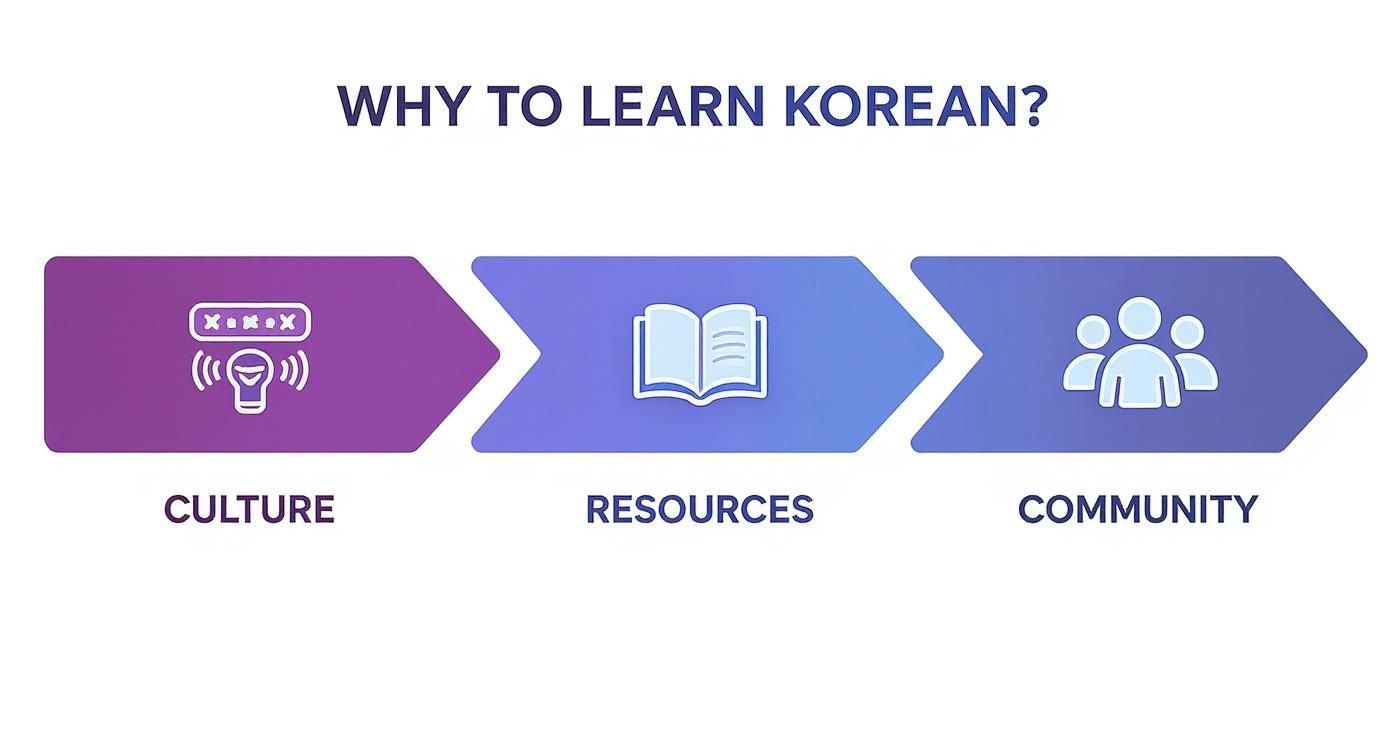
This infographic gives a great overview of why so many people are diving into the language, from pop culture to making new friends.
Starting with the alphabet is the non-negotiable first step. It’s what unlocks everything else.
How Hangul Actually Works
Unlike other character-based writing, Hangul is completely phonetic. The real genius is in its design—the shapes of the consonants are meant to look like the shape your mouth makes when you say them. It’s an incredibly intuitive system.
Letters aren't just written in a line; they're bundled into syllable blocks. Take the word for "hello," 안녕하세요 (annyeonghaseyo). It's built from five separate blocks: 안-녕-하-세-요.
Every block has at least one consonant and one vowel. Once you know the individual letters, you just snap them together like Lego bricks.
The biggest win with Hangul is how fast you can start reading. You don’t need to spend months on flashcards just to read a menu or a sign in a K-drama. That early success gives you a massive confidence boost that keeps you going.
To get you started, here is a small table with some of the most common vowels and consonants you'll encounter.
Essential Hangul Vowels and Consonants
Hangul Character | Romanization | Sound |
|---|---|---|
ㅏ | a | like the 'a' in father |
ㅓ | eo | like the 'o' in song |
ㅗ | o | like the 'o' in go |
ㅜ | u | like the 'oo' in moon |
ㅣ | i | like the 'ee' in see |
ㄱ | g/k | like the 'g' in goat |
ㄴ | n | like the 'n' in nose |
ㅁ | m | like the 'm' in mom |
ㅅ | s | like the 's' in snake |
ㅇ | -/ng | silent or like 'ng' in sing |
Getting comfortable with these basics will have you sounding out words in no time.
Your first move should be to focus on these core characters and their sounds.
Vowels (모음): Begin with the basic vertical lines (ㅣ, ㅏ, ㅓ) and horizontal ones (ㅡ, ㅗ, ㅜ). These are the building blocks for all other vowels.
Consonants (자음): Tackle the 14 base consonants. Use mnemonics to help them stick—for instance, ㄱ (g/k) sort of looks like a gun.
By mastering these simple pieces, you'll find yourself reading real Korean words almost immediately. For anyone wondering how to learn the Korean language for beginners, this is the key. That feeling of success is what gets you hooked and keeps you motivated for the journey ahead.
Building Your First Korean Sentences
Alright, you've conquered Hangul and can now read the building blocks of the language. This is where the real fun kicks off—piecing those letters together to make words and your very first sentences.
The trick is to start small and practical. Forget diving into a dictionary. Think about the first words you learn in any language: hellos, goodbyes, numbers, and everyday objects.
A great way to get started is by labelling stuff around your house. Slap a sticky note with '책상' (chaeksang) on your desk or '문' (mun) on your door. This builds up your core vocabulary with words you’ll actually see and use daily, which is a massive confidence boost.
Getting a Grip on Korean Sentence Structure
Here comes the biggest mental shift for English speakers. Korean sentences are structured differently. While we say "I eat kimchi" (Subject-Verb-Object), Korean flips it to Subject-Object-Verb (SOV). The verb always, always comes at the end.
Let’s look at a classic example to see it in action:
저는 (jeoneun) - I
김치를 (gimchireul) - kimchi
먹어요 (meogeoyo) - eat
So, in Korean, you’d say 저는 김치를 먹어요 (Jeoneun gimchireul meogeoyo). It translates literally to "I kimchi eat." It’ll feel a bit backwards at first, but this is the single most important grammar rule to get comfortable with.
Once the SOV structure clicks, you'll feel like you've cracked a code. Suddenly, you'll start spotting the pattern everywhere, from K-pop lyrics to your favourite K-dramas. Don't aim for perfection right away—just focus on recognising it.
Here's another simple one: 저는 학생입니다 (Jeoneun haksaeng-imnida), which means "I am a student." In this case, '학생' (haksaeng) is the student, and '입니다' (imnida) is the polite version of the verb "to be."
The best way forward? Start making your own super simple sentences. Just pick a subject (I, you), an object (coffee, a book), and a basic verb (drink, read). Actually building sentences yourself is way more powerful than staring at grammar charts.
Finding Korean Learning Resources That Work for You
https://www.youtube.com/embed/Sb5lUgpKwQg
When you first start learning Korean, the sheer number of resources can feel overwhelming. You’ve got everything from gamified apps and classic textbooks to K-dramas and webtoons. The trick isn't to find the one "perfect" tool, but to build a personal toolkit that actually keeps you excited to learn.
Don't ever feel like you have to force yourself to use a method that just isn't clicking. If a flashcard app feels like a total chore, maybe a textbook with deeper grammar explanations is more your speed. Or if textbooks send you straight to sleep, find a great YouTube channel that makes learning feel dynamic and fun.
What you're really aiming for is a balanced learning diet. This kind of variety keeps you from burning out and helps you work on different skills at the same time, which makes your study sessions way more productive.
Creating Your Learning Mix
A fantastic way to start is by picking one structured resource and one immersive one. This combo gives you a solid foundation in the language while making sure you're actually enjoying the process.
Structured Learning: This is your home base for grammar and vocabulary. Think of apps like Memrise for vocabulary drills or a trusted website like Ktalk.live for clear, well-explained grammar points.
Immersive Fun: This is where you get to play with the language in the wild. Try watching K-dramas with Korean subtitles (not English!) to sharpen your listening skills, or learn the lyrics to your favourite K-pop songs to get a feel for natural pronunciation and slang.
This two-pronged approach tackles both the technical rules and the real-world application of the language. And you’re not alone in seeking out these tools; the global interest in Korean is massive. In fact, the Korean language learning market in South Korea is on track to grow to over USD 2.6 billion by 2034. You can explore more data on this incredible growth and the trends behind it.
The best learning strategy is always the one you can stick with. Experiment and mix things up until you find a routine that feels less like studying and more like a hobby you genuinely love.
At the end of the day, learning Korean as a beginner is all about making it a natural part of your world. Consistency is everything, and it’s so much easier to be consistent when you're actually having a good time.
Weaving Korean into Your Everyday Life
If there's one secret to really making progress in Korean, it's consistency. The trick is to stop thinking of "studying" as a separate task and start weaving the language into the fabric of your life. Make it so natural you barely notice it.
The simplest way to start? Grab a pack of sticky notes. Go on a labelling spree around your home. Your ‘mirror’ is now 거울 (geoul). That ‘chair’ you always sit on? It’s 의자 (uija) now. Every time you see them, you get a tiny, effortless vocabulary lesson.
This constant, low-effort exposure is more powerful than you might think. Just look at South Korea, where language learning is a massive part of the culture. In 2021, private education spending there hit a staggering 23.4 trillion KRW, and a huge chunk of that was for languages. You can tap into that same immersive mindset, but for free.
Turn Your Digital World Korean
Ready for another easy win? Switch the language settings on your phone to Korean. It sounds intimidating, but you already have the muscle memory for where everything is. You'll quickly pick up words like 설정 (seoljeong) for settings and 메시지 (mesiji) for messages just by going about your day.
The goal isn't to force fluency overnight. It's about creating a gentle immersion. You're building an environment where Korean is just there, quietly reinforcing everything you learn without ever feeling like a formal lesson.
Here are a few more ideas to get you started:
Narrate your actions: Making your morning coffee? Whisper 커피를 만들어요 (keopireul mandeureoyo)—"I'm making coffee." It feels silly at first, but it works.
Passive listening: Put on a Korean music playlist or a simple podcast while you do chores or commute. You don't have to understand every word; just let the sounds wash over you.
Curate your feed: Follow a few Korean creators or news outlets on social media. This gives you daily micro-doses of the language in a context you already enjoy.
These aren't huge commitments. They're tiny habits that stack up over time, making your journey of learning the Korean language as a beginner feel much more seamless and sustainable.
Your Korean Learning Questions Answered
When you first dive into learning a new language, a million questions probably pop into your head. It's totally normal to wonder if you're on the right track or learning "fast enough." Let's clear up some of the most common worries that new learners face.
One of the first things everyone asks is about fluency. How long does it actually take? Honestly, there’s no magic number. Your progress really depends on your study habits, the methods you choose, and how much you can surround yourself with the language. Instead of chasing a deadline, focus on celebrating the small, consistent wins along the way.
Is Korean Hard to Learn for English Speakers?
The short answer is yes and no. The grammar will definitely feel a bit backward at first, especially the Subject-Object-Verb sentence structure. But on the flip side, Korean has some surprisingly simple parts that give beginners a huge head start.
Hangul is a Breeze: As we mentioned, the Korean alphabet is incredibly logical. You can genuinely get the basics down in an afternoon.
No Tones: Unlike languages like Mandarin or Vietnamese, you don't have to worry about the pitch of your voice completely changing a word's meaning. Phew.
"Konglish" is Your Friend: You already know more Korean than you think! Many modern words are just English words written in Hangul, like 커피 (keopi) for coffee or 아이스크림 (aiseukeulim) for ice cream.
So yes, the grammar can be a hurdle, but so many other parts of the language are refreshingly straightforward.
The biggest mistake I see learners make is getting hung up on being perfect. You will make mistakes, your pronunciation will feel awkward, and you'll forget words you just learned. That’s not failure—it's just what learning looks like. Embrace the messiness.
How Much Should I Study Every Day?
Consistency will always beat cramming. Seriously. Studying for just 15-20 minutes every single day is so much more powerful than a three-hour marathon once a week. This daily repetition is what helps cement new words and grammar in your long-term memory.
The best way to learn Korean as a beginner is to find a routine that actually fits your life. Maybe it's a quick app session on your commute or listening to a podcast while you cook dinner. Find what works for you and make it a non-negotiable part of your day.
Ready to turn that daily habit into real conversation? K-talk Live gives you a structured path and a supportive community to get you speaking. You can book a free 100-minute trial class to see what live, small-group instruction feels like and discover how quickly you can build real confidence.
Ready to stop reading and start speaking?
Practice what you just learned with a native Korean teacher — free for 100 minutes. No card, no commitment.