
Want to practice this with a native Korean teacher?
100-min free trial — no card required.
Learning Korean might seem challenging at first — but with the right approach, it becomes a fun and rewarding journey! Have you ever watched a K-drama and wished you didn't need subtitles, or hummed along to a K-pop song wondering what the lyrics truly mean? You’re not alone, and the good news is, learning how to learn Korean is more achievable than ever.
This guide will walk you through a simple roadmap, breaking down the process into clear, manageable steps. We'll start with the famously logical alphabet, Hangul, move on to building sentences, and finish with tips to help you speak with confidence. Think of this as your friendly mentor, guiding you from zero to your first real conversation. Your Korean journey starts now!
This flowchart gives you a bird's-eye view of the entire process, from day one to confident conversation.
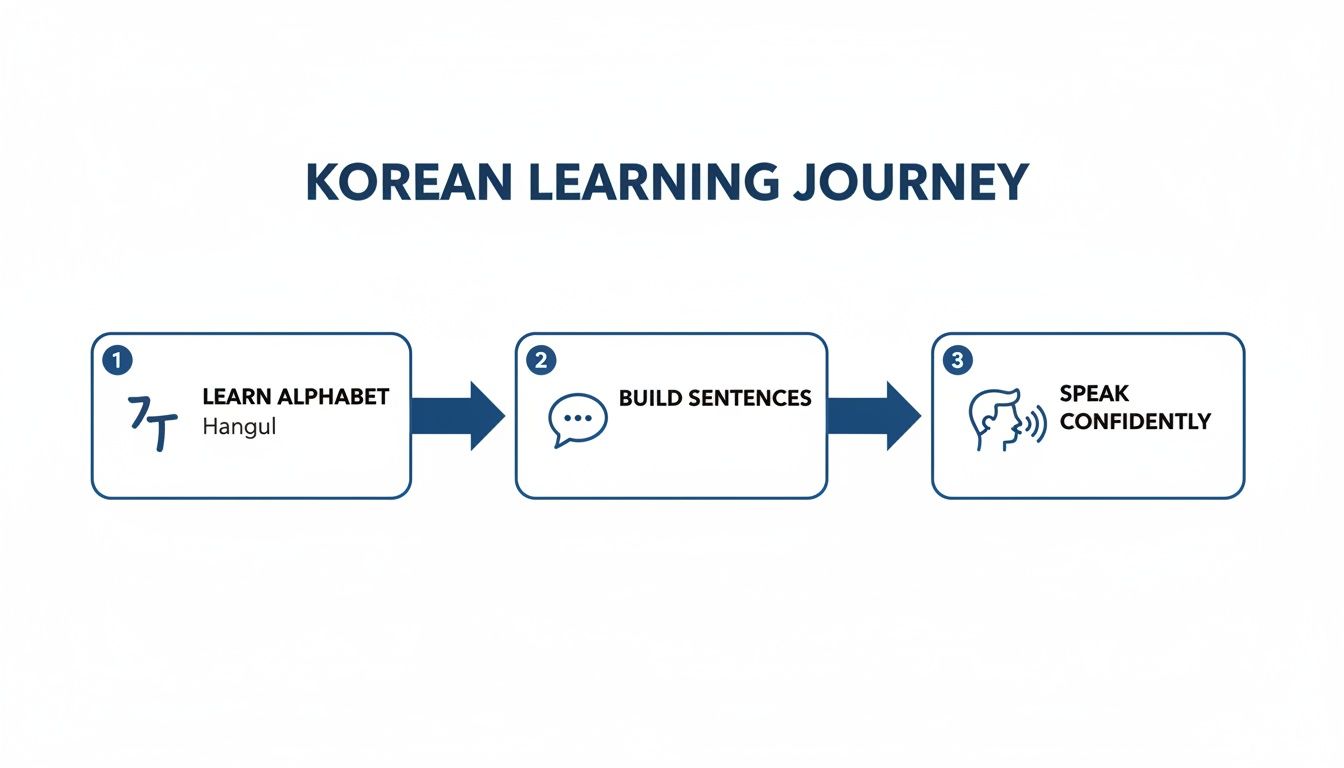
As you can see, every learner starts with the same fundamentals. From there, it's all about building on that foundation until you're speaking with confidence.
Learn Hangul — Your First and Most Important Step
Every rewarding journey begins with a single, decisive step. For anyone wondering how to learn Korean, that first step is mastering Hangul (한글), the Korean alphabet. This is your non-negotiable starting point—the key that unlocks absolutely everything else.
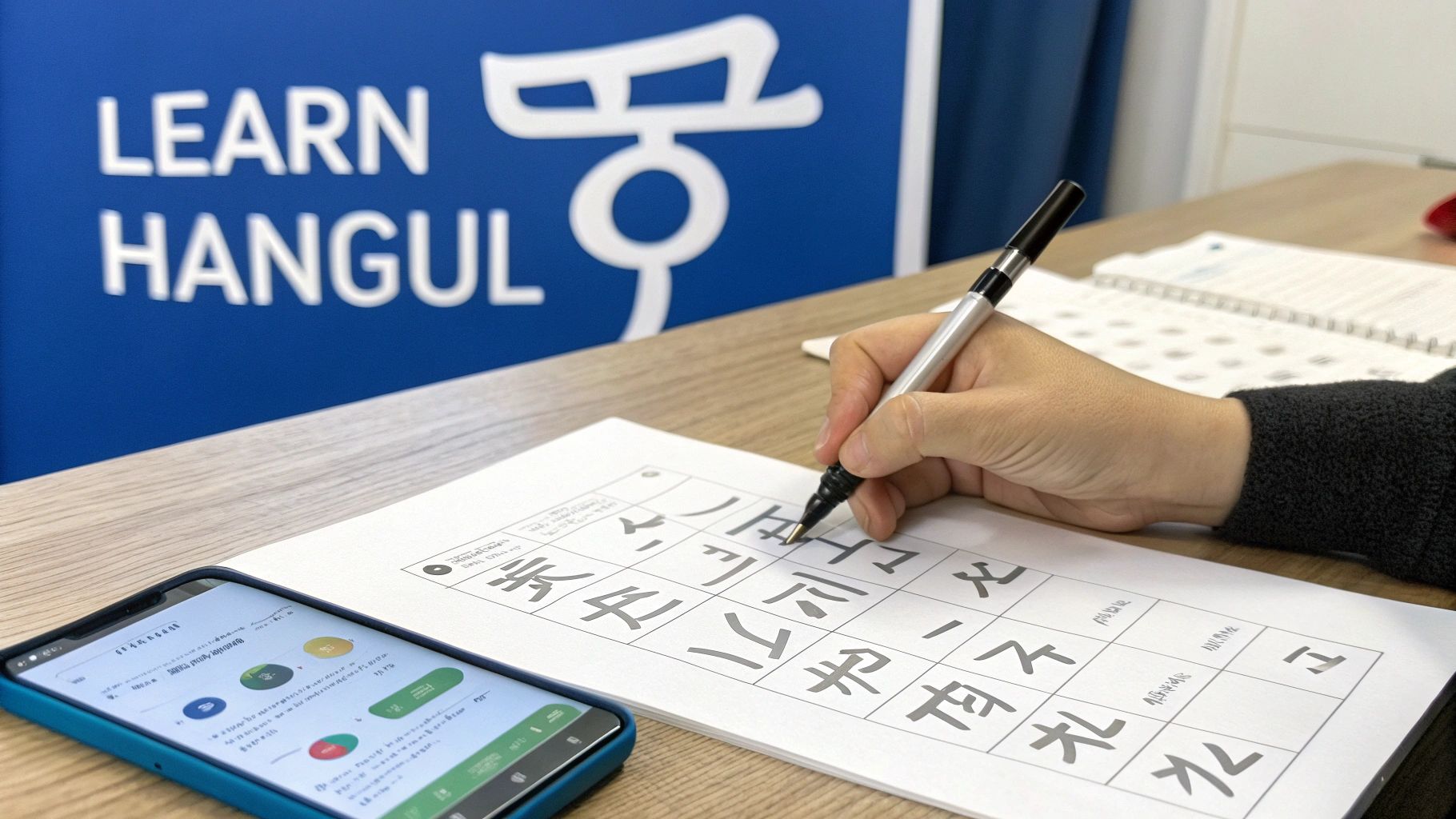
It’s tempting to lean on Romanization (writing Korean words with English letters), but don't fall into that trap! It will only slow you down and ingrain bad pronunciation habits that are tough to unlearn later. The good news? Hangul is famously logical, and most people can learn to read it in just a few days.
Mastering Hangul The Right Way
Getting comfortable with Hangul is your first major win. Go beyond just memorizing letters and focus on how they combine into syllable blocks. Every Korean syllable is built from at least one consonant and one vowel.
Take the word for "person," for example: 사람 (saram).
- It’s made of two syllable blocks: 사 (sa) and 람 (ram).
- 사 (sa) combines the consonant ㅅ (s) with the vowel ㅏ (a).
- 람 (ram) combines ㄹ (r/l), ㅏ (a), and a final consonant ㅁ (m).
To make this stick, try these practical tips:
- Use Flashcard Apps: Apps like Anki or Memrise use spaced repetition to help you memorize characters fast.
- Practice Stroke Order: Writing characters correctly builds muscle memory. Look up the proper stroke order and practice writing them.
- Sound It Out: Find a list of common Korean words and try reading them aloud. Check your pronunciation against a native speaker's recording.
Don’t worry if you make mistakes — even Koreans do sometimes! What matters most is progress.
Build Vocabulary the Smart Way
Once you can read, it’s time to gather words. Instead of memorizing a dictionary, focus on high-frequency words and phrases you can use right away.
Start with words relevant to your life and goals:
- Essential Greetings: 안녕하세요 (annyeonghaseyo) - Hello; 감사합니다 (gamsahamnida) - Thank you.
- Basic Nouns: 사람 (saram) - person; 집 (jip) - house; 학교 (hakgyo) - school.
- Simple Verbs: 가다 (gada) - to go; 먹다 (meokda) - to eat; 하다 (hada) - to do.
Remember, words stick better with context. As soon as you learn a new word, try to make a simple sentence out of it.
Understand Basic Sentence Structure
Here’s where Korean grammar feels different from English. English follows a Subject-Verb-Object (SVO) pattern ("I eat kimchi"). Korean uses Subject-Object-Verb (SOV), meaning the verb always comes last.
- English: I (S) eat (V) kimchi (O).
- Korean: 저는 (S) 김치를 (O) 먹어요 (V).
- Pronunciation: Jeo-neun (S) kimchi-reul (O) meogeoyo (V).
Notice how the verb 먹어요 (meogeoyo - to eat) is at the very end? Grasping this early will make everything else much easier. The small particles like -는 (neun) and -를 (reul) mark the role of each word. You'll get the hang of them over time!
A live, guided environment can make a world of difference here. Hopping into a Ktalk.live free trial class lets you practice these core skills with an expert tutor who can give you instant corrections.
Practice Speaking Naturally
You’ve done the hard work. You've got Hangul down, and your vocabulary is growing. Now for the exciting part: turning those lists of words into actual, living conversations. This is where we move beyond the basics and start weaving everything together.

Think of it less like memorizing and more like building. You’ll start to see how grammar gives Korean its unique structure, moving past simple sentences to express more complex ideas. This is where your journey of figuring out how to learn Korean really starts to shine.
The Two Pillars: Grammar and Politeness
At this stage, your focus narrows to two crucial areas: verb conjugations and the different levels of formality. In Korean, verb endings change based on tense, mood, and, critically, who you're talking to. This idea of politeness is deeply embedded in Korean culture.
Here are the main speech levels you'll need to know:
- Formal Polite (ㅂ니다/습니다 - mnida/seumnida): Used on the news, in presentations, or to show high respect. A safe choice for beginners.
- Informal Polite (아요/어요 - ayo/eoyo): Your everyday go-to. It’s friendly and respectful, perfect for use with shopkeepers, colleagues, and new acquaintances.
- Informal Casual (no special ending): Known as 반말 (banmal), this is for close friends and family. Wait until a Korean speaker gives you the green light to use it!
Learning these politeness levels is more than just avoiding mistakes; it’s a genuine insight into Korean social dynamics.
Putting Grammar to Work
Knowing the theory is one thing, but using it is what counts. Let's walk through a real-life situation.
Scenario: Grabbing a Coffee You’re in a Seoul café and want to order an iced Americano.
- Your words: 아이스 아메리카노 (aiseu amerikano), 하나 (hana - one), 주세요 (juseyo - please give me).
- Putting it all together: 아이스 아메리카노 하나 주세요. (Aiseu amerikano hana juseyo.) - "One iced Americano, please."
That 주세요 (juseyo) is the informal polite form of "to give." It's the perfect, natural choice for this moment.
You Have to Speak It to Learn It
You can't learn to swim by reading about it; you’ve got to jump in the water. The same goes for Korean. You need to start speaking, even if it feels clumsy at first.
Your drive to practice is part of a massive global trend. The language learning market in South Korea has surged past USD 2.6 billion, fueled by the Hallyu wave. The TOPIK exam has seen candidate numbers skyrocket by 140 times since it began. You can explore the data in this Korean language learning market analysis on gminsights.com.
Here are some practical ways to start speaking:
- Find a Language Partner: Apps can connect you with native Korean speakers for a low-pressure way to practice.
- Become an Active Viewer: Don't just watch K-dramas. Pause, repeat lines out loud, and listen for the grammar points you're studying.
- Join a Guided Speaking Class: This is where you can make huge leaps in a structured environment.
This is exactly what Ktalk.live’s small-group classes are designed for. You get instant feedback from a native tutor and the support of peers at your level.
Immerse Yourself in Korean Culture
Hitting an advanced level in Korean is like finally moving into a new city after only visiting. You know the layout, but now it’s about discovering the hidden laneways and understanding the local inside jokes. The goal now isn't just about being correct—it's about sounding natural.
A massive part of advanced Korean is grasping concepts that don't have a direct English translation, like nunchi (눈치). Think of it as the art of reading a room and picking up on unspoken social cues. It's a cornerstone of Korean social interaction.
Understanding nunchi is a game-changer. It explains why conversations can feel indirect and why context is so important. When you start to 'get' nunchi, you're not just speaking Korean; you're thinking in a more Korean way.
To build this instinct, dive into real, unedited conversations through Korean variety shows or podcasts.
Mastering Advanced Language
As you climb higher, your focus shifts to the more colorful parts of the language, where you can express yourself with real personality.
Here are a few areas to zero in on:
- Idiomatic Expressions (사자성어 - Sajasunguh): These four-character idioms show proficiency. A classic is "시작이 반이다" (Sijagi banida), which means "The start is half the battle."
- Modern Slang: To sound current, you have to keep up with slang. Words like "대박" (daebak) for "awesome" are must-haves for casual chats.
- Subtle Word Choices: An advanced learner knows the difference between similar words. For example, "생각하다" (saenggakada) and "고민하다" (gominhada) both mean "to think," but "고민하다" implies you’re wrestling with a problem.
The discipline it takes to get here is backed by a global movement. You can read more about it in the Korea Foundation's official newsletter.
Polishing Your Listening and Speaking
Your listening skills need to be sharp enough to keep up with the natural pace of native speakers.
- Korean News Broadcasts: Anchors speak quickly but with perfect clarity.
- Korean Novels and Essays: These expose you to complex sentences and richer vocabulary.
- Unscripted Podcasts: These are gold for tuning into the natural flow of real dialogue.
For speaking, the goal is authenticity. Record yourself speaking and compare it with audio from a native speaker. This is where high-level, specific feedback becomes essential. The advanced courses at Ktalk.live are designed for this moment, allowing you to engage in complex discussions and get expert feedback to polish those final rough edges.
Your Korean Learning Toolkit
Knowing the rules is one thing, but learning Korean day in and day out is what separates learners who get fluent from those who get stuck. Success is about building smart, sustainable habits and having the right tools on hand.
Think of it as setting up your own personal Korean learning ecosystem. You need reliable resources, a solid method for vocabulary, and simple daily routines that make practice feel like second nature.
Your Digital Tools for Everyday Learning
Having the right apps at your fingertips can make a huge difference. You only need a couple of heavy hitters.
- Naver Dictionary: This is the go-to dictionary for any serious learner. It offers example sentences, audio pronunciation, and explanations of common idioms.
- Anki or Memrise: These flashcard apps use a Spaced Repetition System (SRS) to make memorization incredibly efficient. Create your own decks with new words from your classes.
These tools become your support system, ready whenever you have a question or a few spare moments.
Building Study Habits That Stick
Motivation fades; habits are what pull you through. The secret is to make your study routine so easy that you just do it.
Consistency trumps intensity, every single time. A focused 15 minutes of practice every day will do more for you in the long run than a frantic three-hour cram session once a week.
Here are a couple of powerful habits you can start building today:
- The 15-Minute Rule: Commit to just 15 minutes. It’s a small goal, but it’s enough time to review vocabulary or practice a grammar point.
- Language Journaling: At the end of the day, write one or two simple sentences in Korean about what you did, like "오늘 커피를 마셨어요." (Oneul keopi-reul masyeosseoyo.) - "I drank coffee today."
These small actions create a powerful feedback loop, reinforcing what you've learned.
Simple Immersion for a Busy Life
Immersion doesn't mean you have to move to Seoul. Create a Korean-rich environment right where you are. South Korea's Hallyu wave has driven global interest, with the government supporting thousands of learners worldwide. You can read more about these trends in the full research on Hallyu's impact on language learning on pmc.ncbi.nlm.nih.gov.
Tap into that wave with these simple tactics:
- Change Your Phone's Language: This forces you to learn practical, everyday words like "settings" (설정) and "message" (메시지).
- Make a K-Pop Commute Playlist: Get your ear used to the sounds and rhythms of Korean. Don't worry about understanding every word at first; just absorb the flow.
- Follow Korean Creators on Social Media: Tweak your feed to include Korean chefs, artists, or vloggers. You’ll pick up natural slang while enjoying content you love.
When you combine personal habits with expert feedback from an interactive Ktalk.live class, you create a synergy that will fast-track your confidence.
Are You Ready to Speak Korean?
We’ve walked through the entire journey, from mastering Hangul to having real conversations. Think of it less like a race and more like an incredible adventure. Every word you learn brings you one step closer to confidence. Keep going — your Korean journey starts now!
The best way to turn that inspiration into action is to dive right in. See for yourself how guided, live practice can make all the difference by booking a free trial class at Ktalk.live. Every new word is a victory, and every conversation is a milestone.
Frequently Asked Questions (FAQ)
It's totally natural to have questions when starting a new language. Let's tackle some of the most common ones.
Is Korean actually hard to learn? It’s different, but not as scary as you might think. The grammar is a change from English, but its alphabet, Hangul (한글), is a masterpiece of logic. Most people can learn the basics in a single afternoon, which is a fantastic confidence boost!
How long until I can hold a conversation? It depends on you! With about an hour of dedicated study each day, you could reach a basic conversational level in 6 to 12 months. The biggest shortcut? Speaking from day one. Live practice, like the small-group classes at Ktalk.live, gets you talking immediately.
Can I learn just from K-dramas and K-pop? Watching Korean media is an awesome way to stay motivated and tune your ear to the language. However, think of it as a powerful supplement, not your entire strategy. To truly progress in your how to learn Korean journey, you need structured learning to understand grammar and practice speaking.
What's the most important first step? If you take away just one piece of advice, let it be this: master Hangul. It’s tempting to rely on Romanization, but it's a crutch that will hold you back. Spending a few days locking down the alphabet is the best investment you can make. It’s the key that unlocks everything else.
🌟 Ready to start your Korean journey? Join Ktalk.live — where global learners connect, speak, and grow together! https://ktalk.live
Ready to stop reading and start speaking?
Practice what you just learned with a native Korean teacher — free for 100 minutes. No card, no commitment.