Want to practice this with a native Korean teacher?
100-min free trial — no card required.
Ever feel like there’s a secret ingredient missing in your English sentences? That missing piece is often a helping verb, also known as an auxiliary verb. Don’t let the two names confuse you—they’re just different labels for the same powerful grammar tool. Think of them as the special seasoning that gives your sentences the right flavor!
Learning English, especially when your native language is Korean, can feel like a big challenge. But don’t worry! Understanding helping verbs and auxiliary verbs is a huge step toward speaking English naturally and confidently. They might seem small, but they are the key to forming questions, talking about different times, and expressing yourself with real precision. Ready to unlock the next level of your English fluency? Let’s dive in! 🚀
What Are Helping Verbs and Auxiliary Verbs Anyway?
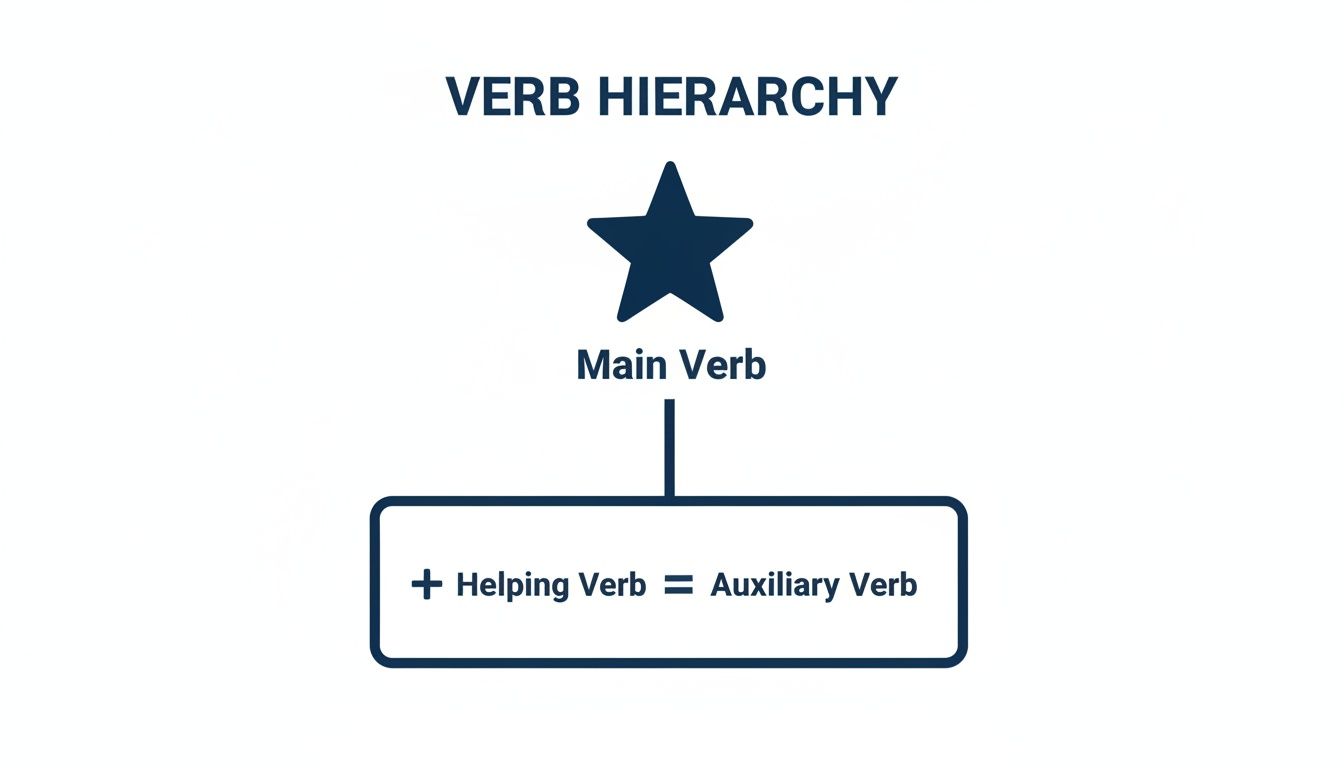
Imagine a main verb is the star of a K-drama—it gets all the attention and performs the main action. Helping verbs, also known as auxiliary verbs, are the amazing supporting cast. They team up with the main verb to add important details about when something happened or the mood of the sentence.
For example, you can't just say, "She studying Korean." It sounds incomplete, right? You need that little helping verb "is" to make it work: "She is studying Korean." Suddenly, the sentence is perfect!
One Job, Two Names
Let's clear this up right away: helping verb and auxiliary verb mean the exact same thing. Think of it like calling someone by their first name or a nickname—it’s still the same person. So, don’t waste any energy trying to find a difference. They both have one job: to support the main verb.
Without these tiny but mighty words, you couldn't ask most questions, make a sentence negative, or talk about the past or future. They are the essential building blocks that give English sentences structure and nuance.
The Big Three: Be, Have, and Do
Now that you know what helping verbs and auxiliary verbs do, let's meet the three most important ones: be, have, and do. Mastering these three is like learning the most useful chords on a guitar—once you know them, you can play almost any song! They are essential for building sentences that make sense.

The Verb ‘Be’: Describing Ongoing Actions
The verb be has many forms (am, is, are, was, were) and is used all the time. Its main job as a helping verb is to form continuous tenses, which describe actions that are happening now or were in progress.
- Example: They are studying for the exam.
- are + studying shows the action is happening now.
- Korean: 그들은 시험 공부를 하고 있어요. (Geudeureun siheom gongbureul hago isseoyo.)
Another key job for be is forming the passive voice, which focuses on the object receiving the action.
- Example: The book was written by a famous author.
- This focuses on the book, not the author.
The Verb ‘Have’: Connecting Past and Present
Next is have (and its forms has, had). This verb is your go-to for building the perfect tenses, which connect different points in time.
Present Perfect: Connects a past action to the present.
- Example: She has visited Korea three times. (The visits happened in the past, but they are part of her experience now.)
Past Perfect: Describes an action that finished before another past action.
- Example: They had finished their homework before the movie started. (Finishing homework came first.)
The Verb ‘Do’: Asking Questions and Making Negatives
Finally, we have do (does, did). This verb is a Korean learner’s best friend because it helps with things that are done differently in Korean.
1. Asking Questions: In English, you need do to form questions in the simple present and past tenses.
- Statement: You like K-pop.
- Question: Do you like K-pop? (케이팝을 좋아해요? Keipabeul joahaeyo?)
2. Making Negative Statements: Do also teams up with "not" to make sentences negative.
- Positive: I understand the lesson.
- Negative: I do not (don't) understand the lesson.
Modal Verbs: Adding Possibility and Advice
Beyond the big three, there's a special group of helping verbs called modal verbs. These are the words that add personality and mood to your sentences. They let you talk about things like ability, permission, possibility, and obligation.
The most common modal verbs are: can, could, may, might, will, would, should, and must.

A simple rule to remember: modal verbs never change their form. It's always "she can," never "she cans." This makes them easy to use!
Ability: Can and Could
- Can shows ability in the present.
- Example: "I can speak a little Korean." (나는 한국말을 조금 할 수 있어요. Naneun hangukmareul jogeum hal su isseoyo.)
- Could shows ability in the past or is used for polite requests.
- Example: "Could you please pass the salt?"
Possibility: May and Might
- May and Might are used when you aren't 100% sure. Might often suggests a slightly smaller chance.
- Example: "It may rain this afternoon." (A reasonable possibility.)
- Example: "He might be late." (A bit more doubtful.)
Obligation and Advice: Must and Should
- Should is for giving friendly advice or recommendations.
- Example: "You should review your notes before the test."
- Must is much stronger; it’s for rules or necessities.
- Example: "You must show your passport at the airport."
How They Shape English Sentences
We've met the main players, now let's see how helping verbs and auxiliary verbs build sentences. Think of them as the architects of your English. They handle four critical jobs that will make you sound more like a native speaker.

1. Forming Questions
To ask a yes/no question in English, you move the auxiliary verb to the front of the sentence, before the subject. This is called inversion.
- Statement: She is studying Korean.
- Question: Is she studying Korean?
2. Creating Negative Sentences
To make a sentence negative, you simply add "not" right after the first helping verb. It’s a simple and consistent rule.
- Positive: I will see you tomorrow.
- Negative: I will not (won't) see you tomorrow.
3. Building Different Tenses
As we saw with be and have, helping verbs are essential for creating tenses like the continuous (is walking) and perfect (has walked) to talk about time precisely.
A Special Tip for Korean Learners
This system can feel strange for Korean speakers. In Korean, you often change the ending of the main verb to ask a question (e.g., 해요 haeyo becomes 해요? haeyo?). English, however, uses separate helping verbs and auxiliary verbs as moveable parts.
Interestingly, Korean also has auxiliary verbs, but they work differently, often attaching directly to the main verb. For example, a linguistic study found 55 auxiliary predicates in Korean! This big difference is why learning the English system is such a key step. If you're curious, you can learn more about these fascinating differences in Korean auxiliary predicates.
Common Mistakes to Avoid
It’s completely normal to make mistakes while learning—even native speakers do! The important thing is to recognize common errors so you can fix them. Don’t worry if you get it wrong sometimes; what matters is progress!
Mismatched Subject and Verb
The helping verb must always agree with the subject. This is a common slip-up.
- Incorrect: She have finished her homework.
- Correct: She has finished her homework. ("She" is singular, so it needs "has".)
Incorrect Question Formation
Remember to use inversion! Don't just add a question mark to a statement.
- Incorrect: You like Korean food?
- Correct: Do you like Korean food?
Confusing Can and May
While they seem similar, they have different social meanings. Use may for polite permission.
- Informal: Can I ask a question?
- Formal/Polite: May I ask a question?
These details can be tricky, especially since the grammar is so different from Korean. Did you know Korean has around 330 auxiliary verbs that come from 60 base verbs? That's a huge system! Learning the much smaller English set is an achievable goal. To dive deeper, you can discover more insights into Korean auxiliary functions.
Your Journey to English Fluency Starts Now
You've done it! You now have a clear map to understanding helping verbs and auxiliary verbs. Remember, they are the small but powerful words that give your English sentences structure, nuance, and clarity. By mastering the "big three" (be, have, do) and the most common modals, you are building a strong foundation for fluency.
Don't aim for perfection right away. Instead, focus on practice and understanding. Every sentence you create is a step forward on your language-learning journey. Keep going—you’re doing great! Every word you learn brings you one step closer to confidence.
🌟 Ready to start your Korean journey? Join Ktalk.live — where global learners connect, speak, and grow together! Start your free trial class today!
Ready to stop reading and start speaking?
Practice what you just learned with a native Korean teacher — free for 100 minutes. No card, no commitment.